PUBLISHER: Mordor Intelligence | PRODUCT CODE: 2100559

PUBLISHER: Mordor Intelligence | PRODUCT CODE: 2100559
North America Cybersecurity of Cars - Market Share Analysis, Industry Trends & Statistics, Growth Forecasts (2026 - 2031)
According to Mordor Intelligence, the North America cybersecurity of Cars Market size was valued at USD 3.21 billion in 2025 and estimated to grow from USD 3.67 billion in 2026 to reach USD 7.12 billion by 2031, at a CAGR of 14.21% during the forecast period (2026-2031).
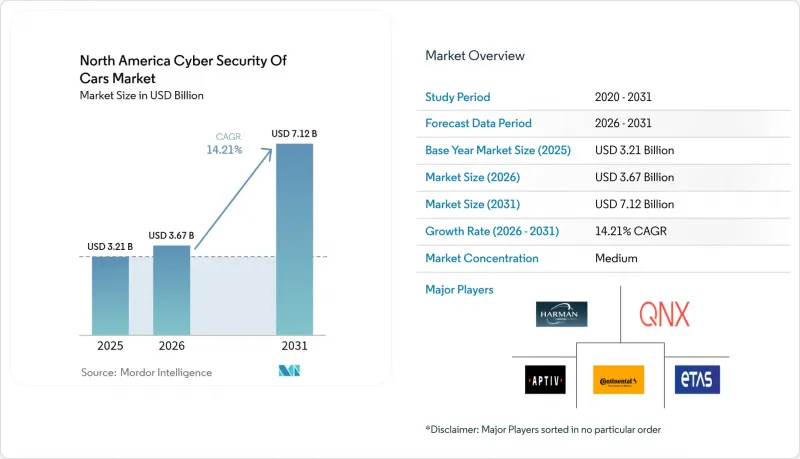
This report is Segmented by Solution Type (Software-Based, Hardware-Based, and More), Security Domain (Network Security, Application Security, and More), Vehicle Type (Passenger Cars, Light Commercial Vehicles, and More), Application (BFSI and More), Deployment Mode (On-Board Edge, Off-board/Cloud), and Geography. The Market Forecasts are Provided in Terms of Value (USD).
North America Cybersecurity of Cars Market Trends and Insights
UN R155 / ISO 21434 compliance deadlines
Mandatory enforcement beginning July 2024 forced OEMs to certify cybersecurity management systems, software-update processes, and continuous vulnerability monitoring. Automakers responded by embedding "security-by-design" procurement across their tier-one supply networks, accelerating demand for third-party audits and managed-service contracts . Suppliers unable to demonstrate process maturity face exclusion from new-vehicle programs, pushing professional-service uptake across the North America Cybersecurity of Cars Market.
Surge in OTA software-update adoption
More than 250 million vehicles are expected to support OTA functions by 2025, shifting recall mitigation from physical service campaigns to secure remote patching . Automakers rely on cryptographic authentication and dual-image fail-safe techniques to safeguard updates. The heightened cadence of software releases amplifies endpoint exposure, thereby elevating demand for endpoint-protection agents and cloud-based threat-intelligence aggregation throughout the North America Cybersecurity of Cars Market.
Highly fragmented software supply chain
Typical vehicles integrate hundreds of supplier modules, each with its own firmware lineage. The absence of comprehensive software bills of materials complicates patch orchestration, leaving latent vulnerabilities across multiple ECUs. Ransomware actors exploited third-party gateways, pushing North America's disclosed automotive supply-chain-attack share to 58% in Q2 2024.
Other drivers and restraints analyzed in the detailed report include:
- Growth of connected-car parc and 5G / V2X roll-out
- Rapid expansion of in-vehicle digital-key ecosystems
- Evolving threat landscape outpacing standards
For complete list of drivers and restraints, kindly check the Table Of Contents.
Segment Analysis
Software-centric platforms captured 39.65% of 2025 revenue as firewalls, intrusion-detection systems, and AI-based analytics became default requirements for connected vehicles. Professional and managed services, however, are forecast to grow 15.33% each year to 2031 as OEMs outsource threat monitoring and incident response functions that outpace in-house capability gaps. The North America Cybersecurity of Cars Market size for professional services is projected to nearly double by 2031. Severe workforce shortages push automakers toward subscription models that bundle security operations center access with compliance reporting.
Momentum in managed services also supports integration consulting, allowing suppliers to harmonize security controls across heterogeneous ECU stacks. Upstream Security's cloud surveillance service already supports more than 25 million vehicles, illustrating a scalable blueprint that other providers emulate . Hardware security modules from NXP and Infineon add root-of-trust features that reduce on-vehicle compute costs, but integration success still depends on holistic vulnerability-management workflows delivered by external partners.
Network security led the market with a 34.78% share in 2025 as OEMs hardened CAN-FD and automotive Ethernet against packet spoofing. Cloud/backend security is expected to post the fastest 15.92% CAGR as centralized data lakes collect up to 40 terabytes per hour of fleet telemetry for real-time anomaly detection. The North America Cybersecurity of Cars Market share for cloud security climbs as domain controllers forward logs to hyperscaler environments that offer elastic compute for AI analytics.
Application-level countermeasures gain relevance as third-party infotainment and insurance applications penetrate in-vehicle ecosystems. Sandboxing and code-signing functionalities protect cockpit marketplaces such as HARMAN Ignite Store, while endpoint ECU security continues to address lightweight encryption for body-control and safety actuators. Identity-and-access-management subdomains show early traction as digital-service portfolios expand.
Complete Report Scope:
- By Solution Type
- Software-based
- Hardware-based
- Professional and Managed Services
- Integration
- Other Solutions
- By Security Domain
- Network Security
- Application Security
- Cloud/Backend Security
- Endpoint ECU Security
- Other Domains
- By Vehicle Type
- Passenger Cars
- Light Commercial Vehicles
- Heavy Commercial Vehicles
- Autonomous and Robo-Taxis
- By Application
- Telematics and Connectivity Control Units
- Infotainment and Digital Cockpit
- ADAS and Autonomous Driving Systems
- Powertrain / EV Charging Interfaces
- Body and Comfort ECUs
- By Deployment Mode
- On-board (Edge)
- Off-board / Cloud
- By Country
- United States
- Canada
- Mexico
List of Companies Covered in this Report:
- Harman International Industries Inc. (Samsung Electronics Co. Ltd.)
- BlackBerry Ltd. (QNX Software Systems)
- Continental AG
- Robert Bosch GmbH (ETAS / ESCRYPT)
- Aptiv PLC
- IBM Corporation
- Cisco Systems Inc.
- NXP Semiconductors N.V.
- Infineon Technologies AG
- Qualcomm Inc.
- Honeywell International Inc.
- Visteon Corporation
- Argus Cyber Security Ltd.
- Karamba Security Ltd.
- Upstream Security Ltd.
- VicOne Inc.
- Cybellum Technologies Ltd.
- Secunet Security Networks AG
- ETAS GmbH
- Trend Micro Inc.
Additional Benefits:
- The market estimate (ME) sheet in Excel format
- 3 months of analyst support
TABLE OF CONTENTS
1 INTRODUCTION
- 1.1 Market Definition and Study Assumptions
- 1.2 Scope of the Study
2 RESEARCH METHODOLOGY
3 EXECUTIVE SUMMARY
4 MARKET LANDSCAPE
- 4.1 Market Overview
- 4.2 Market Drivers
- 4.2.1 UN Regulation R155/ISO 21434 compliance deadlines
- 4.2.2 Surge in OTA software-update adoption
- 4.2.3 Growth of connected-car parc and 5G/V2X roll-out
- 4.2.4 Rapid expansion of in-vehicle digital-key ecosystems
- 4.2.5 Rise of EV-charging-station attack surface
- 4.2.6 OEM "software-defined vehicle" revenue models
- 4.3 Market Restraints
- 4.3.1 Highly fragmented software supply-chain
- 4.3.2 Evolving threat landscape outpacing standards
- 4.3.3 Scarcity of AUTOSAR-cyber-skilled talent
- 4.3.4 Limited CAN-FD bandwidth for security payloads
- 4.4 Value Chain Analysis
- 4.5 Evaluation of Critical Regulatory Framework
- 4.6 Technological Outlook
- 4.7 Porter's Five Forces Analysis
- 4.7.1 Bargaining Power of Suppliers
- 4.7.2 Bargaining Power of Consumers
- 4.7.3 Threat of New Entrants
- 4.7.4 Threat of Substitutes
- 4.7.5 Intensity of Competitive Rivalry
- 4.8 Impact of Macro-economic Factors
5 MARKET SIZE AND GROWTH FORECASTS (VALUE)
- 5.1 By Solution Type
- 5.1.1 Software-based
- 5.1.2 Hardware-based
- 5.1.3 Professional and Managed Services
- 5.1.4 Integration
- 5.1.5 Other Solutions
- 5.2 By Security Domain
- 5.2.1 Network Security
- 5.2.2 Application Security
- 5.2.3 Cloud/Backend Security
- 5.2.4 Endpoint ECU Security
- 5.2.5 Other Domains
- 5.3 By Vehicle Type
- 5.3.1 Passenger Cars
- 5.3.2 Light Commercial Vehicles
- 5.3.3 Heavy Commercial Vehicles
- 5.3.4 Autonomous and Robo-Taxis
- 5.4 By Application
- 5.4.1 Telematics and Connectivity Control Units
- 5.4.2 Infotainment and Digital Cockpit
- 5.4.3 ADAS and Autonomous Driving Systems
- 5.4.4 Powertrain / EV Charging Interfaces
- 5.4.5 Body and Comfort ECUs
- 5.5 By Deployment Mode
- 5.5.1 On-board (Edge)
- 5.5.2 Off-board / Cloud
- 5.6 By Country
- 5.6.1 United States
- 5.6.2 Canada
- 5.6.3 Mexico
6 COMPETITIVE LANDSCAPE
- 6.1 Market Concentration
- 6.2 Strategic Moves
- 6.3 Market Share Analysis
- 6.4 Company Profiles (includes Global level Overview, Market level overview, Core Segments, Financials as available, Strategic Information, Market Rank/Share for key companies, Products and Services, and Recent Developments)
- 6.4.1 Harman International Industries Inc. (Samsung Electronics Co. Ltd.)
- 6.4.2 BlackBerry Ltd. (QNX Software Systems)
- 6.4.3 Continental AG
- 6.4.4 Robert Bosch GmbH (ETAS / ESCRYPT)
- 6.4.5 Aptiv PLC
- 6.4.6 IBM Corporation
- 6.4.7 Cisco Systems Inc.
- 6.4.8 NXP Semiconductors N.V.
- 6.4.9 Infineon Technologies AG
- 6.4.10 Qualcomm Inc.
- 6.4.11 Honeywell International Inc.
- 6.4.12 Visteon Corporation
- 6.4.13 Argus Cyber Security Ltd.
- 6.4.14 Karamba Security Ltd.
- 6.4.15 Upstream Security Ltd.
- 6.4.16 VicOne Inc.
- 6.4.17 Cybellum Technologies Ltd.
- 6.4.18 Secunet Security Networks AG
- 6.4.19 ETAS GmbH
- 6.4.20 Trend Micro Inc.
7 MARKET OPPORTUNITIES AND FUTURE TRENDS
- 7.1 White-space and Unmet-need Assessment

