PUBLISHER: Mordor Intelligence | PRODUCT CODE: 2100561

PUBLISHER: Mordor Intelligence | PRODUCT CODE: 2100561
Glycerin - Market Share Analysis, Industry Trends & Statistics, Growth Forecasts (2026 - 2031)
According to Mordor Intelligence, the glycerin market size was valued at 4.78 Million tons in 2025 and is estimated to grow from 5 Million tons in 2026 to reach 6.24 Million tons by 2031, at a CAGR of 4.55% during the forecast period (2026-2031).
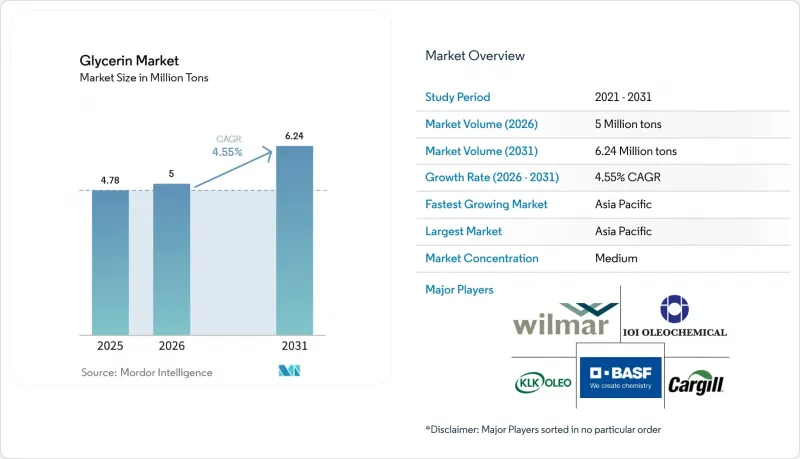
This report is Segmented by Grade (Crude Glycerin and Refined Glycerin), Source (Biodiesel, Fatty Acids, Fatty Alcohols, and Other Sources), Application (Personal Care and Cosmetics, Pharmaceuticals, Food and Beverage, Polyether Polyols, and More), and Geography (Asia-Pacific, North America, Europe, South America, and Middle-East and Africa). The Market Forecasts are Provided in Terms of Volume (tons).
Global Glycerin Market Trends and Insights
Surging Demand for USP-grade Glycerin in Pharmaceutical Industry
FDA's 2023 requirement to test every excipient batch for diethylene and ethylene glycols triggered a sharp pivot toward 99.5%-plus glycerin produced under GMP conditions. Indonesian capacity additions by Louis Dreyfus Company in 2025 and record output from Verbio in Germany illustrate the global scramble for compliant supply in the glycerin market. Oral and topical formulations remain the core outlets, and India's PLI scheme is prompting refiners near Hyderabad and Ahmedabad to backward-integrate so that domestic APIs can secure fully traceable excipients.
Increasing Use in the Personal Care and Cosmetics Industries
Consumer scrutiny of synthetic humectants and tighter sustainability norms are lifting vegetable-glycerin penetration in moisturizers, cleansers, and serums, with major brand launches in 2024-2025 citing natural origin on pack. Partnerships such as BASF-Acies Bio leverage renewable-methanol routes for upstream surfactants that often co-formulate with glycerin, entrenching its role in "clean beauty" claims within the glycerin market.
Volatile Crude-Glycerin Prices Linked to Biodiesel Feedstocks
Crude-glycerin pricing exhibits high correlation with biodiesel production volumes and feedstock costs, creating margin compression for refiners and formulators who cannot pass through price swings to end customers in the glycerol market. Brazil's 2023 export revenue fell 52.9% even as shipments climbed, proving how oversupply from rising biodiesel blend mandates decouples volume from margin. In Argentina, idle capacity topping 70% amid shifting policy keeps supply erratic and spot prices whipsawing, forcing pharmaceutical buyers to hold more inventory and widening working-capital needs.
Other drivers and restraints analyzed in the detailed report include:
- Rising Adoption of Vegetable-Sourced Glycerin in Food Industry
- Emergence of Solid-State Glycerin Electrolytes for Next-Gen Batteries
- Availability of Substitutes (Propylene Glycol, Sorbitol)
For complete list of drivers and restraints, kindly check the Table Of Contents.
Segment Analysis
Refined material captured 69.1% of the glycerin market share in 2025, and its portion of the glycerin market size is set to increase at a 5.02% CAGR because drug, personal-care, and food buyers require USP-grade traceability. The FDA impurity rule accelerated multi-stage distillation and ion-exchange projects worldwide, widening the crude-to-refined margin spread to USD 400-700/t in 2024-2025.
Integrated players such as Verbio and Louis Dreyfus demonstrate that biodiesel complexes can monetize the pharmaceutical premium in-house, while mid-tier technical grades (99.0-99.5%) from Argent Energy fill the gap for industrial users who do not need USP certification. As more biodiesel plants add purification, crude-export flows thin out, but global refined supply remains tight, underpinning premium pricing in North America and Europe.
Complete Report Scope:
- By Grade
- Crude Glycerin
- Refined Glycerin
- By Source
- Biodiesel
- Fatty Acids
- Fatty Alcohols
- Other Sources
- By Application
- Personal Care and Cosmetics
- Pharmaceuticals
- Food and Beverage
- Polyether Polyols
- Alkyd Resins and Surface Coatings
- Tobacco Humectants
- Other Applications
- By Geography
- Asia-Pacific
- China
- India
- Japan
- South Korea
- Rest of Asia-Pacific
- North America
- United States
- Canada
- Mexico
- Europe
- Germany
- United Kingdom
- Italy
- France
- Rest of Europe
- South America
- Brazil
- Argentina
- Rest of South America
- Middle-East and Africa
- Saudi Arabia
- United Arab Emirates
- Turkey
- South Africa
- Egypt
- Rest of Middle-East and Africa
- Asia-Pacific
Geography Analysis
Asia-Pacific owns 49.03% of global demand and is forecast to expand at 5.09% annually through 2031, making it the largest regional contributor in the glycerol market. China exports most of its biodiesel to the EU yet retains associated crude glycerin for domestic oleochemical uses, while India's push to a 5% biodiesel blend by 2030 could unleash significant incremental supply once used-cooking-oil collection infrastructure scales. Japan and South Korea import USP-grade volumes because local production is limited, directing Malaysian and Indonesian refiners to seek WHO-GMP certification to secure market access.
North America remains structurally short in the glycerin market, so imports from Brazil and Southeast Asia persist despite volatile crude-price swings. Renewable diesel co-processing in Canada is tightening domestic supply further, underlining the value of local purification projects near the US Gulf Coast and Midwest biodiesel clusters. The Mexico glycerine market also relies on regional import flows to meet demand.
Europe's historic dominance is ebbing as diesel demand falls and policy pivots toward HVO, yet RED II's double-counting of glycerin valorization encourages downstream conversion to bio-ECH and propylene glycol, supporting development across the glycerol market. Stringent deforestation rules squeeze feedstock from Indonesia and Malaysia, but waste-oil streams in the Netherlands and Germany maintain flow under ISCC certification. South America delivers large crude volumes, though Brazil's margin collapse after B15 implementation and Argentina's policy swings inject uncertainty. The Middle East is nascent but gaining traction via petrochemical diversification moves such as Sipchem-LyondellBasell, which could later influence regional glycerin balances.
- ADM
- Aemetis Inc.
- BASF
- Cargill Inc.
- Dow Chemical Co.
- Emery Oleochemicals
- Godrej Industries
- IOI Corporation Berhad
- Kao Corporation
- KLK OLEO
- Louis Dreyfus Company
- Munzer Bioindustrie GmbH
- Musim Mas Group
- Oleon NV
- Procter & Gamble
- Renewable Biofuels
- Stepan Company
- Thai Glycerine Co.
- Vance Group Ltd.
- Vantage Specialty Chemicals
- Wilmar International Ltd.
Additional Benefits:
- The market estimate (ME) sheet in Excel format
- 3 months of analyst support
TABLE OF CONTENTS
1 Introduction
- 1.1 Study Assumptions & Market Definition
- 1.2 Scope of the Study
2 Research Methodology
3 Executive Summary
4 Market Landscape
- 4.1 Market Overview
- 4.2 Market Drivers
- 4.2.1 Surging demand for USP-grade glycerin in pharmaceuticals
- 4.2.2 Increasing use in personal care & cosmetics
- 4.2.3 Rising adoption of vegetable sourced glycerin in food industry
- 4.2.4 Emergence of solid-state glycerin electrolytes for next-gen batteries
- 4.2.5 Circular-economy projects converting crude glycerin to bio-ECH
- 4.3 Market Restraints
- 4.3.1 Volatile crude-glycerin prices linked to biodiesel feedstocks
- 4.3.2 Availability of substitutes (propylene glycol, sorbitol)
- 4.3.3 Sustainability scrutiny on palm-oil supply chains
- 4.4 Value Chain Analysis
- 4.5 Feedstock Analysis
- 4.6 Pricing Analysis (Historical & Forecast)
- 4.7 Porter's Five Forces
- 4.7.1 Bargaining Power of Suppliers
- 4.7.2 Bargaining Power of Buyers
- 4.7.3 Threat of New Entrants
- 4.7.4 Threat of Substitutes
- 4.7.5 Competitive Rivalry
5 Market Size & Growth Forecasts (Volume)
- 5.1 By Grade
- 5.1.1 Crude Glycerin
- 5.1.2 Refined Glycerin
- 5.2 By Source
- 5.2.1 Biodiesel
- 5.2.2 Fatty Acids
- 5.2.3 Fatty Alcohols
- 5.2.4 Other Sources
- 5.3 By Application
- 5.3.1 Personal Care and Cosmetics
- 5.3.2 Pharmaceuticals
- 5.3.3 Food and Beverage
- 5.3.4 Polyether Polyols
- 5.3.5 Alkyd Resins and Surface Coatings
- 5.3.6 Tobacco Humectants
- 5.3.7 Other Applications
- 5.4 By Geography
- 5.4.1 Asia-Pacific
- 5.4.1.1 China
- 5.4.1.2 India
- 5.4.1.3 Japan
- 5.4.1.4 South Korea
- 5.4.1.5 Rest of Asia-Pacific
- 5.4.2 North America
- 5.4.2.1 United States
- 5.4.2.2 Canada
- 5.4.2.3 Mexico
- 5.4.3 Europe
- 5.4.3.1 Germany
- 5.4.3.2 United Kingdom
- 5.4.3.3 Italy
- 5.4.3.4 France
- 5.4.3.5 Rest of Europe
- 5.4.4 South America
- 5.4.4.1 Brazil
- 5.4.4.2 Argentina
- 5.4.4.3 Rest of South America
- 5.4.5 Middle-East and Africa
- 5.4.5.1 Saudi Arabia
- 5.4.5.2 United Arab Emirates
- 5.4.5.3 Turkey
- 5.4.5.4 South Africa
- 5.4.5.5 Egypt
- 5.4.5.6 Rest of Middle-East and Africa
- 5.4.1 Asia-Pacific
6 Competitive Landscape
- 6.1 Market Concentration
- 6.2 Strategic Moves
- 6.3 Market Share(%)/Ranking Analysis
- 6.4 Company Profiles (includes Global overview, Market overview, Core segments, Financials, Strategic info, Market Rank/Share, Products & Services, Recent Developments)
- 6.4.1 ADM
- 6.4.2 Aemetis Inc.
- 6.4.3 BASF
- 6.4.4 Cargill Inc.
- 6.4.5 Dow Chemical Co.
- 6.4.6 Emery Oleochemicals
- 6.4.7 Godrej Industries
- 6.4.8 IOI Corporation Berhad
- 6.4.9 Kao Corporation
- 6.4.10 KLK OLEO
- 6.4.11 Louis Dreyfus Company
- 6.4.12 Munzer Bioindustrie GmbH
- 6.4.13 Musim Mas Group
- 6.4.14 Oleon NV
- 6.4.15 Procter & Gamble
- 6.4.16 Renewable Biofuels
- 6.4.17 Stepan Company
- 6.4.18 Thai Glycerine Co.
- 6.4.19 Vance Group Ltd.
- 6.4.20 Vantage Specialty Chemicals
- 6.4.21 Wilmar International Ltd.
7 Market Opportunities & Future Outlook
- 7.1 White-space & Unmet-need Assessment
- 7.2 Rapid uptake of glycerin in e-cigarette liquids

