PUBLISHER: Mordor Intelligence | PRODUCT CODE: 2100568

PUBLISHER: Mordor Intelligence | PRODUCT CODE: 2100568
Automated Test Equipment - Market Share Analysis, Industry Trends & Statistics, Growth Forecasts (2026 - 2031)
According to Mordor Intelligence, the automated test equipment market size is expected to grow from USD 9.20 billion in 2025 to USD 9.83 billion in 2026 and is forecast to reach USD 13.67 billion by 2031 at 6.82% CAGR over 2026-2031.
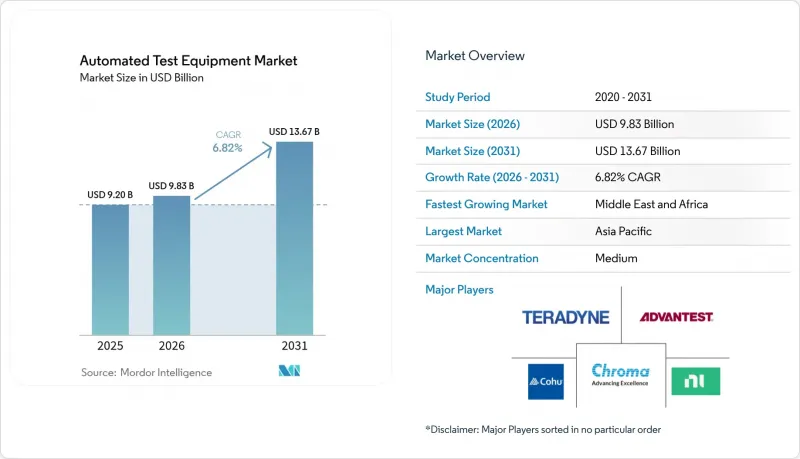
This report is Segmented by Test Equipment Type (Memory, Non - Memory, Discrete, and Test Handlers), by Component (Tester, Handler, Prober, and More), by Test Stage (Wafer Probe Test, and More), by Technology Node (>=28 Nm, 14-22 Nm, 7-10 Nm, and <=5 Nm), End-User Industry (Consumer Electronics, and More), and Geography (North America, South America, Europe, Asia-Pacific, Middle East and Africa).
Global Automated Test Equipment Market Trends and Insights
Shrinking less than 7 nm Nodes Requiring Ultra-Low-Noise ATE
Sub-7 nm production ramp-ups in Taiwan and South Korea have mandated measurement precision below 10 nV/√Hz and picosecond-level timing. Leading foundries have responded by qualifying new vector-parallel architectures that suppress crosstalk through enhanced shielding and optimized ground referencing. Tool suppliers are pairing these designs with machine-learning-driven pattern generation to compress characterization loops, a feature now standard on flagship SoC platforms.
Automotive Functional-Safety IC Testing Surge (ISO 26262)
European Tier-1 semiconductor vendors increased deployments of fault-injection-capable testers by 34% between 2024 and 2025. The equipment executes hundreds of safety-goal permutations, mapping results back to requirements-traceability matrices. Integration with hardware-in-the-loop benches enables simultaneous verification of powertrain inverters, radar sensors, and MCU subsystems, ensuring ASIL-D compliance at scale.
High Capital Intensity and Lengthy Pay-Back for Sub-5 nm Testers
Platform prices rose 35% versus the 7 nm generation, stretching ROI beyond five years for mid-tier fabs. The need for ultra-stable low-k dielectric probing, advanced thermal regulation, and multi-terabit pattern memory inflates both acquisition and service costs, tempering adoption rates among smaller foundries.
Other drivers and restraints analyzed in the detailed report include:
- SiC / GaN Power Devices Driving High-Voltage Discrete ATE
- Growth of System-in-Package Fuelling System-Level Testers
- On-Chip BIST Reducing External Digital ATE Demand
For complete list of drivers and restraints, kindly check the Table Of Contents.
Segment Analysis
Non-memory testers covering logic, SoC, and RF devices captured 46.85% of the Automated Test Equipment market share in 2025. Their dominance arose from demand to screen AI processors, 5G transceivers, and automotive domain controllers. Vendors lifted vector speeds beyond 5 Gbps per pin and added sub-terahertz RF options to serve mixed workloads. Machine-learning pattern generation trimmed cycle times, suiting smartphone and data-centre volume runs. Integrated analytics linked fail signatures to layout blocks, reducing respins and cementing the segment's revenue lead.
Test handlers form the fastest-growing category, with an 10.9% CAGR projected from 2026 to 2031 as automotive and power lines seek higher throughput and tighter thermal control. The Automated Test Equipment market size for handlers is widening as fabs specify multi-zone plates and active vibration damping to qualify wide-bandgap devices at 175 °C. Advanced robotics now moves fragile 3D-stacked packages without micro-cracking, raising first-pass yield in SiP assembly. Predictive-maintenance software further trims downtime, sustaining the segment's double-digit trajectory.
Tester mainframes held 55.90% revenue in 2025, bolstered by upgrades that integrate pattern-generation accelerators and cloud-connected analytics modules. Interface boards now employ low-loss laminates to support 70 Gbps differential lanes, while active thermal-control sockets stabilize junction temperatures within +-0.5 °C.
Automated Test Equipment market size for system-level/burn-in racks is projected to rise at 12.4% CAGR, driven by AI accelerator wafer-level stress testing and photonics assembly validation. Prober innovations address shrinking pad pitches through MEMS spring-probe cards offering 3 μm positional accuracy. Handler designs add multi-zone chill plates to match extended temperature test matrices demanded by safety-critical automotive ICs.
Complete Report Scope:
- By Test Equipment Type
- Memory
- DRAM
- Flash
- Non-Memory
- Logic / SoC
- Mixed-Signal and Analog
- RF
- Discrete
- Test Handlers
- Memory
- By Component
- Tester (Core System)
- Handler
- Prober
- Load/Interface Boards and Sockets
- By Test Stage
- Wafer Probe Test
- Package / Final Test
- System-Level / Burn-in Test
- By Technology Node
- >=28 nm
- 14-22 nm
- 7-10 nm
- <=5 nm
- By End-User Industry
- Consumer Electronics
- IT and Telecommunications
- Automotive and EV
- Aerospace and Defense
- Healthcare Devices
- Industrial and Power
- By Geography
- North America
- United States
- Canada
- Mexico
- South America
- Brazil
- Argentina
- Rest of South America
- Europe
- Germany
- United Kingdom
- France
- Italy
- Nordics (Sweden, Finland, Norway, Denmark)
- Rest of Europe
- Asia-Pacific
- China
- Japan
- South Korea
- Taiwan
- Rest of Asia-Pacific
- Middle East and Africa
- Middle East
- Saudi Arabia
- United Arab Emirates
- Turkey
- Rest of Middle East
- Africa
- South Africa
- Nigeria
- Rest of Africa
- Middle East
- North America
Geography Analysis
Asia Pacific led the automated test equipment market with 61.90% revenue in 2025, supported by dense clusters of 300 mm fabs in Taiwan, South Korea, mainland China, and Japan. Foundry expansions at 3 nm and 2 nm nodes triggered corresponding investments in ultra-low-noise final-test lines across Hsinchu and Gyeonggi provinces, while Chinese IDMs accelerated domestic prober and handler procurement to offset export restrictions.
North America ranked second as CHIPS Act incentives advanced multiple green-field fabs in Arizona, Texas, and New York, creating fresh demand for package/final and system-level stations capable of ambient-minus-40 °C stress profiles; Mexico's automotive electronics corridor likewise upgraded handler fleets to serve nearby vehicle plants.
Europe's share increased on the back of functional-safety IC production, with Germany and France expanding test capacity for ADAS processors and power modules, while the EUR 43 billion European Chips Act aimed to double regional fabrication output by 2030, spurring parallel tester orders.
The Middle East and Africa are projected to post a 8.8% CAGR from 2026 to 2031 as the UAE and Saudi Arabia channel diversification funds into local RF-front-end ventures; African hubs in South Africa and Nigeria have begun qualifying mixed-signal benches for regional fabless start-ups.
- Advantest Corp.
- Cohu Inc.
- National Instruments (NI)
- FormFactor Inc.
- Hon Precision (Huafeng)
- TESEC Corp.
- Tokyo Electron (TEL)
- UniTest Inc.
- Shenzhen ChangHong Tech.
- Blue Chip Testers
- MAC Panel Company
- Star Technologies
- Samsung Semiconductor ( Internal ATE)
- Teradyne Inc.
- Chroma ATE Inc.
- SPEA SpA
- Astronics Corp.
- InTest Corp.
- Toray Engineering
- Hangzhou ChangChuan Tech.
- Exicon Co.
- Leader Tech.
- Roos Instruments
- Virginia Panel Corp.
- Aeroflex Inc. (Cobham)
- Asset InterTech
Additional Benefits:
- The market estimate (ME) sheet in Excel format
- 3 months of analyst support
TABLE OF CONTENTS
1 INTRODUCTION
- 1.1 Study Assumptions and Market Definition
- 1.2 Scope of the Study
2 RESEARCH METHODOLOGY
3 EXECUTIVE SUMMARY
4 MARKET LANDSCAPE
- 4.1 Market Overview
- 4.2 Market Drivers
- 4.2.1 Shrinking <7 nm Nodes Requiring Ultra-Low Noise ATE
- 4.2.2 Automotive Functional-Safety IC Testing (ISO 26262) Surge in EU
- 4.2.3 SiC / GaN Power Devices Driving High-Voltage Discrete ATE
- 4.2.4 Growth of System-in-Package (SiP) Fuelling System-Level Testers
- 4.2.5 5G / 6G RF Front-End Complexity in Asia
- 4.2.6 Reshoring Incentives (US CHIPS, EU Chips Acts) Expanding Test Capacity
- 4.3 Market Restraints
- 4.3.1 High Capital Intensity and Lengthy Pay-back for Sub-5 nm Testers
- 4.3.2 On-Chip BIST Reducing External Digital ATE Demand
- 4.3.3 Limited Inter-Vendor Interface Interoperability
- 4.3.4 Cyclical Semiconductor CAPEX Cuts
- 4.4 Value Chain Analysis
- 4.5 Regulatory / Technological Outlook
- 4.6 Porter's Five Forces
- 4.6.1 Threat of New Entrants
- 4.6.2 Bargaining Power of Buyers
- 4.6.3 Bargaining Power of Suppliers
- 4.6.4 Threat of Substitutes
- 4.6.5 Competitive Rivalry
- 4.7 Investment Analysis
- 4.8 Impact of Macroeconomic factors
5 MARKET SIZE AND GROWTH FORECASTS (VALUE)
- 5.1 By Test Equipment Type
- 5.1.1 Memory
- 5.1.1.1 DRAM
- 5.1.1.2 Flash
- 5.1.2 Non-Memory
- 5.1.2.1 Logic / SoC
- 5.1.2.2 Mixed-Signal and Analog
- 5.1.2.3 RF
- 5.1.3 Discrete
- 5.1.4 Test Handlers
- 5.1.1 Memory
- 5.2 By Component
- 5.2.1 Tester (Core System)
- 5.2.2 Handler
- 5.2.3 Prober
- 5.2.4 Load/Interface Boards and Sockets
- 5.3 By Test Stage
- 5.3.1 Wafer Probe Test
- 5.3.2 Package / Final Test
- 5.3.3 System-Level / Burn-in Test
- 5.4 By Technology Node
- 5.4.1 >=28 nm
- 5.4.2 14-22 nm
- 5.4.3 7-10 nm
- 5.4.4 <=5 nm
- 5.5 By End-User Industry
- 5.5.1 Consumer Electronics
- 5.5.2 IT and Telecommunications
- 5.5.3 Automotive and EV
- 5.5.4 Aerospace and Defense
- 5.5.5 Healthcare Devices
- 5.5.6 Industrial and Power
- 5.6 By Geography
- 5.6.1 North America
- 5.6.1.1 United States
- 5.6.1.2 Canada
- 5.6.1.3 Mexico
- 5.6.2 South America
- 5.6.2.1 Brazil
- 5.6.2.2 Argentina
- 5.6.2.3 Rest of South America
- 5.6.3 Europe
- 5.6.3.1 Germany
- 5.6.3.2 United Kingdom
- 5.6.3.3 France
- 5.6.3.4 Italy
- 5.6.3.5 Nordics (Sweden, Finland, Norway, Denmark)
- 5.6.3.6 Rest of Europe
- 5.6.4 Asia-Pacific
- 5.6.4.1 China
- 5.6.4.2 Japan
- 5.6.4.3 South Korea
- 5.6.4.4 Taiwan
- 5.6.4.5 Rest of Asia-Pacific
- 5.6.5 Middle East and Africa
- 5.6.5.1 Middle East
- 5.6.5.1.1 Saudi Arabia
- 5.6.5.1.2 United Arab Emirates
- 5.6.5.1.3 Turkey
- 5.6.5.1.4 Rest of Middle East
- 5.6.5.2 Africa
- 5.6.5.2.1 South Africa
- 5.6.5.2.2 Nigeria
- 5.6.5.2.3 Rest of Africa
- 5.6.5.1 Middle East
- 5.6.1 North America
6 COMPETITIVE LANDSCAPE
- 6.1 Market Concentration
- 6.2 Strategic Moves
- 6.3 Market Share Analysis
- 6.4 Company Profiles (includes Global level Overview, Market level overview, Core Segments, Financials as available, Strategic Information, Market Rank/Share for key companies, Products & Services, and Recent Developments)
- 6.4.1 Advantest Corp.
- 6.4.2 Cohu Inc.
- 6.4.3 National Instruments (NI)
- 6.4.4 FormFactor Inc.
- 6.4.5 Hon Precision (Huafeng)
- 6.4.6 TESEC Corp.
- 6.4.7 Tokyo Electron (TEL)
- 6.4.8 UniTest Inc.
- 6.4.9 Shenzhen ChangHong Tech.
- 6.4.10 Blue Chip Testers
- 6.4.11 MAC Panel Company
- 6.4.12 Star Technologies
- 6.4.13 Samsung Semiconductor ( Internal ATE)
- 6.4.14 Teradyne Inc.
- 6.4.15 Chroma ATE Inc.
- 6.4.16 SPEA SpA
- 6.4.17 Astronics Corp.
- 6.4.18 InTest Corp.
- 6.4.19 Toray Engineering
- 6.4.20 Hangzhou ChangChuan Tech.
- 6.4.21 Exicon Co.
- 6.4.22 Leader Tech.
- 6.4.23 Roos Instruments
- 6.4.24 Virginia Panel Corp.
- 6.4.25 Aeroflex Inc. (Cobham)
- 6.4.26 Asset InterTech
7 MARKET OPPORTUNITIES AND FUTURE OUTLOOK
- 7.1 White-space and Unmet-Need Assessment

