PUBLISHER: Mordor Intelligence | PRODUCT CODE: 2100569

PUBLISHER: Mordor Intelligence | PRODUCT CODE: 2100569
North America Automated Material Handling - Market Share Analysis, Industry Trends & Statistics, Growth Forecasts (2026 - 2031)
According to Mordor Intelligence, the North America automated material handling market reached USD 12.87 billion in 2026 and is forecast to expand to USD 17.46 billion by 2031, translating into a 6.29% CAGR over the period, underscoring the structural shift toward highly automated, software-orchestrated distribution networks.
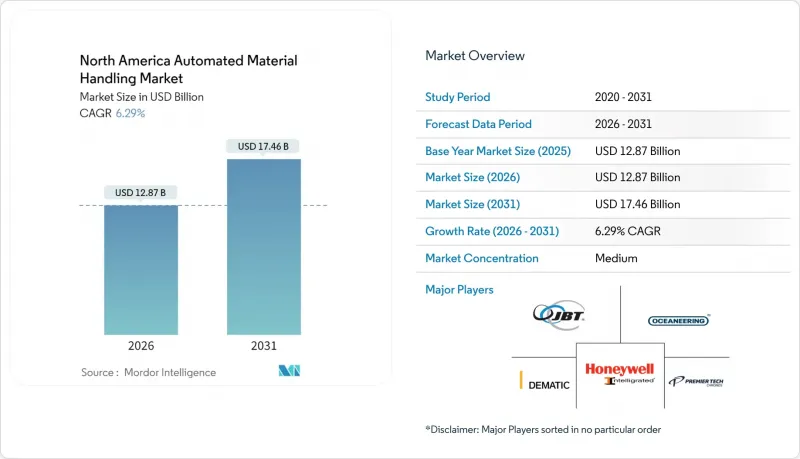
This report is Segmented by Product Type (Hardware, Software, and Services), Equipment Type (Mobile Robots, AS/RS, Conveyors, Palletizers, and More), System Function (Storage, Transportation, Packaging, and More), End-User Vertical (Airport, Automotive, Food and Beverage, Retail and Warehousing, and More), and Geography. The Market Forecasts are Provided in Terms of Value (USD).
North America Automated Material Handling Market Trends and Insights
E-Commerce Driven Demand for High-Throughput Fulfilment Centers
Parcel volumes in North America surpassed 16 billion units in 2025, pushing retailers and 3PLs to compress order-to-ship cycles below two hours in densely populated cities. Tier-one merchants invested heavily: Amazon operated more than 110 sortation centers and 1,000 delivery stations across the United States in 2025; each designed for peak throughput above one million items per day. Walmart earmarked USD 1.4 billion in October 2025 to retrofit 65 distribution centers with AS/RS and robotic palletizers, pursuing same-day delivery coverage for 90% of online orders by 2027. Similar commitments from large chains are cascading to mid-tier operators that now lease space in shared micro-fulfilment hubs equipped with goods-to-person systems, concentrating capital with a handful of integrators.
Rising Adoption of Autonomous Mobile Robots Across 3PL Warehouses
3PLs managed roughly 2.1 billion ft2 of warehouse capacity in the United States in 2025, yet only 18% was automated. Robot suppliers seized the opportunity: one leading vendor reported deployments of more than 12,000 collaborative units across facilities run by DHL, GXO Logistics, and Geodis, boosting pick rates by 2.5X over manual methods. Partnerships that integrate fleet management software directly into warehouse management systems have cut commissioning time from six months to as little as eight weeks, accelerating return on investment. Flexibility is paramount because 3PL clients often renegotiate SKUs and volumes every quarter; AMRs, unaffected by fixed guide paths, allow rapid reconfiguration with minimal downtime.
High Upfront Capital and Integration Costs for Brownfield Sites
Retrofitting older warehouses typically costs 40%-60% more per square foot than comparable greenfield builds because floors, electrical systems, and HVAC often require upgrades to support 24/7 automation. A 2024 survey of 150 logistics operators found 62% cited integration complexity as the main barrier to adoption. One integrator's 2024 project at a U.S. automotive parts distributor suffered USD 8 million in cost overruns due to unforeseen structural issues, magnifying investor caution. Lessees face additional risk: landlords frequently decline permanent modifications, leaving tenants liable for decommissioning expenses at lease end.
Other drivers and restraints analyzed in the detailed report include:
- Adoption of AI-Powered Warehouse Execution Systems
- Investment Tax Credits and Incentives for Automation
- Shortage of Skilled Technicians for Advanced Automation Maintenance
For complete list of drivers and restraints, kindly check the Table Of Contents.
Segment Analysis
Hardware commanded 63.21% of 2025 revenue, reflecting the capital intensity of conveyors, AS/RS cranes, and robotic arms, yet software is the fastest-growing component, advancing at 7.27% CAGR as operators chase data-driven throughput gains. Services revenue, tied to installation and long-term maintenance, follows hardware growth but is constrained by the technician shortage. The North America automated material handling market size for software solutions is projected to capture a growing share of expenditures, enabled by modular licensing that allows phased feature activation. In parallel, hardware remains indispensable for new facilities where conveyors and sorters typically consume up to 80% of project budgets, underscoring a dual-track investment pattern that fuses physical capacity with intelligent control.
Second-generation warehouse execution platforms that integrate predictive analytics, digital twins, and fleet orchestration are solidifying recurring revenue streams. One leading supplier reported that software now accounts for 11% of divisional revenue, up from single-digits two years prior, while another's modular pricing trimmed upfront outlays by 35% yet secured higher lifetime value through annual subscriptions. The North America automated material handling market continues to follow a trajectory where hardware penetrates greenfield sites first, then software increments unlock incremental capacity gains, a pattern mirrored in the rising share of service contracts that embed remote monitoring and preventive maintenance.
Unit-load AS/RS systems held 28.4% of 2025 equipment revenue, demonstrating their enduring appeal for high-throughput environments that prioritize density and pallet-level speed. Nevertheless, autonomous mobile robots represent the fastest-growing category at 7.91% CAGR, driven by their ability to navigate dynamic layouts without fixed guideways. The North America automated material handling market size for AMRs is expanding as brownfield operators seek flexibility that conventional conveyors or AGVs cannot deliver. AGVs maintain relevance in automotive and pharmaceutical settings where predetermined paths and cleanroom requirements prevail, while laser-guided vehicles fill a niche for medium-flexibility applications.
Rising e-commerce parcel volumes and SKU proliferation are tilting purchasing toward robots that can be redeployed quickly as product mixes shift. Leading suppliers now bundle fleet-management software that coordinates tasks across mixed robot brands, easing vendor-lock concerns and fostering multi-fleet strategies. In parallel, fixed infrastructure such as cross-belt sorters remains essential at parcel hubs processing more than 10,000 packages per hour, underscoring that AMRs complement rather than completely displace conveyors in the North America automated material handling market.
Complete Report Scope:
- By Product Type
- Hardware
- Software
- Services
- By Equipment Type
- Mobile Robots
- Automated Guided Vehicles
- Automated Forklift
- Automated Tow-Tractor
- Unit Load
- Assembly Line
- Special Purpose
- Autonomous Mobile Robots
- Laser Guided Vehicles
- Automated Guided Vehicles
- Automated Storage and Retrieval Systems
- Fixed Aisle (Stacker Crane + Shuttle)
- Carousel (Horizontal + Vertical)
- Vertical Lift Module
- Automated Conveyors
- Belt
- Roller
- Pallet
- Overhead
- Palletizers
- Conventional (High Level + Low Level)
- Robotic
- Sortation Systems
- Mobile Robots
- By System Function
- Storage
- Transportation
- Packaging
- Order Picking
- Distribution
- Waste Handling
- By End-User Vertical
- Airport
- Automotive
- Food and Beverage
- Retail, Warehousing and Distribution Centers
- General Manufacturing
- Pharmaceuticals
- Post and Parcel
- Other End-User Verticals
- By Country
- United States
- Canada
- Mexico
List of Companies Covered in this Report:
- Dematic Corp.
- Honeywell Intelligrated (Honeywell International Inc.)
- Daifuku Co., Ltd. (Jervis B. Webb)
- SSI Schaefer Group GmbH
- Bastian Solutions LLC
- JBT Corporation
- Westfalia Technologies Inc.
- Oceaneering International Inc.
- Premier Tech Chronos Inc.
- DMW&H, Inc.
- OPUS Automation Inc.
- Creative Automation Inc.
- Remtec Automation LLC
- Shuttleworth LLC
- Siggins AB
- Cornerstone Automation Systems LLC
Additional Benefits:
- The market estimate (ME) sheet in Excel format
- 3 months of analyst support
TABLE OF CONTENTS
1 INTRODUCTION
- 1.1 Study Assumptions and Market Definition
- 1.2 Scope of the Study
2 RESEARCH METHODOLOGY
3 EXECUTIVE SUMMARY
4 MARKET LANDSCAPE
- 4.1 Market Overview
- 4.2 Impact of Macroeconomic Factors on the Market
- 4.3 Market Drivers
- 4.3.1 Surge in Warehouse Automation Investments
- 4.3.2 Rising Adoption of Autonomous Mobile Robots Across 3PL Warehouses
- 4.3.3 E-Commerce Driven Demand for High-Throughput Fulfilment Centers
- 4.3.4 Adoption of AI-Powered Warehouse Execution Systems
- 4.3.5 Investment Tax Credits and Incentives for Automation in United States and Canada
- 4.3.6 Sustainability Mandates Driving Energy-Efficient Material Handling Solutions
- 4.4 Market Restraints
- 4.4.1 High Upfront Capital and Integration Costs for Brownfield Sites
- 4.4.2 Shortage of Skilled Technicians for Advanced Automation Maintenance
- 4.4.3 Cybersecurity Risks in Connected Material Handling Systems
- 4.4.4 Building Code and Safety Compliance Complexities in Retrofitting
- 4.5 Industry Value Chain Analysis
- 4.6 Regulatory Landscape
- 4.7 Technological Outlook
- 4.8 Porter's Five Forces Analysis
- 4.8.1 Threat of New Entrants
- 4.8.2 Bargaining Power of Suppliers
- 4.8.3 Bargaining Power of Buyers
- 4.8.4 Threat of Substitutes
- 4.8.5 Intensity of Competitive Rivalry
5 MARKET SIZE AND GROWTH FORECASTS (VALUE)
- 5.1 By Product Type
- 5.1.1 Hardware
- 5.1.2 Software
- 5.1.3 Services
- 5.2 By Equipment Type
- 5.2.1 Mobile Robots
- 5.2.1.1 Automated Guided Vehicles
- 5.2.1.1.1 Automated Forklift
- 5.2.1.1.2 Automated Tow-Tractor
- 5.2.1.1.3 Unit Load
- 5.2.1.1.4 Assembly Line
- 5.2.1.1.5 Special Purpose
- 5.2.1.2 Autonomous Mobile Robots
- 5.2.1.3 Laser Guided Vehicles
- 5.2.1.1 Automated Guided Vehicles
- 5.2.2 Automated Storage and Retrieval Systems
- 5.2.2.1 Fixed Aisle (Stacker Crane + Shuttle)
- 5.2.2.2 Carousel (Horizontal + Vertical)
- 5.2.2.3 Vertical Lift Module
- 5.2.3 Automated Conveyors
- 5.2.3.1 Belt
- 5.2.3.2 Roller
- 5.2.3.3 Pallet
- 5.2.3.4 Overhead
- 5.2.4 Palletizers
- 5.2.4.1 Conventional (High Level + Low Level)
- 5.2.4.2 Robotic
- 5.2.5 Sortation Systems
- 5.2.1 Mobile Robots
- 5.3 By System Function
- 5.3.1 Storage
- 5.3.2 Transportation
- 5.3.3 Packaging
- 5.3.4 Order Picking
- 5.3.5 Distribution
- 5.3.6 Waste Handling
- 5.4 By End-User Vertical
- 5.4.1 Airport
- 5.4.2 Automotive
- 5.4.3 Food and Beverage
- 5.4.4 Retail, Warehousing and Distribution Centers
- 5.4.5 General Manufacturing
- 5.4.6 Pharmaceuticals
- 5.4.7 Post and Parcel
- 5.4.8 Other End-User Verticals
- 5.5 By Country
- 5.5.1 United States
- 5.5.2 Canada
- 5.5.3 Mexico
6 COMPETITIVE LANDSCAPE
- 6.1 Market Concentration
- 6.2 Strategic Moves
- 6.3 Market Share Analysis
- 6.4 Company Profiles (includes Global level Overview, Market level overview, Core Segments, Financials as available, Strategic Information, Market Rank/Share for key companies, Products and Services, and Recent Developments)
- 6.4.1 Dematic Corp.
- 6.4.2 Honeywell Intelligrated (Honeywell International Inc.)
- 6.4.3 Daifuku Co., Ltd. (Jervis B. Webb)
- 6.4.4 SSI Schaefer Group GmbH
- 6.4.5 Bastian Solutions LLC
- 6.4.6 JBT Corporation
- 6.4.7 Westfalia Technologies Inc.
- 6.4.8 Oceaneering International Inc.
- 6.4.9 Premier Tech Chronos Inc.
- 6.4.10 DMW&H, Inc.
- 6.4.11 OPUS Automation Inc.
- 6.4.12 Creative Automation Inc.
- 6.4.13 Remtec Automation LLC
- 6.4.14 Shuttleworth LLC
- 6.4.15 Siggins AB
- 6.4.16 Cornerstone Automation Systems LLC
7 MARKET OPPORTUNITIES AND FUTURE OUTLOOK
- 7.1 White-Space and Unmet-Need Assessment

