PUBLISHER: Mordor Intelligence | PRODUCT CODE: 2100575

PUBLISHER: Mordor Intelligence | PRODUCT CODE: 2100575
Silicone Fluids - Market Share Analysis, Industry Trends & Statistics, Growth Forecasts (2026 - 2031)
According to Mordor Intelligence, silicone fluids market size in 2026 is estimated at USD 6.23 billion, growing from 2025 value of USD 5.92 billion with 2031 projections showing USD 8.03 billion, growing at 5.22% CAGR over 2026-2031.
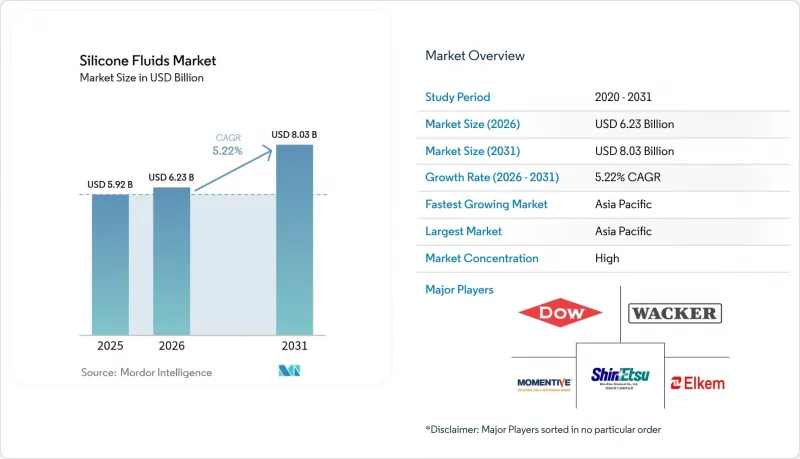
This report is Segmented by Product Type (Straight Silicone Fluid and Modified Silicone Fluid), Application (Lubricants and Greases, Damping Media, Liquid Dielectrics, Hydraulic Fluids, Defoamers, Personal Care, Paints and Coating Additives, Textile, Pharmaceuticals, and Other Applications), and Geography (Asia-Pacific, North America, Europe, South America, and Middle-East and Africa).
Global Silicone Fluids Market Trends and Insights
Rising Demand from Personal Care and Cosmetics
Formulators are moving quickly to replace restricted cyclic silicones with next-generation materials that marry sensory appeal and sustainability. Bio-based alkyl dimethicones from Siltech improve spreadability while cutting reliance on virgin fossil feedstocks. CHT Group's BeauSil RE-AMO 919 EM incorporates over 94% recycled monomers to meet circular-economy targets without sacrificing emolliency. Expanding middle-class populations in Asia-Pacific are embracing premium multifunctional skin- and hair-care products, spurring demand for silicone fluids that deliver conditioning, barrier, and gloss benefits in a single blend. As brands tighten product portfolios, multifunctionality becomes a critical differentiator, and suppliers able to document lower carbon footprints gain preferred-supplier status.
Increasing Adoption in Electric Vehicle Thermal-Management Fluids
Liquid-cooled battery packs need dielectric fluids that suppress thermal runaway yet transfer heat efficiently. Lubrizol's lifetime-fill silicone coolant exemplifies this shift by remaining stable for the full service life of an EV battery pack. China's forthcoming GB 29743.2 conductivity threshold sets a high bar that conventional glycol-water blends cannot meet, steering automakers toward silicone-based formulations. Beyond batteries, wide-bandgap inverters, e-motors, and charging systems also benefit from the broad operating-temperature band of silicone fluids. Upstream, silicon metal demand tied to EV growth is rising 4.56% annually through 2030, rewarding vertically integrated producers that can secure raw supply.
Volatile Silicon Metal and Monomer Prices
China controls roughly three-quarters of the world's silicon metal output, creating a single-country risk that cascades through the silicone fluids market. Energy-price spikes, production curbs, and geopolitical frictions swing spot quotes, disrupting budgeting for downstream formulators. The United States is incentivizing domestic smelter projects under the Inflation Reduction Act, yet new capacity will not meaningfully come onstream before 2030. In the meantime, producers hedge with long-term supply contracts and evaluate backward integration, actions that demand capital many mid-sized players cannot muster.
Other drivers and restraints analyzed in the detailed report include:
- Growth in High-Performance Lubricants for Industrial Automation
- Liquid-Immersion Cooling of Hyperscale Data Centres
- Stringent VOC and REACH Compliance Costs
For complete list of drivers and restraints, kindly check the Table Of Contents.
Segment Analysis
Modified grades are expanding faster than unmodified counterparts, charting a 6.72% CAGR as formulators specify siloxanes with tailored side-chains, reactive sites, or crosslinkable groups. These custom molecules bond selectively to substrates, boost adhesion, or create hydrophobic surfaces, letting end-users hit performance targets without over-engineering. Demand is prominent in EV potting, conformal coatings, and high-flex textile inks. Straight polydimethyl-silicone grades nevertheless maintain volume leadership due to cost efficiency and broad spec inclusion. Their supply chains are mature, and continuous-process debottlenecking further reduces unit cost.
Competition is intensifying around sustainable production. Dow's joint venture with Circusil brings a recycling loop able to cut PDMS carbon footprint by more than 50%. Wacker commissioned new Chinese fluid and emulsion lines in May 2025, adding high-purity capacity aimed at next-gen electronics. KCC's 2024 purchase of Momentive broadens vertical reach from upstream siloxane monomers to downstream specialty fluids. As circular-economy targets harden, producers with closed-loop capabilities gain supply-award preference from global OEMs keen to certify Scope 3 reductions.
Complete Report Scope:
- By Product Type
- Straight Silicone Fluids
- Poly-dimethyl Silicone Fluid
- Methylphenyl Silicone Fluid
- Methylhydrogen Silicone Fluid
- Other Straight Silicone Fluids
- Modified Silicone Fluids
- Reactive Silicone Fluid
- Non-reactive Silicone Fluid
- Straight Silicone Fluids
- By Application
- Lubricants and Greases
- Damping Media
- Liquid Dielectrics
- Hydraulic Fluids
- Defoamers
- Personal Care
- Paints and Coating Additives
- Textile Finishes
- Pharmaceuticals
- Other Applications
- By Geography
- Asia-Pacific
- China
- Japan
- India
- South Korea
- ASEAN Countries
- Rest of Asia-Pacific
- North America
- United States
- Canada
- Mexico
- Europe
- Germany
- United Kingdom
- France
- Italy
- Spain
- Russia
- NORDIC Countries
- Rest of Europe
- South America
- Brazil
- Argentina
- Rest of South America
- Middle-East and Africa
- Saudi Arabia
- South Africa
- Rest of Middle-East and Africa
- Asia-Pacific
Geography Analysis
Asia-Pacific dominates the silicone fluids market, leveraging integrated supply chains that begin with silicon metal smelting and culminate in finished formulations. China's cost advantage and 75% raw-material control anchor the region's leadership, while Japan and South Korea champion miniaturized electronics and memory semiconductors that require ultra-pure dielectric fluids. Southeast Asia is emerging as a manufacturing hedge, with Vietnam and Thailand courting foreign direct investment for specialty-chemical complexes. India, supported by domestic automotive build-out and an expanding personal-care sector, records double-digit local sales increases.
North America presents a different dynamic. The United States orchestrates supply-chain onshoring for critical minerals, while datacenter and EV build-outs propel specialty-fluid demand. Dow's capacity expansion for silicone elastomers in Michigan supports regional customers seeking short lead times. ExxonMobil added high-viscosity synthetic base-stock capacity in Texas, signaling wider industrial acceptance of premium functional fluids. Canada supplies hydro-based metallurgical-grade silicon, and Mexico's maquiladora corridor pulls in fluids for electronics assembly and automotive wiring harness production.
Europe contends with the strictest regulatory hurdles yet remains an innovation epicenter. Wacker forecasts 10% revenue growth in its Silicones division for 2025 as specialty grades offset lower commodity volumes. Germany's engineering companies specify silicone damping media for machine tools, while France's cosmetic houses pioneer upcycled silicone ingredients to meet imminent packaging and carbon-footprint rules. Nordic utilities' green-power matrices lend credibility to circular-manufacturing claims, helping silicone fluid makers sell environmental value alongside technical performance.
- BRB International B.V.
- CHT Germany GmbH
- Dow
- DuPont
- Elkem ASA
- GELEST Inc.
- Innospec Inc.
- IOTA silicone
- KCC SILICONE CORPORATION
- Momentive
- Shin-Etsu Chemical Co., Ltd.
- Siltech Corporation
- Supreme Silicones India Pvt. Ltd.
- Wacker Chemie AG
- Zhejiang Zhongtian Fluorine Silicon Material Co., Ltd.
Additional Benefits:
- The market estimate (ME) sheet in Excel format
- 3 months of analyst support
TABLE OF CONTENTS
1 Introduction
- 1.1 Study Assumptions and Market Definition
- 1.2 Scope of the Study
2 Research Methodology
3 Executive Summary
4 Market Landscape
- 4.1 Market Overview
- 4.2 Market Drivers
- 4.2.1 Rising demand from personal care and cosmetics
- 4.2.2 Increasing adoption in electric vehicle thermal-management fluids
- 4.2.3 Growth in high-performance lubricants for industrial automation
- 4.2.4 Liquid-immersion cooling of hyperscale data centres
- 4.2.5 Precision agriculture anti-foam agents for biostimulant mixtures
- 4.3 Market Restraints
- 4.3.1 Volatile silicon metal and monomer prices
- 4.3.2 Stringent VOC and REACH compliance costs
- 4.3.3 High supplier concentration in raw siloxanes
- 4.4 Value Chain Analysis
- 4.5 Porter's Five Forces
- 4.5.1 Threat of New Entrants
- 4.5.2 Bargaining Power of Suppliers
- 4.5.3 Bargaining Power of Buyers
- 4.5.4 Threat of Substitutes
- 4.5.5 Competitive Rivalry
5 Market Size and Growth Forecasts (Value)
- 5.1 By Product Type
- 5.1.1 Straight Silicone Fluids
- 5.1.1.1 Poly-dimethyl Silicone Fluid
- 5.1.1.2 Methylphenyl Silicone Fluid
- 5.1.1.3 Methylhydrogen Silicone Fluid
- 5.1.1.4 Other Straight Silicone Fluids
- 5.1.2 Modified Silicone Fluids
- 5.1.2.1 Reactive Silicone Fluid
- 5.1.2.2 Non-reactive Silicone Fluid
- 5.1.1 Straight Silicone Fluids
- 5.2 By Application
- 5.2.1 Lubricants and Greases
- 5.2.2 Damping Media
- 5.2.3 Liquid Dielectrics
- 5.2.4 Hydraulic Fluids
- 5.2.5 Defoamers
- 5.2.6 Personal Care
- 5.2.7 Paints and Coating Additives
- 5.2.8 Textile Finishes
- 5.2.9 Pharmaceuticals
- 5.2.10 Other Applications
- 5.3 By Geography
- 5.3.1 Asia-Pacific
- 5.3.1.1 China
- 5.3.1.2 Japan
- 5.3.1.3 India
- 5.3.1.4 South Korea
- 5.3.1.5 ASEAN Countries
- 5.3.1.6 Rest of Asia-Pacific
- 5.3.2 North America
- 5.3.2.1 United States
- 5.3.2.2 Canada
- 5.3.2.3 Mexico
- 5.3.3 Europe
- 5.3.3.1 Germany
- 5.3.3.2 United Kingdom
- 5.3.3.3 France
- 5.3.3.4 Italy
- 5.3.3.5 Spain
- 5.3.3.6 Russia
- 5.3.3.7 NORDIC Countries
- 5.3.3.8 Rest of Europe
- 5.3.4 South America
- 5.3.4.1 Brazil
- 5.3.4.2 Argentina
- 5.3.4.3 Rest of South America
- 5.3.5 Middle-East and Africa
- 5.3.5.1 Saudi Arabia
- 5.3.5.2 South Africa
- 5.3.5.3 Rest of Middle-East and Africa
- 5.3.1 Asia-Pacific
6 Competitive Landscape
- 6.1 Market Concentration
- 6.2 Strategic Moves
- 6.3 Market Share(%)/Ranking Analysis
- 6.4 Company Profiles (includes Global level Overview, Market level overview, Core Segments, Financials as available, Strategic Information, Market Rank/Share, Products and Services, Recent Developments)
- 6.4.1 BRB International B.V.
- 6.4.2 CHT Germany GmbH
- 6.4.3 Dow
- 6.4.4 DuPont
- 6.4.5 Elkem ASA
- 6.4.6 GELEST Inc.
- 6.4.7 Innospec Inc.
- 6.4.8 IOTA silicone
- 6.4.9 KCC SILICONE CORPORATION
- 6.4.10 Momentive
- 6.4.11 Shin-Etsu Chemical Co., Ltd.
- 6.4.12 Siltech Corporation
- 6.4.13 Supreme Silicones India Pvt. Ltd.
- 6.4.14 Wacker Chemie AG
- 6.4.15 Zhejiang Zhongtian Fluorine Silicon Material Co., Ltd.
7 Market Opportunities and Future Outlook
- 7.1 White-space and Unmet-need Assessment

