
PUBLISHER: Mordor Intelligence | PRODUCT CODE: 2100579

PUBLISHER: Mordor Intelligence | PRODUCT CODE: 2100579
Cement Board - Market Share Analysis, Industry Trends & Statistics, Growth Forecasts (2026 - 2031)
According to Mordor Intelligence, the cement board market size is projected to expand from 670.01 Million square meters in 2025 and 704.78 Million square meters in 2026 to 741.36 Million square meters by 2031, registering a CAGR of 5.19% between 2026 to 2031.
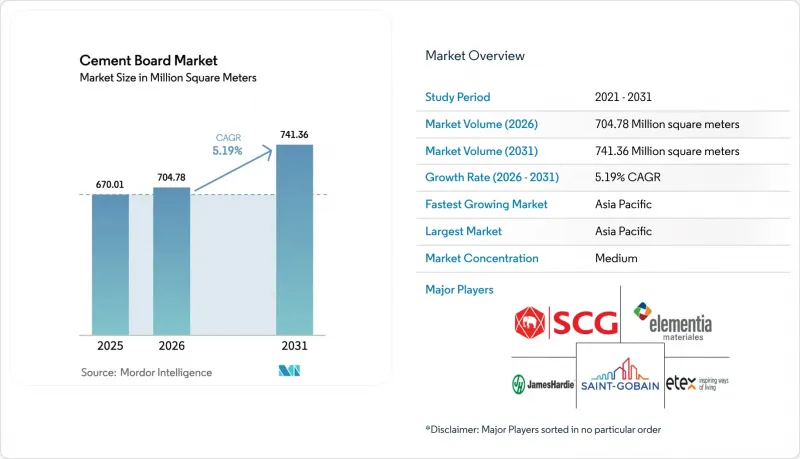
This report is Segmented by Product Type (Fiber Cement Board, Wood Wool Cement Board, Wood Strand Cement Board, and More), Application (Flooring, Roofing, Columns and Beams, Facades, and More), End-User Industry (Residential, Commercial, and More), and Geography (Asia-Pacific, North America, Europe, South America, and Middle East and Africa). The Market Forecasts are Provided in Terms of Volume (Square Meters).
Global Cement Board Market Trends and Insights
Rising Adoption in Residential and Commercial Construction
Tighter building codes and labor shortages make cement board a preferred substrate in both housing and non-residential work. California's 2024 CALGreen update requires Environmental Product Declarations for exterior cladding, disqualifying vinyl options and pushing contractors toward fiber cement. India added 450 million ft2 of residential floor area in 2025, much of it using cement board soffits and stairwell liners to meet 90-minute fire-rating rules. Commercial retrofits in Singapore and Hong Kong now swap gypsum for 12 mm boards to achieve Green Mark Platinum impact-resistance targets. On-site crews can fasten pre-scored panels 40% faster than wet plaster, trimming mid-rise schedules by two to three weeks.
Mandatory Green-Building Codes Favoring Non-Asbestos Boards
The European Union's 2024 revision to the Construction Products Regulation mandates a Declaration of Performance confirming zero asbestos content, accelerating fiber cement uptake. Australia's 2025 National Construction Code closed import loopholes that once allowed uncertified boards. New York City's Local Law 97 caps facade embodied carbon, prompting developers to replace aluminum composites with cement board for a 35% footprint cut. Manufacturers holding ready EPD libraries and ISO 8336 fire-test data reach the market six to nine months sooner than new entrants.
High Initial Cost Versus Gypsum and OSB
Fiber cement panels retail at USD 18-24 in North America, 40-60% above Type X gypsum. The price gap widened after Portland-cement increases of 12% in 2025, whereas gypsum stayed flat. Labor adds cost because carbide blades and pre-drilling extend crew hours by 10-15%. Affordable-housing budgets in India and Southeast Asia often cap material spend, limiting near-term penetration despite lower life-cycle outlays.
Other drivers and restraints analyzed in the detailed report include:
- Demand for Durable, Impact-Resistant Interior Panels
- Uptake in Off-Site Volumetric Modular Buildings
- Volatile Cement and Cellulose Fiber Prices / CO2 Levies
For complete list of drivers and restraints, kindly check the Table Of Contents.
Segment Analysis
Fiber Cement Board captured 58.76% of 2025 volume, locking in its position through mature ASTM C1186-compliant lines. James Hardie's autoclaved boards post 18-22 MPa flexural strength and +-0.3% dimensional tolerance, satisfying both cladding and structural-sheathing roles. Other product types, such as magnesium oxide and rice-husk variants, while costlier, are expanding at a 5.56% CAGR on superior chloride resistance that suits coastal builds. Within this mix, the cement board market size for high-performance FCB is projected to widen fastest in code-driven regions such as North America and the EU. Niche formats, wood wool, and strand boards serve acoustic ceilings, offering NRC values up to 0.75. Producers in India and Vietnam now substitute up to 40% cellulose with rice-husk fiber, lowering raw costs by USD 5 /m2 without sacrificing Class A fire ratings.
Rice-husk and magnesium boards are poised to erode small shares from FCB in price-sensitive and specialty markets. However, the cement board market share of autoclaved FCB will remain dominant where seismic, fire, and warranty criteria override first-cost differences. Saudi Arabian marine projects, Japanese multifamily towers, and U.S. data centers all specify FCB for its verified performance envelope. Momentum also rests on well-documented EPD libraries that help builders meet embodied-carbon targets.
Complete Report Scope:
- By Product Type
- Fiber Cement Board (FCB)
- Wood Wool Cement Board (WWCB)
- Wood Strand Cement Board (WSCB)
- Cement-Bonded Particle Board (CBPB)
- Other Product Types (Magnesium Oxide Cement Board (MOCB), Rice Husk Cement Board)
- By Application
- Flooring
- Exterior and Partition Walls
- Roofing
- Columns and Beams
- Facades, Weatherboard and Cladding
- Acoustic and Thermal Insulation
- Other Applications (Prefabricated and Fire-resistant Construction)
- By End-user Industry
- Residential
- Commercial
- Industrial and Institutional
- By Geography
- Asia-Pacifc
- China
- India
- Japan
- South Korea
- Vietnam
- Malaysia
- Indonesia
- Thailand
- Rest of Asia-Pacific
- North America
- United States
- Canada
- Mexico
- Europe
- Germany
- United Kingdom
- France
- Italy
- Russia
- Turkey
- Spain
- NORDIC Countries
- Rest of Europe
- South America
- Brazil
- Argentina
- Colombia
- Rest of South America
- Middle East and Africa
- Saudi Arabia
- South Africa
- Qatar
- Nigeria
- United Arab Emirates
- Rest of Middle East and Africa
- Asia-Pacifc
Geography Analysis
Asia-Pacific dominated the cement board market with 44.07% of 2025 volume and is poised for a 5.42% CAGR. India's PMAY program alone generated 18 million m2 of demand in 2025 by mandating cyclone-resistant cladding in coastal states. Vietnam's USD 36 billion FDI inflow into electronics parks drove penetration from 12% in 2023 to 22% in 2025. Japan's prefab sector continues to install ductile fiber cement that withstands 0.4 g lateral loads.
In North America, California's WUI code requires Class A cladding in hazard zones, adding 6 million m2 of annual demand. HUD guidance in 2025 promoted fiber cement for modular affordable housing, boosting orders from Pennsylvania and Ontario plants. Canada's 2025 code tightened moisture-management rules in cold climates, favoring boards over OSB.
Europe's market volume is shaped by post-Grenfell fire statutes and the Energy Performance of Buildings Directive. Germany's Building Energy Act credits high-thermal-mass partitions that stabilize indoor temperature swings. The UK replaced combustible facades on 2,500 buildings after 2024, converting to fiber cement. Nordic prefab ventures specify airtight boards to meet Passive House targets, while southern Europe deploys them as wildfire defenses.
In South America and the Middle East & Africa region, Brazil's relaunched Minha Casa program in 2024 mandated termite-resistant cladding, adding 3 million m2 in 2025. Saudi Arabia's Vision 2030 hospitality builds use cement board to tolerate 50°C temperature swings. UAE green-building schemes under Estidama and Al Sa'fat grant credits for EPD-certified boards, nudging suppliers with transparent carbon data.
- Allura
- BetonWood SRL
- Century Ply
- CONWOOD Co.,LTD
- CSR
- ELEMENTIA MATERIALES, S.A.B. DE C.V
- Etex Group
- Everest Industries Limited
- James Hardie Industries plc.
- Johns Manville
- National Gypsum Services Company
- NICHIHA
- Saint-Gobain
- Siam Cement Public Company Limited
Additional Benefits:
- The market estimate (ME) sheet in Excel format
- 3 months of analyst support
TABLE OF CONTENTS
1 Introduction
- 1.1 Study Assumptions
- 1.2 Scope of the Study
2 Research Methodology
3 Executive Summary
4 Market Landscape
- 4.1 Market Overview
- 4.2 Market Drivers
- 4.2.1 Rising adoption in residential and commercial construction
- 4.2.2 Mandatory green-building codes favouring non-asbestos boards
- 4.2.3 Demand for durable, impact-resistant interior panels
- 4.2.4 Uptake in off-site volumetric modular buildings
- 4.2.5 Wild-fire insurance discounts for fire-rated cladding
- 4.3 Market Restraints
- 4.3.1 High initial cost versus gypsum and OSB
- 4.3.2 Volatile cement and cellulose fibre prices / CO2 levies
- 4.3.3 Limited end-of-life recycling infrastructure (under-the-radar)
- 4.4 Value Chain Analysis
- 4.5 Porter's Five Forces
- 4.5.1 Bargaining Power of Suppliers
- 4.5.2 Bargaining Power of Buyers
- 4.5.3 Threat of New Entrants
- 4.5.4 Threat of Substitutes
- 4.5.5 Degree of Competition
5 Market Size and Growth Forecasts (Area)
- 5.1 By Product Type
- 5.1.1 Fiber Cement Board (FCB)
- 5.1.2 Wood Wool Cement Board (WWCB)
- 5.1.3 Wood Strand Cement Board (WSCB)
- 5.1.4 Cement-Bonded Particle Board (CBPB)
- 5.1.5 Other Product Types (Magnesium Oxide Cement Board (MOCB), Rice Husk Cement Board)
- 5.2 By Application
- 5.2.1 Flooring
- 5.2.2 Exterior and Partition Walls
- 5.2.3 Roofing
- 5.2.4 Columns and Beams
- 5.2.5 Facades, Weatherboard and Cladding
- 5.2.6 Acoustic and Thermal Insulation
- 5.2.7 Other Applications (Prefabricated and Fire-resistant Construction)
- 5.3 By End-user Industry
- 5.3.1 Residential
- 5.3.2 Commercial
- 5.3.3 Industrial and Institutional
- 5.4 By Geography
- 5.4.1 Asia-Pacifc
- 5.4.1.1 China
- 5.4.1.2 India
- 5.4.1.3 Japan
- 5.4.1.4 South Korea
- 5.4.1.5 Vietnam
- 5.4.1.6 Malaysia
- 5.4.1.7 Indonesia
- 5.4.1.8 Thailand
- 5.4.1.9 Rest of Asia-Pacific
- 5.4.2 North America
- 5.4.2.1 United States
- 5.4.2.2 Canada
- 5.4.2.3 Mexico
- 5.4.3 Europe
- 5.4.3.1 Germany
- 5.4.3.2 United Kingdom
- 5.4.3.3 France
- 5.4.3.4 Italy
- 5.4.3.5 Russia
- 5.4.3.6 Turkey
- 5.4.3.7 Spain
- 5.4.3.8 NORDIC Countries
- 5.4.3.9 Rest of Europe
- 5.4.4 South America
- 5.4.4.1 Brazil
- 5.4.4.2 Argentina
- 5.4.4.3 Colombia
- 5.4.4.4 Rest of South America
- 5.4.5 Middle East and Africa
- 5.4.5.1 Saudi Arabia
- 5.4.5.2 South Africa
- 5.4.5.3 Qatar
- 5.4.5.4 Nigeria
- 5.4.5.5 United Arab Emirates
- 5.4.5.6 Rest of Middle East and Africa
- 5.4.1 Asia-Pacifc
6 Competitive Landscape
- 6.1 Market Concentration
- 6.2 Strategic Moves
- 6.3 Market Share(%)/Ranking Analysis
- 6.4 Company Profiles (includes Global level Overview, Market level overview, Core Segments, Financials as available, Strategic Information, Market Rank/Share, Products and Services, Recent Developments)
- 6.4.1 Allura
- 6.4.2 BetonWood SRL
- 6.4.3 Century Ply
- 6.4.4 CONWOOD Co.,LTD
- 6.4.5 CSR
- 6.4.6 ELEMENTIA MATERIALES, S.A.B. DE C.V
- 6.4.7 Etex Group
- 6.4.8 Everest Industries Limited
- 6.4.9 James Hardie Industries plc.
- 6.4.10 Johns Manville
- 6.4.11 National Gypsum Services Company
- 6.4.12 NICHIHA
- 6.4.13 Saint-Gobain
- 6.4.14 Siam Cement Public Company Limited
7 Market Opportunities and Future Outlook
- 7.1 White-space and Unmet-Need Assessment
- 7.2 Consumer inclination towards asthetic interior

