PUBLISHER: Mordor Intelligence | PRODUCT CODE: 2100606

PUBLISHER: Mordor Intelligence | PRODUCT CODE: 2100606
Cybersecurity As A Service - Market Share Analysis, Industry Trends & Statistics, Growth Forecasts (2026 - 2031)
According to Mordor Intelligence, the cybersecurity as a service market size is expected to grow from USD 27.92 billion in 2025 to USD 31.4 billion in 2026 and is forecast to reach USD 56.55 billion by 2031 at 12.48% CAGR over 2026-2031.
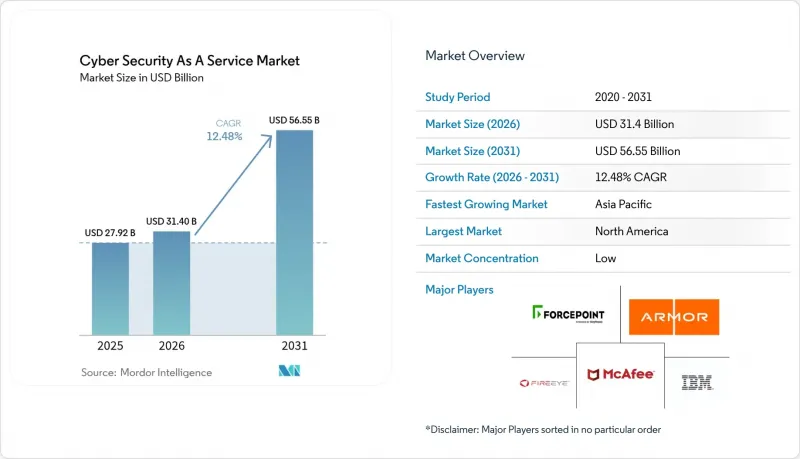
This report is Segmented by End-User Enterprise Size (SMEs, Large Enterprises), Service Model ( SOC As A Service, and More), Security Type (Risk and Vulnerability Assessment, and More), Deployment Mode (Public Cloud, Private Cloud, and More), End-User Industry (BFSI, Manufacturing, and More), and Geography (North America, Europe, and More). The Market Forecasts are Provided in Terms of Value (USD).
Global Cybersecurity As A Service Market Trends and Insights
Rising Cost and Frequency of Data Breaches Drive Service Adoption
Average breach expenses climbed to USD 4.88 million in 2024, a 10% year-over-year jump, pressuring boards to fund continuous monitoring and rapid containment services. Healthcare breaches cost USD 9.77 million and represented 79% of reported incidents, while AI- and automation-enabled organizations saved USD 2.2 million and shortened containment by 54 days. As 70% of breached firms experience material business disruption, regulatory frameworks such as ISO 27001 elevate real-time detection and response to a baseline requirement.
SME Cybersecurity Demand Accelerates Amid Skills Crisis
SMEs suffer 43% of cyberattacks, yet 18% still lack formal defenses; a further 44% rely on basic tools. With 60% of impacted SMEs folding within six months, service providers are tailoring subscription-based offerings that bundle 24/7 SOC oversight, compliance guidance, and cyber-insurance facilitation. Government schemes like the U.K.'s Cyber Essentials and lower-cost SOC bundles priced from USD 10,000 per month are expanding addressable demand.
Data Sovereignty Concerns Create Service Delivery Challenges
NIS2 pushes 350,000 European entities to tighten supply-chain oversight, compelling providers to host telemetry inside the bloc to satisfy residency mandates. Similar rules in Singapore and India force global MSSPs to replicate infrastructure regionally, raising capex and complicating threat-intelligence sharing. Enterprises wary of vendor lock-in increasingly demand contractual exit clauses and open-standards telemetry to mitigate switching barriers.
Other drivers and restraints analyzed in the detailed report include:
- Cloud Migration Expands Attack Surfaces and Service Requirements
- Cyber-Insurance Evolution Mandates Continuous Monitoring
- Multi-Cloud Visibility Gaps Undermine Service Effectiveness
For complete list of drivers and restraints, kindly check the Table Of Contents.
Segment Analysis
Large enterprises accounted for 71.35% of Cybersecurity As A Service Market share in 2025, driven by budgets that support multi-layered MDR, threat-hunting, and compliance orchestration engagements. Contract values routinely surpass USD 500,000 per year for holistic coverage that includes incident-response retainers and breach-insurance alignment. The SME segment, however, is forecast to grow at 13.98% CAGR, fueled by turnkey SOC-as-a-Service bundles and regulatory programs that extend NIS2 obligations to smaller supply-chain partners.
Cost-effective cloud delivery models, flat-fee subscription pricing, and insurer-linked discounts are lowering barriers for SMEs, especially in Asia Pacific, where SMB cloud adoption is surging. Providers tailoring language-localized dashboards and compliance templates are capturing outsized share among first-time buyers of managed security services.
Managed detection and response held 29.10% of the Cybersecurity As A Service Market size in 2025, reflecting enterprises' preference for proactive threat-hunting fused with rapid remediation. CrowdStrike's platform model illustrates competitive advantage achieved through endpoint, identity, and cloud telemetry convergence. SOC as a Service is expanding at 16.95% CAGR, supported by AI-driven triage and pay-as-you-grow licensing that resonates with resource-constrained organizations.
Identity-as-a-Service is also climbing as machine-to-machine traffic explodes in AI workflows, prompting firms to outsource credential lifecycle management. Vulnerability testing and compliance assessment remain foundational, yet differentiation now hinges on continuous validation capabilities that map directly to insurance and board-level risk metrics.
Complete Report Scope:
- By End-user Enterprise Size
- Small and Medium Enterprises (SMEs)
- Large Enterprises
- By Service Model
- Managed Detection and Response (MDR)
- SOC as a Service
- Identity and Access Management as a Service
- Vulnerability and Pen-Test as a Service
- Compliance and Risk Assessment as a Service
- Data Loss Prevention as a Service
- By Security Type
- Risk and Vulnerability Assessment
- Threat Intelligence and Analytics
- Auditing and Logging
- Continuous Monitoring and Encryption
- Identity and Access Management
- Incident Response and Disaster Recovery aaS
- By Deployment Mode
- Public Cloud
- Private Cloud
- Hybrid Cloud
- By End-user Industry
- BFSI
- Healthcare and Life Sciences
- IT and Telecom
- Government and Defense
- Energy and Utilities
- Retail and E-commerce
- Manufacturing
- Geography
- North America
- United States
- Canada
- Mexico
- South America
- Brazil
- Argentina
- Rest of South America
- Europe
- United Kingdom
- Germany
- France
- Russia
- Rest of Europe
- Asia-Pacific
- China
- India
- Japan
- South Korea
- Rest of Asia-Pacific
- Middle East and Africa
- Middle East
- GCC
- Turkey
- Israel
- Rest of Middle East
- Africa
- South Africa
- Nigeria
- Kenya
- Rest of Africa
- Middle East
- North America
Geography Analysis
North America generated 34.10% of 2025 revenue, supported by the world's highest breach costs U.S. organizations pay USD 9.8 million per incident and by stringent SEC disclosure mandates that prioritize continuous detection and reporting. Spending growth remains healthy as boards favor single-platform vendors that cut tool overlap and simplify audit readiness. Venture capital continues to fund AI-centric disruptors, sustaining a vibrant partner ecosystem.
Asia Pacific is the fastest-growing region, advancing at 14.95% CAGR to 2031 as enterprises rush to secure multi-cloud migrations and online-payment channels. India's technology expenditure is set to reach INR 5 trillion (USD 60.4 billion) in 2025, stimulating demand for hybrid-cloud security consulting, while the region's cyber-insurance market grows almost 50% annually. Local regulations ranging from Singapore's Cybersecurity Act to China's Personal Information Protection Law are spurring localized SOC buildouts that blend global threat intelligence with in-country data processing.
Europe maintains steady expansion underpinned by NIS2, which extends mandatory 24/7 SOC coverage to roughly 350,000 critical entities. Data-sovereignty sensitivities drive preference for providers that operate regional clouds and support privacy-enhancing technologies. Economic incentives are emerging as insurers lower premiums for organizations demonstrating adherence to ENISA guidance, further embedding service consumption across mid-market and enterprise segments.
- International Business Machines (IBM) Corporation
- Accenture plc
- Cisco Systems, Inc.
- AT&T Cybersecurity (AT&T Inc.)
- Secureworks, Inc.
- McAfee, LLC
- Trellix LLC (Musarubra US LLC)
- Fortinet, Inc.
- Palo Alto Networks Inc.
- Check Point Software Technologies Ltd.
- CrowdStrike Holdings, Inc.
- Rapid7, Inc.
- Sophos Ltd
- Proofpoint Inc.
- Zscaler, Inc.
- FireEye, LLC
- Armor Defense Inc.
- Convergent Network Solutions Ltd.
- Transputec Ltd.
- Zeguro Inc.
- Sara Technologies Inc.
- Cloud24x7 Pvt. Ltd.
Additional Benefits:
- The market estimate (ME) sheet in Excel format
- 3 months of analyst support
TABLE OF CONTENTS
1 INTRODUCTION
- 1.1 Study Assumptions and Market Definition
- 1.2 Scope of the Study
2 RESEARCH METHODOLOGY
3 EXECUTIVE SUMMARY
4 MARKET LANDSCAPE
- 4.1 Market Overview
- 4.2 Market Drivers
- 4.2.1 Rising cost and frequency of data breaches
- 4.2.2 SME demand amid cyber-skills shortage
- 4.2.3 Cloud and remote-work-led attack surface expansion
- 4.2.4 Cyber-insurance clauses mandating continuous monitoring
- 4.2.5 Identity-centric security for API/M2M traffic
- 4.2.6 NIS2 and similar 24X7 SOC requirements for critical entities
- 4.3 Market Restraints
- 4.3.1 Data-sovereignty / vendor-lock-in concerns
- 4.3.2 Visibility gaps in multi-cloud environments
- 4.3.3 Targeted attacks on MSSP/CSaaS supply chain
- 4.3.4 Talent-cost inflation eroding provider margins
- 4.4 Industry Value Chain Analysis
- 4.5 Regulatory Landscape
- 4.6 Technological Outlook
- 4.7 Porter's Five Forces Analysis
- 4.7.1 Bargaining Power of Suppliers
- 4.7.2 Bargaining Power of Buyers
- 4.7.3 Threat of New Entrants
- 4.7.4 Threat of Substitutes
- 4.7.5 Competitive Rivalry
5 MARKET SIZE AND GROWTH FORECASTS (VALUE)
- 5.1 By End-user Enterprise Size
- 5.1.1 Small and Medium Enterprises (SMEs)
- 5.1.2 Large Enterprises
- 5.2 By Service Model
- 5.2.1 Managed Detection and Response (MDR)
- 5.2.2 SOC as a Service
- 5.2.3 Identity and Access Management as a Service
- 5.2.4 Vulnerability and Pen-Test as a Service
- 5.2.5 Compliance and Risk Assessment as a Service
- 5.2.6 Data Loss Prevention as a Service
- 5.3 By Security Type
- 5.3.1 Risk and Vulnerability Assessment
- 5.3.2 Threat Intelligence and Analytics
- 5.3.3 Auditing and Logging
- 5.3.4 Continuous Monitoring and Encryption
- 5.3.5 Identity and Access Management
- 5.3.6 Incident Response and Disaster Recovery aaS
- 5.4 By Deployment Mode
- 5.4.1 Public Cloud
- 5.4.2 Private Cloud
- 5.4.3 Hybrid Cloud
- 5.5 By End-user Industry
- 5.5.1 BFSI
- 5.5.2 Healthcare and Life Sciences
- 5.5.3 IT and Telecom
- 5.5.4 Government and Defense
- 5.5.5 Energy and Utilities
- 5.5.6 Retail and E-commerce
- 5.5.7 Manufacturing
- 5.6 Geography
- 5.6.1 North America
- 5.6.1.1 United States
- 5.6.1.2 Canada
- 5.6.1.3 Mexico
- 5.6.2 South America
- 5.6.2.1 Brazil
- 5.6.2.2 Argentina
- 5.6.2.3 Rest of South America
- 5.6.3 Europe
- 5.6.3.1 United Kingdom
- 5.6.3.2 Germany
- 5.6.3.3 France
- 5.6.3.4 Russia
- 5.6.3.5 Rest of Europe
- 5.6.4 Asia-Pacific
- 5.6.4.1 China
- 5.6.4.2 India
- 5.6.4.3 Japan
- 5.6.4.4 South Korea
- 5.6.4.5 Rest of Asia-Pacific
- 5.6.5 Middle East and Africa
- 5.6.5.1 Middle East
- 5.6.5.1.1 GCC
- 5.6.5.1.2 Turkey
- 5.6.5.1.3 Israel
- 5.6.5.1.4 Rest of Middle East
- 5.6.5.2 Africa
- 5.6.5.2.1 South Africa
- 5.6.5.2.2 Nigeria
- 5.6.5.2.3 Kenya
- 5.6.5.2.4 Rest of Africa
- 5.6.5.1 Middle East
- 5.6.1 North America
6 COMPETITIVE LANDSCAPE
- 6.1 Market Concentration
- 6.2 Strategic Moves
- 6.3 Market Share Analysis
- 6.4 Company Profiles (includes Global level Overview, Market level overview, Core Segments, Financials as available, Strategic Information, Market Rank/Share for key companies, Products and Services, Recent Developments)
- 6.4.1 International Business Machines (IBM) Corporation
- 6.4.2 Accenture plc
- 6.4.3 Cisco Systems, Inc.
- 6.4.4 AT&T Cybersecurity (AT&T Inc.)
- 6.4.5 Secureworks, Inc.
- 6.4.6 McAfee, LLC
- 6.4.7 Trellix LLC (Musarubra US LLC)
- 6.4.8 Fortinet, Inc.
- 6.4.9 Palo Alto Networks Inc.
- 6.4.10 Check Point Software Technologies Ltd.
- 6.4.11 CrowdStrike Holdings, Inc.
- 6.4.12 Rapid7, Inc.
- 6.4.13 Sophos Ltd
- 6.4.14 Proofpoint Inc.
- 6.4.15 Zscaler, Inc.
- 6.4.16 FireEye, LLC
- 6.4.17 Armor Defense Inc.
- 6.4.18 Convergent Network Solutions Ltd.
- 6.4.19 Transputec Ltd.
- 6.4.20 Zeguro Inc.
- 6.4.21 Sara Technologies Inc.
- 6.4.22 Cloud24x7 Pvt. Ltd.
7 MARKET OPPORTUNITIES and FUTURE OUTLOOK
- 7.1 White-space and Unmet-need Assessment

