PUBLISHER: Mordor Intelligence | PRODUCT CODE: 2100625

PUBLISHER: Mordor Intelligence | PRODUCT CODE: 2100625
Tilt Sensor - Market Share Analysis, Industry Trends & Statistics, Growth Forecasts (2026 - 2031)
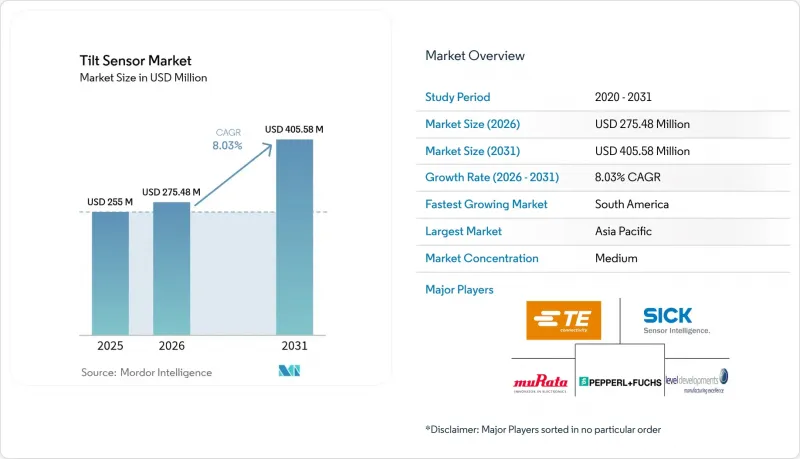
According to Mordor Intelligence, the tilt sensor market size was valued at USD 255 million in 2025 and estimated to grow from USD 275.48 million in 2026 to reach USD 405.58 million by 2031, at a CAGR of 8.03% during the forecast period (2026-2031).
This report is Segmented by Housing Material Type (Metal, Non-Metal), Technology (MEMS, Force Balance and More), Number of Axes (Single Axis, and More), Output Interface (Analog Voltage/Current, Digital and More), End-User Vertical (Mining and Construction, and More), Geography. The Market Forecasts are Provided in Terms of Value (USD).
Global Tilt Sensor Market Trends and Insights
Rapid Proliferation of MEMS-Based IoT Nodes in Industrial Automation Across Asia
Factory digitalization programs in China, Japan, and South Korea increasingly depend on compact MEMS inclinometers that reveal micro-deflections preceding machine failure. Deployments cut unplanned downtime by 37% and extend wireless-node battery life beyond five years, catalyzing repeat orders as return-on-investment becomes visible.
Mandatory Tilt Monitoring Regulations for Wind-Turbine Towers in Europe
EU safety rules now require continuous inclination tracking, prompting wind-farm operators to retrofit dual-redundant sensor arrays. Power-output losses of 1.5% per 0.5° misalignment and the potential for 2-3% performance gains from blade-pitch optimization encourage rapid compliance.
Price Premium of Force-Balance Sensors vs. MEMS in Cost-Sensitive OEMs
Ultrahigh-resolution force-balance devices remain 5-7 times pricier than MEMS units even though they deliver 0.0013° resolution. More than 65% of prospective buyers in India and Indonesia switch to lower-cost MEMS alternatives, restricting the addressable market for premium suppliers.
Other drivers and restraints analyzed in the detailed report include:
- Accelerated Deployment of High-Precision GNSS-Guided Construction Equipment in North America
- Telecom 5G mmWave Antenna Alignment Requirements in Urban Skyscrapers (Middle East)
- Calibration Drift in Fluid-Filled Sensors under Extreme Temperatures
For complete list of drivers and restraints, kindly check the Table Of Contents.
Segment Analysis
Metal housings delivered 66.32% of 2025 revenue, anchoring the tilt sensor market where impact resistance and thermal stability matter. They retain dominance in mining, heavy construction, and high-EMI locations near powerful generators. Meanwhile, non-metal composites are expanding at a 9.84% CAGR as polymer-ceramic blends shed 40% weight and reach IP69K ingress ratings, opening use cases on offshore turbines and marine vessels.
Lightweight corrosion-proof casings permit direct mounting on nacelle structures and drone airframes. Hybrid architectures that combine metal backbones with composite exteriors merge shielding with weight reduction, creating a bridge between legacy and next-generation designs. As a result, designers can embed inclinometers inside moulded polymer components, simplifying assembly and improving long-term reliability. The tilt sensor market size for composite housings is projected to climb steadily as total installed offshore wind capacity accelerates through 2030.
MEMS held 44.48% market share in 2025 due to established supply chains and attractive price-performance ratios. Yet optical fiber Bragg grating devices are set for 11.43% CAGR as interrogation-unit costs fall 35%, enabling their deployment at substations, rail tunnels, and electric-arc-furnace sites where EMI cripples electronics. These optical units now match the +-0.05° accuracy of premium MEMS while remaining immune to lightning-induced surges.
Force-balance instruments serve scientific and aerospace missions that need 0.001° resolution at any orientation, although their price premium narrows uptake. Fluid-filled electrolytic solutions persist in static-structure monitoring but face drift issues in dynamic or hot-cold cycles. Capacitive designs capture wearables and automotive dashboards where moderate accuracy suffices. Together, these technology tiers keep the tilt sensor market diversified, ensuring customers can align performance with budget.
Complete Report Scope:
- By Housing Material Type
- Metal
- Non-metal (Polymer, Ceramic, Composite)
- By Technology
- MEMS
- Force Balance
- Fluid Filled Electrolytic
- Capacitive
- Optical (Fibre Bragg)
- By Number of Axes
- Single-Axis
- Dual-Axis
- 3-Axis and Multi-Axis
- By Output Interface
- Analog Voltage/Current
- Digital (I2C, SPI, UART)
- CAN / CANopen / SAE J1939
- Industrial Ethernet (Profinet, EtherCAT)
- By End-user Vertical
- Mining and Construction
- Aerospace and Defense
- Automotive and Transportation
- Telecommunications Infrastructure
- Industrial Automation and Robotics
- Renewable Energy (Wind, Solar Tracking)
- Marine and Offshore
- Others (Healthcare, Consumer Electronics)
- By Geography
- North America
- United States
- Canada
- South America
- Brazil
- Argentina
- Rest of South America
- Caribbeans
- Puerto Rico
- Dominican Republic
- Rest of Caribbeans
- Europe
- United Kingdom
- Germany
- France
- Italy
- Nordics
- Rest of Europe
- Middle East
- Saudi Arabia
- United Arab Emirates
- Turkey
- Rest of Middle East
- Africa
- South Africa
- Nigeria
- Rest of Africa
- Asia-Pacific
- China
- Japan
- India
- South Korea
- ASEAN
- Rest of Asia-Pacific
- North America
Geography Analysis
Asia-Pacific held 35.62% of global sales in 2025, benefiting from extensive MEMS fabrication capacity and a vast base of industrial customers. Chinese infrastructure expansion fuels bulk orders for structural-health monitoring, while Japanese factories specify sub-0.1° sensors for precision robotics. South Korean shipyards now integrate inclinometers into hull blocks to track deformation during launch, adding another growth layer. Government incentives for local semiconductor production have trimmed regional device costs by 30%, reinforcing Asia's price leadership.
South America is the fastest-growing region, with the tilt sensor market forecast to rise 9.62% yearly through 2031. Brazil's iron-ore giants and Chile's copper mines deploy wireless inclination arrays on tailings dams after several notable failures. Solar-powered gateways make remote deployments feasible in the Andes and Amazon basin. Infrastructure upgrades across Colombia and Peru further expand addressable demand, especially for landslide-hazard zones that require early-warning systems.
Europe remains a premium market driven by regulation and renewable-energy penetration. Offshore-wind build-outs in the North Sea create sustained pull for IP-rated, corrosion-proof sensors. Germany leads volume shipments thanks to its machinery exports, while the United Kingdom and France accelerate retrofits on aging bridges and tunnels. Integrated monitoring suites that deliver actionable insights rather than raw measurements differentiate local suppliers, cementing Europe's role as an innovation hub within the tilt sensor market.
- TE Connectivity Ltd.
- Sick AG
- Murata Manufacturing Co., Ltd.
- Pepperl+Fuchs Vertrieb GmbH and Co. KG
- Level Developments Ltd.
- IFM Electronic GmbH
- Balluff GmbH
- Jewell Instruments LLC
- The Fredericks Company
- DIS Sensors BV
- Gefran S.p.A.
- MEMSIC Inc.
- Analog Devices, Inc.
- Honeywell International Inc.
- Bosch Sensortec GmbH
- Parker Hannifin Corporation
- Omron Corporation
- Sensata Technologies, Inc.
- Tokyo Sokushin Co., Ltd.
- Posital Fraba Inc.
- TWK-ELEKTRONIK GmbH
- RION Co., Ltd.
- Trimble Inc.
- STMicroelectronics N.V.
- InnaLabs Ltd.
- Hirose Electric Co., Ltd.
- ASC GmbH
- L3Harris Technologies, Inc.
Additional Benefits:
- The market estimate (ME) sheet in Excel format
- 3 months of analyst support
TABLE OF CONTENTS
1 INTRODUCTION
- 1.1 Study Assumptions and Market Definition
- 1.2 Scope of the Study
2 RESEARCH METHODOLOGY
3 EXECUTIVE SUMMARY
4 MARKET LANDSCAPE
- 4.1 Market Overview
- 4.2 Market Drivers
- 4.2.1 Rapid Proliferation of MEMS-Based IoT Nodes in Industrial Automation Across Asia
- 4.2.2 Mandatory Tilt Monitoring Regulations for Wind Turbine Towers in Europe
- 4.2.3 Accelerated Deployment of High-Precision GNSS-Guided Construction Equipment in North America
- 4.2.4 Expansion of Underground Mining Projects in Australia and South America Demanding Rugged Tilt Sensing
- 4.2.5 Rising Adoption of Active Suspension and Stability Control in Electric Commercial Vehicles
- 4.2.6 Telecom 5G mmWave Antenna Alignment Requirements in Urban Skyscrapers (Middle East)
- 4.3 Market Restraints
- 4.3.1 Price Premium of Force-Balance Sensors vs. MEMS in Cost-Sensitive OEMs
- 4.3.2 Calibration Drift in Fluid-Filled Sensors under Extreme Temperatures
- 4.3.3 Supply-Chain Concentration of High-End MEMS ASICs in Taiwan Creating Geopolitical Risk
- 4.3.4 Limited Awareness Among SME Construction Contractors in Africa and Caribbeans
- 4.4 Value / Supply-Chain Analysis
- 4.5 Regulatory and Technological Outlook
- 4.6 Porter's Five Forces Analysis
- 4.6.1 Bargaining Power of Suppliers
- 4.6.2 Bargaining Power of Buyers
- 4.6.3 Threat of New Entrants
- 4.6.4 Threat of Substitutes
- 4.6.5 Intensity of Competitive Rivalry
- 4.7 Investment Analysis
- 4.8 Impact of Macroeconomic Disruptions
5 MARKET SIZE AND GROWTH FORECASTS (VALUE)
- 5.1 By Housing Material Type
- 5.1.1 Metal
- 5.1.2 Non-metal (Polymer, Ceramic, Composite)
- 5.2 By Technology
- 5.2.1 MEMS
- 5.2.2 Force Balance
- 5.2.3 Fluid Filled Electrolytic
- 5.2.4 Capacitive
- 5.2.5 Optical (Fibre Bragg)
- 5.3 By Number of Axes
- 5.3.1 Single-Axis
- 5.3.2 Dual-Axis
- 5.3.3 3-Axis and Multi-Axis
- 5.4 By Output Interface
- 5.4.1 Analog Voltage/Current
- 5.4.2 Digital (I2C, SPI, UART)
- 5.4.3 CAN / CANopen / SAE J1939
- 5.4.4 Industrial Ethernet (Profinet, EtherCAT)
- 5.5 By End-user Vertical
- 5.5.1 Mining and Construction
- 5.5.2 Aerospace and Defense
- 5.5.3 Automotive and Transportation
- 5.5.4 Telecommunications Infrastructure
- 5.5.5 Industrial Automation and Robotics
- 5.5.6 Renewable Energy (Wind, Solar Tracking)
- 5.5.7 Marine and Offshore
- 5.5.8 Others (Healthcare, Consumer Electronics)
- 5.6 By Geography
- 5.6.1 North America
- 5.6.1.1 United States
- 5.6.1.2 Canada
- 5.6.2 South America
- 5.6.2.1 Brazil
- 5.6.2.2 Argentina
- 5.6.2.3 Rest of South America
- 5.6.3 Caribbeans
- 5.6.3.1 Puerto Rico
- 5.6.3.2 Dominican Republic
- 5.6.3.3 Rest of Caribbeans
- 5.6.4 Europe
- 5.6.4.1 United Kingdom
- 5.6.4.2 Germany
- 5.6.4.3 France
- 5.6.4.4 Italy
- 5.6.4.5 Nordics
- 5.6.4.6 Rest of Europe
- 5.6.5 Middle East
- 5.6.5.1 Saudi Arabia
- 5.6.5.2 United Arab Emirates
- 5.6.5.3 Turkey
- 5.6.5.4 Rest of Middle East
- 5.6.6 Africa
- 5.6.6.1 South Africa
- 5.6.6.2 Nigeria
- 5.6.6.3 Rest of Africa
- 5.6.7 Asia-Pacific
- 5.6.7.1 China
- 5.6.7.2 Japan
- 5.6.7.3 India
- 5.6.7.4 South Korea
- 5.6.7.5 ASEAN
- 5.6.7.6 Rest of Asia-Pacific
- 5.6.1 North America
6 COMPETITIVE LANDSCAPE
- 6.1 Market Concentration
- 6.2 Strategic Moves
- 6.3 Market Share Analysis
- 6.4 Company Profiles (includes Global level Overview, Market level overview, Core Segments, Financials as available, Strategic Information, Market Rank/Share for key companies, Products and Services, and Recent Developments)
- 6.4.1 TE Connectivity Ltd.
- 6.4.2 Sick AG
- 6.4.3 Murata Manufacturing Co., Ltd.
- 6.4.4 Pepperl+Fuchs Vertrieb GmbH and Co. KG
- 6.4.5 Level Developments Ltd.
- 6.4.6 IFM Electronic GmbH
- 6.4.7 Balluff GmbH
- 6.4.8 Jewell Instruments LLC
- 6.4.9 The Fredericks Company
- 6.4.10 DIS Sensors BV
- 6.4.11 Gefran S.p.A.
- 6.4.12 MEMSIC Inc.
- 6.4.13 Analog Devices, Inc.
- 6.4.14 Honeywell International Inc.
- 6.4.15 Bosch Sensortec GmbH
- 6.4.16 Parker Hannifin Corporation
- 6.4.17 Omron Corporation
- 6.4.18 Sensata Technologies, Inc.
- 6.4.19 Tokyo Sokushin Co., Ltd.
- 6.4.20 Posital Fraba Inc.
- 6.4.21 TWK-ELEKTRONIK GmbH
- 6.4.22 RION Co., Ltd.
- 6.4.23 Trimble Inc.
- 6.4.24 STMicroelectronics N.V.
- 6.4.25 InnaLabs Ltd.
- 6.4.26 Hirose Electric Co., Ltd.
- 6.4.27 ASC GmbH
- 6.4.28 L3Harris Technologies, Inc.
7 MARKET OPPORTUNITIES AND FUTURE OUTLOOK
- 7.1 White-space and Unmet-Need Assessment
- 7.1.1 Integration of AI-Based Auto-Calibration to Eliminate Field Re-zeroing
- 7.1.2 Development of IP69K-Rated Non-metal Housings for Offshore Wind
- 7.1.3 Bundled Sensor-as-a-Service Models for Mid-Size Crane Fleets
- 7.1.4 Adoption of Fibre Bragg Grating Tilt Sensors in Smart Rail Infrastructure
- 7.1.5 Printable MEMS Tilt Sensors for Wearable and Biomedical Devices

