PUBLISHER: Mordor Intelligence | PRODUCT CODE: 2100636

PUBLISHER: Mordor Intelligence | PRODUCT CODE: 2100636
Germany Foodservice - Market Share Analysis, Industry Trends & Statistics, Growth Forecasts (2026 - 2031)
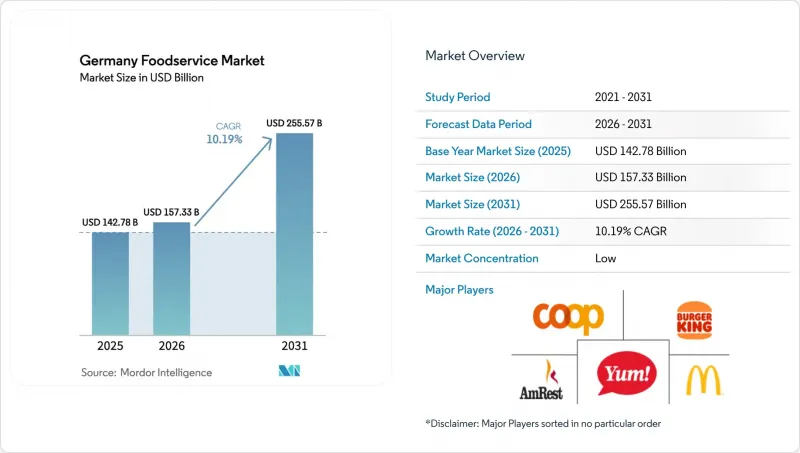
According to Mordor Intelligence, the Germany foodservice market size was valued at USD 142.78 billion in 2025 and estimated to grow from USD 157.33 billion in 2026 to reach USD 255.57 billion by 2031, at a CAGR of 10.19% during the forecast period (2026-2031).
This report is Segmented by Foodservice Type (Cafes and Bars, Cloud Kitchen, Full-Service Restaurants, Quick-Service Restaurants and More), Outlet (Chained Outlets and Independent Outlets), Location (Leisure, Lodging, Retail, Standalone, and More), Service Type (Takeaway, Delivery and More). The Market Forecasts are Provided in Terms of Value (USD).
Germany Foodservice Market Trends and Insights
Expansion of Fast Casual and Quick-Service Formats
Quick-service and fast-casual chains are deploying capital-efficient formats (drive-thrus, kiosks, and modular units) to capture convenience-driven demand without the overhead of full-service real estate. McDonald's Deutschland opened 25 new outlets in 2024 and plans to add 75 restaurants annually from 2025 through 2027, targeting a total of 500 new locations and creating over 10,000 jobs. Yum! Brands operates 240 restaurants in Germany as of 2024, including 180 KFC, 42 Pizza Hut, and 18 Taco Bell, with KFC Deutschland generating millions in operating profit. The shift toward smaller footprints and digital ordering reduces labor intensity while accelerating table turnover, enabling operators to serve higher transaction volumes per square meter. This format proliferation is particularly pronounced in secondary cities where real estate costs remain lower, yet disposable incomes are rising in tandem with remote-work migration.
Growth in Online Food Delivery Services Adoption
The rapid growth in the adoption of online food delivery services is a key driver of the Germany foodservice market, reshaping how consumers access meals and pushing overall industry expansion. As more Germans prefer ordering meals through apps and platforms like Lieferando, Uber Eats, and others, digital channels are capturing a larger share of foodservice consumption, especially in urban areas where convenience and time savings are prioritized. This shift boosts revenue for delivery platforms and encourages traditional restaurants to partner with or integrate delivery services, expanding their reach and customer base. Strong smartphone and internet penetration, along with user-friendly interfaces, real-time tracking, and contactless payments, have further encouraged consumer adoption and repeat usage. As a result, the online food delivery segment is growing at significant CAGR rates, contributing notable value additions to the broader foodservice market and prompting innovation such as cloud kitchens and AI-enabled logistics to meet demand.
Competition from Packaged and Ready-to-Eat Foods
Retail gastronomy and frozen convenience meals are capturing share from traditional foodservice by offering speed, price transparency, and portion control. Out-of-home frozen sales alone generated billions, reflecting the penetration of ready-to-heat options in convenience stores and supermarkets. Meal-kit e-Commerce is forecast to grow in 2025, growing at a double-digit CAGR through 2029, as consumers seek restaurant-quality ingredients with at-home preparation flexibility. Retail gastronomy, prepared meals sold in supermarkets, is projected to rise in 2024. This channel offers lower price points and eliminates tipping, service waits, and parking hassles, appealing to budget-conscious and time-starved consumers. Foodservice operators must differentiate through experiential elements, customization, and loyalty programs that packaged goods cannot replicate.
Other drivers and restraints analyzed in the detailed report include:
- Strong Tourism Driving Restaurant Foot Traffic Demand
- Technological Integration Enhancing Ordering and Service Efficiency
- High Operational Complexity for Compliance Requirements
For complete list of drivers and restraints, kindly check the Table Of Contents.
Segment Analysis
Full-service restaurants held 37.03% of market share in 2025, anchored by Germany's dining culture that prizes table service, ambiance, and multi-course meals. However, cloud kitchens are expanding at 10.71% CAGR through 2031, the fastest rate among all foodservice types, as operators shed front-of-house real estate to focus on delivery-optimized production. Keatz, a Berlin-based B2B2C cloud kitchen, secured EUR 10 million in Series A funding in June 2024 from Vorwerk Ventures and Cavalry Ventures, targeting corporate catering with scalable meal-prep infrastructure. Delivery Hero operates ghost kitchens across Germany under its Kitchen brand, leveraging its aggregator platform to channel orders directly to production hubs.
Quick-service restaurants, encompassing bakeries, burger chains, pizza outlets, and ice cream parlors, benefit from drive-thru and kiosk formats that reduce labor intensity while maintaining high transaction volumes. Cafes and bars, spanning specialist coffee shops, juice bars, and pubs, cater to social and convenience occasions, with Starbucks expanding in travel hubs and Coffee Fellows maintaining a network of urban locations. Full-service restaurants face margin pressure from ingredient inflation and labor shortages, prompting some operators to introduce hybrid models that combine dine-in with takeaway and delivery to maximize asset utilization.
Independent outlets commanded 66.25% of market share in 2025, reflecting Germany's tradition of family-owned restaurants, regional cuisine specialists, and neighborhood cafes. Yet chained outlets are projected to grow at a 10.56% CAGR through 2031, driven by multinational franchises that deploy standardized menus, centralized procurement, and digital ordering systems to achieve economies of scale. Yum! Brands operates 240 restaurants in Germany, including 180 KFC, 42 Pizza Hut, and 18 Taco Bell, with KFC Deutschland generating millions in operating profit in 2024.
AmRest Holdings, which franchises KFC, Pizza Hut, and Starbucks across Central Europe, opened 51 new restaurants in H1 2024 and achieved significant digital sales penetration. Chains leverage brand recognition, loyalty apps, and aggregator partnerships to capture delivery demand, while independents compete on authenticity, localized menus, and personalized service. The labor shortage disproportionately affects independents, which lack the training infrastructure and wage-setting power of chains, accelerating consolidation as smaller operators exit or sell to regional groups. Burger King Deutschland operates over 750 locations, while regional chains such as Hans im Gluck and Nordsee maintain 100-plus outlets each, occupying the middle ground between independents and global franchises.
Complete Report Scope:
- By Foodservice Type
- Cafe and Bars
- By Cuisine
- Bars and Pubs
- Cafe
- Juice/Smoothie/Desserts Bars
- Specialist Coffee and Tea Shops
- By Cuisine
- Cloud Kitchen
- Full-Service Restaurants
- By Cuisine
- Asian
- European
- Latin American
- Middle Eastern
- North American
- Other FSR Cuisines
- By Cuisine
- Quick-Service Restaurants
- By Cuisine
- Bakeries
- Burger
- Ice Cream
- Meat-based Cuisines
- Pizza
- Other QSR Cuisines
- By Cuisine
- Cafe and Bars
- By Outlet
- Chained Outlets
- Independent Outlets
- By Locations
- Leisure
- Lodging
- Retail
- Standalone
- Travel
- By Service Type
- Dine-in
- Takeaway
- Delivery
List of Companies Covered in this Report:
- McDonald's
- Restaurant Brands International Inc.
- Yum! Brands, Inc.
- Starbucks Corporation
- Compass Group PLC
- Sodexo S.A.
- Elior Group S.A.
- Aramark Holding Deutschland GmbH
- LSG Group
- Doctor's Associates Inc.
- Domino's Pizza Deutschland GmbH
- Burger King Deutschland GmbH
- Coop Gruppe Genossenchaft
- Coffee Fellows GmbH
- Sausalito Holding GmbH
- Hans im Gluck Franchise GmbH
- Nordsee GmbH
- Metro AG
- REWE Group
- AmRest Holdings SE
Additional Benefits:
- The market estimate (ME) sheet in Excel format
- 3 months of analyst support
TABLE OF CONTENTS
1 INTRODUCTION
- 1.1 Study Assumptions and Market Definition
- 1.2 Scope of the Study
2 RESEARCH METHODOLOGY
3 EXECUTIVE SUMMARY
4 KEY INDUSTRY TRENDS
- 4.1 Number of Outlets
- 4.2 Average Order Value
- 4.3 Regulatory Framework
5 MARKET LANDSCAPE
- 5.1 Market Overview
- 5.2 Market Drivers
- 5.2.1 Expansion of fast casual and quick-service formats
- 5.2.2 Growth in online food delivery services adoption
- 5.2.3 Strong tourism driving restaurant foot traffic demand
- 5.2.4 Technological integration enhancing ordering and service efficiency
- 5.2.5 Social dining experiences boosting out-of-home eating
- 5.2.6 Greater focus on plant-based and wellness menus
- 5.3 Market Restraints
- 5.3.1 Competition from packaged and ready-to-eat foods
- 5.3.2 High operational complexity for compliance requirements
- 5.3.3 Increasing costs of ingredients and supplies
- 5.3.4 Persistent labor shortages in foodservice operations
- 5.4 Porter's Five Forces
- 5.4.1 Threat of New Entrants
- 5.4.2 Bargaining Power of Buyers
- 5.4.3 Bargaining Power of Suppliers
- 5.4.4 Threat of Substitutes
- 5.4.5 Competitive Rivalry
6 MARKET SIZE AND GROWTH FORECASTS (VALUE)
- 6.1 By Foodservice Type
- 6.1.1 Cafe and Bars
- 6.1.1.1 By Cuisine
- 6.1.1.1.1 Bars and Pubs
- 6.1.1.1.2 Cafe
- 6.1.1.1.3 Juice/Smoothie/Desserts Bars
- 6.1.1.1.4 Specialist Coffee and Tea Shops
- 6.1.1.1 By Cuisine
- 6.1.2 Cloud Kitchen
- 6.1.3 Full-Service Restaurants
- 6.1.3.1 By Cuisine
- 6.1.3.1.1 Asian
- 6.1.3.1.2 European
- 6.1.3.1.3 Latin American
- 6.1.3.1.4 Middle Eastern
- 6.1.3.1.5 North American
- 6.1.3.1.6 Other FSR Cuisines
- 6.1.3.1 By Cuisine
- 6.1.4 Quick-Service Restaurants
- 6.1.4.1 By Cuisine
- 6.1.4.1.1 Bakeries
- 6.1.4.1.2 Burger
- 6.1.4.1.3 Ice Cream
- 6.1.4.1.4 Meat-based Cuisines
- 6.1.4.1.5 Pizza
- 6.1.4.1.6 Other QSR Cuisines
- 6.1.4.1 By Cuisine
- 6.1.1 Cafe and Bars
- 6.2 By Outlet
- 6.2.1 Chained Outlets
- 6.2.2 Independent Outlets
- 6.3 By Locations
- 6.3.1 Leisure
- 6.3.2 Lodging
- 6.3.3 Retail
- 6.3.4 Standalone
- 6.3.5 Travel
- 6.4 By Service Type
- 6.4.1 Dine-in
- 6.4.2 Takeaway
- 6.4.3 Delivery
7 COMPETITIVE LANDSCAPE
- 7.1 Market Concentration
- 7.2 Strategic Moves
- 7.3 Market Share Analysis
- 7.4 Company Profiles (includes Global level Overview, Market level overview, Core Segments, Financials as available, Strategic Information, Market Rank/Share for key companies, Products and Services, and Recent Developments)
- 7.4.1 McDonald's
- 7.4.2 Restaurant Brands International Inc.
- 7.4.3 Yum! Brands, Inc.
- 7.4.4 Starbucks Corporation
- 7.4.5 Compass Group PLC
- 7.4.6 Sodexo S.A.
- 7.4.7 Elior Group S.A.
- 7.4.8 Aramark Holding Deutschland GmbH
- 7.4.9 LSG Group
- 7.4.10 Doctor's Associates Inc.
- 7.4.11 Domino's Pizza Deutschland GmbH
- 7.4.12 Burger King Deutschland GmbH
- 7.4.13 Coop Gruppe Genossenchaft
- 7.4.14 Coffee Fellows GmbH
- 7.4.15 Sausalito Holding GmbH
- 7.4.16 Hans im Gluck Franchise GmbH
- 7.4.17 Nordsee GmbH
- 7.4.18 Metro AG
- 7.4.19 REWE Group
- 7.4.20 AmRest Holdings SE
8 MARKET OPPORTUNITIES AND FUTURE OUTLOOK

