PUBLISHER: Mordor Intelligence | PRODUCT CODE: 2100643

PUBLISHER: Mordor Intelligence | PRODUCT CODE: 2100643
Canine Atopic Dermatitis - Market Share Analysis, Industry Trends & Statistics, Growth Forecasts (2026 - 2031)
According to Mordor Intelligence, the canine atopic dermatitis market size in 2026 is estimated at USD 5.53 billion, growing from 2025 value of USD 5.03 billion with 2031 projections showing USD 8.88 billion, growing at 9.92% CAGR over 2026-2031.
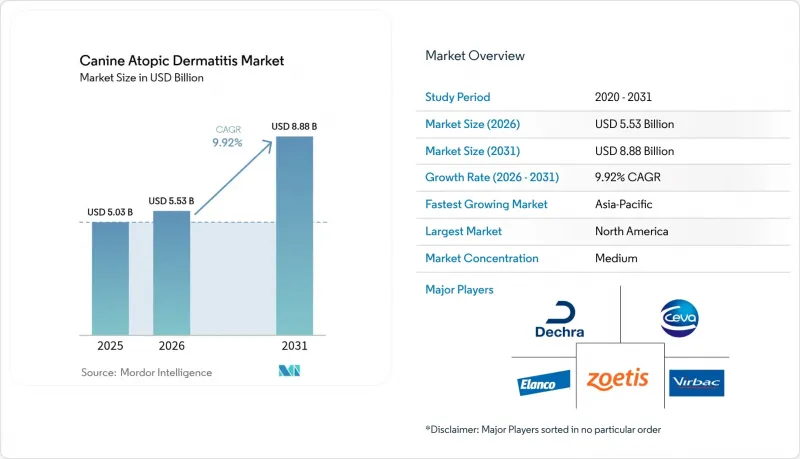
This report is Segmented by Treatment Class (Glucocorticoids, Immunosuppressants, and More), Route of Administration (Topical, Oral, and Injectable), Molecule Type (Small-Molecule Drugs and Biologics), Distribution Channel (Veterinary Hospitals & Referral Centers, and More), and Geography (North America, Europe, Asia-Pacific, and More). The Market Forecasts are Provided in Terms of Value (USD).
Global Canine Atopic Dermatitis Market Trends and Insights
Rising Prevalence of Canine Allergic Skin Disorders
Global incidence is climbing to an estimated 10-15% of the dog population, with Golden Retrievers, Labrador Retrievers, and German Shepherds showing heightened risk. Environmental allergens such as house-dust mites drive persistent pruritus that warrants continuous medical management. Climate change and urbanization elevate allergen load, while diagnostic complexity often delays therapy onset because definitive diagnosis requires meeting at least five of Favrot's criteria. As veterinarians reclassify atopic dermatitis as a lifelong condition demanding chronic care, consistent demand lifts the canine atopic dermatitis market.
Accelerated Regulatory Pathways for Veterinary Biologics
The FDA's Animal and Veterinary Innovation Agenda and the EMA's parallel initiatives compress review times via adaptive trial design, expanded conditional approvals, and AI-enabled toxicology models. Conditional approvals under the Minor Use and Minor Species Act grant seven-year exclusivity, stimulating innovation for niche dermatology indications. These programs lower capital risk and hasten market entry, directly enlarging the canine atopic dermatitis market.
High Cost & Reimbursement Gaps for Novel Biologics
Monthly monoclonal antibody injections exceed USD 100 per dose, pushing annual treatment beyond the budgets of many households. Although insurance coverage is broadening, exclusions for pre-existing conditions and annual benefit caps still leave significant out-of-pocket exposure. Tiered pricing, patient-assistance programs, and on-label generic entry could ease pressure, yet affordability remains a binding constraint in developing economies.
Other drivers and restraints analyzed in the detailed report include:
- Advances in Long-Acting Biologics & Targeted Small Molecules
- Precision dermatology diagnostics enabling earlier intervention
- Shortage Of Veterinary Dermatology Specialists in Emerging Markets
For complete list of drivers and restraints, kindly check the Table Of Contents.
Segment Analysis
Biologics, led by monoclonal antibodies, held 37.66% of revenue in 2025, translating into the single largest tranche of canine atopic dermatitis market share. Stem-cell and exosome therapies are gaining prominence at a 12.12% CAGR and are widely viewed as the next innovation wave, thanks to data showing improved skin-barrier integrity without systemic adverse events. Traditional glucocorticoids retain a niche in acute flare management but face displacement as veterinarians prefer targeted immune modulation. Immunosuppressants such as cyclosporine are under pressure from selective JAK inhibitors offering faster itch relief with fewer metabolic effects.
The competitive pipeline is increasingly diversified. Ongoing trials explore mesenchymal stem-cell-derived exosomes packaged via nano-liposomes to boost epidermal uptake and prolong therapeutic presence. Regenerative approaches that combine cell therapy with targeted biologics aim to halt pruritus while repairing structural damage, positioning "one-two punch" protocols for widespread adoption. These developments reinforce the leadership of biologics and regenerate-based solutions in the canine atopic dermatitis market.
Oral medications represented 51.92% of 2025 revenue, underlining pet owner preference for familiar pill or chewable formats that fit daily routines. Injectables, however, are expanding at 11.05% CAGR as long-acting biologics deliver monthly relief and reduce missed doses. Topical preparations retain utility for focal lesions but seldom suffice for generalized disease.
Long-acting injectables improve compliance by requiring only four to six veterinary visits per year. Industry pipelines also feature transdermal microneedle arrays that could provide depot delivery without needles, a potential breakthrough for needle-averse owners. Meanwhile, flavor-masking technologies and smaller tablet sizes are being introduced to cut pill rejection rates, ensuring oral products sustain their prominent position within the canine atopic dermatitis market.
Complete Report Scope:
- By Treatment Class
- Glucocorticoids
- Immunosuppressants
- Monoclonal Antibodies
- Stem-cell/Exosome Therapies
- Other Testment Classess
- By Route of Administration
- Topical
- Oral
- Injectable
- By Molecule Type
- Small-molecule Drugs
- Biologics
- By Distribution Channel
- Veterinary Hospitals & Referral Centers
- Veterinary Clinics
- Retail & Companion-Animal Pharmacies
- Online Pet Pharmacies
- Geography
- North America
- United States
- Canada
- Mexico
- Europe
- Germany
- United Kingdom
- France
- Italy
- Spain
- Rest of Europe
- Asia-Pacific
- China
- Japan
- India
- Australia
- South Korea
- Rest of Asia-Pacific
- Middle East & Africa
- GCC
- South Africa
- Rest of Middle East & Africa
- South America
- Brazil
- Argentina
- Rest of South America
- North America
Geography Analysis
North America commanded 41.88% of global revenue in 2025, benefiting from USD 38.3 billion of pet healthcare spending and a large pool of dermatology specialists. The region also hosts leading manufacturers and a robust clinical-trial infrastructure, facilitating rapid uptake of first-to-market biologics. Regulatory agility under the FDA's Veterinary Innovation Program further cements North America's dominance in the canine atopic dermatitis market.
Asia-Pacific is advancing fastest at 11.21% CAGR thanks to sustained growth in China's USD 42 billion pet-care sector and expanding middle classes across India, Japan, and Southeast Asia cfaw. Urbanization, rising disposable income, and improving veterinary infrastructure combine to widen product accessibility. Still, specialist shortages and fragmented distribution pose obstacles that manufacturers must address with localized training and robust cold-chain investment.
Europe remains a steady contributor. Centralized EMA approvals enable region-wide launches, while heightened welfare standards spur interest in therapies avoiding long-term corticosteroid use. Workforce deficits and Brexit-related logistics challenges marginally temper growth, yet consistent insurance coverage and high owner awareness secure ongoing demand for premium options in the canine atopic dermatitis market.
- Zoetis
- Elanco
- Virbac
- Ceva
- Dechra Pharmaceuticals
- Toray Industries
- Nextmune
- Vetoquinol
- Phibro Animal Health
- Bioiberica
- Boehringer Ingelheim
- Merck
- Bioceltix
- Animal Dermatology Group
- Kindred Biosciences
- Aratana Therapeutics
- Stonehaven Incubate
- Biogal Galed Labs
- Zomedica
- PetMedix
Additional Benefits:
- The market estimate (ME) sheet in Excel format
- 3 months of analyst support
TABLE OF CONTENTS
1 Introduction
- 1.1 Study Assumptions & Market Definition
- 1.2 Scope of the Study
2 Research Methodology
3 Executive Summary
4 Market Landscape
- 4.1 Market Overview
- 4.2 Market Drivers
- 4.2.1 Rising prevalence of canine allergic skin disorders
- 4.2.2 Growing companion-animal healthcare spend & insurance coverage
- 4.2.3 Accelerated regulatory pathways for veterinary biologics
- 4.2.4 Expansion of pet e-commerce improving Rx access & adherence
- 4.2.5 Advances in long-acting biologics & targeted small molecules
- 4.2.6 Precision dermatology diagnostics enabling earlier intervention
- 4.3 Market Restraints
- 4.3.1 High cost & reimbursement gaps for novel biologics
- 4.3.2 Shortage of veterinary dermatology specialists in emerging markets
- 4.3.3 Biologic cold-chain and fill-finish capacity bottlenecks
- 4.3.4 Rising scrutiny over long-term immunomodulator safety in canines
- 4.4 Regulatory Landscape
- 4.5 Porter's Five Forces Analysis
- 4.5.1 Threat of New Entrants
- 4.5.2 Bargaining Power of Buyers/Consumers
- 4.5.3 Bargaining Power of Suppliers
- 4.5.4 Threat of Substitute Products
- 4.5.5 Intensity of Competitive Rivalry
5 Market Size & Growth Forecasts (Value, USD)
- 5.1 By Treatment Class
- 5.1.1 Glucocorticoids
- 5.1.2 Immunosuppressants
- 5.1.3 Monoclonal Antibodies
- 5.1.4 Stem-cell/Exosome Therapies
- 5.1.5 Other Testment Classess
- 5.2 By Route of Administration
- 5.2.1 Topical
- 5.2.2 Oral
- 5.2.3 Injectable
- 5.3 By Molecule Type
- 5.3.1 Small-molecule Drugs
- 5.3.2 Biologics
- 5.4 By Distribution Channel
- 5.4.1 Veterinary Hospitals & Referral Centers
- 5.4.2 Veterinary Clinics
- 5.4.3 Retail & Companion-Animal Pharmacies
- 5.4.4 Online Pet Pharmacies
- 5.5 Geography
- 5.5.1 North America
- 5.5.1.1 United States
- 5.5.1.2 Canada
- 5.5.1.3 Mexico
- 5.5.2 Europe
- 5.5.2.1 Germany
- 5.5.2.2 United Kingdom
- 5.5.2.3 France
- 5.5.2.4 Italy
- 5.5.2.5 Spain
- 5.5.2.6 Rest of Europe
- 5.5.3 Asia-Pacific
- 5.5.3.1 China
- 5.5.3.2 Japan
- 5.5.3.3 India
- 5.5.3.4 Australia
- 5.5.3.5 South Korea
- 5.5.3.6 Rest of Asia-Pacific
- 5.5.4 Middle East & Africa
- 5.5.4.1 GCC
- 5.5.4.2 South Africa
- 5.5.4.3 Rest of Middle East & Africa
- 5.5.5 South America
- 5.5.5.1 Brazil
- 5.5.5.2 Argentina
- 5.5.5.3 Rest of South America
- 5.5.1 North America
6 Competitive Landscape
- 6.1 Market Concentration
- 6.2 Market Share Analysis
- 6.3 Company Profiles (includes Global-level Overview, Market-level Overview, Core Segments, Financials, Strategic Information, Market Rank/Share, Products & Services, Recent Developments)
- 6.3.1 Zoetis Inc.
- 6.3.2 Elanco Animal Health
- 6.3.3 Virbac
- 6.3.4 Ceva Sant Animale
- 6.3.5 Dechra Pharmaceuticals
- 6.3.6 Toray Industries Inc.
- 6.3.7 Nextmune (Vimian)
- 6.3.8 Vetoquinol
- 6.3.9 Phibro Animal Health Corp.
- 6.3.10 Bioiberica SAU
- 6.3.11 Boehringer Ingelheim
- 6.3.12 Merck Animal Health
- 6.3.13 Bioceltix
- 6.3.14 Animal Dermatology Group
- 6.3.15 Kindred Biosciences
- 6.3.16 Aratana Therapeutics
- 6.3.17 Stonehaven Incubate
- 6.3.18 Biogal Galed Labs
- 6.3.19 Zomedica
- 6.3.20 PetMedix
7 Market Opportunities & Future Outlook
- 7.1 White-space & Unmet-Need Assessment

