PUBLISHER: Mordor Intelligence | PRODUCT CODE: 2100644

PUBLISHER: Mordor Intelligence | PRODUCT CODE: 2100644
Europe Carpets and Rugs - Market Share Analysis, Industry Trends & Statistics, Growth Forecasts (2026 - 2031)
According to Mordor Intelligence, the Europe carpets and Rugs Market size is projected to expand from USD 10.49 billion in 2025 and USD 10.75 billion in 2026 to USD 12.43 billion by 2031, registering a CAGR of 2.94% between 2026 and 2031.
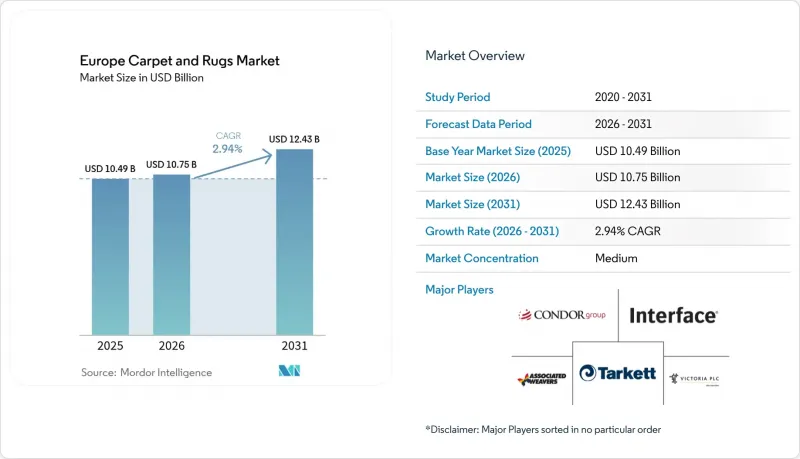
This report is Segmented by Product Type (Tufted, Woven, Needle-Punched, Knotted, Others), Material (Nylon, Polyester, Polypropylene, Wool, Natural Fibres, Recycled Fibres), End User (Residential, Commercial), Distribution Channel (B2B Direct, B2C Retail), and Geography (United Kingdom, Germany, France, Spain, Italy, BENELUX, NORDICS, Rest of Europe). Market Forecasts are Provided in Terms of Value (USD).
Europe Carpets and Rugs Market Trends and Insights
Renovation Wave and EPBD-driven building upgrades accelerate flooring replacement cycles
The European Commission's Renovation Wave targets an upgrade of 35 million buildings by 2030, which supports a steady cadence of flooring replacement during energy retrofits and deep-renovation projects that bundle insulation, acoustics, and interior surfaces into single scopes. Implementation of the recast Energy Performance of Buildings Directive in Member States brings forward national plans and compliance schedules that catalyze procurement as deadlines approach, lifting orders for modular carpet tiles in residential and public buildings where acoustic performance is required. Rail-station modernization programs in continental Europe favor modular carpet tiles for high-traffic concourses, with vendors highlighting ease of phased installation and targeted replacement that aligns with busy facility schedules. The shift toward upgrading the least efficient buildings first increases the likelihood that older wall-to-wall broadlooms are replaced with higher-performing modular and tufted options that contribute to thermal and acoustic targets in rebuilt envelopes. In Germany, access to public-sector renovations requires adherence to external product certifications and VOC testing regimes, which pushes manufacturers to sustain rigorous audits and documentation, strengthening entry barriers in tender-led projects.
Hospitality pipeline and brand conversions spur room and corridor re-carpeting
Operators in Mediterranean resort destinations continue to refresh soft finishes as part of brand upgrades, which support custom-woven corridors and modular guestroom tiles that meet acoustic and durability requirements under high occupancy. Conversion-led projects tend to compress timelines compared with new-build development, which concentrates purchasing into shorter windows and elevates order volumes in single quarters as hotels push to reopen on-season. Public and private tenders increasingly weigh eco-criteria, including low emissions and recycled content, suppliers position Ecolabel-qualified tiles and disclose cradle-to-gate carbon footprints to secure inclusion on bidder lists. Premium and upper-upscale properties emphasize cohesive brand identity through colorways and patterning, which maintains demand for woven formats in selected zones while modular tiles support room turnover efficiency and targeted maintenance. This pattern sustains specification opportunities across Spain, Italy, and Greece as tourism infrastructure is upgraded for throughput and design refresh cycles tied to brand standards.
Resilient or LVT substitution in commercial spaces
The shift to hard-surface alternatives in reception, corridor, and clinical areas constrains broadloom volumes as facility managers emphasize cleanability and minimalist design in high-traffic zones. Healthy-building narratives also shape demand, so product categories perceived as easy to sanitize can displace carpet in sensitive applications, while carpet remains relevant in administrative and sound-critical areas. Project specifications often mix surfaces, which reduces total square meters allocated to carpet on a per-project basis, even as modular tiles retain a role in acoustic spaces. In healthcare, infection-control guidance has steered clinical environments away from textile flooring, while administrative zones continue to utilize modular tiles for comfort, sound, and aesthetics. This mixed-material trend is most apparent in Northern European commercial interiors, where open-plan layouts utilize hard surfaces for circulation and textiles for collaboration spaces.
Other drivers and restraints analyzed in the detailed report include:
- France's EPR and the European Union's EPR expansion catalyze the recycled and bio-based fibers
- Office fit-out and refit programs boost modular carpet tiles
- Petrochemical feedstock volatility inflates carpet costs
For complete list of drivers and restraints, kindly check the Table Of Contents.
Segment Analysis
Tufted carpets and rugs accounted for 67.68% in 2025, giving the category a clear lead in the Europe Carpets and Rugs Market due to high-speed production and broad design flexibility. Woven formats are smaller in share yet post the fastest growth at a 3.85% CAGR over 2026-2031, supported by premium hospitality specifications that prioritize pattern clarity and durability in corridors and ballrooms. Modular tile penetration continues to rise within tufted volumes as specifiers standardize on 50X50 cm formats for targeted acoustic zones and simplified replacement. Product development focuses on low-emission chemistry and allergen-sensitive features, responding to stricter building and wellness requirements in education and office interiors. The Europe Carpets and Rugs Market benefits from these format dynamics because they align with renovation-led projects that value short lead times and minimized disruption.
Modularization within tufted products also changes how portfolios are merchandised, with suppliers curating visual families that coordinate across open offices, meeting rooms, and circulation paths. Suppliers' woven offerings hold their ground in upper-upscale properties and high-end residential settings where brand identity needs and luxury positioning remain decisive. Needle-punched solutions fill a performance niche in transportation, public access, and certain industrial settings where toughness and maintenance ease drive specification. Across formats, compliance with low-VOC and PFAS-free requirements has become table stakes in tender-led segments, reinforcing the need for verified chemistry and traceable inputs. These product shifts collectively support stable mix and margin contributions in the Europe Carpets and Rugs Market.
Polypropylene commanded 35.45% share in 2025 on moisture resistance and ease of maintenance in healthcare and hospitality zones, anchoring the material's position across mid-market installations in the Europe Carpets and Rugs Market. Recycled and bio-based fibers are forecast to grow at an 8.41% CAGR through 2031, propelled by EPR fee structures and eco-label incentives that tilt procurement toward circular content. Backing innovations integrate recycled constituents and bio-based tackifiers that reduce embodied carbon while maintaining performance targets for comfort and durability. Regenerated nylon produced from post-consumer streams is now standard in multiple commercial tile collections, aligning with green-building criteria that value documented recycled shares. These developments build resilience into supply chains and position compliant products for preferred access to EPR-governed tenders in France and other early movers.
Nylons remain the performance benchmark in high-traffic settings where resilience and stain resistance anchor lifecycle value propositions, while polyester variants that incorporate recycled bottle content offer compelling options in residential and light-commercial applications. Natural fibers such as wool keep a stable niche in luxury residential and boutique hospitality based on inherent flame resistance and sensory comfort. Suppliers navigating recycled PET supplies compete for consistent flake streams and emphasize material contracts to manage availability risk, while diversifying recycled inputs in backup to sustain circularity goals. As material portfolios shift, European tender frameworks that favor recycled content and PFAS-free formulations continue to steer product design in the Europe Carpets and Rugs Market.
Complete Report Scope:
- By Product Type
- Tufted
- Woven
- Needle-Punched
- Knotted / Hand-Knotted
- Others (Flat-weave, Hooked, Braided)
- By Material
- Nylon
- Polyester (PET & PTT)
- Polypropylene
- Wool
- Other Natural Fibres (Jute, Sisal, Cotton, Silk)
- Recycled & Bio-based Fibres
- By End User
- Residential
- Commercial
- Hospitality & Leisure
- Corporate Offices
- Retail
- Healthcare & Educational Institutions
- Other Commercial Facilities
- By Distribution Channel
- B2B/Direct from the Manufacturers
- B2C/Retail
- Home-Improvement & DIY Stores
- Specialty Flooring Stores (includes exclusive brand outlets)
- Furniture & Furnishing Stores
- Online
- Other Distribution Channels
- By Geography
- United Kingdom
- Germany
- France
- Spain
- Italy
- BENELUX (Belgium, Netherlands, Luxembourg)
- NORDICS (Denmark, Finland, Iceland, Norway, Sweden)
- Rest of Europe
List of Companies Covered in this Report:
- Tarkett (incl. Desso)
- Victoria PLC
- Condor Group
- Interface
- Associated Weavers (Belgotex)
- Forbo Flooring (Flotex textile)
- Ege Carpets
- Vorwerk Flooring
- Object Carpet
- Balsan
- Lano
- Brintons
- Ulster Carpets
- Cormar Carpets
- Abingdon Flooring
- Milliken (EMEA)
- Fletco Carpets
- Louis De Poortere
- Ragolle Rugs
- Rols Carpets
Additional Benefits:
- The market estimate (ME) sheet in Excel format
- 3 months of analyst support
TABLE OF CONTENTS
1 Introduction
- 1.1 Study Assumptions & Market Definition
- 1.2 Scope of the Study
2 Research Methodology
3 Executive Summary
4 Market Landscape
- 4.1 Market Overview
- 4.2 Market Drivers
- 4.2.1 Renovation Wave And EPBD-Driven Building Upgrades Accelerate Flooring Replacement Cycles
- 4.2.2 Hospitality Pipeline And Brand Conversions Spur Room And Corridor Re-Carpeting
- 4.2.3 France's EPR And The European Union's EPR Expansion Catalyze The Recycled And Bio-Based Fibers
- 4.2.4 Office Fit-Out And Refit Programs Boost Modular Carpet Tiles
- 4.2.5 Rising Demand For Certified Low-VOC And Recycled-Content Textile Flooring
- 4.2.6 PFAS Phase-Outs In Textiles Pivot Demand To PFAS-Free Stain Protection And Wool Or PET
- 4.3 Market Restraints
- 4.3.1 Resilient Or LVT Substitution In Commercial Spaces
- 4.3.2 Petrochemical Feedstock Volatility Inflates Carpet Costs
- 4.3.3 Compliance Costs From Chemical Restrictions And Ecolabel Criteria
- 4.3.4 Installer Shortages And Reinstatement Obligations Raise Costs And Timelines
- 4.4 Industry Value Chain Analysis
- 4.5 Porter's Five Forces
- 4.5.1 Threat of New Entrants
- 4.5.2 Bargaining Power of Suppliers
- 4.5.3 Bargaining Power of Buyers
- 4.5.4 Threat of Substitutes
- 4.5.5 Competitive Rivalry
- 4.6 Insights into the Latest Trends and Innovations in the Market
- 4.7 Insights on Recent Developments (New Product Launches, Strategic Initiatives, Investments, Partnerships, JVs, Expansion, M&As, etc.) in the Market
5 Market Size & Growth Forecasts (Value)
- 5.1 By Product Type
- 5.1.1 Tufted
- 5.1.2 Woven
- 5.1.3 Needle-Punched
- 5.1.4 Knotted / Hand-Knotted
- 5.1.5 Others (Flat-weave, Hooked, Braided)
- 5.2 By Material
- 5.2.1 Nylon
- 5.2.2 Polyester (PET & PTT)
- 5.2.3 Polypropylene
- 5.2.4 Wool
- 5.2.5 Other Natural Fibres (Jute, Sisal, Cotton, Silk)
- 5.2.6 Recycled & Bio-based Fibres
- 5.3 By End User
- 5.3.1 Residential
- 5.3.2 Commercial
- 5.3.2.1 Hospitality & Leisure
- 5.3.2.2 Corporate Offices
- 5.3.2.3 Retail
- 5.3.2.4 Healthcare & Educational Institutions
- 5.3.2.5 Other Commercial Facilities
- 5.4 By Distribution Channel
- 5.4.1 B2B/Direct from the Manufacturers
- 5.4.2 B2C/Retail
- 5.4.2.1 Home-Improvement & DIY Stores
- 5.4.2.2 Specialty Flooring Stores (includes exclusive brand outlets)
- 5.4.2.3 Furniture & Furnishing Stores
- 5.4.2.4 Online
- 5.4.2.5 Other Distribution Channels
- 5.5 By Geography
- 5.5.1 United Kingdom
- 5.5.2 Germany
- 5.5.3 France
- 5.5.4 Spain
- 5.5.5 Italy
- 5.5.6 BENELUX (Belgium, Netherlands, Luxembourg)
- 5.5.7 NORDICS (Denmark, Finland, Iceland, Norway, Sweden)
- 5.5.8 Rest of Europe
6 Competitive Landscape
- 6.1 Market Concentration
- 6.2 Strategic Moves
- 6.3 Market Share Analysis
- 6.4 Company Profiles (includes Global level Overview, Market level overview, Core Segments, Financials as available, Strategic Information, Market Rank/Share for key companies, Products & Services, and Recent Developments)
- 6.4.1 Tarkett (incl. Desso)
- 6.4.2 Victoria PLC
- 6.4.3 Condor Group
- 6.4.4 Interface
- 6.4.5 Associated Weavers (Belgotex)
- 6.4.6 Forbo Flooring (Flotex textile)
- 6.4.7 Ege Carpets
- 6.4.8 Vorwerk Flooring
- 6.4.9 Object Carpet
- 6.4.10 Balsan
- 6.4.11 Lano
- 6.4.12 Brintons
- 6.4.13 Ulster Carpets
- 6.4.14 Cormar Carpets
- 6.4.15 Abingdon Flooring
- 6.4.16 Milliken (EMEA)
- 6.4.17 Fletco Carpets
- 6.4.18 Louis De Poortere
- 6.4.19 Ragolle Rugs
- 6.4.20 Rols Carpets
7 Market Opportunities & Future Outlook
- 7.1 PFAS-Free Stain Protection Leadership (Materials, Testing, Claims)
- 7.2 Closed-Loop Take-Back Networks For Tiles and Event Carpets

