
PUBLISHER: Mordor Intelligence | PRODUCT CODE: 2100645

PUBLISHER: Mordor Intelligence | PRODUCT CODE: 2100645
Satellite Bus - Market Share Analysis, Industry Trends & Statistics, Growth Forecasts (2026 - 2031)
According to Mordor Intelligence, the satellite bus market size was valued at USD 3.21 billion in 2025 and estimated to grow from USD 3.79 billion in 2026 to reach USD 7.31 billion by 2031, at a CAGR of 14.28% during the forecast period (2026-2031).
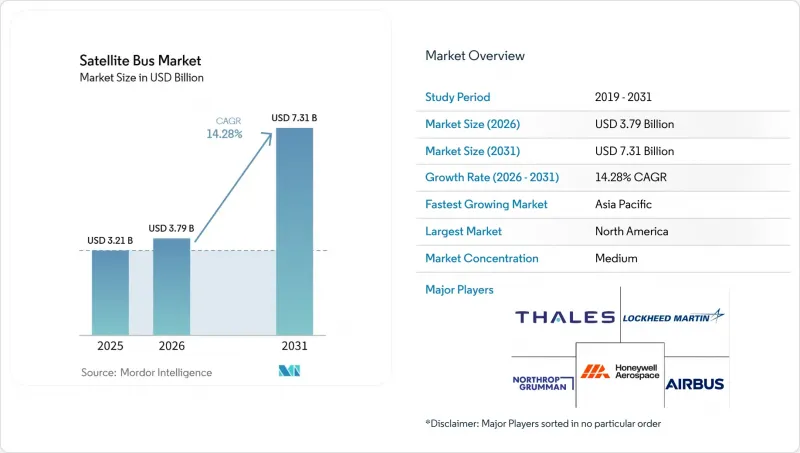
This report is Segmented by Application (Communication, Earth Observation, Navigation, Space Observation, and Others), Satellite Mass (Less Than 10 Kg, 10 To Less Than 100 Kg, and More), Orbit Class (Low-Earth Orbit, and More), End User (Commercial, Government and Military, and Others), and Geography (North America, Europe, Asia-Pacific, and More). The Market Forecasts are Provided in Terms of Value (USD).
Global Satellite Bus Market Trends and Insights
Explosive Demand for Broadband Mega-Constellations Rewrites Bus Economics
Volume has become the main competitive variable in the satellite bus market as large constellation operators continue to favor repeatable designs over mission-specific platforms. SpaceX has maintained a high deployment cadence and produced more than 7,000 Starlink buses since 2019, demonstrating the rapid shift in the satellite bus market toward industrial-scale output rather than low-volume engineering cycles. That production logic is influencing buyer behavior, because operators now expect shorter lead times and more predictable unit economics from the satellite bus market. Standardized architectures also support recurring replenishment cycles, which makes the demand base less dependent on one-time launches. The same pattern is evident in secure communications planning, where customers are increasingly willing to adopt common bus architectures if they improve delivery speed and manufacturing scalability. This keeps the satellite bus market focused on throughput, supplier flexibility, and reusable design blocks.
Government Resilience Programs and SDA Architectures Drive Specialized Volume
Government resilience programs are adding a second large demand stream to the satellite bus market, especially for constellations that need secure communications, tactical data relay, and fast replenishment cycles. The core procurement logic favors repeated bus designs that can host interchangeable payloads and move from contract award to deployment on tighter schedules. That approach reduces the value of one-off engineering and increases the value of certified production lines in the satellite bus market. It also creates a split in demand between very high-security buses for strategic missions and commercial-standard buses adapted for proliferated defense networks. Suppliers that can serve both tiers are better placed to win follow-on work as procurement models continue to evolve. This keeps the satellite bus market closely tied to defense modernization plans, even when individual programs are paused or reviewed.
Persistent Semiconductor and Reaction-Wheel Shortages Constrain Production Ramp
The satellite bus market still faces a real bottleneck in critical subsystems, especially in radiation-hardened electronics and motion-control components. Factory expansion alone does not solve this issue, because final output still depends on a narrow supplier base for flight-qualified parts. That makes the satellite bus market vulnerable when replenishment and new constellation orders arrive simultaneously. The pressure is stronger for companies that do not control subsystem production in-house and must compete for long-lead inventory. Manufacturers with internal capability in star trackers, wheels, power distribution, or avionics, therefore, hold an operational advantage. This supply imbalance slows capacity ramp-up across the satellite bus market even when customer demand remains strong.
Other drivers and restraints analyzed in the detailed report include:
- Price Inflection from Mass-Produced Modular Buses Resets Buyer Expectations
- Dual-Use Intelligence-Surveillance Requirements Expand Total Addressable Market
- Orbital-Debris Mitigation Costs Add Structural Expense to Small-Sat Bus Programs
For complete list of drivers and restraints, kindly check the Table Of Contents.
Segment Analysis
Communication satellites accounted for 75.60% of revenue in 2025, which shows that the satellite bus market still depends most heavily on broadband and connectivity deployments. This lead reflects the volume effect created by constellation programs that need repeated bus purchases rather than isolated mission builds. In the market, communication missions also benefit from design reuse, as operators often maintain common platform families across several payload refresh cycles. That lowers integration risk and helps sustain production cadence across multiple launch windows. SpaceX's multi-year Starlink production record illustrates that demand for communications continues to drive the pace of the satellite bus market.
Navigation is forecast to grow at a 16.01% CAGR through 2031, making it the fastest-growing application in the satellite bus market. The growth case extends beyond GPS augmentation and increasingly includes backup positioning, timing resilience, and defense-related navigation architectures. The US NTIA inventory in May 2025 confirmed a contract for 258 Pulsar LEO satellites intended to provide complementary and backup PNT services in the L- and C-bands. That supports demand for buses with stronger interference protection, secure operations, and more reliable power and pointing performance. It also means the satellite bus market is becoming more exposed to navigation use cases where commercial and national security needs overlap.
Platforms above 1,000 kg accounted for 53.55% of revenue in 2025, indicating that the satellite bus market continues to derive most of its value from large spacecraft, even as unit volumes shift toward smaller buses. These heavier platforms remain important for high-throughput communications, strategic missions, and payloads that need high power, long life, or large apertures. In value terms, they anchor the satellite bus market because one program can generate far more revenue than a larger batch of lighter spacecraft. This explains why major contractors remain active in the large-bus competition even as the broader market focus shifts toward proliferated constellations. The segment, therefore, remains critical to revenue stability for suppliers with deep integration and mission-assurance capability.
The 100 to less than 500 kg segment is projected to expand at a 16.20% CAGR through 2031, making it the most dynamic mass class in the satellite bus market. Apex highlighted the Nova platform in the 200 to 500 kg range when it announced its April 2025 Series C funding round, showing how suppliers are targeting this weight band with productized offerings. In February 2026, Kepler Communications selected Kongsberg NanoAvionics as a preferred European bus provider for hosted payload missions weighing up to 500 kg, confirming active demand in this class. This weight range suits missions that need more capability than nanosatellites but lower cost and faster deployment than large buses. It is also the part of the satellite bus market where modular power systems, optical links, and flexible payload accommodation can scale most efficiently. As a result, the 100 to less than 500 kg class is becoming a focal point for the satellite bus industry and for competition between new-space specialists and established suppliers.
Complete Report Scope:
- By Application
- Communication
- Earth Observation
- Navigation
- Space Observation
- Others
- By Satellite Mass
- Less than 10 kg
- 10 to Less than 100 kg
- 100 to Less than 500 kg
- 500 to Less than 1,000 kg
- Greater than 1,000 kg
- By Orbit Class
- Low Earth Orbit (LEO)
- Medium Earth Orbit (MEO)
- Geosynchronous Earth Orbit (GEO)
- By End User
- Commercial
- Government and Military
- Others
- By Geography
- North America
- United States
- Canada
- Mexico
- Europe
- United Kingdom
- France
- Germany
- Russia
- Rest of Europe
- Asia-Pacific
- China
- India
- Japan
- South Korea
- Australia
- Rest of Asia-Pacific
- South America
- Brazil
- Rest of South America
- Middle East and Africa
- Middle East
- Saudi Arabia
- United Arab Emirates
- Rest of Middle East
- Africa
- South Africa
- Rest of Africa
- Middle East
- North America
Geography Analysis
North America retained 68.40% of revenue in 2025 and held the largest regional share of the satellite bus market. The region remains the center of the satellite bus market because it combines deep government demand with the world's largest commercial constellation base. SpaceX's sustained Starlink build-and-deployment program continues to shape production expectations and supply chain behavior across the regional satellite bus market. In July 2026, Space Systems Command awarded Boeing a USD 2.80 billion strategic communications contract, which shows that high-value government demand remains active in North America. Apex also raised more than USD 200 million in June 2026 to support the scale-up of proliferated constellations, confirming that capital continues to back domestic manufacturing expansion in the satellite bus market.
Asia-Pacific is projected to record the fastest CAGR of 17.05% through 2031, and that keeps the satellite bus market pointed toward a broader manufacturing base over the forecast period. Growth in the region is being supported by state-backed constellation plans, domestic supply chain development, and more active private-sector participation. Japan's 2025 space strategy supports low-cost, mass-producible solar cells and arrays, giving the regional satellite bus market a clearer hardware foundation for future bus output. In April 2025, Aerospacelab announced that JAXA had selected it, through Mitsui Bussan Aerospace, to supply a satellite bus platform for a maritime domain awareness demonstration mission in Japan. These moves show that the satellite bus market in Asia-Pacific is developing through both institutional backing and targeted supplier partnerships.
Europe held the third-largest regional share, and the satellite bus market there is defined by sovereign capability building and institutional program continuity. The region still relies heavily on established primes, but the supplier base is widening to include smaller manufacturers that win targeted science, defense, and hosted-payload work. In October 2025, ESA selected Kongsberg NanoAvionics to build a 12-16U CubeSat platform for the IOD/IOV in-orbit demonstration program, which shows continued institutional support for smaller European bus providers. In February 2026, Kepler selected Kongsberg NanoAvionics as a preferred European satellite bus provider for hosted payload missions up to 500 kg, reinforcing Europe's position in configurable mid-weight platforms. South America, the Middle East, and Africa remain smaller opportunity pools in the satellite bus market, but selective sovereign communications and Earth observation programs still create openings for aligned suppliers.
- Airbus SE
- Lockheed Martin Corporation
- Northrop Grumman Corporation
- Thales Alenia Space (Thales Group)
- The Boeing Company
- Maxar Technologies Inc.
- Honeywell Aerospace Inc.
- Sierra Nevada Corporation
- OHB SE
- NEC Corporation
- NanoAvionics (Kongsberg Gruppen ASA)
- Mitsubishi Electric Corporation
- York Space Systems
- Blue Canyon Technologies (RTX Corporation)
- Apex Technology, Inc.
- Lux Aeterna Space Inc.
- Sitael S.p.A.
- Indian Space Research Organisation
- China Aerospace Science and Technology Corporation
Additional Benefits:
- The market estimate (ME) sheet in Excel format
- 3 months of analyst support
TABLE OF CONTENTS
1 INTRODUCTION
- 1.1 Study Assumptions and Market Definition
- 1.2 Scope of the Study
2 RESEARCH METHODOLOGY
3 EXECUTIVE SUMMARY AND KEY FINDINGS
4 MARKET LANDSCAPE
- 4.1 Market Overview
- 4.2 Market Drivers
- 4.2.1 Explosive demand for broadband mega-constellations
- 4.2.2 Government resilience programs and SDA architectures
- 4.2.3 Price inflection from mass-produced modular buses
- 4.2.4 Dual-use intelligence-surveillance requirements
- 4.2.5 Venture-backed "bus-as-a-service" business models
- 4.2.6 On-orbit servicing compatibility mandates
- 4.3 Market Restraints
- 4.3.1 Persistent semiconductor/reaction-wheel shortages
- 4.3.2 Orbital-debris mitigation costs
- 4.3.3 ITAR/export-control compliance burden
- 4.3.4 Insurance premium spikes for small-sat buses
- 4.4 Value Chain Analysis
- 4.5 Regulatory Landscape
- 4.6 Technological Outlook
- 4.7 Porter's Five Forces Analysis
- 4.7.1 Threat of New Entrants
- 4.7.2 Bargaining Power of Suppliers
- 4.7.3 Bargaining Power of Buyers
- 4.7.4 Threat of Substitutes
- 4.7.5 Intensity of Competitive Rivalry
5 MARKET SIZE AND GROWTH FORECASTS (VALUE)
- 5.1 By Application
- 5.1.1 Communication
- 5.1.2 Earth Observation
- 5.1.3 Navigation
- 5.1.4 Space Observation
- 5.1.5 Others
- 5.2 By Satellite Mass
- 5.2.1 Less than 10 kg
- 5.2.2 10 to Less than 100 kg
- 5.2.3 100 to Less than 500 kg
- 5.2.4 500 to Less than 1,000 kg
- 5.2.5 Greater than 1,000 kg
- 5.3 By Orbit Class
- 5.3.1 Low Earth Orbit (LEO)
- 5.3.2 Medium Earth Orbit (MEO)
- 5.3.3 Geosynchronous Earth Orbit (GEO)
- 5.4 By End User
- 5.4.1 Commercial
- 5.4.2 Government and Military
- 5.4.3 Others
- 5.5 By Geography
- 5.5.1 North America
- 5.5.1.1 United States
- 5.5.1.2 Canada
- 5.5.1.3 Mexico
- 5.5.2 Europe
- 5.5.2.1 United Kingdom
- 5.5.2.2 France
- 5.5.2.3 Germany
- 5.5.2.4 Russia
- 5.5.2.5 Rest of Europe
- 5.5.3 Asia-Pacific
- 5.5.3.1 China
- 5.5.3.2 India
- 5.5.3.3 Japan
- 5.5.3.4 South Korea
- 5.5.3.5 Australia
- 5.5.3.6 Rest of Asia-Pacific
- 5.5.4 South America
- 5.5.4.1 Brazil
- 5.5.4.2 Rest of South America
- 5.5.5 Middle East and Africa
- 5.5.5.1 Middle East
- 5.5.5.1.1 Saudi Arabia
- 5.5.5.1.2 United Arab Emirates
- 5.5.5.1.3 Rest of Middle East
- 5.5.5.2 Africa
- 5.5.5.2.1 South Africa
- 5.5.5.2.2 Rest of Africa
- 5.5.5.1 Middle East
- 5.5.1 North America
6 COMPETITIVE LANDSCAPE
- 6.1 Market Concentration
- 6.2 Strategic Moves
- 6.3 Market Share Analysis
- 6.4 Company Profiles (includes Global Level Overview, Market Level Overview, Core Segments, Financials as available, Strategic Information, Market Rank/Share for key companies, Products and Services, and Recent Developments)
- 6.4.1 Airbus SE
- 6.4.2 Lockheed Martin Corporation
- 6.4.3 Northrop Grumman Corporation
- 6.4.4 Thales Alenia Space (Thales Group)
- 6.4.5 The Boeing Company
- 6.4.6 Maxar Technologies Inc.
- 6.4.7 Honeywell Aerospace Inc.
- 6.4.8 Sierra Nevada Corporation
- 6.4.9 OHB SE
- 6.4.10 NEC Corporation
- 6.4.11 NanoAvionics (Kongsberg Gruppen ASA)
- 6.4.12 Mitsubishi Electric Corporation
- 6.4.13 York Space Systems
- 6.4.14 Blue Canyon Technologies (RTX Corporation)
- 6.4.15 Apex Technology, Inc.
- 6.4.16 Lux Aeterna Space Inc.
- 6.4.17 Sitael S.p.A.
- 6.4.18 Indian Space Research Organisation
- 6.4.19 China Aerospace Science and Technology Corporation
7 MARKET OPPORTUNITIES AND FUTURE OUTLOOK
- 7.1 White-space and Unmet-need Assessment

