PUBLISHER: Mordor Intelligence | PRODUCT CODE: 2100651

PUBLISHER: Mordor Intelligence | PRODUCT CODE: 2100651
Digital Banking Platform - Market Share Analysis, Industry Trends & Statistics, Growth Forecasts (2026 - 2031)
According to Mordor Intelligence, the digital banking platform market size was valued at USD 13.79 billion in 2025 and estimated to grow from USD 15.79 billion in 2026 to reach USD 31.08 billion by 2031, at a CAGR of 14.52% during the forecast period (2026-2031).
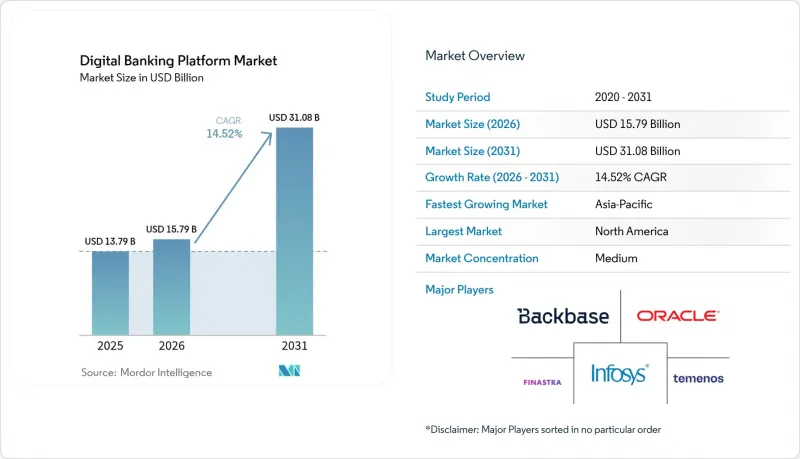
This report is Segmented by Deployment (Cloud and On-Premises), Banking Type (Retail Banking and Corporate/SME Banking), Component (Platform and Services), Service Model (SaaS Subscription, Licensed, and Banking-As-A-Service), Access Mode (Mobile Banking and Online/Web Banking). And Geography. The Market Forecasts are Provided in Terms of Value (USD).
Global Digital Banking Platform Market Trends and Insights
Cloud-First Core Banking Migrations Among Tier-1 Banks
Tier-1 institutions fast-track multi-cloud deployments to lower fixed infrastructure costs and compress product launch cycles. JPMorgan Chase has finished a multi-cloud roll-out, while Santander's ten-market overhaul underlines the commitment required to sunset legacy cores. Banks report 50% shorter time-to-market for new digital products after migration, reinforcing cloud as a strategic lever. Real-time analytics, embedded fraud-detection engines, and AI-based customer insights ride on the same architecture, boosting cross-sell and compliance agility. Banco Itau intends to complete a 100% cloud move by 2028, a signal to peers that measurable efficiency gains outweigh transition risk.
Smartphone-Centric Lifestyle Banking Demand in Emerging Markets
Mobile-first adoption short-circuits branch expansion economics across Asia-Pacific and Latin America. Digital wallets already underpin more than 70% of regional e-commerce spend, compelling banks to recast their front ends as lifestyle super-apps. Cost economics drive momentum: a mobile transaction costs USD 0.17 against USD 4.25 at the counter, freeing margin for reinvestment in UX refresh and embedded merchant services. Nubank demonstrates scale advantage, growing its customer base from 33.3 million in 2020 to 93.9 million in 2023 while sustaining a 27% pre-tax ROE.
Rising Cost of Real-Time Fraud-Analytics and AML Compliance
Global AML spend has reached USD 213.9 billion. Despite investment, launderers funnel an estimated USD 2 trillion through synthetic IDs and crypto mixers each year. Banks fielded USD 7 billion in fines during 2023 alone. Smart-AML suites promise 60% cost savings through false-positive reduction, yet rollout demands capital and specialist skill, pressuring small-to-mid-tier lenders.
Other drivers and restraints analyzed in the detailed report include:
- Regulatory Push for Open-Banking and API-Standard Compliance
- Generative-AI Powered Hyper-Personalized UX Roll-Outs
- Vendor Lock-In Risks from Hyperscaler Managed Services
For complete list of drivers and restraints, kindly check the Table Of Contents.
Segment Analysis
Cloud captured 60.74% of the digital banking platform market share in 2025 and is expanding at a 15.54% CAGR as institutions convert capex burdens into flexible opex. Banks cite 50% lower infrastructure upkeep and stronger disaster-recovery postures once workloads move to scalable regions. On-premises cores persist in jurisdictions enforcing strict data-localization, but even these deployments now mimic the cloud's elasticity through container orchestration. EQ Bank's Temenos-based migration underscores how regional lenders leverage cloud to close capability gaps with money-center peers.
Cloud adoption reshapes vendor economics: subscription licensing aligns revenue with usage peaks, letting banks prototype new services without procurement delays. Real-time analytics, embedded fraud scoring, and AI-driven credit modeling activate natively, reducing integration complexity. In parallel, platform vendors tune data-center designs for energy efficiency, addressing European Green-IT directives and lowering total cost of ownership. As more tier-1 banks publish carbon-net-zero timelines, cloud footprints that demonstrate verifiable emission savings gain a procurement advantage.
Retail banking represented 63.12% of 2025 revenue, yet corporate/SME banking now tracks a 16.19% CAGR, making it the fastest sub-segment within the digital banking platform market. Businesses seek real-time liquidity dashboards, API-driven payments, and embedded trade-finance modules that dovetail with ERP workflows. Average implementation deal sizes outstrip retail contracts, supporting higher vendor margins and longer lock-in periods.
Cross-border suppliers in Asia-Pacific elevate demand for instant settlement and dynamic FX hedging within single workspaces. Embedded finance propositions add further lift: fintech partnerships allow manufacturers to embed invoice-discounting or supplier-credit tools directly inside procurement portals, boosting platform stickiness.
Complete Report Scope:
- By Deployment
- Cloud
- On-Premises
- By Banking Type
- Retail Banking
- Corporate/SME Banking
- By Component
- Platform (Software)
- Services (Implementation and Support)
- By Service Model
- SaaS Subscription
- Licensed (Perpetual)
- Banking-as-a-Service (BaaS)
- By Access Mode
- Mobile Banking
- Online/Web Banking
- By Geography
- North America
- United States
- Canada
- Mexico
- South America
- Brazil
- Argentina
- Chile
- Rest of South America
- Europe
- Germany
- United Kingdom
- France
- Italy
- Spain
- Russia
- Rest of Europe
- Asia-Pacific
- China
- India
- Japan
- South Korea
- Singapore
- Malaysia
- Australia
- Rest of Asia-Pacific
- Middle East and Africa
- Middle East
- United Arab Emirates
- Saudi Arabia
- Turkey
- Rest of Middle East
- Africa
- South Africa
- Nigeria
- Rest of Africa
- Middle East
- North America
Geography Analysis
Asia-Pacific drives the fastest advance, recording a 16.34% CAGR that lifts regional contribution within the digital banking platform market. Smartphone saturation, universal QR payment infrastructure, and supportive licensing regimes nurture both incumbent digitization and neo-bank launches. China alone handled USD 7.6 trillion in digital-wallet spend during 2024, while Singapore and Malaysia expand digital-bank quotas to promote competition. Southeast Asia's digital financial services revenue reached USD 33 billion, confirming commercial viability.
North America retains a 37.35% share, underpinned by deep technology budgets and early-stage cloud adoption. Banks channel spending into AI copilots for credit analytics, FedNow integrations, and ESG-aligned core replacements. Regulatory clarity around open banking is still forming, but investment momentum remains intact as institutions refresh decades-old mainframes. Cloud concentration risk garners oversight, prompting multi-cloud experiments that temper vendor dependency.
Europe balances open-banking leadership with sustainability imperatives. PSD2 has normalized API exposure, while ESG reporting now influences vendor selection energy-efficient SaaS cores earn scorecard preference. Nordic markets illustrate maturity, with nearly 90% digital banking penetration and rapid adoption of biometric authentication. Latin America follows a mobile-first trajectory; Brazil's Pix rails demonstrate how instant-payment infrastructure accelerates digital adoption. Africa, though nascent, benefits from telco money ecosystems acting as on-ramps to full digital banking, creating greenfield opportunities for cloud-native vendors.
- Backbase B.V.
- Temenos Headquarters SA
- Finastra Group Holdings Limited
- Infosys Ltd. (Finacle)
- Oracle Corporation
- Fiserv, Inc.
- SAP SE
- Sopra Steria Group SA
- Tata Consultancy Services Limited
- CREALOGIX Holding AG
- Appway AG
- Worldline SA
- nCino, Inc.
- Alkami Technology, Inc.
- Mambu GmbH
- Thought Machine Group Ltd.
- Finxact, Inc.
- Fidor Solutions AG
- Technisys S.A.
- Plaid Inc.
- Intellect Design Arena Limited
- Ohpen Holding B.V.
- Jack Henry & Associates, Inc.
- Sopra Banking Software USA, Inc.
- Avaloq Group AG
Additional Benefits:
- The market estimate (ME) sheet in Excel format
- 3 months of analyst support
TABLE OF CONTENTS
1 INTRODUCTION
- 1.1 Study Assumptions and Market Definition
- 1.2 Scope of the Study
2 RESEARCH METHODOLOGY
3 EXECUTIVE SUMMARY
4 MARKET LANDSCAPE
- 4.1 Market Overview
- 4.2 Market Drivers
- 4.2.1 Cloud-first core banking migrations among Tier-1 banks
- 4.2.2 Smartphone-centric lifestyle banking demand in emerging markets
- 4.2.3 Regulatory push for open-banking and API-standard compliance
- 4.2.4 Generative-AI powered hyper-personalized UX roll-outs
- 4.2.5 Green-IT mandates driving shift to energy-efficient SaaS cores
- 4.2.6 Digital-only neo-bank expansion in under-banked regions
- 4.3 Market Restraints
- 4.3.1 Rising cost of real-time fraud-analytics and AML compliance
- 4.3.2 Vendor lock-in risks from hyperscaler managed services
- 4.3.3 Scarcity of cloud-native banking talent in developing nations
- 4.3.4 Interoperability gaps across legacy and micro-services stacks
- 4.4 Industry Value Chain Analysis
- 4.5 Regulatory Landscape
- 4.6 Technological Outlook
- 4.7 Industry Attractiveness - Porter's Five Forces Analysis
- 4.7.1 Bargaining Power of Suppliers
- 4.7.2 Bargaining Power of Consumers
- 4.7.3 Threat of New Entrants
- 4.7.4 Threat of Substitutes
- 4.7.5 Intensity of Competitive Rivalry
- 4.8 Impact of Macroeconomic Factors on the Market
5 MARKET SIZE AND GROWTH FORECASTS (VALUES)
- 5.1 By Deployment
- 5.1.1 Cloud
- 5.1.2 On-Premises
- 5.2 By Banking Type
- 5.2.1 Retail Banking
- 5.2.2 Corporate/SME Banking
- 5.3 By Component
- 5.3.1 Platform (Software)
- 5.3.2 Services (Implementation and Support)
- 5.4 By Service Model
- 5.4.1 SaaS Subscription
- 5.4.2 Licensed (Perpetual)
- 5.4.3 Banking-as-a-Service (BaaS)
- 5.5 By Access Mode
- 5.5.1 Mobile Banking
- 5.5.2 Online/Web Banking
- 5.6 By Geography
- 5.6.1 North America
- 5.6.1.1 United States
- 5.6.1.2 Canada
- 5.6.1.3 Mexico
- 5.6.2 South America
- 5.6.2.1 Brazil
- 5.6.2.2 Argentina
- 5.6.2.3 Chile
- 5.6.2.4 Rest of South America
- 5.6.3 Europe
- 5.6.3.1 Germany
- 5.6.3.2 United Kingdom
- 5.6.3.3 France
- 5.6.3.4 Italy
- 5.6.3.5 Spain
- 5.6.3.6 Russia
- 5.6.3.7 Rest of Europe
- 5.6.4 Asia-Pacific
- 5.6.4.1 China
- 5.6.4.2 India
- 5.6.4.3 Japan
- 5.6.4.4 South Korea
- 5.6.4.5 Singapore
- 5.6.4.6 Malaysia
- 5.6.4.7 Australia
- 5.6.4.8 Rest of Asia-Pacific
- 5.6.5 Middle East and Africa
- 5.6.5.1 Middle East
- 5.6.5.1.1 United Arab Emirates
- 5.6.5.1.2 Saudi Arabia
- 5.6.5.1.3 Turkey
- 5.6.5.1.4 Rest of Middle East
- 5.6.5.2 Africa
- 5.6.5.2.1 South Africa
- 5.6.5.2.2 Nigeria
- 5.6.5.2.3 Rest of Africa
- 5.6.5.1 Middle East
- 5.6.1 North America
6 COMPETITIVE LANDSCAPE
- 6.1 Market Concentration
- 6.2 Strategic Moves
- 6.3 Market Share Analysis
- 6.4 Company Profiles (includes Global level Overview, Market level overview, Core Segments, Financials as available, Strategic Information, Market Rank/Share for key companies, Products and Services, and Recent Developments)
- 6.4.1 Backbase B.V.
- 6.4.2 Temenos Headquarters SA
- 6.4.3 Finastra Group Holdings Limited
- 6.4.4 Infosys Ltd. (Finacle)
- 6.4.5 Oracle Corporation
- 6.4.6 Fiserv, Inc.
- 6.4.7 SAP SE
- 6.4.8 Sopra Steria Group SA
- 6.4.9 Tata Consultancy Services Limited
- 6.4.10 CREALOGIX Holding AG
- 6.4.11 Appway AG
- 6.4.12 Worldline SA
- 6.4.13 nCino, Inc.
- 6.4.14 Alkami Technology, Inc.
- 6.4.15 Mambu GmbH
- 6.4.16 Thought Machine Group Ltd.
- 6.4.17 Finxact, Inc.
- 6.4.18 Fidor Solutions AG
- 6.4.19 Technisys S.A.
- 6.4.20 Plaid Inc.
- 6.4.21 Intellect Design Arena Limited
- 6.4.22 Ohpen Holding B.V.
- 6.4.23 Jack Henry & Associates, Inc.
- 6.4.24 Sopra Banking Software USA, Inc.
- 6.4.25 Avaloq Group AG
7 MARKET OPPORTUNITIES AND FUTURE TRENDS
- 7.1 White-Space and Unmet-Need Assessment

