PUBLISHER: Mordor Intelligence | PRODUCT CODE: 2100653

PUBLISHER: Mordor Intelligence | PRODUCT CODE: 2100653
Resilient Flooring - Market Share Analysis, Industry Trends & Statistics, Growth Forecasts (2026 - 2031)
According to Mordor Intelligence, the resilient flooring market size is expected to grow from USD 33.59 billion in 2025 to USD 36.31 billion in 2026 and is forecast to reach USD 53.60 billion by 2031 at 8.10% CAGR over 2026-2031.
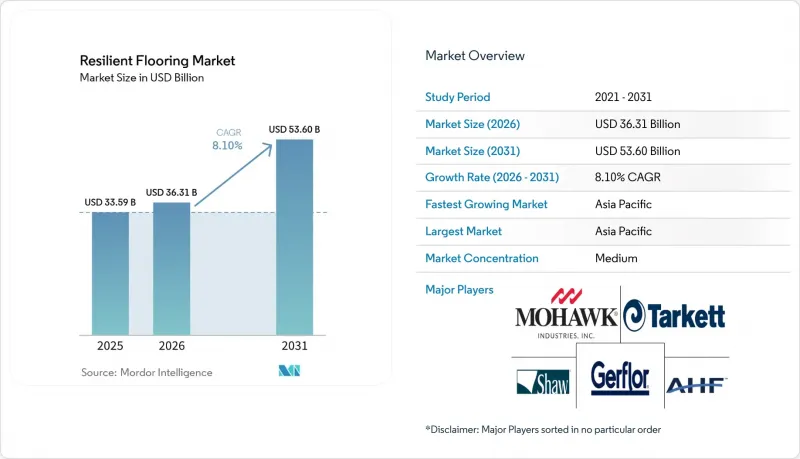
This report is Segmented by Product Type (Vinyl Flooring, Rubber Flooring, and Other Product Types), Installation Method (Click-Lock, Glue-Down, Loose-Lay, and Self-Adhesive), End-Use Industry (Residential, Commercial, Institutional, and Industrial), and Geography (Asia-Pacific, North America, Europe, South America, and Middle East and Africa). The Market Forecasts are Provided in Terms of Value (USD).
Global Resilient Flooring Market Trends and Insights
Rapid Penetration of Luxury Vinyl Tile (LVT)
Rigid-core technology eradicates acclimation delays, allows direct installation over imperfect substrates, and reduces labor by 20-25% in the multifamily segment. Limestone-rich SPC cores resist telegraphing, while advanced embossing reproduces premium hardwood visuals at one-third the installed cost. Click-lock edges keep retail sites operational during overnight renovations and have displaced ceramic tile in wet areas of healthcare environments where swift turnover matters.
Surge in Residential DIY Renovation Via Click-Lock Rigid-Core Products
Home-improvement chains raised click-lock stock-keeping units by roughly 40% between 2024 and 2025, mirroring a spike in tutorial views for leading brands. Minimal tooling requirements empower homeowners, who subsequently refresh floors more often, generating repeat traffic for retailers. This DIY momentum now represents nearly one-third of U.S. residential volume.
Stricter VOC and Phthalate Regulations on PVC Products
The U.S. Environmental Protection Agency's December 2024 vinyl chloride review prefigures tougher controls that raise compliance costs. Europe's Regulation 923/2023 bans lead-based stabilizers from January 2026, lifting raw-material bills by 5-8% as producers shift to calcium-zinc systems. Similar emission limits in China trigger factory audits and recalls for non-conforming imports.
Other drivers and restraints analyzed in the detailed report include:
- APAC Housing and Infrastructure Stimulus Programmes
- Growing Application of Resilient Vinyl Flooring in Commercial Spaces
- Competition from Ceramic Tile and Engineered Wood
For complete list of drivers and restraints, kindly check the Table Of Contents.
Segment Analysis
Vinyl flooring accounted for 38.98% of the resilient flooring market in 2025 and will post a 9.85% CAGR to 2031. This trajectory underscores how SPC and WPC planks are overcoming sheet vinyl's subfloor demands while adding photorealistic visuals. Limestone fillers' demand rose as SPC volumes ballooned. Rubber remains a niche for fitness and transport settings, whereas linoleum attracts eco-centric specifiers despite its lengthier curing period. A boutique cork segment thrives on acoustic comfort but lags under heavy static loads.
Innovation is blurring material boundaries. Bio-attributed PVC feedstocks now feed mass-balance programs, and recycled-content formulations such as an 85% post-consumer blend qualify for multiple green-building points. The resilient flooring market size for vinyl is projected to widen faster than any alternative product because it absorbs embossing, waterproof cores, and antimicrobial additives more swiftly than rubber or linoleum can integrate comparable upgrades.
Complete Report Scope:
- By Product Type
- Vinyl Flooring
- Rubber Flooring
- Other Product Types (Cork Flooring etc.)
- By Installation Method
- Click-lock
- Glue-down
- Loose-lay
- Self-adhesive
- By End-use Industry
- Residential
- Commercial
- Institutional
- Industrial
- By Geography
- Asia-Pacific
- China
- India
- Japan
- South Korea
- Vietnam
- Malaysia
- Indonesia
- Thailand
- Rest of Asia-Pacific
- North America
- United States
- Canada
- Mexico
- Europe
- Germany
- United Kingdom
- France
- Italy
- Spain
- NORDIC Countries
- Rest of Europe
- South America
- Brazil
- Argentina
- Rest of South America
- Middle East and Africa
- Saudi Arabia
- South Africa
- Qatar
- Nigeria
- United Arab Emirates
- Rest of Middle East and Africa
- Asia-Pacific
Geography Analysis
Asia-Pacific held 47.21% of the resilient flooring market in 2025 and is advancing at an 8.76% CAGR through 2031. Indian infrastructure outlays and China's property-sector stabilization are principal engines, while Vietnam attracts foreign direct investment that adds regional manufacturing heft. Mature economies such as Japan and South Korea register steady retrofit demand tied to aging demographics.
North America benefits from a buoyant remodeling cycle and flexible-office fit-outs. U.S. home-improvement retailers boosted click-lock SKUs by 40% from 2024 levels, underscoring DIY traction. Canada's public-works pipeline sustains institutional demand despite labor constraints, and Mexico's near-shoring wave fuels industrial installations along border corridors.
Europe balances renovation opportunities against the compliance costs of stringent VOC rules. Germany, the United Kingdom, and France top per-capita consumption, while Nordic nations adopt bio-based linoleum quickly. Southern Europe sustains ceramic tile's cultural dominance, limiting vinyl's residential penetration but embracing LVT in fast-track commercial refurbishments.
South America and the Middle East-Africa contribute emerging-market upside. Brazil's federal housing programs support modest rebounds, whereas Saudi Arabia's Vision 2030 megaprojects specify resilient flooring for hospitality components. The United Arab Emirates sees ongoing demand in retail precincts post-Expo 2020, and South Africa retains steady industrial requisitions amid import competition.
- AHF Products
- Altro Limited
- Beaulieu International Group
- Congoleum
- Forbo Flooring Systems
- Gerflor
- Interface, Inc.
- Karndean Designflooring
- LG Hausys
- Mannington Mills, Inc.
- Milliken
- Mohawk Industries, Inc.
- Mondo Spa
- Novalis
- NOX Corp.
- Polyflor Ltd
- Responsive Industries Ltd.
- Shaw Industries Group, Inc.
- Tarkett
Additional Benefits:
- The market estimate (ME) sheet in Excel format
- 3 months of analyst support
TABLE OF CONTENTS
1 Introduction
- 1.1 Study Assumptions and Market Definition
- 1.2 Scope of the Study
2 Research Methodology
3 Executive Summary
4 Market Landscape
- 4.1 Market Overview
- 4.2 Market Drivers
- 4.2.1 Rapid Penetration of Luxury Vinyl Tile (LVT)
- 4.2.2 Surge in Residential DIY Renovation Via Click-Lock Rigid-Core Products
- 4.2.3 APAC Housing and Infrastructure Stimulus Programmes
- 4.2.4 Growing Application of Resilient Vinyl Flooring in Commercial Spaces
- 4.2.5 Leasing Models for Office Fit-Outs Driving High-Turnover Installs
- 4.3 Market Restraints
- 4.3.1 Stricter VOC and Phthalate Regulations on PVC Products
- 4.3.2 Competition from Ceramic Tile and Engineered Wood
- 4.3.3 Shortage of Certified Installers in Several Countries
- 4.4 Value Chain Analysis
- 4.5 Porter's Five Forces
- 4.5.1 Bargaining Power of Suppliers
- 4.5.2 Bargaining Power of Buyers
- 4.5.3 Threat of New Entrants
- 4.5.4 Threat of Substitutes
- 4.5.5 Competitive Rivalry
5 Market Size and Growth Forecasts (Value)
- 5.1 By Product Type
- 5.1.1 Vinyl Flooring
- 5.1.2 Rubber Flooring
- 5.1.3 Other Product Types (Cork Flooring etc.)
- 5.2 By Installation Method
- 5.2.1 Click-lock
- 5.2.2 Glue-down
- 5.2.3 Loose-lay
- 5.2.4 Self-adhesive
- 5.3 By End-use Industry
- 5.3.1 Residential
- 5.3.2 Commercial
- 5.3.3 Institutional
- 5.3.4 Industrial
- 5.4 By Geography
- 5.4.1 Asia-Pacific
- 5.4.1.1 China
- 5.4.1.2 India
- 5.4.1.3 Japan
- 5.4.1.4 South Korea
- 5.4.1.5 Vietnam
- 5.4.1.6 Malaysia
- 5.4.1.7 Indonesia
- 5.4.1.8 Thailand
- 5.4.1.9 Rest of Asia-Pacific
- 5.4.2 North America
- 5.4.2.1 United States
- 5.4.2.2 Canada
- 5.4.2.3 Mexico
- 5.4.3 Europe
- 5.4.3.1 Germany
- 5.4.3.2 United Kingdom
- 5.4.3.3 France
- 5.4.3.4 Italy
- 5.4.3.5 Spain
- 5.4.3.6 NORDIC Countries
- 5.4.3.7 Rest of Europe
- 5.4.4 South America
- 5.4.4.1 Brazil
- 5.4.4.2 Argentina
- 5.4.4.3 Rest of South America
- 5.4.5 Middle East and Africa
- 5.4.5.1 Saudi Arabia
- 5.4.5.2 South Africa
- 5.4.5.3 Qatar
- 5.4.5.4 Nigeria
- 5.4.5.5 United Arab Emirates
- 5.4.5.6 Rest of Middle East and Africa
- 5.4.1 Asia-Pacific
6 Competitive Landscape
- 6.1 Market Concentration
- 6.2 Strategic Moves
- 6.3 Market Share(%)/Ranking Analysis
- 6.4 Company Profiles (includes Global level Overview, Market level overview, Core Segments, Financials as available, Strategic Information, Market Rank/Share, Products and Services, Recent Developments)
- 6.4.1 AHF Products
- 6.4.2 Altro Limited
- 6.4.3 Beaulieu International Group
- 6.4.4 Congoleum
- 6.4.5 Forbo Flooring Systems
- 6.4.6 Gerflor
- 6.4.7 Interface, Inc.
- 6.4.8 Karndean Designflooring
- 6.4.9 LG Hausys
- 6.4.10 Mannington Mills, Inc.
- 6.4.11 Milliken
- 6.4.12 Mohawk Industries, Inc.
- 6.4.13 Mondo Spa
- 6.4.14 Novalis
- 6.4.15 NOX Corp.
- 6.4.16 Polyflor Ltd
- 6.4.17 Responsive Industries Ltd.
- 6.4.18 Shaw Industries Group, Inc.
- 6.4.19 Tarkett
7 Market Opportunities and Future Outlook
- 7.1 White-space and Unmet-Need Assessment
- 7.2 IoT-enabled "Smart Floors" for Predictive Maintenance in Retail

