PUBLISHER: Mordor Intelligence | PRODUCT CODE: 2100655

PUBLISHER: Mordor Intelligence | PRODUCT CODE: 2100655
Vietnam Home Improvement - Market Share Analysis, Industry Trends & Statistics, Growth Forecasts (2026 - 2031)
According to Mordor Intelligence, the Vietnam home improvement market size is expected to grow from USD 3.77 billion in 2025 to USD 3.91 billion in 2026 and is forecast to reach USD 4.72 billion by 2031 at a 3.84% CAGR over 2026-2031.
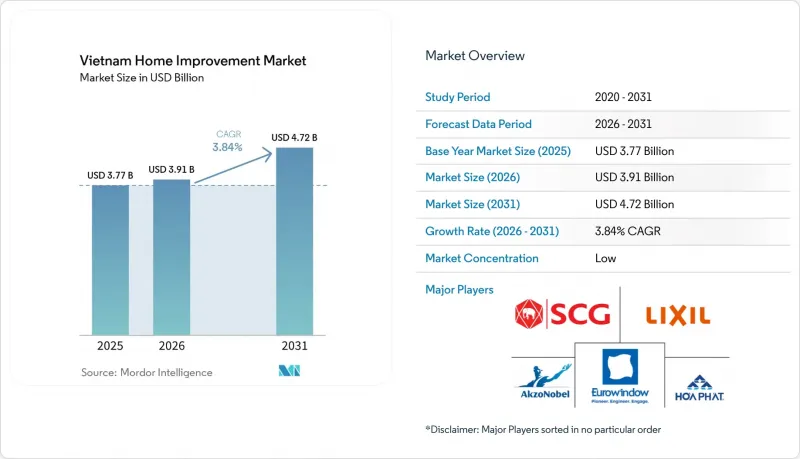
This report is Segmented by Product Type (Building Materials, Paints and Coatings, Tools and Equipment, and More), Project Type (Renovation, Remodeling, Maintenance & Repair), End User (DIY, DIFM / Professional Installation), Distribution Channel (Home Improvement, Specialty Stores, and More), and Geography. The Market Forecasts are Provided in Terms of Value (USD).
Vietnam Home Improvement Market Trends and Insights
Urban migration surge and rising disposable earnings
Vietnam exceeded 45% urbanization in 2025, with policymakers targeting 50% by 2030, expanding the potential market for renovation and remodelling in dense urban clusters. Household incomes are also rising, with official surveys showing higher monthly earnings in 2025, enabling discretionary spending on upgrades beyond basic repairs. The IMF highlights that investment levels remain elevated at around 31% of GDP through 2026, supporting private construction activity and home-related expenditures as credit channels normalize. As per capita GDP surpassed USD 5,000 in 2025, urban households are increasingly investing in smart fixtures, premium flooring, and upgraded bathrooms that enhance comfort and efficiency. Suppliers with regional manufacturing and Vietnam-tailored product lines, such as LIXIL, are well-positioned to benefit from this trend. The World Bank further notes that domestic demand is bolstered by a faster real estate recovery and clearer project clearance procedures, sustaining home improvement purchasing momentum in key cities.
Government-led renovation subsidies
Policy support for housing renewal scaled up significantly in 2024 and 2025, with a nationwide campaign rebuilding over 330,000 substandard dwellings ahead of schedule (vietcetera.com). The program boosted demand for construction materials, benefiting steel and cement producers, while leading domestic suppliers reported strong sales during the 2025 construction season (hoaphat.com.vn). A VND145 trillion (USD 6 billion) social-housing credit package, complemented by city-level interest support, unlocked financing for both new units and refurbishment projects in priority districts (vietnamnews.vn; vietnamplus.vn). Ho Chi Minh City plans to deliver 28,500 social housing units in 2026, with prepared land for multiple projects, sustaining demand for interior finishes and fixtures. Hanoi is advancing a pipeline of 69 projects, including major developments in Dong Anh District, creating large procurement opportunities for home improvement products (vietnamplus.vn). As project delivery accelerates, large contractors with established client relationships and strong backlogs, such as Coteccons, are positioned to benefit from more predictable project sequencing.
Fragmented supply chain leading to inconsistent quality standards
Raw-material volatility affects project budgets and retail pricing, creating uncertainty for both consumers and trade buyers in 2026. Iron ore and energy inputs moved through sharp cycles in 2025, which influenced steel mill spreads and stocking decisions in the distribution channel. Domestic construction materials, including cement, are also subject to seasonal and weather-driven volume variations, which can compress margins when combined with cost swings. While rising selling prices can partially offset these pressures, the pass-through varies by product category and brand strength. Integrated producers with expanded capacity have greater flexibility to manage throughput and product mix during periods of price volatility. Investments in low-carbon cement lines and logistics efficiency further help certain manufacturers mitigate the impact of material cost fluctuations on final pricing.
Other drivers and restraints analyzed in the detailed report include:
- Online home-improvement sales boom
- Compact-space DIY upgrades
- Limited skilled installers in Tier-2 And Tier-3 cities
For complete list of drivers and restraints, kindly check the Table Of Contents.
Segment Analysis
Building Materials accounted for a 43.33% share in 2025, anchoring the category mix with structural steel, cement, and ceramic tiles that form the backbone of residential and small-commercial projects. Price volatility in steel, energy inputs, and logistics influenced working capital cycles for mills and distributors, as rebar and ore spreads shifted during the year. Cement sales experienced seasonal and weather-related dips, although infrastructure spending sustained baseline demand. Analysts project firmer selling prices and improved mill throughput, which could enhance gross margins for integrated producers. Specialty capacity expansions, including railway-grade rails and specialized steels at Dung Quat, are broadening product offerings to support transport infrastructure and diversified project pipelines. Low-carbon production and energy-efficient processes are increasingly being adopted to meet environmental standards and export compliance requirements.
Paints, coatings, decor, and lighting categories are driving growth through plant upgrades, premium product lines, and developer-focused specifications. New color systems, interior finishes, and exclusive supply agreements have strengthened brand performance in retail and project pipelines. Tools and equipment are benefiting from e-commerce adoption and omnichannel strategies that integrate point-of-sale experience centers with online content and services. The Vietnam home improvement market size for decor and lighting is projected to expand at a 9.33% CAGR between 2026 and 2031 as developers and homeowners invest in premium surfaces and connected ambient systems. Plumbing and electrical categories are advancing as brands refresh premium lines and introduce antibacterial and surface-protection technologies to meet hygiene expectations. Regulatory modernization, including a national construction information system and digitized approvals, further supports category momentum by clarifying compliance benchmarks for materials and systems.
Renovation represented 45.37% of activity in 2025 as aging stock and deferred maintenance met better financing access and stronger contractor mobilization. Nationwide housing repair initiatives completed large-scale rebuilds ahead of schedule, generating significant demand for core materials and finishing products. Social-housing credit programs and city-level interest support have sustained repair and upgrade cycles, encouraging more households to engage with formal procurement channels. Infrastructure beautification and utility upgrades in high-traffic urban corridors provide additional opportunities for renovation spending. The digitization of project approval processes and the expansion of construction data systems are improving phase sequencing and project efficiency. Together, these factors are maintaining a strong baseline of renovation activity across core cities and surrounding areas.
Remodelling is projected to grow at a 7.40% CAGR through 2031 as buyers reconfigure living spaces with premium finishes and smart functions suited to evolving urban lifestyles. New residential projects are increasingly equipped with wiring and infrastructure that facilitate post-handover upgrades, including smart lighting, advanced kitchens, and high-spec bathrooms. Premium materials such as sintered stone, high-performance laminates, and antibacterial sanitaryware are helping brands protect margins in the remodelling segment. Product updates and category roadmaps emphasize simplified installation and long-term durability, aligning with urban apartment and villa upgrade cycles. Maintenance and minor repair work continue to generate recurring demand for paints, sealants, fixtures, and service calls. Overall, remodelling complements renovation activity, expanding the market's scope and supporting steady growth across residential segments.
Complete Report Scope:
- By Product Type
- Building Materials
- Paints and Coatings
- Tools and Equipment
- Decore and Lighting
- Flooring and Tiles
- Plumbing and Electrical
- Others
- By Project Type
- Renovation
- Remodelling
- Maintenance & Repair
- By End User (Value)
- DIY
- DIFM / Professional Installation
- By Distribution Channel
- Home Improvement Stores
- Specialty Stores
- Online
- Others
- By Geography
- Northern Vietnam
- Central Vietnam
- Southern Vietnam
List of Companies Covered in this Report:
- SCG
- LIXIL
- AkzoNobel (Dulux)
- Eurowindow
- Hoa Phat Group
- Viglacera Corporation
- Austdoor Group
- Panasonic
- Bosch
- Coteccons
- Hoa Binh Construction Group
- Vingroup (VinHomes & VinDS Home)
- Jotun Paints
- Kingdoor
- An Cường Wood Working
- TOTO
- Sơn Ha Architecture
- Dai Dung Steel
- Caesar Bath
- Rehau
Additional Benefits:
- The market estimate (ME) sheet in Excel format
- 3 months of analyst support
TABLE OF CONTENTS
1 Introduction
- 1.1 Study Assumptions & Market Definition
- 1.2 Scope of the Study
2 Research Methodology
3 Executive Summary
4 Market Landscape
- 4.1 Market Overview
- 4.2 Market Drivers
- 4.2.1 Urban migration surge and rising disposable earnings
- 4.2.2 Government-led renovation subsidies
- 4.2.3 Online home-improvement sales boom
- 4.2.4 Compact-space DIY upgrades
- 4.2.5 High-spending repatriate consumers
- 4.2.6 Eco-friendly building material uptake
- 4.3 Market Restraints
- 4.3.1 Fragmented supply chain leading to inconsistent quality standards
- 4.3.2 Escalating property costs limiting remodel spend
- 4.3.3 Limited skilled installers in Tier-2 And Tier-3 cities
- 4.3.4 Fluctuating global input prices
- 4.4 Industry Value Chain Analysis
- 4.5 Porter's Five Forces
- 4.5.1 Threat of New Entrants
- 4.5.2 Bargaining Power of Buyers
- 4.5.3 Bargaining Power of Suppliers
- 4.5.4 Threat of Substitutes
- 4.5.5 Competitive Rivalry
- 4.6 Insights into the Latest Trends and Innovations in the Market
- 4.7 Insights on Recent Developments (New Product Launches, Strategic Initiatives, Investments, Partnerships, JVs, Expansion, M&As, etc.) in the Market
5 Market Size & Growth Forecasts (Value)
- 5.1 By Product Type
- 5.1.1 Building Materials
- 5.1.2 Paints and Coatings
- 5.1.3 Tools and Equipment
- 5.1.4 Decore and Lighting
- 5.1.5 Flooring and Tiles
- 5.1.6 Plumbing and Electrical
- 5.1.7 Others
- 5.2 By Project Type
- 5.2.1 Renovation
- 5.2.2 Remodelling
- 5.2.3 Maintenance & Repair
- 5.3 By End User (Value)
- 5.3.1 DIY
- 5.3.2 DIFM / Professional Installation
- 5.4 By Distribution Channel
- 5.4.1 Home Improvement Stores
- 5.4.2 Specialty Stores
- 5.4.3 Online
- 5.4.4 Others
- 5.5 By Geography
- 5.5.1 Northern Vietnam
- 5.5.2 Central Vietnam
- 5.5.3 Southern Vietnam
6 Competitive Landscape
- 6.1 Market Concentration
- 6.2 Strategic Moves
- 6.3 Market Share Analysis
- 6.4 Company Profiles (includes Global level Overview, Market level overview, Core Segments, Financials as available, Strategic Information, Market Rank/Share for key companies, Products & Services, and Recent Developments)
- 6.4.1 SCG
- 6.4.2 LIXIL
- 6.4.3 AkzoNobel (Dulux)
- 6.4.4 Eurowindow
- 6.4.5 Hoa Phat Group
- 6.4.6 Viglacera Corporation
- 6.4.7 Austdoor Group
- 6.4.8 Panasonic
- 6.4.9 Bosch
- 6.4.10 Coteccons
- 6.4.11 Hoa Binh Construction Group
- 6.4.12 Vingroup (VinHomes & VinDS Home)
- 6.4.13 Jotun Paints
- 6.4.14 Kingdoor
- 6.4.15 An Cường Wood Working
- 6.4.16 TOTO
- 6.4.17 Sơn Ha Architecture
- 6.4.18 Dai Dung Steel
- 6.4.19 Caesar Bath
- 6.4.20 Rehau
7 Market Opportunities & Future Outlook
- 7.1 Surge in demand for smart and energy-efficient home solutions

