PUBLISHER: Mordor Intelligence | PRODUCT CODE: 2100657

PUBLISHER: Mordor Intelligence | PRODUCT CODE: 2100657
Main Automation Contractor (MAC) in the Oil and Gas Industry - Market Share Analysis, Industry Trends & Statistics, Growth Forecasts (2026 - 2031)
According to Mordor Intelligence, the main automation contractor (MAC) market size in the oil and gas industry market size in 2026 is estimated at USD 23.85 billion, growing from 2025 value of USD 22.45 billion with 2031 projections showing USD 32.28 billion, growing at 6.24% CAGR over 2026-2031.
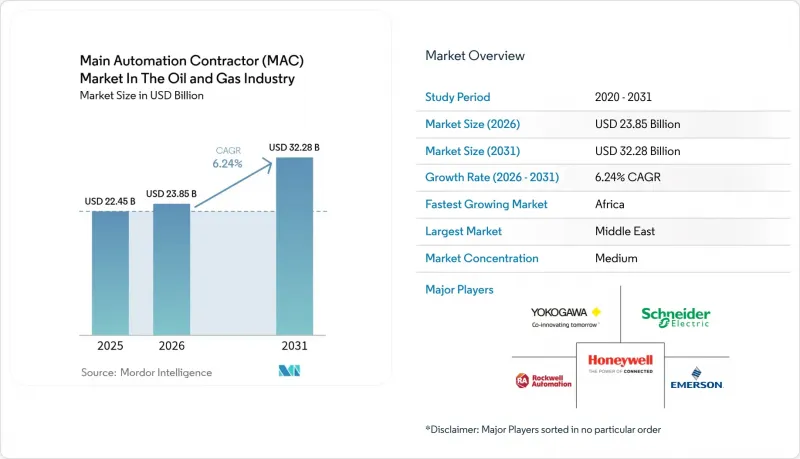
This report is Segmented by Sector (Upstream, Midstream, and Downstream), Project Size (Small and Medium, and Large), Automation System Type (DCS, PLC, SCADA, SIS, and More), Service Type (FEED, Procurement, and More), Project Phase (Greenfield, and Brownfield), and Geography. The Market Forecasts are Provided in Terms of Value (USD).
Global Main Automation Contractor (MAC) in the Oil and Gas Industry Trends and Insights
Integrated Automation Platforms Cut Costs
Operators are pulling disparate point solutions into unified ecosystems that span distributed control, safety instrumentation, and asset performance modules. Emerson's February 2024 overhaul of LyondellBasell's Wesseling cracker compressed a two-month engineering window into a two-week turnaround by using AI-powered code conversion, demonstrating how integrated suites shrink schedule risk and maintenance burdens. S-OIL's three-year S-imoms program linked 30 legacy applications into one backbone and is forecast to recoup its KRW 25.5 billion investment in under 15 months. ADNOC's August 2024 rollout of Neuron 5 AI illustrates the upside: a 50% cut in unplanned shutdowns and a 20% extension of service intervals. These outcomes validate a pay-as-you-save argument that accelerates integrated-platform adoption worldwide.
Deepwater and Subsea Projects Require High-Reliability Control
Ultra-deepwater assets such as Chevron's Anchor field in the Gulf of Mexico employ 20,000 psi subsea trees, all-electric actuation, and long-offset tiebacks that demand real-time, deterministic automation. Subsea investment is predicted to grow roughly 10% annually through 2027, reaching USD 32 billion by end-2024, thereby enlarging the addressable Main Automation Contractor market. SLB OneSubsea's 2024 FEED award for Equinor's Fram Sor 12-well all-electric system underscores the pivot from hydraulic to fully electric control that simplifies installation, reduces carbon intensity, and integrates natively with digital twins
Volatile Crude Prices Pressure Budgets
When Brent hovers below USD 85 per barrel, discretionary automation scopes slide to future years. Petrobras, for example, targets USD 100 million in annual rig-fleet savings through automation but is staging spend over multiple phases to hedge price uncertainty. Deepwater tiebacks among the first deferred when forward curves flatten illustrate how cyclicality chips 0.9 percentage points off the forecast CAGR.
Other drivers and restraints analyzed in the detailed report include:
- Digital Twins Amplify Lifecycle Value
- Safety and Environmental Regulation Spurs Retrofits
- Talent Shortage Stalls Project Velocity
For complete list of drivers and restraints, kindly check the Table Of Contents.
Segment Analysis
Upstream assets generated nearly half of 2025 spending, yet midstream's higher 7.12% CAGR signals structural catch-up as pipeline operators electrify compressor stations and add edge SCADA for leak detection. ADNOC's USD 920 million program to digitize its onshore fields typifies the upstream installed-base advantage. However, new hydrogen-ready pipelines and CO2 trunk lines will give midstream a larger slice of future Main Automation Contractor (MAC) in the Oil and Gas Industry revenue. Integrated control suites that merge pipeline simulation, SCADA, and predictive maintenance are rapidly becoming bid-spec norms. Meanwhile, downstream margins remain tight, limiting capital allocation to incremental advanced process control rollouts rather than whole-of-plant DCS swaps.
The Main Automation Contractor (MAC) in the Oil and Gas Industry share tied to upstream control packages is expected to trail the broader market as greenfield LNG and carbon-capture projects realign spending toward transmission and export hubs. Operators also channel funds into autonomous drilling and electric fracturing platforms that reduce rig crew counts and improve rate of penetration, thereby demonstrating tangible payback to investment committees.
Projects exceeding USD 31 million still dominate revenue, but small and medium contracts are expanding faster at an 7.92% CAGR as NOCs break mega-EPCs into digestible modules. Saudi Vision 2030 and the UAE's In-Country Value drive this fragmentation, giving local integrators an opening to compete for decoupled instrumentation, cyber-hardening, and brownfield DCS migration work. Emerson's AI-assisted code-conversion tool shortens shutdown windows, making sub-USD 10 million revamp packages economically practical for aging plants.
Large LNG trains, gas-processing expansions, and deepwater host platforms will continue to underpin Main Automation Contractor (MAC) in the Oil and Gas Industry size growth, but award timing creates revenue volatility. Mega-projects offer scale economies yet expose suppliers to sharper commodity-linked repricing when crude drops. Consequently, many players balance portfolios with a higher volume of quick-turn, medium-sized jobs that carry lower execution risk and faster cash conversion.
Complete Report Scope:
- By Sector
- Upstream (Offshore and Onshore)
- Midstream
- Downstream
- By Project Size
- Small and Medium (USD 5 million to USD 30 million)
- Large (USD 31 million and Above)
- By Automation System Type
- Distributed Control System (DCS)
- Programmable Logic Controller (PLC)
- Supervisory Control and Data Acquisition (SCADA)
- Safety Instrumented System (SIS)
- Other Automation System Types
- By Service Type
- Front-End Engineering Design (FEED)
- Procurement
- Installation and Commissioning
- Training
- Maintenance and Support
- By Project Phase
- Greenfield
- Brownfield
- By Geography
- North America
- United States
- Canada
- Mexico
- South America
- Brazil
- Argentina
- Chile
- Rest of South America
- Europe
- United Kingdom
- Germany
- France
- Italy
- Spain
- Rest of Europe
- Asia-Pacific
- China
- Japan
- India
- South Korea
- Australia and New Zealand
- Rest of Asia-Pacific
- Middle East and Africa
- Middle East
- United Arab Emirates
- Saudi Arabia
- Turkey
- Rest of Middle East
- Africa
- South Africa
- Kenya
- Nigeria
- Rest of Africa
- Middle East
- North America
Geography Analysis
The Middle East contributed 28.29% of 2025 spending, underpinned by Saudi Aramco's USD 7.7 billion Fadhili expansion and ADNOC's multi-asset AI rollouts. Supply-chain localization schemes force Tier-1s to form joint ventures, invest in local assembly, and cede workshare to regional integrators. Africa is projected to deliver the highest regional CAGR at 9.55% on the back of deepwater sanctioning in Nigeria, Angola, and Senegal plus gas-export facilities in Mozambique and Tanzania. Frame agreements for subsea inspection and maintenance indicate follow-on service revenue that will outlast construction spend.
North America benefits from mature shale automation and prototype Open Process Automation deployments yet wrestles with cost-of-capital inflation and labor scarcity. Europe concentrates on electrifying offshore platforms, integrating carbon capture, and migrating to electric subsea architectures that dovetail with continental decarbonization targets. Asia-Pacific presents a fragmented picture: China and India bankroll refinery-petrochemical complexes, Australia pursues deepwater gas, and Southeast Asia advances floating storage and regasification units, each with distinct approval timelines and local-content hurdles. Collectively, these dynamics sustain diversification opportunities for suppliers capable of balancing project risk across basins. Regional policy shifts, such as methane-fee rules in the United States or net-zero mandates in Europe, will further shape spending patterns and technology choice.
- Rockwell Automation Inc.
- Schneider Electric SE
- Yokogawa Electric Corporation
- Honeywell International Inc.
- Emerson Electric Co.
- Siemens AG
- ABB Ltd.
- Mitsubishi Electric Corporation
- General Electric Company
- Baker Hughes Company
- Schlumberger NV
- Larsen and Toubro Limited
- Petrofac Limited
- Worley Ltd.
- Technip Energies NV
- Kongsberg Gruppen ASA
- Valmet Oyj
- National Instruments Corporation
- Aveva Group plc
- Wood Group PLC
Additional Benefits:
- The market estimate (ME) sheet in Excel format
- 3 months of analyst support
TABLE OF CONTENTS
1 INTRODUCTION
- 1.1 Study Assumptions and Market Definition
- 1.2 Scope of the Study
2 RESEARCH METHODOLOGY
3 EXECUTIVE SUMMARY
4 MARKET LANDSCAPE
- 4.1 Market Overview
- 4.2 Market Drivers
- 4.2.1 Rising Adoption of Integrated Automation Platforms to Reduce CAPEX and OPEX
- 4.2.2 Accelerated Deployment of Deepwater and Subsea Projects Requiring Complex Automation
- 4.2.3 Digital Twin and Advanced Analytics Integration Enhancing MAC Value Proposition
- 4.2.4 Strict Safety and Environmental Regulations Driving Automation Upgrades
- 4.2.5 Growing Brownfield Modernization in Maturing Fields
- 4.2.6 Supply Chain Localization Incentives in Middle East Mega-Projects
- 4.3 Market Restraints
- 4.3.1 Volatility in Crude Prices Limiting Capital Expenditure
- 4.3.2 Talent Shortage in Integrated Control System Engineering
- 4.3.3 Cybersecurity Concerns Over Multivendor Integration
- 4.3.4 Lengthy Approval Cycles for National Oil Company Projects
- 4.4 Impact of Macroeconomic Factors on the Market
- 4.5 Industry Value / Supply-Chain Analysis
- 4.6 Regulatory Landscape
- 4.7 Technological Outlook
- 4.8 Porter's Five Forces Analysis
- 4.8.1 Threat of New Entrants
- 4.8.2 Bargaining Power of Buyers
- 4.8.3 Bargaining Power of Suppliers
- 4.8.4 Threat of Substitute Products
- 4.8.5 Intensity of Competitive Rivalry
5 MARKET SIZE AND GROWTH FORECASTS (VALUE)
- 5.1 By Sector
- 5.1.1 Upstream (Offshore and Onshore)
- 5.1.2 Midstream
- 5.1.3 Downstream
- 5.2 By Project Size
- 5.2.1 Small and Medium (USD 5 million to USD 30 million)
- 5.2.2 Large (USD 31 million and Above)
- 5.3 By Automation System Type
- 5.3.1 Distributed Control System (DCS)
- 5.3.2 Programmable Logic Controller (PLC)
- 5.3.3 Supervisory Control and Data Acquisition (SCADA)
- 5.3.4 Safety Instrumented System (SIS)
- 5.3.5 Other Automation System Types
- 5.4 By Service Type
- 5.4.1 Front-End Engineering Design (FEED)
- 5.4.2 Procurement
- 5.4.3 Installation and Commissioning
- 5.4.4 Training
- 5.4.5 Maintenance and Support
- 5.5 By Project Phase
- 5.5.1 Greenfield
- 5.5.2 Brownfield
- 5.6 By Geography
- 5.6.1 North America
- 5.6.1.1 United States
- 5.6.1.2 Canada
- 5.6.1.3 Mexico
- 5.6.2 South America
- 5.6.2.1 Brazil
- 5.6.2.2 Argentina
- 5.6.2.3 Chile
- 5.6.2.4 Rest of South America
- 5.6.3 Europe
- 5.6.3.1 United Kingdom
- 5.6.3.2 Germany
- 5.6.3.3 France
- 5.6.3.4 Italy
- 5.6.3.5 Spain
- 5.6.3.6 Rest of Europe
- 5.6.4 Asia-Pacific
- 5.6.4.1 China
- 5.6.4.2 Japan
- 5.6.4.3 India
- 5.6.4.4 South Korea
- 5.6.4.5 Australia and New Zealand
- 5.6.4.6 Rest of Asia-Pacific
- 5.6.5 Middle East and Africa
- 5.6.5.1 Middle East
- 5.6.5.1.1 United Arab Emirates
- 5.6.5.1.2 Saudi Arabia
- 5.6.5.1.3 Turkey
- 5.6.5.1.4 Rest of Middle East
- 5.6.5.2 Africa
- 5.6.5.2.1 South Africa
- 5.6.5.2.2 Kenya
- 5.6.5.2.3 Nigeria
- 5.6.5.2.4 Rest of Africa
- 5.6.5.1 Middle East
- 5.6.1 North America
6 COMPETITIVE LANDSCAPE
- 6.1 Market Concentration
- 6.2 Strategic Moves
- 6.3 Market Share Analysis
- 6.4 Company Profiles (includes Global-level Overview, Market-level Overview, Core Segments, Financials as available, Strategic Information, Market Rank / Share for key companies, Products and Services, and Recent Developments)
- 6.4.1 Rockwell Automation Inc.
- 6.4.2 Schneider Electric SE
- 6.4.3 Yokogawa Electric Corporation
- 6.4.4 Honeywell International Inc.
- 6.4.5 Emerson Electric Co.
- 6.4.6 Siemens AG
- 6.4.7 ABB Ltd.
- 6.4.8 Mitsubishi Electric Corporation
- 6.4.9 General Electric Company
- 6.4.10 Baker Hughes Company
- 6.4.11 Schlumberger NV
- 6.4.12 Larsen and Toubro Limited
- 6.4.13 Petrofac Limited
- 6.4.14 Worley Ltd.
- 6.4.15 Technip Energies NV
- 6.4.16 Kongsberg Gruppen ASA
- 6.4.17 Valmet Oyj
- 6.4.18 National Instruments Corporation
- 6.4.19 Aveva Group plc
- 6.4.20 Wood Group PLC
7 MARKET OPPORTUNITIES AND FUTURE OUTLOOK
- 7.1 White-space and Unmet-Need Assessment

