PUBLISHER: Mordor Intelligence | PRODUCT CODE: 2100703

PUBLISHER: Mordor Intelligence | PRODUCT CODE: 2100703
Asia-Pacific E-commerce - Market Share Analysis, Industry Trends & Statistics, Growth Forecasts (2026 - 2031)
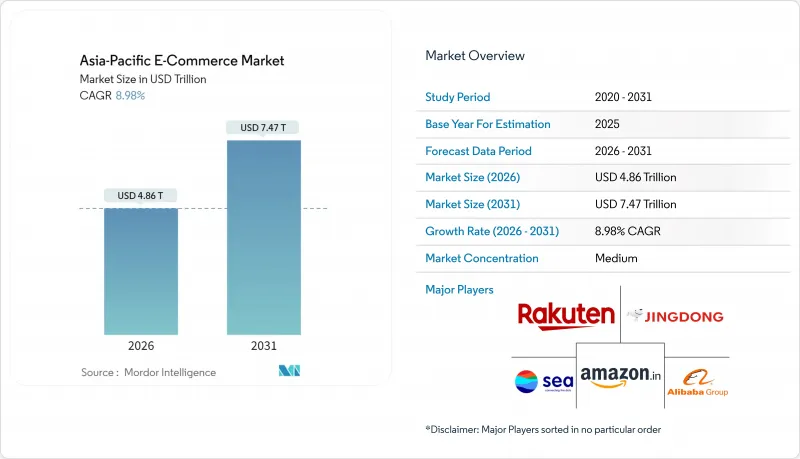
According to Mordor Intelligence, the Asia-Pacific e-commerce market size is valued at USD 4.86 trillion in 2026 and is projected to climb to USD 7.47 trillion by 2031, advancing at an 8.98% CAGR.
This report is Segmented is Segmented by Business Model (B2C, and B2B), Device Type for B2C (Smartphone/Mobile, Desktop and Laptop, and More), Payment Method for B2C (Credit and Debit Cards, Digital Wallets, BNPL, and More), Product Category for B2C (Beauty and Personal Care, Consumer Electronics, Fashion and Apparel, and More), and Geography. The Market Forecasts are Provided in Terms of Value (USD).
Asia-Pacific E-commerce Market Trends and Insights
AI-Driven Hyper-Local Fulfilment Hubs
Machine-learning systems are predicting demand at the postal-code level, enabling inventory to be staged inside micro-warehouses that sit within 5 kilometers of dense residential zones. JD.com operated more than 1,600 automated centers by 2025, achieving 30-minute delivery in Beijing and Shanghai. The concept is transferring to India, where Flipkart's partnership with kirana stores cut delivery expenses by 40% while preserving sub-60-minute windows. Shopee is rolling out similar dark-store networks in Jakarta and Manila to counter GrabMart's grocery push. Capital intensity limits fast replication, giving well-funded incumbents a defensible moat and compressing cash-conversion cycles as faster turnover lets suppliers accept shorter payment terms.
Social-Commerce and Live-Stream Shopping Boom
Live-stream commerce generated CNY 2.5 trillion (USD 350 billion) in China during 2025, with Douyin securing 45% of the gross merchandise value. Southeast Asian platforms are mirroring the tactic: Shopee Live and Lazada Live host daily influencer shows that regularly triple conversion rates compared with standard listings. Augmented-reality try-ons allow shoppers to visualize makeup shades or apparel fits in real time, narrowing the experiential gap with brick-and-mortar outlets. China's regulator now holds influencers jointly liable for product misrepresentation, elevating compliance thresholds but boosting consumer trust.
Fragmented Last-Mile Logistics
Fragmented last-mile logistics result in inconsistent couriers and sparse cold-chain facilities. Tokopedia disclosed that 22% of orders in eastern Indonesia were delayed beyond five days during 2025, denting repeat-purchase rates. India's tier-2 and tier-3 cities face parallel hurdles of non-standard addresses and manual handoffs between national and local carriers. Crowd-sourced gig networks offer flexibility but create liability and quality risks, while Australia's 2024 ruling that riders are employees raises labor costs.
Other drivers and restraints analyzed in the detailed report include:
- Government-Led Cross-Border E-commerce Pacts
- Rapid Adoption of M-Commerce and Super-Apps
- Rising ESG-Compliance Platform Costs
For complete list of drivers and restraints, kindly check the Table Of Contents.
Segment Analysis
The B2C segment accounted for 78.34% of the Asia-Pacific E-commerce Market share in 2025, anchoring near-term revenue for most platforms. In contrast, the B2B segment is widening at a 9.67% CAGR through 2031 as enterprises digitize procurement and agriculture supply chains. Alibaba's 1688.com handled CNY 1.2 trillion (USD 168 billion) in 2025 by pairing manufacturers with wholesalers through AI-enabled sourcing engines. Pinduoduo's Duo Duo Wholesale aggregates demand from rural retailers, funneling factory-gate pricing to towns previously served by informal intermediaries. Higher repeat-purchase rates and lower customer-acquisition costs give B2B a margin profile that increasingly appeals to investors.
Cross-border B2B marketplaces processed USD 45 billion in export orders during 2025, illustrating how easier customs rules convert offline trade into digital flows. India's government-backed ONDC B2B module, launched in 2025, removes marketplace commissions and threatens incumbent fee structures. JD.com's enterprise unit now supplies MRO goods to factories, compressing sourcing cycles by 40% and capturing share from offline distributors. As a result, the Asia-Pacific E-commerce Market size attached to B2B is set to expand more quickly than consumer-facing volumes over the forecast horizon.
Smartphones generated 64.23% of transaction value in 2025, giving them the dominant slice of the Asia-Pacific E-commerce Market size for device categories. Affordable 5G handsets priced below USD 150 in India and Vietnam are enlarging the total addressable base. Platforms now build progressive web apps that cache catalog data for low-bandwidth zones and use biometric authentication for one-click payments. Voice-assistant commerce remains niche but is growing in Japan and South Korea, where households reorder staples through speakers paired with local marketplaces.
Mobile's primacy is reshaping user-interface design: vertical scrolling, large tap targets, and image-first layouts replace desktop carousels. Social-commerce integration lets buyers move from discovery on TikTok or Instagram to checkout inside a super-app without app-hopping. Payment tokenization and device-based authentication reduce fraud and raise trust among older demographics. Consequently, desktop and laptop shares will keep receding, locking mobile in as the innovation frontier for the Asia-Pacific E-commerce Market.
Complete Report Scope:
- By Business Model
- B2C
- B2B
- By Device Type (B2C)
- Smartphone / Mobile
- Desktop and Laptop
- Other Device Types
- By Payment Method (B2C)
- Credit and Debit Cards
- Digital Wallets
- Buy Now Pay Later (BNPL)
- Other Payment Methods
- By Product Category (B2C)
- Beauty and Personal Care
- Consumer Electronics
- Fashion and Apparel
- Food and Beverages
- Furniture and Home
- Toys, DIY and Media
- Other Product Categories
- By Country
- China
- India
- Japan
- South Korea
- South East Asia
- Australia and New Zealand
- Rest of Asia-Pacific
List of Companies Covered in this Report:
- Alibaba Group Holding Ltd.
- Amazon.com Inc.
- JD.com Inc.
- Rakuten Group Inc.
- Sea Ltd. (Shopee)
- eBay Inc.
- Flipkart Internet Pvt Ltd.
- Pinduoduo Inc. (PDD)
- Meituan Dianping
- Lazada Group SA
- Coupang Corp.
- Bukalapak .com PT
- Tokopedia PT
- Shopify Inc.
- Apple Inc. (Apple Store Online)
- Reliance Retail Ltd. (JioMart)
- Myntra Designs Pvt Ltd.
- Kogan.com Ltd.
- Catch.com.au Pty Ltd.
- Tiki Corp.
Additional Benefits:
- The market estimate (ME) sheet in Excel format
- 3 months of analyst support
TABLE OF CONTENTS
1 INTRODUCTION
- 1.1 Study Assumptions and Market Definition
- 1.2 Scope of the Study
2 RESEARCH METHODOLOGY
3 EXECUTIVE SUMMARY
4 MARKET LANDSCAPE
- 4.1 Market Overview
- 4.2 Market Drivers
- 4.2.1 Growing Disposable Income of Consumers
- 4.2.2 Extensive Internet Accessibility
- 4.2.3 Rapid Adoption of M-Commerce and Super-Apps
- 4.2.4 Government-Led Cross-Border E-Commerce Pacts
- 4.2.5 Social-Commerce and Live-Stream Shopping Boom
- 4.2.6 AI-Driven Hyper-Local Fulfilment Hubs
- 4.3 Market Restraints
- 4.3.1 Security and Privacy Concerns
- 4.3.2 Fragmented Last-Mile Logistics
- 4.3.3 Cross-Border Tax Complexity
- 4.3.4 Rising ESG-Compliance Platform Costs
- 4.4 Industry Value Chain Analysis
- 4.5 Regulatory Landscape
- 4.6 Technological Outlook
- 4.7 Assessment of Macroeconomic Trends on the Market
- 4.8 Porter's Five Forces Analysis
- 4.8.1 Bargaining Power of Suppliers
- 4.8.2 Bargaining Power of Buyers / Consumers
- 4.8.3 Threat of New Entrants
- 4.8.4 Threat of Substitute Products
- 4.8.5 Intensity of Competitive Rivalry
5 MARKET SIZE AND GROWTH FORECASTS (VALUE)
- 5.1 By Business Model
- 5.1.1 B2C
- 5.1.2 B2B
- 5.2 By Device Type (B2C)
- 5.2.1 Smartphone / Mobile
- 5.2.2 Desktop and Laptop
- 5.2.3 Other Device Types
- 5.3 By Payment Method (B2C)
- 5.3.1 Credit and Debit Cards
- 5.3.2 Digital Wallets
- 5.3.3 Buy Now Pay Later (BNPL)
- 5.3.4 Other Payment Methods
- 5.4 By Product Category (B2C)
- 5.4.1 Beauty and Personal Care
- 5.4.2 Consumer Electronics
- 5.4.3 Fashion and Apparel
- 5.4.4 Food and Beverages
- 5.4.5 Furniture and Home
- 5.4.6 Toys, DIY and Media
- 5.4.7 Other Product Categories
- 5.5 By Country
- 5.5.1 China
- 5.5.2 India
- 5.5.3 Japan
- 5.5.4 South Korea
- 5.5.5 South East Asia
- 5.5.6 Australia and New Zealand
- 5.5.7 Rest of Asia-Pacific
6 COMPETITIVE LANDSCAPE
- 6.1 Market Concentration
- 6.2 Strategic Moves
- 6.3 Market Share Analysis
- 6.4 Company Profiles (includes Global Level Overview, Market Level Overview, Core Segments, Financials as available, Strategic Information, Market Rank/Share, Products and Services, Recent Developments)
- 6.4.1 Alibaba Group Holding Ltd.
- 6.4.2 Amazon.com Inc.
- 6.4.3 JD.com Inc.
- 6.4.4 Rakuten Group Inc.
- 6.4.5 Sea Ltd. (Shopee)
- 6.4.6 eBay Inc.
- 6.4.7 Flipkart Internet Pvt Ltd.
- 6.4.8 Pinduoduo Inc. (PDD)
- 6.4.9 Meituan Dianping
- 6.4.10 Lazada Group SA
- 6.4.11 Coupang Corp.
- 6.4.12 Bukalapak .com PT
- 6.4.13 Tokopedia PT
- 6.4.14 Shopify Inc.
- 6.4.15 Apple Inc. (Apple Store Online)
- 6.4.16 Reliance Retail Ltd. (JioMart)
- 6.4.17 Myntra Designs Pvt Ltd.
- 6.4.18 Kogan.com Ltd.
- 6.4.19 Catch.com.au Pty Ltd.
- 6.4.20 Tiki Corp.
7 MARKET OPPORTUNITIES AND FUTURE OUTLOOK
- 7.1 White-Space and Unmet-Need Assessment

