PUBLISHER: Mordor Intelligence | PRODUCT CODE: 2100711

PUBLISHER: Mordor Intelligence | PRODUCT CODE: 2100711
Non-Destructive Testing (NDT) Software - Market Share Analysis, Industry Trends & Statistics, Growth Forecasts (2026 - 2031)
According to Mordor Intelligence, NDT software market size in 2026 is estimated at USD 772.01 million, growing from 2025 value of USD 690 million with 2031 projections showing USD 1.36 billion, growing at 12.03% CAGR over 2026-2031.
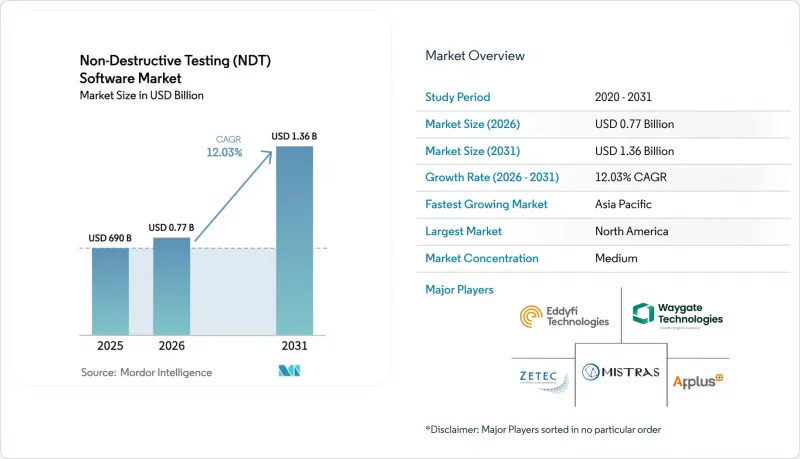
This report is Segmented by Software Type (Standard Software, and Integrated Software), Deployment Mode (On-Premises, Cloud-Based, and Hybrid), Technique (Traditional/Conventional, and AI-Enabled), Testing Method (Ultrasonic Testing, Magnetic Particle and Dye Penetrant, and More), End-User Industry (Oil and Gas, Power Generation, and More), and Geography. The Market Forecasts are Provided in Terms of Value (USD).
Global Non-Destructive Testing (NDT) Software Market Trends and Insights
Rapid Digitization of Inspection Workflows
Digital transformation pushes inspection software into the center of plant operations. DICONDE-compliant images seamlessly integrate with scanners and asset-management portals, eliminating paper logbooks and reducing transcription errors by 40%. Remote teams log in through secure browsers, annotate findings in real-time, and export audit-ready PDFs that regulators accept without the need for onsite visits. For multi-site operators, central dashboards identify trends such as recurring weld flaws across facilities, enabling timely process improvements. The result is a fundamentally different work culture, where inspection data shifts from a passive record to a strategic asset.
Increasing Adoption of Advanced Analytics and AI
Convolutional neural networks now exceed 95% accuracy when classifying common casting defects, slashing false positives by 30% in live production trials. Algorithms forecast flaw propagation, allowing planners to schedule weld repairs before cracks breach tolerance. Edge devices process images on scanners, reducing latency and data-sovereignty risk. AI performance hinges on training volume, giving incumbents with decades of archives a head start. New entrants close the gap by licensing public datasets and crowd-sourcing annotations, but large industrial vaults remain a moat for integrated suppliers.
High Upfront Licensing and Customization Costs
Full-suite deployments often list at USD 100,000-500,000, with integration and training doubling the spend in the first three years. Smaller inspection firms defer purchases or opt for limited-scope modules that delay ROI. Subscription cloud models shift costs to operating budgets, but multiyear fees can ultimately outpace perpetual licenses. Complex ERP interfaces require specialist consultancies, adding USD 50,000 to USD 200,000 to the rollout costs. While mature markets recoup costs through productivity gains, price sensitivity slows adoption across small service providers and emerging economies.
Other drivers and restraints analyzed in the detailed report include:
- Stringent Regulatory Compliance
- Aging Infrastructure Requires Frequent Inspections
- Scarcity of NDT Data Scientists
For complete list of drivers and restraints, kindly check the Table Of Contents.
Segment Analysis
Standard programs accounted for 56.85% of 2025 revenue, thanks to their entrenched role in single-method shops. Yet integrated suites are expanding at a 15.05% CAGR as plants consolidate data silos. Large refineries that deploy integrated platforms see a 25% drop in inspection time after linking ultrasonic, radiography, and eddy-current files in a single repository. Integrated environments synchronize with enterprise asset-management systems, allowing maintenance planners to prioritize repairs based on real-time risk scores rather than static calendars. Vendors achieve stickiness by bundling analytics, visualization, and compliance modules that lock in multi-year renewals.
Competition centers on ecosystem breadth. Baker Hughes folded Phoenix software into its scanner lineup, offering customers an end-to-end proposition from probe to dashboard. Pure-play developers counter with hardware-agnostic connectors that import DICONDE files from third-party devices. As more clients demand digital twins, integrated suites position themselves as the backbone for simulation and lifecycle programs. Fragmentation will decline as mergers bundle specialist codebases into broader stacks, creating a clearer divide between platform leaders and niche plugin providers in the NDT software market.
On-premises solutions maintained a 60.95% share in 2025, reflecting the need for security rules in defense and nuclear sites. However, cloud deployments are projected to post a 14.88% CAGR, thanks to elastic storage and remote collaboration. Multinational manufacturers stream terabytes of video radiography to regional data centers, where AI engines classify flaws and push concise alerts to tablets on factory floors. Updated NIST OT-security guidelines outline encryption and access-control blueprints that meet the needs of corporate risk teams. Hybrid strategies will dominate in the near term: sensitive raw images will be kept behind firewalls, while metadata, analytics, and software updates will reside on managed clouds. Latency remains a barrier to real-time phased-array scans in remote oil fields; however, improvements in satellite bandwidth will gradually shift the preference toward cloud-first architectures.
Complete Report Scope:
- By Software Type
- Standard Software
- Integrated Software
- By Deployment Mode
- On-premises
- Cloud-based
- Hybrid
- By Technique
- Traditional/ Conventional
- AI-enabled
- By Testing Method
- Ultrasonic Testing
- Radiography Testing
- Eddy-current Testing
- Magnetic Particle and Dye Penetrant
- Other Testing Methods (IR, Acoustic, etc.)
- By End-user Industry
- Oil and Gas
- Power Generation
- Aerospace
- Defense
- Automotive and Transportation
- Manufacturing and Heavy Engineering
- Construction and Infrastructure
- Chemical and Petrochemical
- Marine and Ship Building
- Electronics and semiconductor
- Mining
- Medical Devices
- Other End-user Industries
- By Geography
- North America
- United States
- Canada
- Mexico
- South America
- Brazil
- Argentina
- Rest of South America
- Europe
- Germany
- United Kingdom
- France
- Italy
- Spain
- Rest of Europe
- Asia-Pacific
- China
- Japan
- India
- South Korea
- South-East Asia
- Rest of Asia-Pacific
- Middle East and Africa
- Middle East
- Saudi Arabia
- United Arab Emirates
- Turkey
- Rest of Middle East
- Africa
- South Africa
- Nigeria
- Rest of Africa
- Middle East
- North America
Geography Analysis
North America secured 36.15% of 2025 revenue, buoyed by regulations such as the Pipeline and Hazardous Materials Safety Administration's integrity rules, which explicitly require digital archives. Aerospace primes embed AI radiography into production cells, and Canadian pipeline operators deploy multi-modal suites across thousands of miles of transmission network. High software budgets, legacy asset complexity, and strong governance sustain premium license sales.
The Asia-Pacific region is expected to record the fastest growth, with a 13.96% CAGR from 2026 to 2031. China's smart-factory roll-outs integrate inspection data with MES and ERP layers, creating end-to-end traceability. India's highways and metro projects are specifying cloud-enabled ultrasound for weld audits, driving the uptake of mobile-first SaaS solutions. Technical societies partner with cloud hyperscalers on boot camps that bridge the skills gap, fostering a domestic ecosystem of implementers. Japan and South Korea pioneer AI eddy-current analytics for electronics solder joints, exporting know-how to regional suppliers.
Europe presents a mature yet stable opportunity, driven by green retrofit programs that prioritize lifecycle health monitoring and maintenance. Germany standardizes DICONDE across automotive suppliers, while the United Kingdom's Civil Aviation Authority pilots blockchain-secured inspection logs. The Middle East and Africa are expected to grow modestly as operators modernize their offshore rigs. Latin American miners adopt risk-based inspection for slurry pipelines, incrementally enlarging addressable demand.
- Zetec Inc.
- Eddyfi Technologies Inc.
- Baker Hughes Co. (Waygate Technologies)
- Mistras Group Inc.
- Olympus Corporation
- Sonatest Ltd.
- YXLON International GmbH
- DolphiTech AS
- Testia GmbH (Airbus Group)
- NDT Global GmbH and Co. KG
- Innerspec Technologies Inc.
- Dr. Foerster GmbH and Co. KG
- TSC Inspection Systems Ltd.
- Applus+ RTD B.V.
- NOVOTEST LLC
- Ether NDE Ltd.
- Tecnatom S.A.
- PTC Inc. (Integrity Software)
- Viridis3D (NDT modules)
- TechWaves Inc.
- Advanced OEM Solutions Inc.
- JIREH Industries Ltd.
- LynX Inspection Inc.
- Elements NDT Ltd.
Additional Benefits:
- The market estimate (ME) sheet in Excel format
- 3 months of analyst support
TABLE OF CONTENTS
1 INTRODUCTION
- 1.1 Study Assumptions and Market Definition
- 1.2 Scope of the Study
2 RESEARCH METHODOLOGY
3 EXECUTIVE SUMMARY
4 MARKET LANDSCAPE
- 4.1 Market Overview
- 4.2 Market Drivers
- 4.2.1 Rapid digitization of inspection workflows
- 4.2.2 Increasing adoption of advanced analytics and AI for defect characterization
- 4.2.3 Stringent regulatory compliance in safety-critical industries
- 4.2.4 Aging infrastructure requiring frequent inspection cycles
- 4.2.5 Shift toward predictive maintenance in Industry 4.0 programs
- 4.2.6 Growth of digital twins integrating NDT data streams
- 4.3 Market Restraints
- 4.3.1 High upfront software licensing and customization costs
- 4.3.2 Scarcity of NDT data scientists hindering AI module adoption
- 4.3.3 Cyber-security concerns over cloud deployment
- 4.3.4 Fragmented standards for data interoperability
- 4.4 Industry Value Chain Analysis
- 4.5 Impact of Macroeconomic Factors
- 4.6 Regulatory Landscape
- 4.7 Technological Outlook
- 4.8 Porter's Five Forces Analysis Analysis
- 4.8.1 Bargaining Power of Buyers
- 4.8.2 Bargaining Power of Suppliers
- 4.8.3 Threat of New Entrants
- 4.8.4 Threat of Substitutes
- 4.8.5 Competitive Rivalry
5 MARKET SIZE AND GROWTH FORECASTS (VALUE)
- 5.1 By Software Type
- 5.1.1 Standard Software
- 5.1.2 Integrated Software
- 5.2 By Deployment Mode
- 5.2.1 On-premises
- 5.2.2 Cloud-based
- 5.2.3 Hybrid
- 5.3 By Technique
- 5.3.1 Traditional/ Conventional
- 5.3.2 AI-enabled
- 5.4 By Testing Method
- 5.4.1 Ultrasonic Testing
- 5.4.2 Radiography Testing
- 5.4.3 Eddy-current Testing
- 5.4.4 Magnetic Particle and Dye Penetrant
- 5.4.5 Other Testing Methods (IR, Acoustic, etc.)
- 5.5 By End-user Industry
- 5.5.1 Oil and Gas
- 5.5.2 Power Generation
- 5.5.3 Aerospace
- 5.5.4 Defense
- 5.5.5 Automotive and Transportation
- 5.5.6 Manufacturing and Heavy Engineering
- 5.5.7 Construction and Infrastructure
- 5.5.8 Chemical and Petrochemical
- 5.5.9 Marine and Ship Building
- 5.5.10 Electronics and semiconductor
- 5.5.11 Mining
- 5.5.12 Medical Devices
- 5.5.13 Other End-user Industries
- 5.6 By Geography
- 5.6.1 North America
- 5.6.1.1 United States
- 5.6.1.2 Canada
- 5.6.1.3 Mexico
- 5.6.2 South America
- 5.6.2.1 Brazil
- 5.6.2.2 Argentina
- 5.6.2.3 Rest of South America
- 5.6.3 Europe
- 5.6.3.1 Germany
- 5.6.3.2 United Kingdom
- 5.6.3.3 France
- 5.6.3.4 Italy
- 5.6.3.5 Spain
- 5.6.3.6 Rest of Europe
- 5.6.4 Asia-Pacific
- 5.6.4.1 China
- 5.6.4.2 Japan
- 5.6.4.3 India
- 5.6.4.4 South Korea
- 5.6.4.5 South-East Asia
- 5.6.4.6 Rest of Asia-Pacific
- 5.6.5 Middle East and Africa
- 5.6.5.1 Middle East
- 5.6.5.1.1 Saudi Arabia
- 5.6.5.1.2 United Arab Emirates
- 5.6.5.1.3 Turkey
- 5.6.5.1.4 Rest of Middle East
- 5.6.5.2 Africa
- 5.6.5.2.1 South Africa
- 5.6.5.2.2 Nigeria
- 5.6.5.2.3 Rest of Africa
- 5.6.5.1 Middle East
- 5.6.1 North America
6 COMPETITIVE LANDSCAPE
- 6.1 Market Concentration
- 6.2 Strategic Moves
- 6.3 Market Share Analysis
- 6.4 Company Profiles (includes Global level Overview, Market level overview, Core Segments, Financials as available, Strategic Information, Market Rank/Share for key companies, Products and Services, and Recent Developments)
- 6.4.1 Zetec Inc.
- 6.4.2 Eddyfi Technologies Inc.
- 6.4.3 Baker Hughes Co. (Waygate Technologies)
- 6.4.4 Mistras Group Inc.
- 6.4.5 Olympus Corporation
- 6.4.6 Sonatest Ltd.
- 6.4.7 YXLON International GmbH
- 6.4.8 DolphiTech AS
- 6.4.9 Testia GmbH (Airbus Group)
- 6.4.10 NDT Global GmbH and Co. KG
- 6.4.11 Innerspec Technologies Inc.
- 6.4.12 Dr. Foerster GmbH and Co. KG
- 6.4.13 TSC Inspection Systems Ltd.
- 6.4.14 Applus+ RTD B.V.
- 6.4.15 NOVOTEST LLC
- 6.4.16 Ether NDE Ltd.
- 6.4.17 Tecnatom S.A.
- 6.4.18 PTC Inc. (Integrity Software)
- 6.4.19 Viridis3D (NDT modules)
- 6.4.20 TechWaves Inc.
- 6.4.21 Advanced OEM Solutions Inc.
- 6.4.22 JIREH Industries Ltd.
- 6.4.23 LynX Inspection Inc.
- 6.4.24 Elements NDT Ltd.
7 MARKET OPPORTUNITIES AND FUTURE OUTLOOK
- 7.1 White-space and Unmet-need Assessment

