PUBLISHER: Mordor Intelligence | PRODUCT CODE: 2100718

PUBLISHER: Mordor Intelligence | PRODUCT CODE: 2100718
North America Oilseed for Sowing - Market Share Analysis, Industry Trends & Statistics, Growth Forecasts (2026 - 2031)
According to Mordor Intelligence, the North America oilseed market size for sowing was valued at USD 6.18 billion in 2025 and estimated to grow from USD 6.56 billion in 2026 to reach USD 8.86 billion by 2031, at a CAGR of 6.19% during the forecast period (2026-2031).
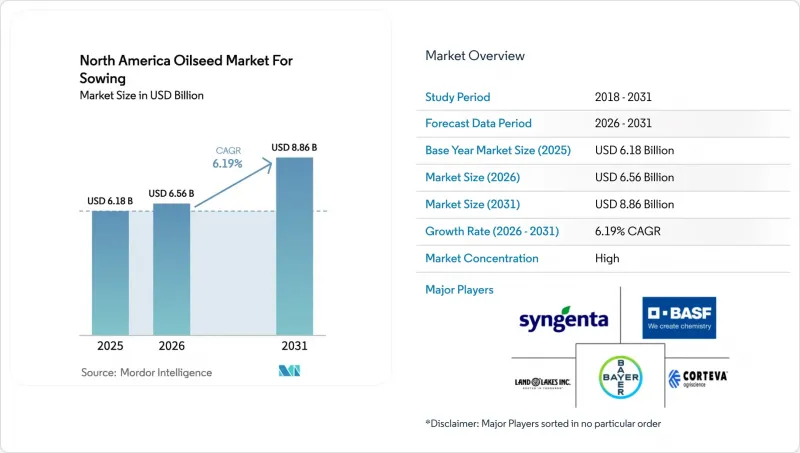
This report is Segmented by Breeding Technology (Hybrids, and Open Pollinated Varieties, and Hybrid Derivatives), by Crop (Canola, Rapeseed and Mustard, Soybean, Sunflower, and More), and by Geography (Canada, Mexico, United States, and More). The Market Forecasts are Provided in Terms of Value (USD) and Volume (Metric Tons).
North America Oilseed for Sowing Market Trends and Insights
Renewable-Diesel Driven Demand Surge for Vegetable Oils
United States renewable diesel capacity is on track to hit 5.9 billion gallons in 2025, more than doubling 2023 output and requiring heavy volumes of soybean and canola oil feedstocks. Each gallon of fuel consumes roughly 7.6 pounds of vegetable oil, so processors such as Cargill and ADM are racing to expand crush facilities designed for fuel-grade oils. The premium offered by fuel blenders over food markets is widening basis levels for high-oil varieties, steering planting decisions toward genetics that maximize oil yield per acre. Federal and state low-carbon mandates provide a multi-year demand signal that underpins processor investments and encourages growers to pivot acreage from feed grains into oilseeds.
Rapid On-Farm Adoption of Herbicide-Tolerant GM Traits
Herbicide-tolerant soybeans now cover 96% of United States acres, but grower focus has shifted from single glyphosate tolerance to triple-stacked platforms that layer glyphosate, glufosinate, and either dicamba or 2,4-D resistance. This rotation is a direct response to herbicide-resistant weeds that blanket more than 70 million acres in the United States. Trait cycling forces annual seed replacement, lifting royalty collections but also exposing farmers to steeper input costs as trait fees can represent 40% of seed invoices. Health Canada approvals keep pace, clearing transgenic soybeans and canola within months of United States authorizations and allowing simultaneous North American launches. As resistance intensifies, stacked traits become a management necessity rather than a premium option, sustaining growth in the North America oilseed market.
Regulatory Uncertainty on GM Traits and Herbicide Bans
Average regulatory review for new GM traits now exceeds five years in North America, inflating R&D budgets that ultimately filter into seed invoices. The EPA's drifting stance on chemistries such as glyphosate and glufosinate raises doubts over trait longevity, complicating product-cycle planning for breeders. Mexico's proposed GM corn ban underscores global policy risk and signals possible spillover into oilseed approvals. Although the Canadian Food Inspection Agency remains supportive, synchronized launches with the United States mean any delay stalls Canadian market access. Litigation from environmental groups layers added unpredictability, nudging companies to prioritize traits with clearer regulatory paths over cutting-edge gene-edited solutions that lack precedent.
Other drivers and restraints analyzed in the detailed report include:
- Record Canadian Canola Acreage Expansion
- Dicamba Exit Accelerates 2,4-D-Based Trait Replacement Cycle
- Yield Volatility from Extreme Weather Events
For complete list of drivers and restraints, kindly check the Table Of Contents.
Segment Analysis
Hybrid cultivars held 92.35% of the North America Oilseed for Sowing Market share in 2025, and this sub-segment is set to advance at a 6.23% CAGR through 2031. Non-transgenic hybrids carve a premium niche among growers serving identity-preserved export channels that restrict GM content, yet their footprint remains small compared with transgenic stacks. Trait developers are pairing hybrid vigor with CRISPR-enabled oil-quality edits that fetch food and fuel premiums, reinforcing the North America oilseed market growth trajectory.
Open-pollinated varieties continue to shrink, sustained mainly by organic rotations where GM traits are prohibited. Hybrid derivatives built on public germplasm offer a transitional step for regional breeders lacking proprietary parents, but royalty terms often mirror full hybrids, limiting uptake. Commercial pipeline data show more than 150 fresh oilseed varieties, almost all hybrid, cleared North American registration in 2024. The intellectual property framework ensures breeders can recoup R&D investment, sustaining innovation momentum.
Complete Report Scope:
- Breeding Technology
- Hybrids
- Non-Transgenic Hybrids
- Transgenic Hybrids
- Herbicide Tolerant Hybrids
- Insect Resistant Hybrids
- Other Traits
- Open Pollinated Varieties & Hybrid Derivatives
- Hybrids
- Crop
- Canola, Rapeseed & Mustard
- Soybean
- Sunflower
- Other Oilseeds
- Geography
- Canada
- Mexico
- United States
- Rest of North America
List of Companies Covered in this Report:
- Syngenta Group
- Bayer AG
- Advanta Seeds (UPL Ltd.)
- DLF A/S
- Groupe Limagrain
- KWS SAAT SE & Co. KGaA
- S&W Seed Co.
- BASF SE
- Land O'Lakes Inc.
- Beck's Superior Hybrids Inc.
- Corteva Inc.
- Stine Seed Company
- Nuseed (Nufarm Ltd.)
- Sakata Seed Corporation
Additional Benefits:
- The market estimate (ME) sheet in Excel format
- 3 months of analyst support
TABLE OF CONTENTS
1 INTRODUCTION
- 1.1 Study Assumptions and Market Definition
- 1.2 Scope of the Study
- 1.3 Research Methodology
2 REPORT OFFERS
3 EXECUTIVE SUMMARY & KEY FINDINGS
4 KEY INDUSTRY TRENDS
- 4.1 Area Under Cultivation
- 4.1.1 Row Crops
- 4.2 Most Popular Traits
- 4.2.1 Soybean
- 4.3 Breeding Techniques
- 4.3.1 Row Crops
- 4.4 Regulatory Framework
- 4.5 Value Chain & Distribution Channel Analysis
- 4.6 Market Drivers
- 4.6.1 Renewable diesel-driven demand surge for vegetable oils
- 4.6.2 Rapid on-farm adoption of herbicide-tolerant GM traits
- 4.6.3 Record Canadian canola acreage expansion
- 4.6.4 Dicamba exit accelerates 2,4-D-based trait replacement cycle
- 4.6.5 Carbon-credit programs stimulate sunflower and flax cover-crop seed demand
- 4.6.6 High-oleic soybean contract premiums reshape seed mix
- 4.7 Market Restraints
- 4.7.1 Regulatory uncertainty on GM traits and herbicide bans
- 4.7.2 Yield volatility from extreme weather events
- 4.7.3 Herbicide-resistant weed proliferation eroding trait value
- 4.7.4 Rising seed prices from IP concentration hitting small growers
5 MARKET SIZE AND GROWTH FORECASTS (VALUE AND VOLUME)
- 5.1 Breeding Technology
- 5.1.1 Hybrids
- 5.1.1.1 Non-Transgenic Hybrids
- 5.1.1.2 Transgenic Hybrids
- 5.1.1.2.1 Herbicide Tolerant Hybrids
- 5.1.1.2.2 Insect Resistant Hybrids
- 5.1.1.2.3 Other Traits
- 5.1.2 Open Pollinated Varieties & Hybrid Derivatives
- 5.1.1 Hybrids
- 5.2 Crop
- 5.2.1 Canola, Rapeseed & Mustard
- 5.2.2 Soybean
- 5.2.3 Sunflower
- 5.2.4 Other Oilseeds
- 5.3 Geography
- 5.3.1 Canada
- 5.3.2 Mexico
- 5.3.3 United States
- 5.3.4 Rest of North America
6 COMPETITIVE LANDSCAPE
- 6.1 Key Strategic Moves
- 6.2 Market Share Analysis
- 6.3 Company Landscape
- 6.4 Company Profiles (Includes Global Level Overview, Market Level Overview, Core Business Segments, Financials, Key Information, Market Rank, Market Share, Products and Services, and Analysis of Recent Developments).
- 6.4.1 Syngenta Group
- 6.4.2 Bayer AG
- 6.4.3 Advanta Seeds (UPL Ltd.)
- 6.4.4 DLF A/S
- 6.4.5 Groupe Limagrain
- 6.4.6 KWS SAAT SE & Co. KGaA
- 6.4.7 S&W Seed Co.
- 6.4.8 BASF SE
- 6.4.9 Land O'Lakes Inc.
- 6.4.10 Beck's Superior Hybrids Inc.
- 6.4.11 Corteva Inc.
- 6.4.12 Stine Seed Company
- 6.4.13 Nuseed (Nufarm Ltd.)
- 6.4.14 Sakata Seed Corporation
7 KEY STRATEGIC QUESTIONS FOR SEED CEOS

