PUBLISHER: Mordor Intelligence | PRODUCT CODE: 2100753

PUBLISHER: Mordor Intelligence | PRODUCT CODE: 2100753
Satellite Parts and Components - Market Share Analysis, Industry Trends & Statistics, Growth Forecasts (2026 - 2031)
According to Mordor Intelligence, the satellite parts and components market size is expected to grow from USD 40.66 billion in 2025 to USD 44.28 billion in 2026, and is forecasted to reach USD 68.05 billion by 2031 at an 8.97% CAGR over 2026-2031.
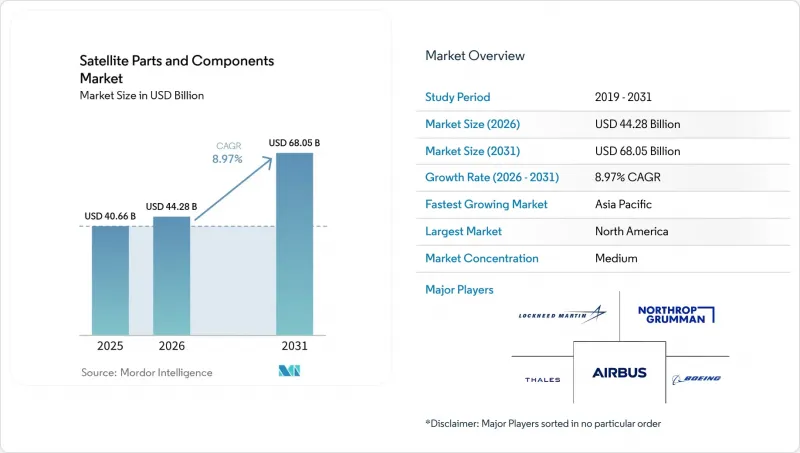
This report is Segmented by Subsystem (Solar Array and Power Hardware, Structures, Harness and Mechanisms, Propulsion Hardware and Propellant, and More), Component (Hardware and Software), Application (Communication, Navigation, Earth Observation, and More), and Geography (North America, Europe, Asia-Pacific, and More). The Market Forecasts are Provided in Terms of Value (USD).
Global Satellite Parts and Components Market Trends and Insights
Rapid Proliferation of LEO Broadband Constellations
LEO broadband deployments are resetting build cadence and component standardization across the satellite parts and components market. Commercial operators are scaling production lines and embedding higher-throughput crosslinks, which lifts demand for phased arrays, electric propulsion, and radiation-tolerant compute. Amazon's Project Kuiper reported early service demonstrations in 2026 and confirmed high-volume assembly with optical inter-satellite link capability, a signal that mission-critical components are entering a repeatable manufacturing regime. Airbus disclosed a EUR 2.2 billion (USD 2.59 billion) award for 440 next-generation satellites that move more signal processing onboard, expanding the addressable market for space-qualified FPGAs and high-throughput digital processors. Regional programs add to the wave, with the G60 plan in Shanghai highlighting mass deployments that amplify demand for standardized buses and propulsion kits. The cumulative effect is a predictable, serial demand profile that enables tiered suppliers to invest in automation and quality systems suitable for aerospace tolerances.
Standardization and Mass-Manufacture of Satellite Buses
Manufacturers are consolidating part counts and tooling with modular bus templates and additive fabrication, compressing integration cycles in the satellite parts and components market. Boeing announced 3D-printed solar array substrates designed to cut composite build time by up to 6 months and reported delivering over 150,000 printed parts across its aerospace portfolio, demonstrating maturation from prototyping to production-grade flight hardware. Japan's Space Strategy Fund earmarked financing to lift Quality-Cost-Delivery (QCD) across key components such as solar cells, cover glass, and arrays, supporting domestic standardization that meets defense specifications without bespoke rework. As bus platforms converge on common interfaces, suppliers of structures, harnesses, and power modules can scale through flexible, semi-automated flow lines that reduce requalification costs. This pattern mirrors high-volume playbooks in adjacent sectors while maintaining the fundamentals of traceability and reliability for flight systems. Over time, standardization supports interchangeable subsystems, which smooths demand volatility and reduces working capital needs.
High-Rel Buy-Qualified Component Shortages and Long Lead Times
Specialized space-grade electronics and materials continue to face supply constraints, slowing assembly schedules and moderating near-term growth in the satellite parts and components market. Demand for advanced memory, packaging, and radiation-hardened devices competes with adjacent sectors, which limits surge capacity at foundries and module lines. Niche optical terminals, crypto devices, and certain propulsion components rely on a small number of qualified suppliers, so disruptions ripple through integration timelines. Prime contractors have responded by expanding integration and test space, which supports parallel workstreams and higher throughput once components arrive. Ground segment programs also emphasize cloud-native architectures and agile release cycles to keep mission schedules on track while flight hardware backlogs unwind. Over time, further standardization and dual-sourcing strategies are expected to reduce bottlenecks, but the near-term impact remains material for high-reliability builds.
Other drivers and restraints analyzed in the detailed report include:
- Defense Adoption of Commercial-Off-The-Shelf (COTS) Components
- 3-D Printing of RF and Structural Parts
- Orbital-Debris Liability Raising Insurance and Design Costs
For complete list of drivers and restraints, kindly check the Table Of Contents.
Segment Analysis
Propulsion hardware and propellant commanded a 33.76% share in 2025 and are projected to grow at a 10.22% CAGR through 2031, making it the fastest-rising subsystem within the satellite parts and components market. Electric propulsion options such as Hall-effect and ion thrusters are gaining share in LEO constellations where continuous station-keeping and efficient orbital transfers are priorities. The requirement to meet end-of-life disposal timelines continues to nudge designs toward greater propellant reserves and more reliable attitude-control logic. Growth in optical crosslinks and mesh routing drives orbit-raising and phasing needs that align with electric propulsion profiles. Suppliers with combined portfolios in chemical and electric thrusters are focusing on flexible interfaces, enabling bus-level configurability across mission profiles. Integration of propulsion with bus avionics and fault-tolerant power architectures is improving system-level reliability as production runs lengthen and test data accumulates.
The propulsion segment's trajectory is reinforced by sustainability mandates and proliferated architectures that demand precise end-of-life control. The FCC's 2024 five-year deorbit standard codified propulsive disposal planning as a non-negotiable baseline for operators, with implications for sizing and redundancy of both chemical and electric thrusters. The satellite parts and components industry is also experimenting with new propellants and feed systems to raise specific impulse without sacrificing manufacturability. As serial production advances, procurement emphasizes components with proven radiation tolerance, long-life cathodes, and consistent qualification test results across lots. Production capacity expansions at leading integrators support parallel lines for different thruster classes, which lowers cycle times once buy-qualified parts are available. Over the forecast horizon, the satellite parts and components market is expected to see propulsion suppliers consolidate around scalable modules that serve both compliance and maneuverability needs.
Complete Report Scope:
- By Subsystem
- Solar Array and Power Hardware
- Structures, Harness and Mechanisms
- Propulsion Hardware and Propellant
- Satellite Bus and Subsystems
- By Component
- Hardware
- Software
- By Application
- Communication
- Navigation
- Earth Observation
- Space Observation
- Others
- By Geography
- North America
- United States
- Canada
- Mexico
- Europe
- United Kingdom
- Germany
- France
- Russia
- Rest of Europe
- Asia-Pacific
- China
- India
- Japan
- South Korea
- Rest of Asia-Pacific
- South America
- Brazil
- Argentina
- Rest of South America
- Middle East and Africa
- Middle East
- Israel
- Saudi Arabia
- Turkey
- Rest of Middle East
- Africa
- South Africa
- Rest of Africa
- Middle East
- North America
Geography Analysis
North America led with 39.54% share in 2025, supported by defense and civil space programs that underpin consistent procurement of bus avionics, propulsion, power, and communications payloads. The US Space Development Agency's Transport and Tracking Layers have awarded multi-vendor tranches for a proliferated LEO architecture, spreading orders across primes and specialist manufacturers while reinforcing serial production behaviors. Prime contractors have expanded integration and test capacity to support larger parallel workstreams, leading to a smoother transition from development to production. Ground segment modernization is integrating cloud-native approaches that enhance command and control for proliferated architectures. The regulatory environment emphasizes orbital debris compliance and technology controls, shaping component specifications and increasing the need for mission assurance in procurement. Suppliers in the region benefit from government-backed programs that maintain cadence across budget cycles.
Asia-Pacific is forecasted to grow fastest at 11.73% CAGR through 2031, propelled by constellation build-outs and government programs that emphasize domestic component capability. China's large-scale LEO plans and regional manufacturing initiatives have increased the flow of standardized bus and subsystem orders, and public sector programs signal sustained capacity development. Japan's Space Strategy Fund commits to domestic production of solar cells, cover glass, arrays, and related components, with quality and radiation-resilience targets that align with both commercial and defense missions. Regional launch providers and integrators continue to focus on small- and medium-class satellites that support modular component ecosystems. As supply chains localize, qualification and testing infrastructure within the region will expand, enabling faster time-to-fly for domestic builds. These moves position Asia-Pacific suppliers to compete for global orders as standards converge.
Europe maintains steady demand anchored by climate monitoring, secure communications, and sovereign constellation initiatives that reinforce ongoing investment in bus platforms and payloads. ESA's Zero Debris Charter and active debris removal programs influence component sizing and end-of-life capabilities, supporting propulsion, guidance, and structural segments. European primes continue to streamline operations and pursue technology upgrades in additive manufacturing, digital payloads, and optical terminals to compete on cost and capability. Secure communications and defense-driven programs expand opportunities for suppliers of crypto, radiation-hardened electronics, and optical crosslinks. Overall, regional policy and agency-backed missions create durable demand for components while standardization pushes efficiency gains across the value chain.
- AAC Clyde Space AB
- GomSpace
- Airbus SE
- BAE Systems plc
- The Boeing Company
- General Dynamics Corporation
- Honeywell International Inc.
- Jena-Optronik GmbH
- L3Harris Technologies, Inc.
- Lockheed Martin Corporation
- Mitsubishi Electric Corporation
- Northrop Grumman Corporation
- OHB SE
- Redwire Corporation
- Sener Engineering Group
- Sierra Space Corporation
- Thales Group
Additional Benefits:
- The market estimate (ME) sheet in Excel format
- 3 months of analyst support
TABLE OF CONTENTS
1 INTRODUCTION
- 1.1 Study Assumptions and Market Definition
- 1.2 Scope of the Study
2 RESEARCH METHODOLOGY
3 EXECUTIVE SUMMARY
4 KEY INDUSTRY TRENDS
- 4.1 Satellite Miniaturization
- 4.2 Satellite Mass and Launch Statistics Analysis
- 4.3 Spending on Space Programs Analysis
5 MARKET LANDSCAPE
- 5.1 Market Overview
- 5.2 Market Drivers
- 5.2.1 Rapid proliferation of LEO broadband constellations
- 5.2.2 Standardization and mass-manufacture of satellite buses
- 5.2.3 Defense adoption of Commercial-Off-The-Shelf (COTS) components
- 5.2.4 3D printing of RF and structural parts
- 5.2.5 Optical inter-satellite link (OISL) design wins in small sats
- 5.2.6 Space-sustainability mandates driving demand for de-orbit kits
- 5.3 Market Restraints
- 5.3.1 High-rel buy-qualified component shortages and long lead times
- 5.3.2 Tariff and export-control risk on radiation-hardened semiconductors
- 5.3.3 Orbital-debris liability raising insurance and design costs
- 5.3.4 Super-heavy-lift launch delay risk for next-gen large buses
- 5.4 Value Chain Analysis
- 5.5 Regulatory Landscape
- 5.6 Technological Outlook
- 5.7 Porter's Five Forces Analysis
- 5.7.1 Threat of New Entrants
- 5.7.2 Bargaining Power of Suppliers
- 5.7.3 Bargaining Power of Buyers
- 5.7.4 Threat of Substitutes
- 5.7.5 Intensity of Competitive Rivalry
6 MARKET SIZE AND GROWTH FORECASTS (VALUE)
- 6.1 By Subsystem
- 6.1.1 Solar Array and Power Hardware
- 6.1.2 Structures, Harness and Mechanisms
- 6.1.3 Propulsion Hardware and Propellant
- 6.1.4 Satellite Bus and Subsystems
- 6.2 By Component
- 6.2.1 Hardware
- 6.2.2 Software
- 6.3 By Application
- 6.3.1 Communication
- 6.3.2 Navigation
- 6.3.3 Earth Observation
- 6.3.4 Space Observation
- 6.3.5 Others
- 6.4 By Geography
- 6.4.1 North America
- 6.4.1.1 United States
- 6.4.1.2 Canada
- 6.4.1.3 Mexico
- 6.4.2 Europe
- 6.4.2.1 United Kingdom
- 6.4.2.2 Germany
- 6.4.2.3 France
- 6.4.2.4 Russia
- 6.4.2.5 Rest of Europe
- 6.4.3 Asia-Pacific
- 6.4.3.1 China
- 6.4.3.2 India
- 6.4.3.3 Japan
- 6.4.3.4 South Korea
- 6.4.3.5 Rest of Asia-Pacific
- 6.4.4 South America
- 6.4.4.1 Brazil
- 6.4.4.2 Argentina
- 6.4.4.3 Rest of South America
- 6.4.5 Middle East and Africa
- 6.4.5.1 Middle East
- 6.4.5.1.1 Israel
- 6.4.5.1.2 Saudi Arabia
- 6.4.5.1.3 Turkey
- 6.4.5.1.4 Rest of Middle East
- 6.4.5.2 Africa
- 6.4.5.2.1 South Africa
- 6.4.5.2.2 Rest of Africa
- 6.4.5.1 Middle East
- 6.4.1 North America
7 COMPETITIVE LANDSCAPE
- 7.1 Market Concentration
- 7.2 Strategic Moves
- 7.3 Market Share Analysis
- 7.4 Company Profiles (includes Global level Overview, Market level overview, Core Segments, Financials as available, Strategic Information, Market Rank/Share for key companies, Products and Services, and Recent Developments)
- 7.4.1 AAC Clyde Space AB
- 7.4.2 GomSpace
- 7.4.3 Airbus SE
- 7.4.4 BAE Systems plc
- 7.4.5 The Boeing Company
- 7.4.6 General Dynamics Corporation
- 7.4.7 Honeywell International Inc.
- 7.4.8 Jena-Optronik GmbH
- 7.4.9 L3Harris Technologies, Inc.
- 7.4.10 Lockheed Martin Corporation
- 7.4.11 Mitsubishi Electric Corporation
- 7.4.12 Northrop Grumman Corporation
- 7.4.13 OHB SE
- 7.4.14 Redwire Corporation
- 7.4.15 Sener Engineering Group
- 7.4.16 Sierra Space Corporation
- 7.4.17 Thales Group
8 MARKET OPPORTUNITIES AND FUTURE OUTLOOK
- 8.1 White-space and Unmet-need Assessment

