PUBLISHER: Mordor Intelligence | PRODUCT CODE: 2100755

PUBLISHER: Mordor Intelligence | PRODUCT CODE: 2100755
Southeast Asia Health and Fitness Club - Market Share Analysis, Industry Trends & Statistics, Growth Forecasts (2026 - 2031)
According to Mordor Intelligence, Southeast Asia health and fitness club market size in 2026 is estimated at USD 2.93 billion, growing from 2025 value of USD 2.68 billion with 2031 projections showing USD 4.56 billion, growing at 9.24% CAGR over 2026-2031.
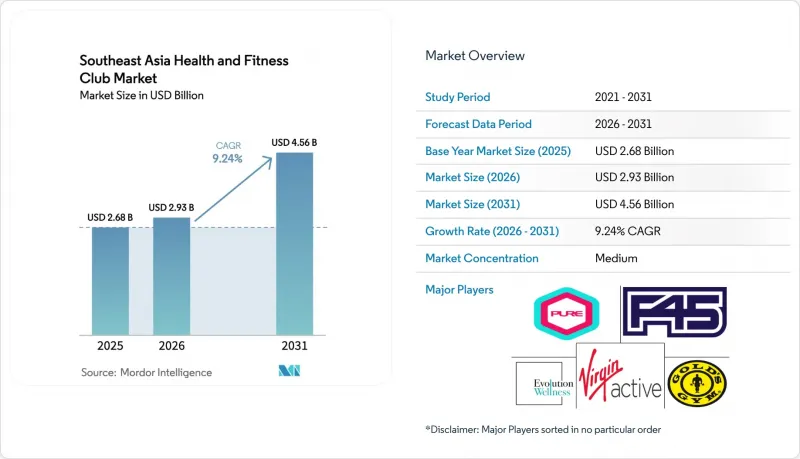
This report is Segmented by Service Type (Membership Fees, Personal Training and Instruction, and More), by Outlet Format (Chained Clubs and Independent Clubs), by End User (Male and Female), and by Geography (Singapore, Malaysia, Thailand, Indonesia, Philippines, Vietnam, and Rest of Southeast Asia). The Market Forecasts are Provided in Terms of Value (USD).
Southeast Asia Health and Fitness Club Market Trends and Insights
Increasing Health Consciousness and Proactive Wellness Focus
In Southeast Asia, the wellness economy is evolving, pushing the demand for fitness clubs beyond mere exercise to a holistic approach to lifestyle management. In 2024, Singapore's Health Promotion Board rolled out the 'Healthier SG' initiative, spotlighting preventive care and forging community health partnerships. Complementing this, the National Steps Challenge incentivizes citizens, rewarding them for hitting the target of 150 minutes of moderate-to-vigorous physical activity weekly. Such government-endorsed wellness initiatives are not just promoting exercise as a leisure activity but are embedding it into the very fabric of healthcare, ensuring a steady demand for fitness services. As healthcare costs climb and awareness of chronic diseases grows, Southeast Asia's burgeoning middle class is increasingly viewing fitness memberships as vital health investments. This regional health consciousness isn't just about treatment; it's about a proactive approach to fitness, underscored by Thailand's allure, drawing in 2.86 million medical tourists in 2023.
Rising Prevalence of Lifestyle Diseases Driving Preventive Healthcare
As diabetes and obesity rates surge, Southeast Asia's urbanization and sedentary lifestyles underscore the value of fitness clubs. Indonesia's Healthcare Law No. 17 of 2023, prioritizing preventive care and telemedicine, signals a shift. Concurrently, Bio Farma partners with Google Cloud and Fitbit, launching platforms aimed at chronic disease prevention. Such moves elevate fitness clubs from mere service providers to pivotal healthcare allies. With the region's demographic shift leaning towards an aging populace, the demand for preventive healthcare intensifies. Medical professionals increasingly prescribe fitness programs for managing chronic conditions. Highlighting this trend, Thailand's Department of Older Persons reported in June 2024, approximately 7.45 million female and 5.87 million male senior citizens. Recognizing the benefits, corporate wellness programs flourish, as employers see fitness investments curtailing healthcare costs and boosting productivity.
Intense Competition Among Fitness Providers
In prime urban locations, market saturation is squeezing operator margins and speeding up consolidation trends. Vietnam's fitness market saw a notable shrinkage, with a drop in gym numbers over the year. Smaller chains faced stiff competition, leading to rising membership fees as operators chased revenue stability. The bankruptcy of WeFit in Vietnam underscores the risks of aggressive pricing. Their unlimited access model, while enticing, set off unsustainable costs, resulting in delayed payments to partners and ultimately, the company's downfall. As international chains ramp up their presence, competition heats up. Notably, Japanese fitness operators are eyeing Southeast Asia, drawn by demographic hurdles back home. This heightened competition pushes operators to stand out, leaning on tech adoption, specialized programs, or elevated service levels, rather than just price wars. In 2024, Thailand boasted 450 Muay Thai gyms, with Bangkok leading the pack at 164.
Other drivers and restraints analyzed in the detailed report include:
- Growing Popularity of Specialized Fitness Offerings
- Expansion and Adoption of Fitness Technology
- High Operating and Maintenance Costs
For complete list of drivers and restraints, kindly check the Table Of Contents.
Segment Analysis
Despite membership fees commanding an 80.12% market share in 2025, personal training services are on track to achieve the fastest growth rate, projected at a 11.78% CAGR through 2031. This trend underscores consumers' readiness to invest in premium, personalized coaching and specialized programming-services that standard gym access fails to offer. Other service categories, such as group fitness classes, nutrition counseling, and wellness services, are emerging as lucrative revenue streams. Operators are increasingly bundling these services with core memberships, aiming to boost both retention rates and average revenue per user.
This pivot towards personalized fitness mirrors a broader healthcare movement that champions individualized treatments and preventive care. Highlighting this trend, Singapore's Active Health program, as noted by Sport Singapore, showcases government endorsement for tailored fitness guidance. By backing qualified experts and bespoke programming, the government lends regulatory credibility to premium service models. Furthermore, operators are harnessing technology to amplify personal training. With tools like virtual coaching, AI-driven workout suggestions, and remote monitoring, trainers can extend their influence beyond traditional one-on-one interactions. This tech infusion not only enables fitness clubs to command higher premiums for personal training but also ensures they operate efficiently while broadening service access to a larger member base.
Complete Report Scope:
- By Service Type
- Membership Fees
- Personal Training and Instruction
- Other Service Type
- By Outlet Format
- Chained Clubs
- Independent Clubs
- By End User
- Male
- Female
- By Geography
- Singapore
- Malaysia
- Thailand
- Indonesia
- Philippines
- Vietnam
- Rest of Southeast Asia
List of Companies Covered in this Report:
- Evolution Wellness
- Pure International
- Self Esteem Brands (Anytime Fitness)
- RSG Group (Gold's Gym, McFIT)
- Virgin Active
- Celebrity Fitness
- Fitness First Asia
- F45 Training Holdings
- Snap Fitness
- UFC Gym
- Saigon Sports Club
- Elite Fitness Vietnam
- Believe Fitness Malaysia
- Fitstop (Australia/SEA)
- True Group
- GoFit
- Ritual Gym
- The Hybrid Movement
- REV Cycle
- Ride Revolution
Additional Benefits:
- The market estimate (ME) sheet in Excel format
- 3 months of analyst support
TABLE OF CONTENTS
1 INTRODUCTION
- 1.1 Study Assumptions and Market Definition
- 1.2 Scope of the Study
2 RESEARCH METHODOLOGY
3 EXECUTIVE SUMMARY
4 MARKET LANDSCAPE
- 4.1 Market Overview
- 4.2 Market Drivers
- 4.2.1 Increasing Health Consciousness and Proactive Wellness Focus
- 4.2.2 Rising Prevalence of Lifestyle Diseases (Obesity, Diabetes) Driving Preventive Healthcare
- 4.2.3 Growing Popularity of Specialized Fitness Offerings (Yoga, Pilates, HIIT)
- 4.2.4 Expansion and Adoption of Fitness Technology
- 4.2.5 Increasing Female Participation in Fitness Activities
- 4.2.6 Rising Demand for Personalized Fitness Plans and One-on-One Coaching
- 4.3 Market Restraints
- 4.3.1 Intense Competition Among Fitness Providers
- 4.3.2 High Operating and Maintenance Costs
- 4.3.3 Competition from Alternative Fitness Formats (Home Workouts, Outdoor Activities)
- 4.3.4 Challenges in Retaining Membership and Building Brand Loyalty
- 4.4 Consumer Behavior Analysis
- 4.5 Regulatory Landscape
- 4.6 Technological Outlook
- 4.7 Porter's Five Forces
- 4.7.1 Threat of New Entrants
- 4.7.2 Bargaining Power of Buyers
- 4.7.3 Bargaining Power of Suppliers
- 4.7.4 Threat of Substitutes
- 4.7.5 Competitive Rivalry
5 MARKET SIZE AND GROWTH FORECASTS (VALUE)
- 5.1 By Service Type
- 5.1.1 Membership Fees
- 5.1.2 Personal Training and Instruction
- 5.1.3 Other Service Type
- 5.2 By Outlet Format
- 5.2.1 Chained Clubs
- 5.2.2 Independent Clubs
- 5.3 By End User
- 5.3.1 Male
- 5.3.2 Female
- 5.4 By Geography
- 5.4.1 Singapore
- 5.4.2 Malaysia
- 5.4.3 Thailand
- 5.4.4 Indonesia
- 5.4.5 Philippines
- 5.4.6 Vietnam
- 5.4.7 Rest of Southeast Asia
6 COMPETITIVE LANDSCAPE
- 6.1 Market Concentration
- 6.2 Strategic Moves
- 6.3 Market Share Analysis
- 6.4 Company Profiles (includes Global level Overview, Market level overview, Core Segments, Financials as available, Strategic Information, Market Rank/Share for key companies, Products and Services, and Recent Developments)
- 6.4.1 Evolution Wellness
- 6.4.2 Pure International
- 6.4.3 Self Esteem Brands (Anytime Fitness)
- 6.4.4 RSG Group (Gold's Gym, McFIT)
- 6.4.5 Virgin Active
- 6.4.6 Celebrity Fitness
- 6.4.7 Fitness First Asia
- 6.4.8 F45 Training Holdings
- 6.4.9 Snap Fitness
- 6.4.10 UFC Gym
- 6.4.11 Saigon Sports Club
- 6.4.12 Elite Fitness Vietnam
- 6.4.13 Believe Fitness Malaysia
- 6.4.14 Fitstop (Australia/SEA)
- 6.4.15 True Group
- 6.4.16 GoFit
- 6.4.17 Ritual Gym
- 6.4.18 The Hybrid Movement
- 6.4.19 REV Cycle
- 6.4.20 Ride Revolution
7 MARKET OPPORTUNITIES AND FUTURE OUTLOOK

