PUBLISHER: Mordor Intelligence | PRODUCT CODE: 2100759

PUBLISHER: Mordor Intelligence | PRODUCT CODE: 2100759
Non-Woven Packaging - Market Share Analysis, Industry Trends & Statistics, Growth Forecasts (2026 - 2031)
According to Mordor Intelligence, the non-Woven packaging market size was valued at 1.73 billion tons in 2025 and estimated to grow from 1.86 billion tons in 2026 to reach 2.65 billion tons by 2031, at a CAGR of 7.38% during the forecast period (2026-2031).
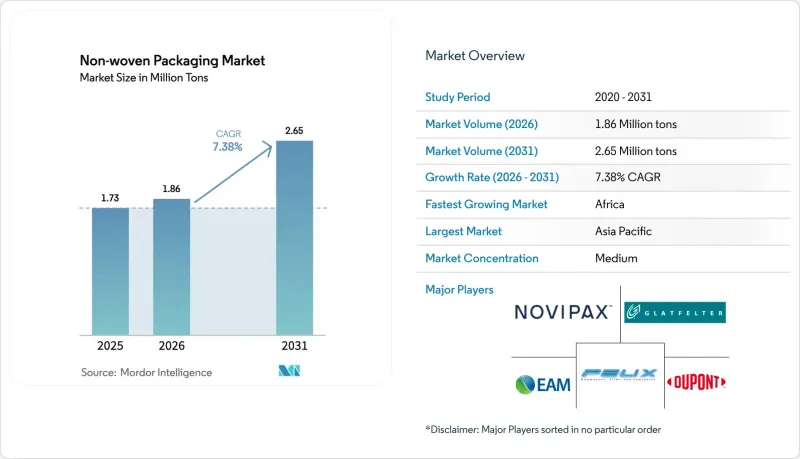
This report is Segmented by Technology (Dry-Laid, Spun-Laid, Melt-Blown, Hydro-Entangled, Other Technologies), End-User Packaging Application (Food and Beverage, Industrial, Medical and Healthcare, Consumer Goods, Agriculture, Other Applications), and by Geography. The Market Forecasts are Provided in Terms of Volume (Tons).
Global Non-Woven Packaging Market Trends and Insights
Growing Demand for Environmentally Sustainable Packaging
California's SB 1046 bans single-use plastic carry-out bags that lack recyclability from January 2025, forcing retailers to shift to compostable non-woven substitutes that meet strict biodegradation criteria. Vermont's statewide ban cut plastic bag consumption by 91% and achieved strong public approval, reinforcing the policy momentum that favors compostable PLA or cellulose non-woven formats. The Fraunhofer Institute demonstrated commercial-scale PLA film that fully decomposes under industrial composting and won the 2024 Joseph von Fraunhofer Prize, giving converters a proven high-performance substrate.
Rising Consumption in Food-Grade Sacks, Bags and Wrap
Retailers boost lightweight spunbond polypropylene sacks for staples, sauces, and ready meals to curb transport weight and avoid condensation. Non-woven crop and seed bulk bags unlock longer shelf life by regulating humidity inside the weave, a feature especially valued by Asian rice exporters. EU single-use rules further accelerate compostable pouch launches based on PLA webs with embedded non-woven filters for applications such as coffee pods released by NatureWorks in 2024.
Volatile Polypropylene and PET Feedstock Prices
Raffia-grade polypropylene averaged USD 980 per metric ton in South Asia in March 2025, a 4% quarter-on-quarter rise that squeezed converter margins. Crude-linked PTA and MEG hikes ripple into PET sheets, prompting moth-balled lines in Europe to curb losses. These gyrations push buyers toward fixed-price bio-based feedstocks, especially when carbon-tax exposure is considered.
Other drivers and restraints analyzed in the detailed report include:
- E-Commerce Boom Fuelling Protective Non-Woven Formats
- Proliferation of Medical PPE and Sterilization Wraps
- Tightening Single-Use Plastic Legislation
For complete list of drivers and restraints, kindly check the Table Of Contents.
Segment Analysis
Spun-laid lines captured 43.60% of 2025 throughput on the strength of integrated fiber spinning and web consolidation that lowers unit cost and allows fabric weights below 15 gsm without sacrificing tensile strength. This cost edge keeps commodity sacks and agriculture row covers in the spun-laid camp. Melt-blown plants post the fastest gains at an 8.12% CAGR to 2031 as filtration-grade diameters below 2 µm become essential for sterile wraps and high-barrier snack packs. Dry-laid and hydro-entangled substrates retain niches in premium gift wraps and consumer wipes where hand feel counts. DiloGroup's patent on energy-saving intense needling reduces kWh per kilogram by one-third versus water-jet bonding, offering converters a profitability booster once the design scales.
A deeper technology mix reduces supply risk and cushions raw-material volatility. Spun-laid output relocates closer to resin sources in the Gulf Cooperation Council, while melt-blown specialists co-locate near medical device hubs in North America and East Asia. These moves shorten lead times and prune freight emissions. Consequently, spun-laid remains pivotal in the Non-Woven Packaging Market as the preferred choice for cost-sensitive bulk formats, yet melt-blown gains relevance in value-added protective
Complete Report Scope:
- By Technology
- Dry-Laid
- Spun-Laid
- Melt-blown
- Hydro-Entangled
- Other Technologies
- By End-user Packaging Application
- Food and Beverage
- Industrial
- Medical and Healthcare
- Consumer Goods
- Agriculture
- Other Applications
- By Geography
- North America
- United States
- Canada
- Mexico
- South America
- Brazil
- Argentina
- Rest of South America
- Europe
- Germany
- United Kingdom
- France
- Italy
- Spain
- Rest of Europe
- Asia-Pacific
- China
- Japan
- South Korea
- India
- Indonesia
- Australia
- Rest of Asia-Pacific
- Middle East and Africa
- Middle East
- UAE
- Saudi Arabia
- Turkey
- Rest of Middle East
- Africa
- South Africa
- Egypt
- Rest of Africa
- Middle East
- North America
Geography Analysis
Asia-Pacific led the Non-Woven Packaging Market in 2025 with 31.75% share due to integrated resin-to-fabric hubs in China, India, and Malaysia. China's packaging converters enjoyed low-cost energy and massive e-commerce parcel flow that justified new spun-laid lines of 10,000 tons per year. India's flexible packaging expansion, valued at USD 49 billion in 2023, created downstream pull for specialty webs as local food giants replace PVC film with recyclable PP non-wovens. Japan and South Korea leveraged high-precision melt-blown expertise for medical consumables bound for the United States and Europe.
Africa recorded the quickest growth at 7.99% CAGR owing to government incentives for domestic manufacturing and continental free-trade corridors that ease movement of finished bags. New lines in Nigeria and Egypt feed regional grain exporters, reducing reliance on imported jute sacks. South Africa's retailers trial compostable PLA carry-bags that comply with extended producer responsibility fees. These moves push capacity utilization past 70% on recently installed spunbond machines by 2026, giving Africa a distinctive growth narrative within the Non-Woven Packaging Market.
- Novipax Buyer LLC
- EAM Corporation (Domtar)
- Glatfelter Corporation
- Felix Nonwovens
- DuPont de Nemours Inc.
- Freudenberg Performance Materials
- Mundo Productos SA
- Eximius Innovative Pvt Ltd
- Ahlstrom-Munksj Oyj
- Berry Global Inc.
- Kimberly-Clark Corporation
- Suominen Corporation
- Fibertex Nonwovens A/S
- PFNonwovens a.s.
- Johns Manville
- Avgol Industries Ltd
- Toray Industries Inc.
- Mitsui Chemicals Inc.
- Fitesa S.A.
- Pegas Nonwovens (R2G)
- Lydall Inc. (Unifrax)
- Sandler AG
- TWE Group
- Zhejiang Kingsafe Advanced Material Co.
Additional Benefits:
- The market estimate (ME) sheet in Excel format
- 3 months of analyst support
TABLE OF CONTENTS
1 INTRODUCTION
- 1.1 Study Assumptions and Market Definition
- 1.2 Scope of the Study
2 RESEARCH METHODOLOGY
3 EXECUTIVE SUMMARY
4 MARKET LANDSCAPE
- 4.1 Market Overview
- 4.2 Market Drivers
- 4.2.1 Growing demand for environmentally sustainable packaging
- 4.2.2 Rising consumption in food-grade sacks, bags and wrap
- 4.2.3 E-commerce boom fuelling protective non-woven formats
- 4.2.4 Proliferation of medical PPE and sterilisation wraps
- 4.2.5 Adoption of mono-material recyclable laminates (under-radar)
- 4.2.6 Bio-based polymer breakthroughs lowering VOC footprint (under-radar)
- 4.3 Market Restraints
- 4.3.1 Volatile poly-propylene and PET feedstock prices
- 4.3.2 Tightening single-use-plastic legislation
- 4.3.3 Competition from paper and bioplastic alternatives
- 4.3.4 Limited recycling infrastructure for composite webs (under-radar)
- 4.4 Supply-Chain Analysis
- 4.5 Regulatory Landscape
- 4.6 Technological Outlook
- 4.7 Porter's Five Forces Analysis
- 4.7.1 Threat of New Entrants
- 4.7.2 Bargaining Power of Buyers
- 4.7.3 Bargaining Power of Suppliers
- 4.7.4 Threat of Substitutes
- 4.7.5 Competitive Rivalry
- 4.8 Assesment of Macroeconomic Factors on the Market
5 MARKET SIZE AND GROWTH FORECASTS (VALUE)
- 5.1 By Technology
- 5.1.1 Dry-Laid
- 5.1.2 Spun-Laid
- 5.1.3 Melt-blown
- 5.1.4 Hydro-Entangled
- 5.1.5 Other Technologies
- 5.2 By End-user Packaging Application
- 5.2.1 Food and Beverage
- 5.2.2 Industrial
- 5.2.3 Medical and Healthcare
- 5.2.4 Consumer Goods
- 5.2.5 Agriculture
- 5.2.6 Other Applications
- 5.3 By Geography
- 5.3.1 North America
- 5.3.1.1 United States
- 5.3.1.2 Canada
- 5.3.1.3 Mexico
- 5.3.2 South America
- 5.3.2.1 Brazil
- 5.3.2.2 Argentina
- 5.3.2.3 Rest of South America
- 5.3.3 Europe
- 5.3.3.1 Germany
- 5.3.3.2 United Kingdom
- 5.3.3.3 France
- 5.3.3.4 Italy
- 5.3.3.5 Spain
- 5.3.3.6 Rest of Europe
- 5.3.4 Asia-Pacific
- 5.3.4.1 China
- 5.3.4.2 Japan
- 5.3.4.3 South Korea
- 5.3.4.4 India
- 5.3.4.5 Indonesia
- 5.3.4.6 Australia
- 5.3.4.7 Rest of Asia-Pacific
- 5.3.5 Middle East and Africa
- 5.3.5.1 Middle East
- 5.3.5.1.1 UAE
- 5.3.5.1.2 Saudi Arabia
- 5.3.5.1.3 Turkey
- 5.3.5.1.4 Rest of Middle East
- 5.3.5.2 Africa
- 5.3.5.2.1 South Africa
- 5.3.5.2.2 Egypt
- 5.3.5.2.3 Rest of Africa
- 5.3.5.1 Middle East
- 5.3.1 North America
6 COMPETITIVE LANDSCAPE
- 6.1 Market Concentration
- 6.2 Strategic Initiatives
- 6.3 Market Share Analysis
- 6.4 Company Profiles (includes Global level Overview Recent Developments)
- 6.4.1 Novipax Buyer LLC
- 6.4.2 EAM Corporation (Domtar)
- 6.4.3 Glatfelter Corporation
- 6.4.4 Felix Nonwovens
- 6.4.5 DuPont de Nemours Inc.
- 6.4.6 Freudenberg Performance Materials
- 6.4.7 Mundo Productos SA
- 6.4.8 Eximius Innovative Pvt Ltd
- 6.4.9 Ahlstrom-Munksj Oyj
- 6.4.10 Berry Global Inc.
- 6.4.11 Kimberly-Clark Corporation
- 6.4.12 Suominen Corporation
- 6.4.13 Fibertex Nonwovens A/S
- 6.4.14 PFNonwovens a.s.
- 6.4.15 Johns Manville
- 6.4.16 Avgol Industries Ltd
- 6.4.17 Toray Industries Inc.
- 6.4.18 Mitsui Chemicals Inc.
- 6.4.19 Fitesa S.A.
- 6.4.20 Pegas Nonwovens (R2G)
- 6.4.21 Lydall Inc. (Unifrax)
- 6.4.22 Sandler AG
- 6.4.23 TWE Group
- 6.4.24 Zhejiang Kingsafe Advanced Material Co.
7 MARKET OPPORTUNITIES AND FUTURE OUTLOOK
- 7.1 White-space and Unmet-need Assessment

