PUBLISHER: Mordor Intelligence | PRODUCT CODE: 2113199

PUBLISHER: Mordor Intelligence | PRODUCT CODE: 2113199
Functional Printing - Market Share Analysis, Industry Trends & Statistics, Growth Forecasts (2026 - 2031)
According to Mordor Intelligence, functional printing market size in 2026 is estimated at USD 35.11 billion, growing from 2025 value of USD 29.75 billion with 2031 projections showing USD 80.39 billion, growing at 18.02% CAGR over 2026-2031.
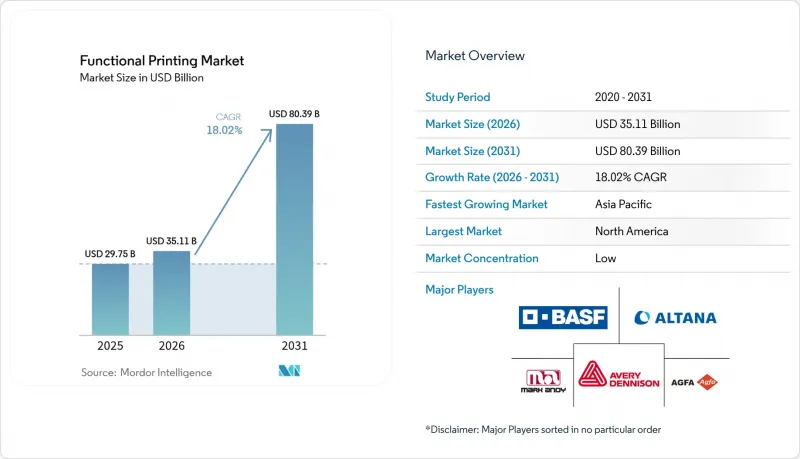
This report is Segmented by Substrates (Paper and Paperboard, Plastic Films, and More), Ink (Conductive Inks, Dielectric and Insulating Inks, and More), Printing Technology (Inkjet Printing, Screen Printing, Gravure Printing, Flexography Printing, and More), Application (Sensors, Displays, OLED Lighting Panels, and More), and Geography. The Market Sizes and Forecasts are Provided in Terms of Value (USD).
Global Functional Printing Market Trends and Insights
Demand for Low-Cost, High-Speed Electronic Production
Cost pressure across the consumer and automotive sectors prompts OEMs to replace photolithography with roll-processed functional circuits that require no cleanroom infrastructure. Automotive battery-management systems now integrate printed temperature and current sensors that cut electronics cost by up to 60% while meeting non-critical accuracy thresholds. Regional fabs equipped with roll-to-roll lines can localize production in under six months, allowing quicker response to design iterations than traditional silicon foundries. This flexibility helps Asian contract manufacturers win new projects for smart packaging inserts and Bluetooth antennas by bundling design support with low-margin, high-volume output. As performance ceilings rise through better ink sintering, the functional printing market gains share in mid-range electronics previously reserved for rigid PCBs.
Rapid Adoption of Flexible and Wearable Electronics
Digitized healthcare embraces on-skin devices that flex naturally with body movement, an area where rigid silicon substrates underperform. Northwestern University's skin health patch captures hydration and pH data without user discomfort. European cardiology clinics are piloting printed ECG stickers that achieve 96-hour wear without irritation, improving patient compliance. High-yield printing of stretchable circuits enables mass adoption because each unit ships fully functional from the press, reducing costly assembly steps. Asian manufacturers capitalize on scale economics to ship tens of millions of glucose-monitoring patches annually, feeding a global installed base that drives recurring demand for ancillary cloud-based analytics.
Performance Gap vs. Silicon Electronics
Printed IGZO transistors still lag silicon mobility benchmarks, limiting uptake in computing and high-speed telecom devices. Silicon carbide's 2700 °C melting point dwarfs printed electronics' thermal ceiling below 200 °C, excluding printed circuits from harsh-temperature automotive zones. Mission-critical aerospace and medical implants remain tethered to proven silicon because long-term drift in polymer inks risks field failures. This ceiling confines the functional printing market to segments where flexibility or price trumps ultimate performance.
Other drivers and restraints analyzed in the detailed report include:
- Advances in Conductive and Dielectric Ink Chemistry
- IoT-Driven Smart Packaging Volumes
- Lack of Global Manufacturing Standards
For complete list of drivers and restraints, kindly check the Table Of Contents.
Segment Analysis
Glass and ceramic substrates are projected to grow at 21.98% CAGR, outpacing the wider functional printing market through 2031. Their thermal stability and optical clarity suit automotive HUD displays and high-temperature pressure sensors. Plastic films retained 54.12% functional printing market share in 2025 by supporting ultrafast, low-cost roll-to-roll lines that supply smart labels and consumer wearables. Despite higher handling costs, glass improves dimensional stability at micron pitches, enabling multilayer OLED backplanes that plastic cannot achieve with sufficient yield.
Manufacturers optimize each substrate choice around curing profiles; PET allows photo-sintered silver within seconds, while ceramic routes use thermal sintering to achieve high conductivity without substrate warping. Paper and nanocellulose boards gain traction for disposable biodevice patches, aligning with circular-economy regulations. Metal foils remain niche for EMI shielding and high-current bus lines where their conductivity offsets added weight. Substrate diversification gives OEMs a palette to match performance with sustainability targets driving balanced growth across segments of the functional printing market.
Conductive inks captured 64.89% of revenue in 2025 and remain the bedrock of most printed circuits. Yet nanoparticle-based functional inks are forecast to escalate at 22.12% CAGR, underscoring their prowess in reducing line resistance without elevating curing temperature. Silver nanoparticle pastes now reach 10^5 S/m conductivity after photonic sintering, a figure once reserved for bulk metal.Copper inks pare material spend but demand inert-atmosphere curing stations to prevent oxidation, prompting hybrid printing lines that switch atmospheres mid-run.
Dielectric inks evolve alongside conductors; low-loss organosilicate formulations permit GHz-range antennas on thin PET, replacing etched FR-4 in low-power IoT nodes. Photovoltaic and thermoelectric ink systems widen functional printing market addressable use-cases by letting manufacturers coat large solar or energy-harvest layers in minutes. As chemistry innovation accelerates, ink suppliers differentiate on flake geometry, binder biology, and sintering compatibility, deepening collaborative R&D with printer-OEMs.
Complete Report Scope:
- By Substrates
- Paper and Paperboard
- Plastic Films
- Glass and Ceramics
- Metal Foils and Flex-metals
- By Inks
- Conductive Inks
- Dielectric and Insulating Inks
- Semiconductive and PV Inks
- Nanoparticle-based Functional Inks
- By Printing Technology
- Inkjet Printing
- Drop-on-Demand Inkjet
- Continuous Inkjet
- Screen Printing
- Gravure Printing
- Flexography Printing
- Aerosol Jet Printing
- Other Printing Technology
- Inkjet Printing
- By Application
- Sensors
- Temperature and Humidity Sensors
- Pressure and Force Sensors
- Biosensors and Wearables
- Displays
- E-paper Displays
- OLED Displays
- OLED Lighting Panels
- Flexible Thin-film Batteries
- Photovoltaic
- Organic PV
- Perovskite PV
- RFID and NFC Tags
- Other Application
- Sensors
- By Geography
- North America
- United States
- Canada
- Mexico
- Europe
- Germany
- United Kingdom
- France
- Italy
- Spain
- Russia
- Rest of Europe
- Asia-Pacific
- China
- Japan
- South Korea
- India
- ASEAN
- Australia
- Rest of Asia-Pacific
- Middle East and Africa
- Middle East
- GCC
- Turkey
- Rest of Middle East
- Africa
- South Africa
- Egypt
- Nigeria
- Rest of Africa
- Middle East
- South America
- Brazil
- Argentina
- Rest of South America
- North America
Geography Analysis
North America maintained leadership with 32.12% share in 2025 on the back of defense avionics and advanced automotive interiors that specify cutting-edge printed films. The functional printing market size for North America is slated to grow steadily on high equipment replacement cycles in flexible PCB lines. Asia-Pacific, meanwhile, is forecast for the quickest 21.09% CAGR, buoyed by Chinese and Japanese incentives that reimburse capital outlays for roll-to-roll production. Elephantech's USD 20.1 million Series E demonstrates domestic appetite for sustainable printed PCBs.
European suppliers focus on premium segments such as medical wearables and automotive lidar housings, leveraging stringent regulatory hurdles as a competitive moat. Initiatives like the Reform Project aim to secure a local supply chain for critical inks and substrates, mitigating geopolitical risk. The Middle East and Africa invest in printed solar foils for off-grid lighting, while South American agribusiness deploys low-cost soil-moisture labels to optimize irrigation. These divergent priorities underline why regional specialization rather than one-size-fits-all solutions will drive functional printing market adoption.
- Avery Dennison Corp.
- BASF SE
- Blue Spark Technologies
- E Ink Holdings Inc.
- Eastman Kodak Co.
- Enfucell Oy
- GSI Technologies LLC
- Isorg SA
- Mark Andy Inc.
- ALTANA AG
- Agfa-Gevaert NV
- Ceradrop - MGI Group
- DuPont de Nemours Inc.
- Samsung Electronics (Printed Solutions)
- LG Display Co.
- Molex LLC
- Thinfilm Electronics ASA
- Toppan Forms Co.
- Toyo Ink SC Holdings
- Optomec Inc.
- Xaar PLC
- Xennia Technology Ltd.
- Kateeva Inc.
- NovaCentrix
- Cambrios Advanced Materials
- Nano Dimension Ltd.
Additional Benefits:
- The market estimate (ME) sheet in Excel format
- 3 months of analyst support
TABLE OF CONTENTS
1 INTRODUCTION
- 1.1 Study Assumptions and Market Definition
- 1.2 Scope of the Study
2 RESEARCH METHODOLOGY
3 EXECUTIVE SUMMARY
4 MARKET LANDSCAPE
- 4.1 Market Overview
- 4.2 Market Drivers
- 4.2.1 Demand for low-cost, high-speed electronic production
- 4.2.2 Rapid adoption of flexible and wearable electronics
- 4.2.3 Advances in conductive and dielectric ink chemistry
- 4.2.4 IoT-driven smart packaging volumes
- 4.2.5 Roll-to-roll 3D structural electronics in e-mobility
- 4.2.6 On-skin diagnostic patches for tele-health
- 4.3 Market Restraints
- 4.3.1 Performance gap vs. silicon electronics
- 4.3.2 Lack of global manufacturing standards
- 4.3.3 Silver nanoparticle supply volatility
- 4.3.4 E-waste rules targeting non-recyclable substrates
- 4.4 Supply-Chain Analysis
- 4.5 Regulatory Landscape
- 4.6 Technological Outlook
- 4.7 Investment and Funding Landscape
- 4.8 Porter's Five Forces Analysis
- 4.8.1 Threat of New Entrants
- 4.8.2 Bargaining Power of Buyers
- 4.8.3 Bargaining Power of Suppliers
- 4.8.4 Threat of Substitutes
- 4.8.5 Intensity of Rivalry
5 MARKET SIZE AND GROWTH FORECASTS (VALUE)
- 5.1 By Substrates
- 5.1.1 Paper and Paperboard
- 5.1.2 Plastic Films
- 5.1.3 Glass and Ceramics
- 5.1.4 Metal Foils and Flex-metals
- 5.2 By Inks
- 5.2.1 Conductive Inks
- 5.2.2 Dielectric and Insulating Inks
- 5.2.3 Semiconductive and PV Inks
- 5.2.4 Nanoparticle-based Functional Inks
- 5.3 By Printing Technology
- 5.3.1 Inkjet Printing
- 5.3.1.1 Drop-on-Demand Inkjet
- 5.3.1.2 Continuous Inkjet
- 5.3.2 Screen Printing
- 5.3.3 Gravure Printing
- 5.3.4 Flexography Printing
- 5.3.5 Aerosol Jet Printing
- 5.3.6 Other Printing Technology
- 5.3.1 Inkjet Printing
- 5.4 By Application
- 5.4.1 Sensors
- 5.4.1.1 Temperature and Humidity Sensors
- 5.4.1.2 Pressure and Force Sensors
- 5.4.1.3 Biosensors and Wearables
- 5.4.2 Displays
- 5.4.2.1 E-paper Displays
- 5.4.2.2 OLED Displays
- 5.4.3 OLED Lighting Panels
- 5.4.4 Flexible Thin-film Batteries
- 5.4.5 Photovoltaic
- 5.4.5.1 Organic PV
- 5.4.5.2 Perovskite PV
- 5.4.6 RFID and NFC Tags
- 5.4.7 Other Application
- 5.4.1 Sensors
- 5.5 By Geography
- 5.5.1 North America
- 5.5.1.1 United States
- 5.5.1.2 Canada
- 5.5.1.3 Mexico
- 5.5.2 Europe
- 5.5.2.1 Germany
- 5.5.2.2 United Kingdom
- 5.5.2.3 France
- 5.5.2.4 Italy
- 5.5.2.5 Spain
- 5.5.2.6 Russia
- 5.5.2.7 Rest of Europe
- 5.5.3 Asia-Pacific
- 5.5.3.1 China
- 5.5.3.2 Japan
- 5.5.3.3 South Korea
- 5.5.3.4 India
- 5.5.3.5 ASEAN
- 5.5.3.6 Australia
- 5.5.3.7 Rest of Asia-Pacific
- 5.5.4 Middle East and Africa
- 5.5.4.1 Middle East
- 5.5.4.1.1 GCC
- 5.5.4.1.2 Turkey
- 5.5.4.1.3 Rest of Middle East
- 5.5.4.2 Africa
- 5.5.4.2.1 South Africa
- 5.5.4.2.2 Egypt
- 5.5.4.2.3 Nigeria
- 5.5.4.2.4 Rest of Africa
- 5.5.4.1 Middle East
- 5.5.5 South America
- 5.5.5.1 Brazil
- 5.5.5.2 Argentina
- 5.5.5.3 Rest of South America
- 5.5.1 North America
6 COMPETITIVE LANDSCAPE
- 6.1 Market Concentration
- 6.2 Strategic Moves
- 6.3 Market Share Analysis
- 6.4 Company Profiles (includes Global level Overview, Market level overview, Core Segments, Financials as available, Strategic Information, Market Rank/Share, Products and Services, Recent Developments)
- 6.4.1 Avery Dennison Corp.
- 6.4.2 BASF SE
- 6.4.3 Blue Spark Technologies
- 6.4.4 E Ink Holdings Inc.
- 6.4.5 Eastman Kodak Co.
- 6.4.6 Enfucell Oy
- 6.4.7 GSI Technologies LLC
- 6.4.8 Isorg SA
- 6.4.9 Mark Andy Inc.
- 6.4.10 ALTANA AG
- 6.4.11 Agfa-Gevaert NV
- 6.4.12 Ceradrop - MGI Group
- 6.4.13 DuPont de Nemours Inc.
- 6.4.14 Samsung Electronics (Printed Solutions)
- 6.4.15 LG Display Co.
- 6.4.16 Molex LLC
- 6.4.17 Thinfilm Electronics ASA
- 6.4.18 Toppan Forms Co.
- 6.4.19 Toyo Ink SC Holdings
- 6.4.20 Optomec Inc.
- 6.4.21 Xaar PLC
- 6.4.22 Xennia Technology Ltd.
- 6.4.23 Kateeva Inc.
- 6.4.24 NovaCentrix
- 6.4.25 Cambrios Advanced Materials
- 6.4.26 Nano Dimension Ltd.
7 MARKET OPPORTUNITIES AND FUTURE OUTLOOK
- 7.1 White-space and Unmet-Need Assessment

