PUBLISHER: Mordor Intelligence | PRODUCT CODE: 2113208

PUBLISHER: Mordor Intelligence | PRODUCT CODE: 2113208
North America Agriculture Adjuvants - Market Share Analysis, Industry Trends & Statistics, Growth Forecasts (2026 - 2031)
According to Mordor Intelligence, North America agriculture adjuvants market size in 2026 is estimated at USD 1.77 billion, growing from 2025 value of USD 1.67 billion with 2031 projections showing USD 2.33 billion, growing at 5.73% CAGR over 2026-2031.
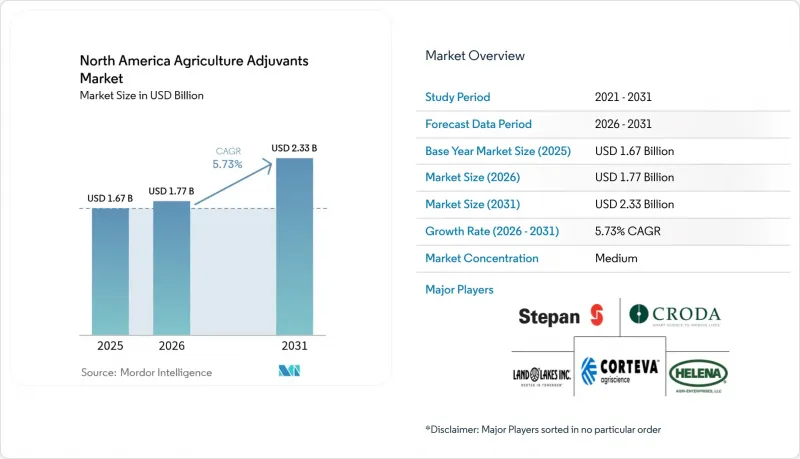
This report is Segmented by Type (Activator Adjuvants and Utility Adjuvants), by Application (Herbicide Adjuvants, Insecticide Adjuvants, Fungicide Adjuvants, and More), by Crop Type (Crop-Based and Non-Crop-Based), and by Geography (United States, Mexico, Canada, and More). The Market Forecasts are Provided in Terms of Value (USD).
North America Agriculture Adjuvants Market Trends and Insights
Increasing Use of Natural and Sustainable Adjuvants
Organic acreage in the United States grew 12% year on year to 5.6 million acres in 2024, opening more shelf space for OMRI-listed adjuvants that comply with National Organic Program rules . Methyl soyate and ethyl lactate are now displacing petroleum-based crop-oil concentrates in many herbicide programs as retailers extend sustainability scorecards to their supply partners. Croda's rapeseed-derived surfactant line, launched in 2024, illustrates how renewable feedstocks can satisfy both volatile-organic-compound limits and grower preference for lower-risk inputs. California's stringent Volatile Organic Compound (VOC) rules accelerate this trend because low adjuvants preserve air-quality compliance without compromising efficacy. Carbon-intensity metrics embedded in food-processor supply contracts amplify demand by rewarding input suppliers that can document Scope 3 reductions.
Growing Demand for Crop-Protection Chemicals
Palmer amaranth and waterhemp resistance to glyphosate triggered a 25% surge in herbicide treatments per acre in Midwestern corn and soybean systems since 2020, elevating adjuvant usage to maintain coverage without raising active-ingredient loads. Mexico mirrors this trajectory: federal subsidies now offset up to 50% of herbicide and adjuvant costs for commercial farms in Sinaloa and Sonora under the Fertilizantes para el Bienestar program. Insecticide adjuvants are also climbing as pyrethroid resistance spreads in corn rootworm and soybean aphid populations, spurring interest in chemistries that enhance cuticle penetration and rainfastness. Almond and grape growers deploy premium adjuvants to enhance fungicide canopy coverage, thereby extending spray intervals and reducing labor bottlenecks during peak season as growers stack modes of action, adjuvants that buffer pH, and manage water hardness, becoming indispensable to avoid antagonism in complex tank mixes.
Stringent Environmental Protection Agency and Regulatory Guidelines
The Environmental Protection Agency's (EPA's) 2024 Herbicide Strategy requires applicators in 1,500 counties designated under the Endangered Species Act to log adjuvant selection and weather parameters, prompting small operators to adopt new record-keeping systems or face compliance penalties. Coarser droplet mandates now cover 40% of the United States cropland, which can reduce efficacy on small-seeded weeds and may lead to repeat treatments if unsuitable adjuvants are used. Canada's Pest Management Regulatory Agency added aquatic-toxicity data requirements for every surfactant component, extending registration timelines and raising costs for new entrants. Mexico tightened import permits on nonylphenol ethoxylate blends, forcing distributors either to reformulate or exit. As hurdles rise, suppliers with Environmental Protection Agency (EPA) registrations gain a market advantage because growers prefer traceable products that simplify audits.
Other drivers and restraints analyzed in the detailed report include:
- Higher Investment in Adjuvant R&D by Multinationals
- Expansion of Precision-Spraying Technologies
- Low Grower Awareness in Specialty-Crop Pockets
For complete list of drivers and restraints, kindly check the Table Of Contents.
Segment Analysis
Activator adjuvants accounted for 60.25% of the revenue in 2025, as non-ionic surfactants and crop-oil concentrates remained core to post-emergence herbicide programs in corn and soybeans. Oil-based blends that include methyl soyate offer enhanced penetration and rainfastness, explaining their continued presence even as bio-based alternatives emerge. Utility adjuvants, however, are forecast to rise 9.41% annually to 2031, lifting the North America agriculture adjuvants market size for this category well above USD 980 million by the period end. Drift-control polymers and deposition aids form the backbone of this surge because precision sprayers triple the active-ingredient concentration in the tank, which increases the risk of clogging without specialized additives .
Water conditioners are another high-growth pocket, given evidence that untreated hard-water conditions can slash glyphosate efficacy by as much as 30%. Compatibility agents round out the story as biologicals move mainstream, making it a non-negotiable requirement for growers who want single-pass applications, preventing flocculation when mixing microbes and synthetics. Momentum in these utility segments means the North America agriculture adjuvants market share for activators is expected to slide modestly even as absolute activator revenue rises.
Complete Report Scope:
- By Type
- Activator Adjuvants
- Surfactants
- Oil Adjuvants
- Utility Adjuvants
- Activator Adjuvants
- By Application
- Herbicide Adjuvants
- Insecticide Adjuvants
- Fungicide Adjuvants
- Other Applications
- By Crop Type
- Crops Based
- Grains and Cereals
- Fruits and Vegetables
- Oil Seeds
- Other Applications
- Non-Crops Based
- Turf and Ornamental Grass
- Others
- Crops Based
- By Geography
- United States
- Canada
- Mexico
- Rest of North America
List of Companies Covered in this Report:
- Corteva Agriscience
- Land O'Lakes Inc.
- Stepan Company
- Croda International plc
- Helena Agri-Enterprises LLC (Marubeni Corporation)
- Huntsman Corporation
- Farmers Business Network Inc.
- BASF SE
- Evonik Industries AG
- Solvay SA
- Nufarm Limited
- Loveland Products Inc. (Nutrien Ltd.)
- Wilbur-Ellis Company LLC
- Clariant AG
- Nouryon Holding B.V.
Additional Benefits:
- The market estimate (ME) sheet in Excel format
- 3 months of analyst support
TABLE OF CONTENTS
1 Introduction
- 1.1 Study Assumptions and Market Definition
- 1.2 Scope of the Study
2 Research Methodology
3 Executive Summary
4 Market Landscape
- 4.1 Market Overview
- 4.2 Market Drivers
- 4.2.1 Increasing use of natural and sustainable adjuvants
- 4.2.2 Growing demand for crop-protection chemicals
- 4.2.3 Higher investment in adjuvant R&D by multinationals
- 4.2.4 Expansion of precision-spraying technologies
- 4.2.5 Carbon-credit incentives for input-efficiency products
- 4.2.6 Surfactant blends optimized for biologicals
- 4.3 Market Restraints
- 4.3.1 Stringent Environmental Protection Agency and regulatory guidelines
- 4.3.2 Low grower awareness in specialty-crop pockets
- 4.3.3 Volatility in tall-oil and methyl-soyate feedstocks
- 4.3.4 Increasing scrutiny of wetting agents
- 4.4 Regulatory Landscape
- 4.5 Technological Outlook
- 4.6 Porter's Five Forces Analysis
- 4.6.1 Bargaining Power of Suppliers
- 4.6.2 Bargaining Power of Buyers
- 4.6.3 Threat of New Entrants
- 4.6.4 Threat of Substitute Products
- 4.6.5 Intensity of Competitive Rivalry
5 Market Size and Growth Forecasts (Value)
- 5.1 By Type
- 5.1.1 Activator Adjuvants
- 5.1.1.1 Surfactants
- 5.1.1.2 Oil Adjuvants
- 5.1.2 Utility Adjuvants
- 5.1.1 Activator Adjuvants
- 5.2 By Application
- 5.2.1 Herbicide Adjuvants
- 5.2.2 Insecticide Adjuvants
- 5.2.3 Fungicide Adjuvants
- 5.2.4 Other Applications
- 5.3 By Crop Type
- 5.3.1 Crops Based
- 5.3.1.1 Grains and Cereals
- 5.3.1.2 Fruits and Vegetables
- 5.3.1.3 Oil Seeds
- 5.3.1.4 Other Applications
- 5.3.2 Non-Crops Based
- 5.3.2.1 Turf and Ornamental Grass
- 5.3.2.2 Others
- 5.3.1 Crops Based
- 5.4 By Geography
- 5.4.1 United States
- 5.4.2 Canada
- 5.4.3 Mexico
- 5.4.4 Rest of North America
6 Competitive Landscape
- 6.1 Market Concentration
- 6.2 Strategic Moves
- 6.3 Market Share Analysis
- 6.4 Company Profiles (Includes Global Level Overview, Market Level Overview, Core Segments, Financials as Available, Strategic Information, Market Rank/Share, Products and Services, Recent Developments)
- 6.4.1 Corteva Agriscience
- 6.4.2 Land O'Lakes Inc.
- 6.4.3 Stepan Company
- 6.4.4 Croda International plc
- 6.4.5 Helena Agri-Enterprises LLC (Marubeni Corporation)
- 6.4.6 Huntsman Corporation
- 6.4.7 Farmers Business Network Inc.
- 6.4.8 BASF SE
- 6.4.9 Evonik Industries AG
- 6.4.10 Solvay SA
- 6.4.11 Nufarm Limited
- 6.4.12 Loveland Products Inc. (Nutrien Ltd.)
- 6.4.13 Wilbur-Ellis Company LLC
- 6.4.14 Clariant AG
- 6.4.15 Nouryon Holding B.V.
7 Market Opportunities and Future Outlook

