PUBLISHER: Mordor Intelligence | PRODUCT CODE: 2113224

PUBLISHER: Mordor Intelligence | PRODUCT CODE: 2113224
Whole Slide Imaging - Market Share Analysis, Industry Trends & Statistics, Growth Forecasts (2026 - 2031)
According to Mordor Intelligence, whole slide imaging market size in 2026 is estimated at USD 1.37 billion, growing from 2025 value of USD 1.29 billion with 2031 projections showing USD 1.86 billion, growing at 6.31% CAGR over 2026-2031.
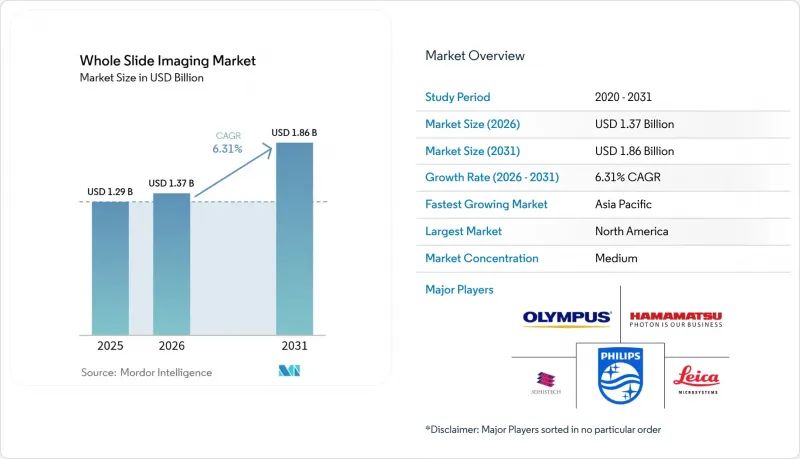
This report is Segmented by Component (Hardware, Software), Scanner Type (Brightfield Scanners, Fluorescence Scanners, and More), Application (Telepathology, Cytopathology, and More), End User (Hospitals & Clinical Laboratories, Academic & Research Institutes, and More), and Geography (North America, Europe, and More). The Market Forecasts are Provided in Terms of Value (USD), Based On Availability.
Global Whole Slide Imaging Market Trends and Insights
Accelerating Adoption of Digital Pathology for Remote Diagnostics
Remote reporting allows scarce pathologists to serve multiple sites, slashing turnaround from days to hours. China's national telepathology network processed more than 16,000 consults within two years, showing scale efficiencies in underserved regions. During the COVID-19 emergency, the FDA issued guidance supporting home-based digital reads, cementing clinical trust in virtual workflows. Cloud portals now link scanners, image managers, and laboratory information systems so cases move seamlessly from staining to sign-out. Third-party AI plug-ins add tumor detection and grading, turning remote practice into a subscription service rather than a capital project.
Rising Cancer Incidence & Need for Faster Histopathology Workflows
Cancer prevalence keeps outpacing traditional slide review capacity. Whole Slide Imaging market users report productivity gains of up to 37% after adopting AI-assisted tumor localization, freeing specialists for complex analytics. Digital co-reading lets several consultants review the same specimen simultaneously, eliminating sequential bottlenecks that delay therapy. Precision oncology also drives demand for automated immunostains and molecular overlays that require pixel-perfect registration, something optical microscopes cannot deliver. Labs running mature digital protocols processed 21% more cases per pathologist in 2024.
High Upfront Capital Expenditure for Scanners & Storage
Full digitization can cost USD 100,000-200,000 for hardware, servers, and licenses, a hurdle for community providers. Added expenses include maintenance, cybersecurity, and staff retraining. Financial studies still show ROI inside six years via labor savings and space consolidation, yet many buyers lack the capital to bridge that gap. Leasing, managed-service, and pay-per-scan contracts are emerging to spread costs across operational budgets, an option that may lift adoption in price-sensitive segments of the Whole Slide Imaging industry.
Other drivers and restraints analyzed in the detailed report include:
- Declining Scanner Costs & Improving Image Resolution
- Integration with AI-Driven Image-Analysis Software
- Data-Privacy & Cross-Border Image-Transfer Regulations
For complete list of drivers and restraints, kindly check the Table Of Contents.
Segment Analysis
Hardware carried 64.45% of Whole Slide Imaging market share in 2025, underlining the significance of scanners, storage, and high-speed networks. Top-end autoloaders process 210-540 slides per run, ensuring capacity for national referral centers. Feature additions like fluorescent channels and darkfield imaging now arrive as firmware updates, protecting earlier investments.
Software revenues grow faster at 6.63% CAGR because buyers look beyond pixel capture toward workflow engines, AI scoring, and cloud collaboration. Subscription models create annuity streams for vendors and flatten spending for labs. Interoperable viewers, LIS bridges, and zero-footprint web consoles raise switching costs once embedded. Every new algorithm release enhances existing datasets, letting users unlock more value from archived cases and pushing the Whole Slide Imaging market toward a data-services orientation.
Brightfield devices owned 51.62% of Whole Slide Imaging market size in 2025. They remain the default for H&E, which constitutes most clinical workload. Mature optics now exceed optical microscopes in depth of focus, so adoption debates have shifted from image quality to IT integration.
Fluorescence units post the top 6.90% growth rate because multiplex biomarker panels power precision oncology. Dual-mode systems that capture brightfield and fluorescence on one chassis reduce footprint and accelerate ROI. Multispectral variants deconvolute overlapping fluorophores, helping drug developers quantify target engagement. These innovations diversify revenue and cushion hardware sellers against commoditization risks in the Whole Slide Imaging market.
Complete Report Scope:
- By Component
- Hardware
- Software
- By Scanner Type
- Brightfield Scanners
- Fluorescence Scanners
- Multiplex / Multispectral Scanners
- Others
- By Application
- Telepathology
- Cytopathology
- Hematopathology
- Immunohistochemistry
- Toxicological Pathology
- Others
- By End User
- Hospitals & Clinical Laboratories
- Academic & Research Institutes
- Pharmaceutical & Biotechnology Companies
- Contract Research Organizations
- By Geography
- North America
- United States
- Canada
- Mexico
- Europe
- Germany
- United Kingdom
- France
- Italy
- Spain
- Rest of Europe
- Asia-Pacific
- China
- India
- Japan
- South Korea
- Australia
- Rest of Asia-Pacific
- South America
- Brazil
- Argentina
- Rest of South America
- Middle East and Africa
- GCC
- South Africa
- Rest of Middle East and Africa
- North America
Geography Analysis
North America kept 43.70% of Whole Slide Imaging market revenue in 2025. Early FDA clearances normalized digital reads for primary diagnosis, and CAP checklists codified validation. Academic giants such as Memorial Sloan Kettering have proven scalability by digitizing hundreds of thousands of cases, setting reference architectures other institutions follow. Future growth leans on AI co-diagnostics rather than first-time scanner purchases.
Asia-Pacific records a 7.02% CAGR to 2031. China's nationwide program shows state-level commitment to telepathology scale-up, while Japan's mature ecosystem employs WSI in teaching and autopsy services. India's hospital build-out attracts cloud vendors who can offer subscription scanning to capacity-constrained city labs. Price sensitivity shapes buying criteria toward open-file formats, online viewers, and hosted analytics that bypass large on-premise servers, propelling the Whole Slide Imaging market across diverse income bands.
Europe sits between these extremes. Multi-hospital projects such as DigiPatICS demonstrate pan-regional rollouts operating one million slides a year. The Netherlands achieved 96% concordance between glass and digital, encouraging other EU nations to pursue full switch-overs. Data-sovereignty rules oblige localized clouds, stimulating partnerships with regional hosting providers. South America plus Middle East & Africa remain early in adoption yet present white-space upside as healthcare digitization plans mature.
- Danaher Corp. (Leica Biosystems)
- Koninklijke Philips
- Roche
- Hamamatsu Photonics
- Olympus Corp.
- 3DHistech
- Nikon Corp.
- Huron Digital Pathology Inc.
- Inspirata Inc.
- Sectra
- Indica Labs
- OptraSCAN Inc.
- Motic Digital Pathology
- Visiopharm
- Akoya Biosciences Inc.
- Corista LLC
- Glencoe Software Inc.
- Definiens AG
Additional Benefits:
- The market estimate (ME) sheet in Excel format
- 3 months of analyst support
TABLE OF CONTENTS
1 Introduction
- 1.1 Study Assumptions & Market Definition
- 1.2 Scope of the Study
2 Research Methodology
3 Executive Summary
4 Market Landscape
- 4.1 Market Overview
- 4.2 Market Drivers
- 4.2.1 Accelerating adoption of digital pathology for remote diagnostics
- 4.2.2 Rising cancer incidence & need for faster histopathology workflows
- 4.2.3 Declining scanner costs & improving image resolution
- 4.2.4 Integration with AI-driven image-analysis software
- 4.2.5 Expansion of national telepathology networks (e.g., Canada, Nordics)
- 4.2.6 Growing demand for companion diagnostics in precision oncology
- 4.3 Market Restraints
- 4.3.1 High upfront capital expenditure for scanners & storage
- 4.3.2 Data-privacy & cross-border image-transfer regulations
- 4.3.3 Limited reimbursement for digital pathology procedures
- 4.3.4 Pathologist resistance to full-scale digital workflow adoption
- 4.4 Value / Supply-Chain Analysis
- 4.5 Regulatory Landscape
- 4.6 Technological Outlook
- 4.7 Porter's Five Forces
- 4.7.1 Threat of New Entrants
- 4.7.2 Bargaining Power of Buyers
- 4.7.3 Bargaining Power of Suppliers
- 4.7.4 Threat of Substitutes
- 4.7.5 Competitive Rivalry
5 Market Size & Growth Forecasts (Value & Volume)
- 5.1 By Component
- 5.1.1 Hardware
- 5.1.2 Software
- 5.2 By Scanner Type
- 5.2.1 Brightfield Scanners
- 5.2.2 Fluorescence Scanners
- 5.2.3 Multiplex / Multispectral Scanners
- 5.2.4 Others
- 5.3 By Application
- 5.3.1 Telepathology
- 5.3.2 Cytopathology
- 5.3.3 Hematopathology
- 5.3.4 Immunohistochemistry
- 5.3.5 Toxicological Pathology
- 5.3.6 Others
- 5.4 By End User
- 5.4.1 Hospitals & Clinical Laboratories
- 5.4.2 Academic & Research Institutes
- 5.4.3 Pharmaceutical & Biotechnology Companies
- 5.4.4 Contract Research Organizations
- 5.5 By Geography
- 5.5.1 North America
- 5.5.1.1 United States
- 5.5.1.2 Canada
- 5.5.1.3 Mexico
- 5.5.2 Europe
- 5.5.2.1 Germany
- 5.5.2.2 United Kingdom
- 5.5.2.3 France
- 5.5.2.4 Italy
- 5.5.2.5 Spain
- 5.5.2.6 Rest of Europe
- 5.5.3 Asia-Pacific
- 5.5.3.1 China
- 5.5.3.2 India
- 5.5.3.3 Japan
- 5.5.3.4 South Korea
- 5.5.3.5 Australia
- 5.5.3.6 Rest of Asia-Pacific
- 5.5.4 South America
- 5.5.4.1 Brazil
- 5.5.4.2 Argentina
- 5.5.4.3 Rest of South America
- 5.5.5 Middle East and Africa
- 5.5.5.1 GCC
- 5.5.5.2 South Africa
- 5.5.5.3 Rest of Middle East and Africa
- 5.5.1 North America
6 Competitive Landscape
- 6.1 Market Concentration
- 6.2 Market Share Analysis
- 6.3 Company Profiles (includes Global level Overview, Market level overview, Core Segments, Financials as available, Strategic Information, Market Rank/Share for key companies, Products & Services, and Recent Developments)
- 6.3.1 Danaher Corp. (Leica Biosystems)
- 6.3.2 Koninklijke Philips N.V.
- 6.3.3 F. Hoffmann-La Roche AG
- 6.3.4 Hamamatsu Photonics K.K.
- 6.3.5 Olympus Corp.
- 6.3.6 3DHISTECH Ltd.
- 6.3.7 Nikon Corp.
- 6.3.8 Huron Digital Pathology Inc.
- 6.3.9 Inspirata Inc.
- 6.3.10 Sectra AB
- 6.3.11 Indica Labs
- 6.3.12 OptraSCAN Inc.
- 6.3.13 Motic Digital Pathology
- 6.3.14 Visiopharm A/S
- 6.3.15 Akoya Biosciences Inc.
- 6.3.16 Corista LLC
- 6.3.17 Glencoe Software Inc.
- 6.3.18 Definiens AG
7 Market Opportunities & Future Outlook
- 7.1 White-Space & Unmet-Need Assessment

