PUBLISHER: Mordor Intelligence | PRODUCT CODE: 2113230

PUBLISHER: Mordor Intelligence | PRODUCT CODE: 2113230
Feed Processing Machinery - Market Share Analysis, Industry Trends & Statistics, Growth Forecasts (2026 - 2031)
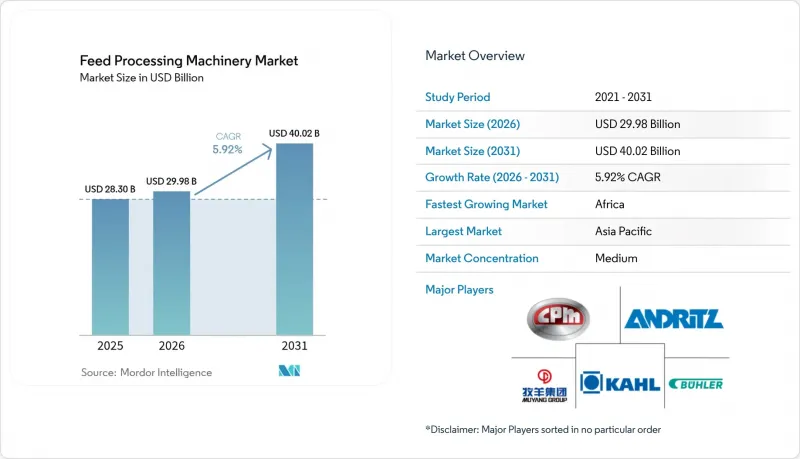
According to Mordor Intelligence, the feed processing machinery market size in 2026 is estimated at USD 29.98 billion, growing from 2025 value of USD 28.30 billion with 2031 projections showing USD 40.02 billion, growing at 5.92% CAGR over 2026-2031.
This report is Segmented by Function (Pelleting, Mixing, Grinding, and Extrusion), by Feed Type (Ruminant Feed, Poultry Feed, Swine Feed, Aquaculture Feed, and Other Animal Feed), and by Geography (North America, Europe, Asia-Pacific, South America, Middle East, and Africa). The Market Forecasts are Provided in Terms of Value (USD).
Global Feed Processing Machinery Market Trends and Insights
Rapid Shift Toward Fully Automated and IoT Enabled Feed Mills
Fully networked mills with edge-computing controllers are transforming throughput efficiency. Buhler's PelletingPro adjusts die compression every 30 seconds, reducing energy consumption by 8% and pellet breakage by 12%. Andritz's Metris suite monitors 40 sensor points per mill, reducing unscheduled stoppages by 30% during a 2024 trial in Thailand. CPM's real-time vision system automatically adjusts steam injection when pellet durability declines. For mega-farms operating continuously, these improvements in uptime are essential. Compliance with ISO 22000 standards and upcoming EU traceability regulations has made the use of automated quality logs a procurement requirement. Mid-sized mills without these capabilities risk losing supply contracts.
Expansion of Industrial Livestock Mega-Farms
In 2024, farms in China with over 5,000 sows accounted for 68% of the country's pork production, driving increased demand for pellet mills with a capacity of 40-60 metric tons per hour. Brazil's JBS invested in a poultry complex equipped with twin-shaft mixers and automated micro-dosing systems. Meanwhile, Vietnam's CP Group implemented Wenger twin-screw extruders to enhance the production of piglet starter feed. High-volume operations benefit from internalizing feed costs, utilizing advanced automation, and adjusting feed recipes daily based on growth data. While this model is less prevalent in India's fragmented poultry industry, it is now being supported by subsidized loan programs.
Volatility in Stainless Steel and Fabricated Metal Prices
Stainless steel costs increased by 18% year-over-year in early 2024 due to a tightening nickel supply and rising energy costs in Europe. Austenitic grades, including 304 and 316L, account for approximately 45% of a pellet mill's bill of materials. Andritz implemented a 12% surcharge, leading South American buyers to postpone projects, while smaller Asian fabricators experienced margin reductions of up to 300 basis points. Currency fluctuations further exacerbated costs, increasing landed expenses for import-reliant buyers and encouraging a shift toward domestic alternatives.
Other drivers and restraints analyzed in the detailed report include:
- Rising Demand for Floating and Micro-Pellet Lines in Aquafeed
- Government Incentives for Domestically Built Agro-Machinery
- High Up-Front Cost Limiting Adoption Among Small and Mid Feed Mills
For complete list of drivers and restraints, kindly check the Table Of Contents.
Segment Analysis
Pelleting equipment accounted for 37.80% of the feed processing machinery market share in 2025, highlighting its importance in poultry, swine, and ruminant diets. Pellets enhance feed conversion ratios by up to 12%, making them a critical component in animal nutrition. The market size for pelleting lines is projected to grow in alignment with the overall feed processing machinery market through 2031. This growth is supported by the continued requirement for conditioners that inject steam at 90°C and coolers that reduce moisture levels below 12%, ensuring compliance with ISO 22000 standards. Suppliers are focusing on differentiation through innovations such as quick-change dies and energy-efficient paddles. Buhler's DPMS modules enable die set changes within 30 minutes, while CPM's Turbo Conditioner has increased throughput by 15% by enhancing mash uniformity. Integrated cooling and drying modules help prevent mold formation during storage, and real-time vision systems are employed to monitor pellet durability.
Extrusion systems are anticipated to achieve the highest CAGR of 8.35%, driven by twin-screw designs that meet the specific requirements of aquaculture for floating pellets and micro-feeds. The market share for extrusion systems is expanding as twin-screw barrels can be reconfigured for different diets, such as shrimp, tilapia, or salmon, without requiring disassembly. This reduces changeover times from hours to minutes. The advancements align with the increasing precision in nutrition programs, which demand tighter particle-size tolerances.
Complete Report Scope:
- By Function
- Pelleting
- Pellet Mills
- Pellet Dies
- Conditioners
- Others (Coolers, Dryers)
- Mixing
- Mixers
- Dosing and Batching
- Others (Dust-filters)
- Grinding
- Hammer Mills
- Fine Pulverizers
- Others (Roller Mills, Screens)
- Extrusion
- Extruders
- Fat Sprayers
- Others (Pre-conditioners)
- Pelleting
- By Feed Type
- Ruminant Feed
- Poultry Feed
- Swine Feed
- Aquaculture Feed
- Other Animal Feed
- By Geography
- North America
- United States
- Canada
- Mexico
- Rest of North America
- Europe
- Germany
- United Kingdom
- France
- Italy
- Spain
- Rest of Europe
- Asia-Pacific
- China
- Japan
- India
- Rest of Asia-Pacific
- South America
- Brazil
- Argentina
- Rest of South America
- Middle East
- Saudi Arabia
- United Arab Emirates
- Rest of Middle East
- Africa
- South Africa
- Egypt
- Rest of Africa
- North America
Geography Analysis
Asia-Pacific accounted for 45.75% of the feed processing machinery market share in 2025, led by China's production of compound feed and the consolidation into 5,000-sow complexes requiring on-site mills with capacities of 40-60 metric tons per hour. India's Production-Linked Incentive program boosted demand for locally manufactured equipment, while Vietnam's aquaculture feed production reached 6.8 million metric tons, supported by state subsidies for twin-screw extruders. Thailand and Indonesia continue to expand their poultry and swine industries, whereas Japan and South Korea are retrofitting older mills with predictive maintenance systems to address labor shortages. The feed processing machinery market in the Asia-Pacific region is projected to grow further, driven by livestock intensification and stricter food safety regulations.
Africa, while smaller in absolute market size, leads in growth with a CAGR of 8.45%. Nigeria's livestock development plan and Kenya's climate-smart initiatives are channeling funds toward hammer mills, mixers, and pelletizers, promoting the adoption of cooperative farming practices. South Africa's 12 million metric tons of feed now supplies neighboring countries. Challenges such as electricity unreliability and spare parts shortages extend downtime; mobile service hubs from Buhler and Andritz are improving response times in Kenya, Tanzania, and Ghana. As subsidy programs mature, regional manufacturers such as Ottevanger and Prokop are increasing their market share.
In North America, the United States integrators are adopting CPM's SmartBatch technology for amino-acid dosing based on carcass analytics, while Canada's dairy sector is implementing precise batching systems for total mixed rations. In Europe, the European Union's Farm to Fork strategy, which mandates feed ingredient traceability by 2027, is driving investments in automation across countries such as Germany and Spain. South America, led by Brazil's feed production, benefits from low-interest loans provided by the Brazilian Development Bank, which are being used to modernize mills in the Northeast region. Chile and Ecuador are accelerating the adoption of aquafeed, while Argentina is upgrading its grinding lines to meet beef export requirements.
- Andritz AG
- Buhler Holding AG
- CPM Holdings, Inc. (American Securities LLC)
- Jiangsu Muyang Group Co., Ltd.
- Wenger Manufacturing, Inc. (Marel HF)
- Amandus Kahl GmbH & Co. KG. (KAHL Holding GmbH)
- Skiold Group A/S (Solix Group AB)
- Dinnissen B.V. (Triott Group)
- Clextral S.A.S. (Legris Industries Group)
- Van Aarsen Group B.V.
- The Ken Bratney Co.
- LA MECCANICA S.R.L. DI REFFO
- Jiangsu Zhengchang Group Co., Ltd..
- Lark Engineering Co. (India) Pvt. Ltd.
- FAMSUN Co., Ltd. (Yenher Holdings Berhad)
Additional Benefits:
- The market estimate (ME) sheet in Excel format
- 3 months of analyst support
TABLE OF CONTENTS
1 Introduction
- 1.1 Study Assumptions and Market Definition
- 1.2 Scope of the Study
2 Research Methodology
3 Executive Summary
4 Market Landscape
- 4.1 Market Overview
- 4.2 Market Drivers
- 4.2.1 Rapid Shift Toward Fully-automated and IoT-enabled Feed Mills
- 4.2.2 Expansion of Industrial Livestock Mega-farms
- 4.2.3 Rising Demand for Floating and Micro-Pellet Lines in Aquafeed
- 4.2.4 Surge in Precision-Nutrition Formulations Requiring Flexible Batching
- 4.2.5 Government Incentives for Domestically-Built Agro-machinery
- 4.2.6 AI-Driven Predictive Maintenance Reducing Unplanned Downtime
- 4.3 Market Restraints
- 4.3.1 Volatility in Stainless-Steel and Fabricated-Metal Prices
- 4.3.2 High Up-Front Cost Limiting Adoption Among Small and Mid Feed Mills
- 4.3.3 Dependence of Machinery Demand on Animal-Protein Price Cycles
- 4.3.4 Lengthy Procurement Lead Times Due to Supply-Chain Disruptions
- 4.4 Regulatory Landscape
- 4.5 Technological Outlook
- 4.6 Porter's Five Forces Analysis
- 4.6.1 Bargaining Power of Suppliers
- 4.6.2 Bargaining Power of Buyers
- 4.6.3 Threat of New Entrants
- 4.6.4 Threat of Substitutes
- 4.6.5 Intensity of Competitive Rivalry
5 Market Size and Growth Forecasts (Value)
- 5.1 By Function
- 5.1.1 Pelleting
- 5.1.1.1 Pellet Mills
- 5.1.1.2 Pellet Dies
- 5.1.1.3 Conditioners
- 5.1.1.4 Others (Coolers, Dryers)
- 5.1.2 Mixing
- 5.1.2.1 Mixers
- 5.1.2.2 Dosing and Batching
- 5.1.2.3 Others (Dust-filters)
- 5.1.3 Grinding
- 5.1.3.1 Hammer Mills
- 5.1.3.2 Fine Pulverizers
- 5.1.3.3 Others (Roller Mills, Screens)
- 5.1.4 Extrusion
- 5.1.4.1 Extruders
- 5.1.4.2 Fat Sprayers
- 5.1.4.3 Others (Pre-conditioners)
- 5.1.1 Pelleting
- 5.2 By Feed Type
- 5.2.1 Ruminant Feed
- 5.2.2 Poultry Feed
- 5.2.3 Swine Feed
- 5.2.4 Aquaculture Feed
- 5.2.5 Other Animal Feed
- 5.3 By Geography
- 5.3.1 North America
- 5.3.1.1 United States
- 5.3.1.2 Canada
- 5.3.1.3 Mexico
- 5.3.1.4 Rest of North America
- 5.3.2 Europe
- 5.3.2.1 Germany
- 5.3.2.2 United Kingdom
- 5.3.2.3 France
- 5.3.2.4 Italy
- 5.3.2.5 Spain
- 5.3.2.6 Rest of Europe
- 5.3.3 Asia-Pacific
- 5.3.3.1 China
- 5.3.3.2 Japan
- 5.3.3.3 India
- 5.3.3.4 Rest of Asia-Pacific
- 5.3.4 South America
- 5.3.4.1 Brazil
- 5.3.4.2 Argentina
- 5.3.4.3 Rest of South America
- 5.3.5 Middle East
- 5.3.5.1 Saudi Arabia
- 5.3.5.2 United Arab Emirates
- 5.3.5.3 Rest of Middle East
- 5.3.6 Africa
- 5.3.6.1 South Africa
- 5.3.6.2 Egypt
- 5.3.6.3 Rest of Africa
- 5.3.1 North America
6 Competitive Landscape
- 6.1 Market Concentration
- 6.2 Strategic Initiatives
- 6.3 Market Share Analysis
- 6.4 Company Profiles (Includes Global-Level Overview, Market-Level Overview, Core Segments, Financials as Available, Strategic Information, Market Rank/Share for Key Companies, Products and Services, and Recent Developments)
- 6.4.1 Andritz AG
- 6.4.2 Buhler Holding AG
- 6.4.3 CPM Holdings, Inc. (American Securities LLC)
- 6.4.4 Jiangsu Muyang Group Co., Ltd.
- 6.4.5 Wenger Manufacturing, Inc. (Marel HF)
- 6.4.6 Amandus Kahl GmbH & Co. KG. (KAHL Holding GmbH)
- 6.4.7 Skiold Group A/S (Solix Group AB)
- 6.4.8 Dinnissen B.V. (Triott Group)
- 6.4.9 Clextral S.A.S. (Legris Industries Group)
- 6.4.10 Van Aarsen Group B.V.
- 6.4.11 The Ken Bratney Co.
- 6.4.12 LA MECCANICA S.R.L. DI REFFO
- 6.4.13 Jiangsu Zhengchang Group Co., Ltd..
- 6.4.14 Lark Engineering Co. (India) Pvt. Ltd.
- 6.4.15 FAMSUN Co., Ltd. (Yenher Holdings Berhad)
7 Market Opportunities and Future Outlook

