PUBLISHER: Mordor Intelligence | PRODUCT CODE: 2113237

PUBLISHER: Mordor Intelligence | PRODUCT CODE: 2113237
Automotive Navigation System - Market Share Analysis, Industry Trends & Statistics, Growth Forecasts (2026 - 2031)
According to Mordor Intelligence, the automotive navigation system market is expected to grow from USD 25.45 billion in 2025 to USD 27.13 billion in 2026 and is forecast to reach USD 37.54 billion by 2031, growing at a 6.71% CAGR over the forecast period (2026-2031).
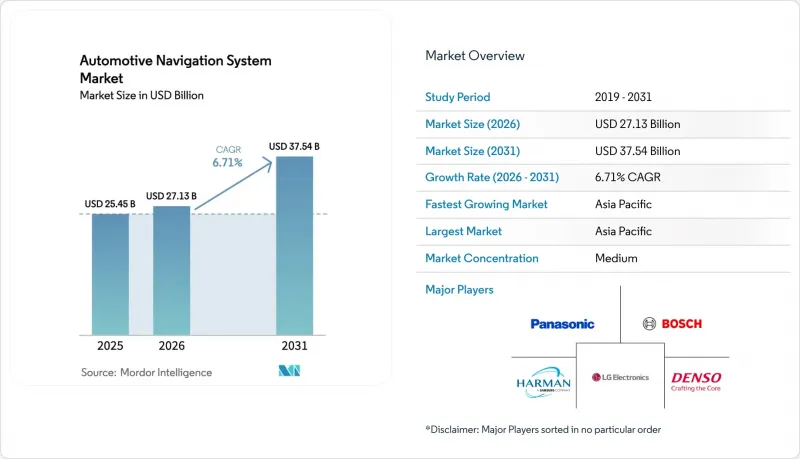
This report is Segmented by Device Type (In-Dash Navigation Systems, Portable Navigation Devices, and More), Technology (2D Maps, and More), Vehicle Type (Passenger Cars, Commercial Vehicles), Component (Hardware, and More), Connectivity (Embedded Systems, and More), Distribution Channel (OEM-Installed Systems, and More), and Geography. The Market Forecasts are Provided in Terms of Value (USD).
Global Automotive Navigation System Market Trends and Insights
Rising Demand for Connected and Autonomous-Ready Vehicles
The majority of vehicles in Europe and North America shipped with embedded connectivity modules in 2025, creating a larger installed base for navigation-centric driver-assistance functions. High-definition maps with centimeter-level lane geometry now underpin adaptive cruise, lane keeping, and automated parking, shifting navigation from simple routing to a localization backbone. Tesla's software loads the road topology before sensors, improving urban energy efficiency by 8-12%. Automakers favor suppliers that can integrate mapping, localization, and path-planning into a single stack, thereby accelerating vertical integration across the automotive navigation system market. Predictive capabilities that anticipate road conditions rather than reacting to them are becoming a differentiator, supporting Level 2+ and future Level 3 autonomy programs.
Penetration of Factory-Fitted Infotainment/Navigation Units
Factory-fit navigation penetration in Japan, Europe, and North America surged in 2025, driven by bundled infotainment strategies that lower incremental hardware cost to under USD 50 per vehicle. The EU's General Safety Regulation mandates speed limit recognition based on map data, further solidifying the role of embedded units. Platforms such as Harman Ignite integrate voice assistants and e-commerce, locking users into OEM ecosystems and generating recurring revenue from apps. Lower price premiums and tighter ADAS coupling mean that embedded systems are increasingly recapturing share from smartphones within the automotive navigation system market.
Free Smartphone-Navigation Substitutes
Google Maps and Apple Maps offer free routing, frequent updates, and calendar integration, leading the United States drivers to prefer phones over embedded systems in 2025. Their dominance in the portable navigation device segment collapsed, pushing Garmin's revenue down 42% between 2020 and 2025. Automakers respond by integrating CarPlay and Android Auto, yet doing so surrenders control of the interface and data monetization. The convenience and perceived parity of smartphones continue to be a headwind for the automotive navigation system market, particularly in price-sensitive segments.
Other drivers and restraints analyzed in the detailed report include:
- Regulatory Push for e-Call and Advanced Safety Compliance
- EV-Specific Range-Aware Routing Algorithms
- High Hardware and Software Development Costs
For complete list of drivers and restraints, kindly check the Table Of Contents.
Segment Analysis
Smartphone-based solutions retained 48.11% of the automotive navigation system market share in 2025, benefitting from familiar interfaces and zero incremental cost. In-dash systems, however, are forecast to grow at a 12.84% CAGR through 2031 as automakers integrate navigation with ADAS that demands vehicle-calibrated positioning. The automotive navigation system market size for in-dash units is projected to reach USD 18.9 billion by 2031, reflecting the rising penetration of factory-fit units. Portables have shrunk to niche commercial use but persist where device mobility matters.
Reliability and deeper sensor integration give embedded platforms a unique value proposition. Alpine's Halo11 continues to provide guidance even when smartphones are disconnected, satisfying professional drivers. Pioneer's integration of Alexa voice control demonstrates convergence between consumer IoT ecosystems and vehicle functions. Over-the-air updates narrow the map freshness gap with phones, supporting the gradual reclaiming of share inside the automotive navigation system market.
Traditional 2D maps held a 51.63% market share in the automotive navigation system market in 2025, driven by their low data requirements and broad hardware compatibility. Augmented-reality navigation will expand at a 24.72% CAGR, unlocking new revenue pockets in premium segments. The automotive navigation system market size for AR-enabled solutions is expected to surpass USD 5 billion by 2031 as head-up displays proliferate.
Continental's AR-HUD projects full-color graphics onto the real road view in a 130 cm (51 in) wide by 60 cm (23 in) high segment of the driver's field of vision, simulating an optical distance of 7.5 m (24 ft 9 in). distance, reducing driver distraction. WayRay's holographic projector delivers full-color images visible in sunlight and is currently implemented in Mercedes-Benz EQS models. Panasonic adds eye-tracking to maintain alignment, highlighting the rapid evolution of this feature. While 3D maps and voice guidance remain important, AR's immersive overlay positions it as the next competitive frontier.
Complete Report Scope:
- By Device Type
- In-Dash Navigation Systems
- Portable Navigation Devices (PNDs)
- Smartphone-Based Navigation
- By Technology
- 2D Maps
- 3D Maps
- Voice-Guided Navigation
- Augmented Reality Navigation
- By Vehicle Type
- Passenger Cars
- Commercial Vehicles
- By Component
- Hardware
- Software
- Services
- By Connectivity
- Embedded Systems
- Connected Systems
- By Distribution Channel
- OEM-Installed Systems
- Aftermarket Systems
- By Geography
- North America
- United States
- Canada
- Rest of North America
- South America
- Brazil
- Argentina
- Rest of South America
- Europe
- Germany
- United Kingdom
- France
- Italy
- Spain
- Rest of Europe
- Asia-Pacific
- China
- India
- Japan
- South Korea
- Rest of Asia-Pacific
- Middle East and Africa
- United Arab Emirates
- Saudi Arabia
- South Africa
- Turkey
- Rest of Middle-East and Africa
- North America
Geography Analysis
The Asia-Pacific region held a 33.48% share of the automotive navigation system market in 2025 and is projected to outpace all other areas with a 6.93% CAGR through 2031. India's subsidies for NavIC-compatible receivers stimulate domestic supplier growth. These dynamics boost local innovation, although foreign vendors must navigate data-sovereignty rules to capture share inside the automotive navigation system market.
North America commanded the second-highest share in 2025. General Motors plans to phase out CarPlay in favor of its Ultifi stack, signaling a strategic pivot. Ford's BlueCruise relies on embedded maps to designate hands-free zones, illustrating the role of navigation in ADAS branding. Canada pilots weather-overlay features that reduce winter accidents, demonstrating how regional conditions influence product priorities.
E-call mandates and a high density of premium vehicles underpin the European market. Continental generated EUR 3.8 billion from navigation and infotainment in 2025, reflecting robust demand from Tier 1. The U.K.'s impending 2030 ICE ban is expected to accelerate the uptake of EV-specific navigation systems, with JLR's Pivi Pro emphasizing range prediction. France's Michelin acquired a 30% stake in Sygic, illustrating cross-segment convergence.
- TomTom International BV
- HERE Technologies
- Garmin Ltd.
- Continental AG
- Denso Corporation
- Robert Bosch GmbH
- Alpine Electronics
- Pioneer Corporation
- Mitsubishi Electric Corp.
- Aisin AW Co.
- Harman International
- JVCKENWOOD Corp.
- Panasonic Holdings Corporation
- Sony Group Corp.
- Visteon Corp.
- Faurecia Clarion
- LG Electronics Inc.
- Apple Inc. (CarPlay)
- Google LLC (Android Auto / Maps)
- WayRay AG
Additional Benefits:
- The market estimate (ME) sheet in Excel format
- 3 months of analyst support
TABLE OF CONTENTS
1 Introduction
- 1.1 Study Assumptions and Market Definition
- 1.2 Scope of the Study
2 Research Methodology
3 Executive Summary
4 Market Landscape
- 4.1 Market Overview
- 4.2 Market Drivers
- 4.2.1 Rising Demand for Connected and Autonomous-Ready Vehicles
- 4.2.2 Penetration of Factory-Fitted Infotainment/Navigation Units
- 4.2.3 Regulatory Push for e-Call and Advanced Safety Compliance
- 4.2.4 EV-Specific Range-Aware Routing Algorithms
- 4.2.5 Subscription-Based OTA Map-Update Revenue Streams
- 4.2.6 Low-Cost Dual-Frequency GNSS + IMU Accuracy Gains
- 4.3 Market Restraints
- 4.3.1 Free Smartphone-Navigation Substitutes
- 4.3.2 High Hardware and Software Development Costs
- 4.3.3 GNSS Spoofing and Cyber-Attack Liability
- 4.3.4 Data-Sovereignty Laws Restricting Cloud Mapping
- 4.4 Value/Supply-Chain Analysis
- 4.5 Regulatory Landscape
- 4.6 Technological Outlook
- 4.7 Porter's Five Forces
- 4.7.1 Threat of New Entrants
- 4.7.2 Bargaining Power of Suppliers
- 4.7.3 Bargaining Power of Buyers
- 4.7.4 Threat of Substitutes
- 4.7.5 Competitive Rivalry
5 Market Size and Growth Forecasts (Value (USD))
- 5.1 By Device Type
- 5.1.1 In-Dash Navigation Systems
- 5.1.2 Portable Navigation Devices (PNDs)
- 5.1.3 Smartphone-Based Navigation
- 5.2 By Technology
- 5.2.1 2D Maps
- 5.2.2 3D Maps
- 5.2.3 Voice-Guided Navigation
- 5.2.4 Augmented Reality Navigation
- 5.3 By Vehicle Type
- 5.3.1 Passenger Cars
- 5.3.2 Commercial Vehicles
- 5.4 By Component
- 5.4.1 Hardware
- 5.4.2 Software
- 5.4.3 Services
- 5.5 By Connectivity
- 5.5.1 Embedded Systems
- 5.5.2 Connected Systems
- 5.6 By Distribution Channel
- 5.6.1 OEM-Installed Systems
- 5.6.2 Aftermarket Systems
- 5.7 By Geography
- 5.7.1 North America
- 5.7.1.1 United States
- 5.7.1.2 Canada
- 5.7.1.3 Rest of North America
- 5.7.2 South America
- 5.7.2.1 Brazil
- 5.7.2.2 Argentina
- 5.7.2.3 Rest of South America
- 5.7.3 Europe
- 5.7.3.1 Germany
- 5.7.3.2 United Kingdom
- 5.7.3.3 France
- 5.7.3.4 Italy
- 5.7.3.5 Spain
- 5.7.3.6 Rest of Europe
- 5.7.4 Asia-Pacific
- 5.7.4.1 China
- 5.7.4.2 India
- 5.7.4.3 Japan
- 5.7.4.4 South Korea
- 5.7.4.5 Rest of Asia-Pacific
- 5.7.5 Middle East and Africa
- 5.7.5.1 United Arab Emirates
- 5.7.5.2 Saudi Arabia
- 5.7.5.3 South Africa
- 5.7.5.4 Turkey
- 5.7.5.5 Rest of Middle-East and Africa
- 5.7.1 North America
6 Competitive Landscape
- 6.1 Market Concentration
- 6.2 Strategic Moves
- 6.3 Market Share Analysis
- 6.4 Company Profiles (Includes Global level Overview, Market level overview, Core Segments, Financials as available, Strategic Information, Market Rank/Share for key companies, Products and Services, and Recent Developments)
- 6.4.1 TomTom International BV
- 6.4.2 HERE Technologies
- 6.4.3 Garmin Ltd.
- 6.4.4 Continental AG
- 6.4.5 Denso Corporation
- 6.4.6 Robert Bosch GmbH
- 6.4.7 Alpine Electronics
- 6.4.8 Pioneer Corporation
- 6.4.9 Mitsubishi Electric Corp.
- 6.4.10 Aisin AW Co.
- 6.4.11 Harman International
- 6.4.12 JVCKENWOOD Corp.
- 6.4.13 Panasonic Holdings Corporation
- 6.4.14 Sony Group Corp.
- 6.4.15 Visteon Corp.
- 6.4.16 Faurecia Clarion
- 6.4.17 LG Electronics Inc.
- 6.4.18 Apple Inc. (CarPlay)
- 6.4.19 Google LLC (Android Auto / Maps)
- 6.4.20 WayRay AG
7 Market Opportunities and Future Outlook
- 7.1 White-space and Unmet-Need Assessment

