PUBLISHER: Mordor Intelligence | PRODUCT CODE: 2113267

PUBLISHER: Mordor Intelligence | PRODUCT CODE: 2113267
North America Beer - Market Share Analysis, Industry Trends & Statistics, Growth Forecasts (2026 - 2031)
According to Mordor Intelligence, the North American beer market size is expected to grow from USD 183.42 billion in 2025 to USD 192.65 billion in 2026 and is forecast to reach USD 246.23 billion by 2031 at 5.03% CAGR over 2026-2031.
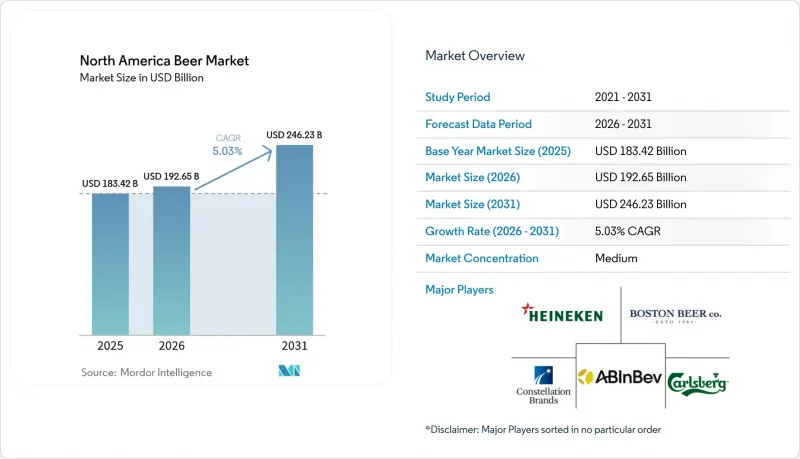
This report is Segmented by Type (Lager, Ale, Stout & Porter, Pilsner, Non-Alcoholic Beer, Others), Category (Standard, Premium), Packaging Type (Cans, Bottles, Kegs, Others), Distribution Channels (On-Trade, Off-Trade), and Geography (United States, Canada, Mexico, Rest of North America). The Market Forecasts are Provided in Terms of Value (USD) and Volume (Liters).
North America Beer Market Trends and Insights
Growth in Craft Beer Segment
In North America, the craft beer segment, while navigating a broader market contraction, is still at the forefront of innovation and premiumization, albeit at a more tempered pace than in years past. The industry witnessed a phase of rationalization, marked by 399 brewery closures juxtaposed with 335 new openings. This trend underscores a maturing market, emphasizing the imperative for operational efficiency amidst intensifying competition. In response, craft brewers are streamlining their portfolios, zeroing in on top-selling products, and diversifying into non-beer beverages, all to tap into a wider consumer appetite. This strategic shift not only elevates craft beer's status as a premium category, but also allows it to command superior margins, aligning with the changing consumer preference for quality over sheer volume.
Innovations in Flavors and Brewing Techniques
Technological advancements in hop extraction and flavor consistency are revolutionizing brewing capabilities by addressing persistent challenges related to ingredient variability and production efficiency. Abstrax Hops introduced Quantum Brite in February 2024, a water-soluble hop extract that eliminates the need for hop removal, reduces beer loss, and claims 100% utilization rates. Additionally, their Omni Hop Profiles utilize terpene-driven recreations to deliver consistent flavors year after year, regardless of harvest variability. These innovations allow brewers to achieve precise flavor profiles while cutting costs and minimizing waste, which is particularly beneficial given the ongoing volatility in hop prices. This technology enables smaller craft brewers to compete with larger operations by providing access to consistent, high-quality flavor compounds that were previously difficult to source or replicate. Advanced botanical analysis, which identifies over 500 compounds in hop profiles, creates opportunities for customization and flavor banking. This allows brewers to develop unique signature tastes, helping their products stand out in competitive market segments.
Stringent and Complex Regulatory/Tax Environment
Beer producers in North America face increasing tax burdens and regulatory complexities. In April 2024, Canada introduced a 4.7% federal beer tax hike, marking the largest increase in nearly 40 years. Beer Canada estimates this tax hike will cost taxpayers approximately CAD 40 million during the 2025-26 fiscal year. Currently, taxes make up about 46% of retail beer prices in Canada. The regulatory landscape is further complicated by proposed federal labeling mandates, such as TTB's"Alcohol Facts" requirements, which mandate per-serving disclosures of alcohol content, calories, and nutrients. With a five-year compliance period, these mandates impose significant costs for label redesign and supply chain adjustments. Additionally, state-level variations in distribution rules, licensing, and packaging regulations add another layer of complexity. Producers must navigate multiple compliance frameworks, increasing operational costs and restricting market access. These combined regulatory pressures limit pricing flexibility and reduce profitability, particularly for smaller craft brewers who lack the scale to efficiently manage these challenges.
Other drivers and restraints analyzed in the detailed report include:
- Expansion of Low-Alcohol and Non-Alcoholic Beer
- Popularity of Ready-to-Drink (RTD) and Flavored Malt Beverages
- Rising Consumption of Alternative Beverages
For complete list of drivers and restraints, kindly check the Table Of Contents.
Segment Analysis
In 2025, Lager holds a commanding 61.92% market share, while Ale, growing at a 6.08% CAGR through 2031, stands out as the fastest-growing type. This trend highlights increasing consumer interest in complex flavor profiles and the appeal of craft brewing. The Lager segment thrives on established consumer preferences, efficient production methods, and strong brand recognition driven by major brewers. In contrast, Ale's growth is propelled by the expansion of craft breweries and premiumization trends, which yield higher margins. Stout and Porter cater to niche markets with loyal consumers, benefiting from seasonal demand and food pairing opportunities. Pilsner, with its crisp and accessible flavor, continues to attract both traditional and emerging consumer groups, ensuring stable performance.
Non-Alcoholic Beer emerges as the most dynamic growth segment, leveraging advanced brewing techniques to closely replicate traditional beer characteristics while addressing the needs of health-conscious consumers. New Holland Brewing's collaboration with Dungeons & Dragons to launch limited-edition Dragon's Milk products illustrates how traditional beer types can evolve through strategic partnerships and premium positioning. The 'Others' category includes hybrid products and experimental styles that blur traditional boundaries, creating opportunities for differentiation and premium pricing. Innovations such as Abstrax Hops' Quantum Brite system in hop extraction are transforming the industry by delivering consistent flavor across beer types, reducing production costs, and minimizing waste, thereby supporting both traditional and innovative brewing approaches.
In 2025, Standard beer holds a 56.15% market share, ensuring stable volumes and offering affordable price points that attract a broad consumer base. Meanwhile, the Premium segment is experiencing strong growth, with a 6.74% CAGR. This growth is driven by consumers' willingness to pay more for perceived quality, distinctive flavors, and engaging brand experiences. The Premium segment's expansion is further supported by the influence of craft brewing, the prestige associated with imported beers, and the appeal of limited-edition releases, which cater to consumers seeking unique and exclusive products. In contrast, the Standard category remains the market's cornerstone, consistently providing quality and value that appeal to cost-conscious consumers and those seeking high-volume consumption.
The Premium segment's growth is driven by a strategic emphasis on high-quality ingredients, artisanal production methods, and compelling brand storytelling that justifies premium pricing. Tilray's acquisition of craft breweries from Molson Coors highlights this focus on premium positioning, with the company aiming to rise from the ninth to the fifth-largest craft beer player in the U.S., prioritizing revenue growth over volume expansion. The distinction between categories is becoming increasingly blurred: Standard brands are introducing premium extensions, while Premium brands are offering more accessible options, creating a dynamic and fluid competitive landscape. Digital marketing and direct-to-consumer channels are particularly advantageous for the Premium segment, enabling targeted messaging and fostering relationships that enhance margins and build brand loyalty.
Complete Report Scope:
- By Type
- Lager
- Ale
- Non-Alcoholic Beer
- Others
- By Category
- Standard
- Premium
- By Packaging Type
- Cans
- Bottles
- Kegs
- Others
- By Distribution Channels
- On-Trade
- Off-Trade
- Specialty/Liquor Stores
- Other Off-Trade Channels
- Geography
- United States
- Canada
- Mexico
- Rest of North America
List of Companies Covered in this Report:
- Anheuser-Busch InBev
- Molson Coors Beverage Company
- Heineken Holding N.V.
- Constellation Brands Inc.
- Boston Beer Company
- Diageo Plc
- Carlsberg Group
- Grupo Modelo
- Pabst Brewing Company
- FIFCO USA
- Suntory Beverage & Food Ltd.
- D.G. Yuengling & Son Inc.
- Stone Brewing Co.
- Brooklyn Brewery
- Sierra Nevada Brewing Co.
- Royal Unibrew
- Goose Island Beer Company
- Amsterdam Brewery Co. Ltd.
- New Belgium Brewing Company
Additional Benefits:
- The market estimate (ME) sheet in Excel format
- 3 months of analyst support
TABLE OF CONTENTS
1 INTRODUCTION
- 1.1 Study Assumptions & Market Definition
- 1.2 Scope of the Study
2 RESEARCH METHODOLOGY
3 EXECUTIVE SUMMARY
4 MARKET LANDSCAPE
- 4.1 Market Overview
- 4.2 Market Drivers
- 4.2.1 Growth in craft beer segment
- 4.2.2 Innovations in flavors and brewing techniques
- 4.2.3 Expansion of low-alcohol and non-alcoholic beer
- 4.2.4 Popularity of ready-to-drink (RTD) and flavored malt beverages
- 4.2.5 Increasing E-commerce and direct-to-consumer sales
- 4.2.6 Sustainability initiatives in packaging and brewing
- 4.3 Market Restraints
- 4.3.1 Stringent and complex regulatory/tax environment
- 4.3.2 Rising Consumption of Alternative Beverages
- 4.3.3 Trade barriers and cross-border tariffs
- 4.3.4 Barley Yield Volatility due to Water Scarcity
- 4.4 Consumer Demand Analysis
- 4.5 Supply Chain Analysis
- 4.6 Regulatory Outlook
- 4.7 Porter's Five Forces
- 4.7.1 Threat of New Entrants
- 4.7.2 Bargaining Power of Buyers/Consumers
- 4.7.3 Bargaining Power of Suppliers
- 4.7.4 Threat of Substitute Products
- 4.7.5 Intensity of Competitive Rivalry
5 MARKET SIZE AND GROWTH FORECAST (Value and Volume Analysis)
- 5.1 By Type
- 5.1.1 Lager
- 5.1.2 Ale
- 5.1.3 Non-Alcoholic Beer
- 5.1.4 Others
- 5.2 By Category
- 5.2.1 Standard
- 5.2.2 Premium
- 5.3 By Packaging Type
- 5.3.1 Cans
- 5.3.2 Bottles
- 5.3.3 Kegs
- 5.3.4 Others
- 5.4 By Distribution Channels
- 5.4.1 On-Trade
- 5.4.2 Off-Trade
- 5.4.2.1 Specialty/Liquor Stores
- 5.4.2.2 Other Off-Trade Channels
- 5.5 Geography
- 5.5.1 United States
- 5.5.2 Canada
- 5.5.3 Mexico
- 5.5.4 Rest of North America
6 COMPETITIVE LANDSCAPE
- 6.1 Market Concentration
- 6.2 Strategic Moves
- 6.3 Market Share Analysis
- 6.4 Company Profiles (includes Global-level Overview, Market-level Overview, Core Segments, Financials (if available), Strategic Information, Market Rank/Share, Products & Services, Recent Developments)
- 6.4.1 Anheuser-Busch InBev
- 6.4.2 Molson Coors Beverage Company
- 6.4.3 Heineken Holding N.V.
- 6.4.4 Constellation Brands Inc.
- 6.4.5 Boston Beer Company
- 6.4.6 Diageo Plc
- 6.4.7 Carlsberg Group
- 6.4.8 Grupo Modelo
- 6.4.9 Pabst Brewing Company
- 6.4.10 FIFCO USA
- 6.4.11 Suntory Beverage & Food Ltd.
- 6.4.12 D.G. Yuengling & Son Inc.
- 6.4.13 Stone Brewing Co.
- 6.4.14 Brooklyn Brewery
- 6.4.15 Sierra Nevada Brewing Co.
- 6.4.16 Royal Unibrew
- 6.4.17 Goose Island Beer Company
- 6.4.18 Amsterdam Brewery Co. Ltd.
- 6.4.19 New Belgium Brewing Company
7 MARKET OPPORTUNITIES AND FUTURE OUTLOOK

