PUBLISHER: Mordor Intelligence | PRODUCT CODE: 2113268

PUBLISHER: Mordor Intelligence | PRODUCT CODE: 2113268
Butadiene - Market Share Analysis, Industry Trends & Statistics, Growth Forecasts (2026 - 2031)
According to Mordor Intelligence, the butadiene market size is expected to grow from 14.61 million tons in 2025 to 15.04 million tons in 2026 and is forecast to reach 17.39 million tons by 2031 at 2.95% CAGR over 2026-2031.
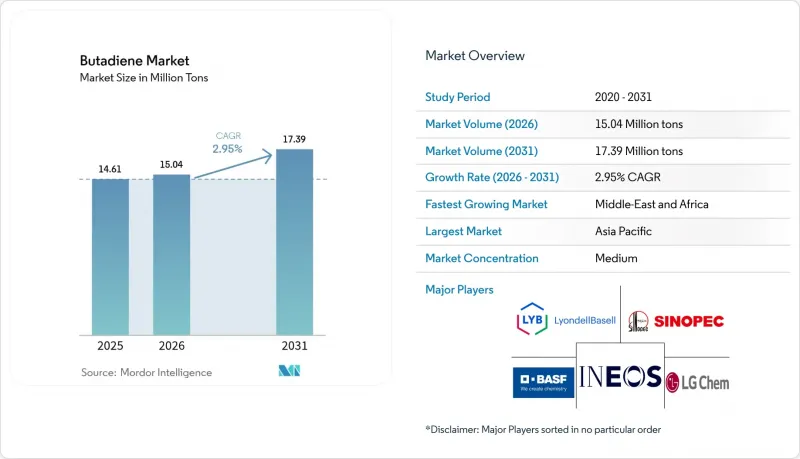
This report is Segmented by Application (Polybutadiene, Chloroprene, Styrene-Butadiene, Nitrile Rubber, SB Latex, ABS, Adiponitrile, Sulfolane, Ethylidene Norbornene, and Others), End-User Industry (Plastic and Polymer, Tire and Rubber, Chemical, and Others), and Geography (Asia-Pacific, North America, Europe, South America, and Middle East and Africa). Market Forecasts are Provided in Terms of Volume (tons).
Global Butadiene Market Trends and Insights
Rising Automotive and Tire Production in Asia-Pacific
Asia-Pacific tire output surpassed 1.3 billion units in 2024, supported by China, India, and Japan, which jointly contributed about 70% of regional volume. High-cis polybutadiene accounts for 10-15% of passenger-tire tread formulations, thereby directly increasing butadiene market demand. Thailand's strong natural-rubber supply and Indonesia's motorcycle-tire ecosystem underpin regional growth, while India and Vietnam's shift toward radial truck tires increases synthetic-rubber use per unit. Imports into the European Union and the United Kingdom increased by 18% year-over-year in 2024, indicating that Asian producers are capturing incremental demand even in mature markets.
Expanding ABS Demand from Consumer Electronics
ABS resin maintains a 15-20% price premium over high-impact polystyrene because it offers superior impact strength and a smoother surface finish. US trade measures enacted in 2025 lifted landed costs for imported electronics by roughly 10%, prompting brands to nearshore assembly and secure domestic ABS, tightening butadiene balances in North America. Because butadiene accounts for 20-25% of ABS composition, each incremental percentage point of ABS output drives 0.2-0.25 percentage points of additional butadiene consumption. Automotive interior-trim growth further supports ABS volumes, as ABS-polycarbonate blends meet stringent flame-retardancy standards without the use of halogenated additives.
Toxicity and Tightening Exposure Limits
The US Occupational Safety and Health Administration enforces an 8-hour permissible exposure limit of 1 ppm and a 15-minute excursion limit of 5 ppm for butadiene, prompting cracker operators to install closed-loop vapor-recovery systems and continuous monitors, often costing USD 5-8 million per facility. California's Proposition 65 labeling requirements add downstream compliance expenses, while the European Chemicals Agency is proposing a 0.5 ppm workplace limit, half the current US threshold. Smaller extraction units are disproportionately impacted, driving consolidation and trimming the global count of butadiene extraction facilities to an estimated 160 by 2026.
Other drivers and restraints analyzed in the detailed report include:
- EV-Ready High-Performance S-SBR Adoption
- Rapid Capacity Additions in Bio-Butadiene
- Crude-Oil Price Volatility
For complete list of drivers and restraints, kindly check the Table Of Contents.
Segment Analysis
Polybutadiene captured 26.27% of 2025 application volume, confirming its entrenched role in tire tread and sidewall formulations where high-cis grades maximize abrasion resistance and cold-weather flexibility. SIBUR expanded its Russian polybutadiene capacity in 2024, while ARLANXEO is building a 140,000-ton-per-year ultra-high-cis facility in Jubail, slated for a 2026 start-up. ABS resins are projected to advance at a 3.94% CAGR to 2031, driven by demand for consumer electronics and automotive interior trim, which is expected to tighten regional butadiene market balances. Styrene-butadiene rubber remains vital for mainstream tire producers that balance wet grip and rolling resistance; solution grades are steadily displacing emulsion types in EV fitments.
Nitrile rubber accounts for 60% of automotive seal applications, while emerging hydrogenated nitrile rubbers target EV battery packs that face sustained 150°C thermal cycling. Adiponitrile produced from butadiene cyanation feeds nylon 6,6 for under-hood components, with Invista increasing its North American capacity in 2024 to meet a 4-5% annual growth in this segment. Smaller outlets, such as chloroprene rubber, sulfolane, and ethylidene norbornene, help maintain a stable baseline demand; price rises of USD 500 per ton in 2024 reflected higher feedstock and energy costs.
Complete Report Scope:
- By Application
- Polybutadiene (PBR)
- Chloroprene
- Styrene-Butadiene (SBR)
- Nitrile Rubber (Acrylonitrile Butadiene NBR)
- SB Latex
- Acrylonitrile Butadiene Styrene (ABS)
- Adiponitrile
- Sulfolane
- Ethylidene Norbornene
- Others
- By End-user Industry
- Plastic and Polymer
- Tire and Rubber
- Chemical
- Others
- By Geography
- Asia-Pacific
- China
- India
- Japan
- South Korea
- ASEAN Countries
- Rest of Asia-Pacific
- North America
- United States
- Canada
- Mexico
- Europe
- Germany
- France
- United Kingdom
- Italy
- Russia
- Rest of Europe
- South America
- Brazil
- Argentina
- Rest of South America
- Middle East and Africa
- Saudi Arabia
- South Africa
- Rest of Middle-East and Africa
- Asia-Pacific
Geography Analysis
The Asia-Pacific region represented 51.62% of the 2025 volume, thanks to Chinese PDH complexes that added capacity 77% above 2022 levels, enabling on-purpose production costs 10-15% below naphtha-cracker averages when propane-naphtha spreads widen beyond USD 150 per ton. Lotte Chemical increased its extraction capacity to 210,000 tons per year in 2024, while Reliance Industries plans a 0.7-million-ton expansion at Jamnagar, featuring bio-naphtha integration, by 2030. Despite capacity gains, spot prices dipped below USD 900 per ton in early 2024, compelling Chinese producers to export at discounts that squeezed Middle Eastern and North American competitors. Japan and South Korea are curbing output-Zeon intends to reduce Tokuyama elastomer lines in fiscal 2026-and the Lotte-Ube JV in Malaysia is winding down after years of margin pressure.
Middle East & Africa is projected to grow at a 5.89% CAGR, led by Saudi approvals for a Sipchem-LyondellBasell mixed-feed cracker capable of 1.5 million tons of ethylene and 1.8 million tons of derivatives, including butadiene, with a final investment decision reached in February 2025. Tasnee's 3.3 million-ton petrochemical complex, due by 2030, and ADNOC's bid to acquire specialty assets, such as Covestro, illustrate the region's move to monetize associated gas via integrated platforms. Gulf Cooperation Council chemical revenue is forecast to climb from USD 85.8 billion in 2023 to USD 133.3 billion by 2030, anchoring incremental butadiene demand tied to downstream diversification.
North America and Europe contend with margin compression and asset rationalization. Shell sold its Geismar extraction unit to INEOS in 2023, and Versalis shuttered its 105,000-ton polybutadiene line at Grangemouth in 2024 as energy costs outstripped peer regions. Goodyear's announced divestiture of its Beaumont and Houston chemical assets under a USD 1.3 billion cost-reduction program underscores the shift toward higher-value performance tires over commodity elastomers. European tire output rose 3% in Q1 2025, but Chinese tire imports surged 18% in 2024, highlighting competitiveness challenges for regional producers. South America remains a smaller contributor but benefits from ARLANXEO's expanded Triunfo capacity and proximity to natural-rubber plantations that facilitate blended formulations.
- BASF
- Braskem
- China National Petroleum Corporation
- China Petroleum & Chemical Corporation
- Dow
- ENEOS Materials Corporation
- Evonik Industries AG
- Exxon Mobil Corporation
- Formosa Plastics Corporation
- INEOS
- LG Chem
- LOTTE CHEMICAL TITAN HOLDING BERHAD
- LyondellBasell Industries Holdings BV
- Reliance Industries Limited
- Repsol
- Shell plc
- SABIC
- TPC Group
- ARLANXEO
Additional Benefits:
- The market estimate (ME) sheet in Excel format
- 3 months of analyst support
TABLE OF CONTENTS
1 Introduction
- 1.1 Study Assumptions
- 1.2 Scope of the Study
2 Research Methodology
3 Executive Summary
4 Market Landscape
- 4.1 Market Overview
- 4.2 Market Drivers
- 4.2.1 Rising automotive and tire production in Asia-Pacific
- 4.2.2 Expanding ABS demand from consumer electronics
- 4.2.3 EV-ready high-performance S-SBR adoption
- 4.2.4 Rapid capacity additions in bio-butadiene
- 4.2.5 Growth of Li-ion battery binders using SBR
- 4.3 Market Restraints
- 4.3.1 Toxicity and tightening exposure limits
- 4.3.2 Crude-oil price volatility
- 4.3.3 China overcapacity depressing margins
- 4.4 Value Chain Analysis
- 4.5 Porter's Five Forces
- 4.5.1 Bargaining Power of Suppliers
- 4.5.2 Bargaining Power of Buyers
- 4.5.3 Threat of New Entrants
- 4.5.4 Threat of Substitutes
- 4.5.5 Degree of Competition
- 4.6 Feedstock Analysis
- 4.7 Technological snapshot
5 Market Size & Growth Forecasts (Volume)
- 5.1 By Application
- 5.1.1 Polybutadiene (PBR)
- 5.1.2 Chloroprene
- 5.1.3 Styrene-Butadiene (SBR)
- 5.1.4 Nitrile Rubber (Acrylonitrile Butadiene NBR)
- 5.1.5 SB Latex
- 5.1.6 Acrylonitrile Butadiene Styrene (ABS)
- 5.1.7 Adiponitrile
- 5.1.8 Sulfolane
- 5.1.9 Ethylidene Norbornene
- 5.1.10 Others
- 5.2 By End-user Industry
- 5.2.1 Plastic and Polymer
- 5.2.2 Tire and Rubber
- 5.2.3 Chemical
- 5.2.4 Others
- 5.3 By Geography
- 5.3.1 Asia-Pacific
- 5.3.1.1 China
- 5.3.1.2 India
- 5.3.1.3 Japan
- 5.3.1.4 South Korea
- 5.3.1.5 ASEAN Countries
- 5.3.1.6 Rest of Asia-Pacific
- 5.3.2 North America
- 5.3.2.1 United States
- 5.3.2.2 Canada
- 5.3.2.3 Mexico
- 5.3.3 Europe
- 5.3.3.1 Germany
- 5.3.3.2 France
- 5.3.3.3 United Kingdom
- 5.3.3.4 Italy
- 5.3.3.5 Russia
- 5.3.3.6 Rest of Europe
- 5.3.4 South America
- 5.3.4.1 Brazil
- 5.3.4.2 Argentina
- 5.3.4.3 Rest of South America
- 5.3.5 Middle East and Africa
- 5.3.5.1 Saudi Arabia
- 5.3.5.2 South Africa
- 5.3.5.3 Rest of Middle-East and Africa
- 5.3.1 Asia-Pacific
6 Competitive Landscape
- 6.1 Market Concentration
- 6.2 Strategic Moves
- 6.3 Market Share(%)/Ranking Analysis
- 6.4 Company Profiles (includes Global level Overview, Market level overview, Core Segments, Financials as available, Strategic Information, Market Rank/Share, Products & Services, Recent Developments)
- 6.4.1 BASF
- 6.4.2 Braskem
- 6.4.3 China National Petroleum Corporation
- 6.4.4 China Petroleum & Chemical Corporation
- 6.4.5 Dow
- 6.4.6 ENEOS Materials Corporation
- 6.4.7 Evonik Industries AG
- 6.4.8 Exxon Mobil Corporation
- 6.4.9 Formosa Plastics Corporation
- 6.4.10 INEOS
- 6.4.11 LG Chem
- 6.4.12 LOTTE CHEMICAL TITAN HOLDING BERHAD
- 6.4.13 LyondellBasell Industries Holdings BV
- 6.4.14 Reliance Industries Limited
- 6.4.15 Repsol
- 6.4.16 Shell plc
- 6.4.17 SABIC
- 6.4.18 TPC Group
- 6.4.19 ARLANXEO
7 Market Opportunities and Future Outlook
- 7.1 White-space and Unmet-need Assessment

