PUBLISHER: Mordor Intelligence | PRODUCT CODE: 2113278

PUBLISHER: Mordor Intelligence | PRODUCT CODE: 2113278
Turf And Ornamental Inputs - Market Share Analysis, Industry Trends & Statistics, Growth Forecasts (2026 - 2031)
According to Mordor Intelligence, the turf and ornamental inputs market size is expected to grow from USD 5.1 billion in 2025 to USD 5.38 billion in 2026 and is forecast to reach USD 7.05 billion by 2031 at 5.55% CAGR over 2026-2031.
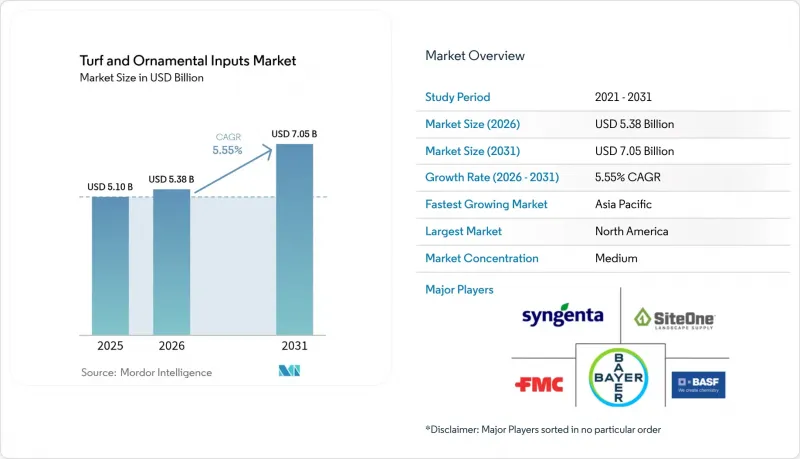
This report is Segmented by Turf Grass Type (Bermuda Grass, Zoysia Grass, and More), by Ornamental Grass Type (Feather Reed Grass, Fountain Grass, Purple Millet, and More), by Input Type (Pesticides, Fertilizers, Plant Growth Regulators, and More), and by Geography (North America, Europe, Asia-Pacific, and More). The Market Forecasts are Provided in Terms of Value (USD).
Global Turf And Ornamental Inputs Market Trends and Insights
Precision-spray Technologies Reduce Chemical Over-application
Autonomous sprayers equipped with computer vision identify individual weeds and apply herbicide only where needed, slashing use rates by as much as 90% while preserving control levels. Drone-based spot applications verified by Texas A&M University and USDA research replicated full-coverage weed control yet used 67% less chemical, lowering both cost and environmental load. Equipment costs continue to decline, and university extension services now offer operator training that accelerates adoption. Municipal restrictions near waterways further incentivize the use of precision equipment, as it documents compliance. For buyers, return on investment occurs within three seasons owing to input savings and reduced re-spray labor. As a result, the turf and ornamental inputs market increasingly ties product sales to hardware and software ecosystems that optimize timing and placement.
Shift Toward Low-toxicity Bio-based Formulations
Municipal bans on certain synthetics have prompted distributors to expand their lines of bio-stimulants and organic-certified pesticides, now the fastest-growing segment within the turf and ornamental inputs market. BASF's 2024 launch of the Aramax fungicide illustrates how legacy producers are reformulating active ingredients to lower persistence while preserving spectrum. End-users report that bio-based products often require shorter re-application intervals, creating steady demand for service contractors who can manage tighter schedules. Corporate campuses and homeowner associations are increasingly stipulating low-impact programs in bid documents, thereby broadening the customer base. While price premiums persist, controlled-release coatings and microbial carriers are improving longevity, which narrows total-cost gaps with conventional chemistries. The trend is long-lived because it is supported by regulation, client preference, and supplier innovation.
Tightening PFAS and Neonicotinoid Bans
California's 2024 PFAS restrictions eliminated several legacy turf products, and the European Commission is preparing similar measures that will further shrink chemical portfolios. Replacement formulas often carry higher per-unit costs and different application windows, which can disrupt established programs. Stringent buffer-zone rules add scheduling complexity and may require specialized nozzle sets, raising capital outlays for smaller contractors. Manufacturers are racing to reformulate, but development timelines compress margins. Until compliant alternatives scale, the turf and ornamental inputs market will face friction in product availability and user confidence.
Other drivers and restraints analyzed in the detailed report include:
- Turf Rebuild After 2024-2026 El Nino Damage
- Climate-linked Insurance Requiring IPM Compliance
- Micro-dosing Robotics Delaying Bulk Chemical Demand
For complete list of drivers and restraints, kindly check the Table Of Contents.
Segment Analysis
Bermuda grass held 26.65% of the turf and ornamental inputs market size in 2025, underscoring its status as the workhorse for warm-season sports venues and commercial landscapes. Its aggressive growth habit demands consistent nitrogen and targeted pre-emergent herbicides, creating a steady pull-through for input suppliers. Zoysia grass is gaining momentum at a 7.45% CAGR because improved cold tolerance expands its viable zone into transition regions. Kentucky bluegrass still commands a 24.25% share due to its visual appeal in northern climates, yet its water and disease needs remain high, making it a reliable consumer of fungicides and wetting agents.
Tall fescue adoption increases in drought-prone municipal parks, as its deep roots reduce irrigation bills. Ryegrass retains importance as an overseed during winter, supporting seed and fertilizer sales outside the main growing season. Ongoing cultivar development at Oregon State University targets traits such as salt tolerance and reduced clipping yield, which can reduce mowing labor. For suppliers, aligning agronomic packages with region-specific cultivars becomes essential to capture the next wave of growth in the turf and ornamental inputs market.
Complete Report Scope:
- By Turf Grass Type
- Bermuda Grass
- Zoysia Grass
- Kentucky Bluegrass
- Ryegrass
- Tall Fescue
- Other Turf Grasses
- By Ornamental Grass Type
- Feather Reed Grass
- Fountain Grass
- Purple Millet
- Ravenna Grass
- Fiber Optic Grass
- Other Ornamental Grasses
- By Input Type
- Pesticides
- Fertilizers
- Plant Growth Regulators
- Wetting Agents and Surfactants
- Bio-stimulants
- Geography
- North America
- United States
- Canada
- Mexico
- Rest of North America
- Europe
- Germany
- United Kingdom
- France
- Spain
- Italy
- Denmark
- Rest of Europe
- Asia-Pacific
- China
- Japan
- India
- Australia
- Thailand
- Rest of Asia-Pacific
- South America
- Brazil
- Argentina
- Rest of South America
- Middle East
- Saudi Arabia
- United Arab Emirates
- Rest of Middle East
- Africa
- South Africa
- Kenya
- Rest of Africa
- North America
Geography Analysis
North America commanded 34.60% of global revenue in 2025, driven by its extensive golf course network and professional sports footprint. The United States alone hosts more than 1,250 courses in Florida, each requiring high-intensity fertility and protection programs that drive steady demand. Precision-spray adoption and insurance-driven IPM documentation are expected to sustain a significant CAGR through 2030, even as the installed base matures. Canada and Mexico add incremental volume through growing sports tourism and urban greening projects that mirror the best practices of the United States.
The Asia-Pacific region is the fastest-growing region, with a 6.55% CAGR through 2031, driven by rapid urbanization, increasing middle-class spending, and national initiatives to expand recreational spaces. China invests in public golf despite earlier course caps, while Japan upgrades aging sports infrastructure ahead of international events. India's metropolitan parks are embracing drought-tolerant turf varieties, which stimulate seed and bio-stimulant imports. Equipment suppliers partner with local dealers to introduce autonomous mowing fleets, which offset labor shortages and accelerate the penetration of precision inputs across the region.
Europe grows annually as environmental mandates shift spending toward compliant chemistries and data-driven application systems. Germany and the United Kingdom lead in the adoption of buffer-zone mapping tools that minimize drift. Southern Europe, prone to water stress, invests in wetting agents and low-input warm-season grasses. South America, the Middle East, and Africa post impressive CAGRs, reflecting tourism investments and mega-sporting events that require elite playing surfaces. In these emerging regions, distributors that offer technical training capture early loyalty, positioning themselves favorably as regulatory frameworks become more stringent.
- Bayer AG
- Syngenta Group
- BASF SE
- FMC Corporation
- Nufarm Ltd
- American Vanguard Corporation
- Koch Agronomic Services
- Gowan International
- Precision Laboratories
- UPL Limited
- Valent USA
- SiteOne Landscape Supply Inc
- LebanonTurf
- WinField United
- Corteva Agriscience
- ICL Specialty Fertilizers
Additional Benefits:
- The market estimate (ME) sheet in Excel format
- 3 months of analyst support
TABLE OF CONTENTS
1 Introduction
- 1.1 Study Assumptions and Market Definition
- 1.2 Scope of the Study
2 Research Methodology
3 Executive Summary
4 Market Landscape
- 4.1 Market Overview
- 4.2 Market Drivers
- 4.2.1 Precision-spray technologies reduce chemical over-application
- 4.2.2 Shift toward low-toxicity bio-based formulations
- 4.2.3 Turf rebuild after 2024-2026 El Nino damage
- 4.2.4 Climate-linked insurance requiring IPM compliance
- 4.2.5 Outsourced sports-turf management contracts
- 4.2.6 Golf-course renovations ahead of PGA/LPGA calendar expansion
- 4.3 Market Restraints
- 4.3.1 Tightening PFAS and neonicotinoid bans
- 4.3.2 Labor shortages limiting professional turf service frequency
- 4.3.3 Micro-dosing robotics delaying bulk chemical demand
- 4.3.4 Public pushback on fertilizer runoff in urban lakes
- 4.4 Regulatory Landscape
- 4.5 Technological Outlook
- 4.6 Porter's Five Forces Analysis
- 4.6.1 Bargaining Power of Suppliers
- 4.6.2 Bargaining Power of Buyers
- 4.6.3 Threat of New Entrants
- 4.6.4 Threat of Substitute Products
- 4.6.5 Intensity of Competitive Rivalry
5 Market Size and Growth Forecasts (Value)
- 5.1 By Turf Grass Type
- 5.1.1 Bermuda Grass
- 5.1.2 Zoysia Grass
- 5.1.3 Kentucky Bluegrass
- 5.1.4 Ryegrass
- 5.1.5 Tall Fescue
- 5.1.6 Other Turf Grasses
- 5.2 By Ornamental Grass Type
- 5.2.1 Feather Reed Grass
- 5.2.2 Fountain Grass
- 5.2.3 Purple Millet
- 5.2.4 Ravenna Grass
- 5.2.5 Fiber Optic Grass
- 5.2.6 Other Ornamental Grasses
- 5.3 By Input Type
- 5.3.1 Pesticides
- 5.3.2 Fertilizers
- 5.3.3 Plant Growth Regulators
- 5.3.4 Wetting Agents and Surfactants
- 5.3.5 Bio-stimulants
- 5.4 Geography
- 5.4.1 North America
- 5.4.1.1 United States
- 5.4.1.2 Canada
- 5.4.1.3 Mexico
- 5.4.1.4 Rest of North America
- 5.4.2 Europe
- 5.4.2.1 Germany
- 5.4.2.2 United Kingdom
- 5.4.2.3 France
- 5.4.2.4 Spain
- 5.4.2.5 Italy
- 5.4.2.6 Denmark
- 5.4.2.7 Rest of Europe
- 5.4.3 Asia-Pacific
- 5.4.3.1 China
- 5.4.3.2 Japan
- 5.4.3.3 India
- 5.4.3.4 Australia
- 5.4.3.5 Thailand
- 5.4.3.6 Rest of Asia-Pacific
- 5.4.4 South America
- 5.4.4.1 Brazil
- 5.4.4.2 Argentina
- 5.4.4.3 Rest of South America
- 5.4.5 Middle East
- 5.4.5.1 Saudi Arabia
- 5.4.5.2 United Arab Emirates
- 5.4.5.3 Rest of Middle East
- 5.4.6 Africa
- 5.4.6.1 South Africa
- 5.4.6.2 Kenya
- 5.4.6.3 Rest of Africa
- 5.4.1 North America
6 Competitive Landscape
- 6.1 Market Concentration
- 6.2 Strategic Moves
- 6.3 Market Share Analysis
- 6.4 Company Profiles (Includes Global Level Overview, Market Level Overview, Core Segments, Financials as Available, Strategic Information, Market Rank/Share for Key Companies, Products and Services, and Recent Developments)
- 6.4.1 Bayer AG
- 6.4.2 Syngenta Group
- 6.4.3 BASF SE
- 6.4.4 FMC Corporation
- 6.4.5 Nufarm Ltd
- 6.4.6 American Vanguard Corporation
- 6.4.7 Koch Agronomic Services
- 6.4.8 Gowan International
- 6.4.9 Precision Laboratories
- 6.4.10 UPL Limited
- 6.4.11 Valent USA
- 6.4.12 SiteOne Landscape Supply Inc
- 6.4.13 LebanonTurf
- 6.4.14 WinField United
- 6.4.15 Corteva Agriscience
- 6.4.16 ICL Specialty Fertilizers
7 Market Opportunities and Future Outlook

