PUBLISHER: Mordor Intelligence | PRODUCT CODE: 2113302

PUBLISHER: Mordor Intelligence | PRODUCT CODE: 2113302
India Automotive Sunroof - Market Share Analysis, Industry Trends & Statistics, Growth Forecasts (2026 - 2031)
According to Mordor Intelligence, the India automotive sunroof market size was valued at USD 0.72 billion in 2025 and estimated to grow from USD 0.82 billion in 2026 to reach USD 1.57 billion by 2031, at a CAGR of 13.88% during the forecast period (2026-2031).
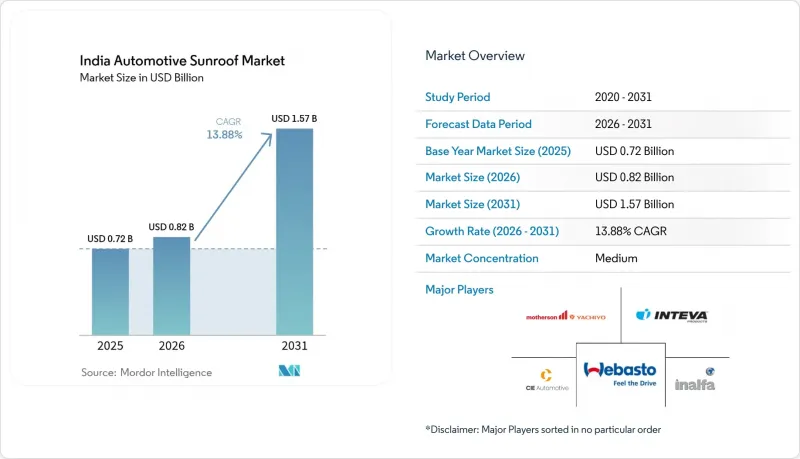
This report is Segmented by Material Type (Glass and Fabric), Sunroof Operation Type (Pop-Up, Slide-in/Spoiler, Panoramic, and Solar-Integrated), Vehicle Type (Hatchback, Sedan, Sport Utility Vehicle, and MPV/Others), Sales Channel (OEM-Fitted, and Aftermarket Retrofit), and Region. The Market Forecasts are Provided in Terms of Value (USD).
India Automotive Sunroof Market Trends and Insights
Premium-Feature Adoption in Mass-Market Cars
Penetration of factory-installed sunroofs has reached roughly one in four new-car sales, underlining a decisive shift toward experiential content in the Indian automotive sunroof market offerings. Mainstream brands now equip mid-trim variants-rather than only top trims-because economies of scale from local sourcing have cut system costs by nearly one-third since. Volume leaders consistently package sunroofs alongside connectivity and safety bundles, allowing customers to perceive a step-up in lifestyle value for a modest incremental outlay. Younger urban buyers equate a powered sunroof with social-status signaling and open-air leisure, moving it from optional to expected equipment. As a result, feature parity has supplanted price as a winning formula in fiercely contested B-segment hatchbacks and compact SUVs.
Solar-Integrated Roofs to Meet CO2 Norms
Embedded photovoltaic cells now offer a practical 80-100 W trickle-charge benefit, extending EV range or powering auxiliary ventilation in idling ICE vehicles. Early adopters previewed the technology at Auto Expo 2025, signaling a ramp-up path once battery pack prices cross the USD 80 per kWh threshold. Forward-looking OEMs view solar roofs as a compliance hedge against the Bharat Stage VII emissions roadmap, while tech-savvy buyers prize the environmental narrative. As module efficiencies rise above 20%, solar-equipped variants will migrate from halo products into core model lines, raising the innovation bar for the entire India automotive sunroof market.
Cost-Sensitive Entry-Level Segment
In India, a large segment of car buyers remains focused on affordability, steering their purchases towards budget-friendly options. For these consumers, essentials like fuel efficiency and safety overshadow luxury features, such as sunroofs, which are often deemed non-essential and a financial strain. Without a significant reduction in the cost of sunroof systems by suppliers, their adoption in entry-level vehicles will likely stay constrained, limiting the market's potential in this segment for the foreseeable future.
Other drivers and restraints analyzed in the detailed report include:
- OEM Differentiation Race via Factory-Fitted Sunroofs
- Domestic Manufacturing Lowers Module Costs
- Leakage and High-Maintenance Perception
For complete list of drivers and restraints, kindly check the Table Of Contents.
Segment Analysis
Glass held a 89.82% share of 2025 shipments within the Indian automotive sunroof market. The laminated safety glass, UV-filter interlayers, and structural rigidity align neatly with the SUV body styles that dominate new-car bookings. Electrochromic glazing and solar-reflective coatings, now entering mid-segment nameplates, further entrench glass as the aspirational baseline. Fabric modules appeal to price-conscious buyers who still crave an open-sky feel, and their 14.6% CAGR underscores untapped headroom once localized textile skins and sealants bring costs below glass alternatives. Manufacturers are already experimenting with dual-layer synthetic weaves that promise improved noise insulation, hinting at a broader role for fabric in upcoming refreshes.
Looking ahead, the Indian automotive sunroof industry will see glass evolve into a multifunction platform that integrates ambient LEDs, heads-up projection, and antenna arrays-all without compromising rollover strength. Fabric, meanwhile, will anchor emerging crossover body styles where weight reduction ranks higher than panoramic visuals. Both materials ensure that the Indian automotive sunroof market retains flexibility across the pyramid, from sub-compact commuters to premium electric crossovers.
Panoramic roofs captured 46.82% of 2025 revenue, underlining a consumer appetite for near-full-length glazing that amplifies cabin spaciousness. The segment's dominance is built on economies of scale from shared SUV platforms, enabling OEMs to spread costs across multi-brand portfolios. Slide-in and spoiler variants retain relevance in hatchbacks where roof curvature limits panel travel, yet their combined share steadily erodes. Solar-integrated designs, though only a fraction of units today, are forecast to clock a 15.02% CAGR, thanks to incoming fleet-average CO2 targets and customer interest in self-charging convenience.
The Indian automotive sunroof market size attached to panoramic systems will likely widen as two-panel architectures move down-segment. Conversely, solar roofs will play a critical role in premium EVs, offering a marketing halo that transcends kWh savings. Over the forecast window, hybrid formats-panoramic glass embedded with thin-film photovoltaic stripes-could emerge, marrying the visual drama of full glass with measurable energy gains.
Complete Report Scope:
- By Material Type
- Glass
- Fabric
- By Sunroof Operation Type
- Pop-up
- Slide-in / Spoiler
- Panoramic
- Solar-integrated
- By Vehicle Type
- Hatchback
- Sedan
- Sport Utility Vehicle
- MPV / Others
- By Sales Channel
- OEM-fitted
- Aftermarket Retrofit
- By Region
- North India
- South India
- West India
- East and North-East India
List of Companies Covered in this Report:
- Webasto Roof Systems Inc.
- Inalfa Gabriel Sunroof Systems Private Limited (IGSSPL)
- Motherson Yachiyo Automotive Systems Co., Ltd.
- Inteva Products
- Mitsuba Corp.
- BOS GmbH
- Magna International Inc.
- Aisin Corporation
- CIE Automotive (Sunkid)
- Shanghai Wanchao Car Sunroof Co. Ltd.
- Guangdong Tianjin Auto Parts
- AIS Glass
- Minda-HCMF JV (Spark Minda)
Additional Benefits:
- The market estimate (ME) sheet in Excel format
- 3 months of analyst support
TABLE OF CONTENTS
1 Introduction
- 1.1 Study Assumptions and Market Definition
- 1.2 Scope of the Study
2 Research Methodology
3 Executive Summary
4 Market Landscape
- 4.1 Market Overview
- 4.2 Market Drivers
- 4.2.1 Premium-Feature Adoption in Mass-Market Cars
- 4.2.2 OEM Differentiation Race Via Factory-Fitted Sunroofs
- 4.2.3 Domestic Manufacturing Lowers Module Costs
- 4.2.4 Experiential Tourism Drives Rental-Fleet Retrofits
- 4.2.5 Solar-Integrated Roofs to Meet CO2 Norms
- 4.2.6 Ventilated/Anti-Smog Sunroofs for Urban Heat
- 4.3 Market Restraints
- 4.3.1 Leakage and High Maintenance Perception
- 4.3.2 Head-Room and Rollover Safety Concerns
- 4.3.3 Cost-Sensitive Entry-Level Segment
- 4.3.4 Glare/UV Discomfort in Tropical Climate
- 4.4 Value / Supply-Chain Analysis
- 4.5 Regulatory Landscape
- 4.6 Technological Outlook
- 4.7 Porter's Five Forces
- 4.7.1 Threat of New Entrants
- 4.7.2 Bargaining Power of Buyers
- 4.7.3 Bargaining Power of Suppliers
- 4.7.4 Threat of Substitutes
- 4.7.5 Intensity of Competitive Rivalry
5 Market Size & Growth Forecasts (Value, USD)
- 5.1 By Material Type
- 5.1.1 Glass
- 5.1.2 Fabric
- 5.2 By Sunroof Operation Type
- 5.2.1 Pop-up
- 5.2.2 Slide-in / Spoiler
- 5.2.3 Panoramic
- 5.2.4 Solar-integrated
- 5.3 By Vehicle Type
- 5.3.1 Hatchback
- 5.3.2 Sedan
- 5.3.3 Sport Utility Vehicle
- 5.3.4 MPV / Others
- 5.4 By Sales Channel
- 5.4.1 OEM-fitted
- 5.4.2 Aftermarket Retrofit
- 5.5 By Region
- 5.5.1 North India
- 5.5.2 South India
- 5.5.3 West India
- 5.5.4 East and North-East India
6 Competitive Landscape
- 6.1 Market Concentration
- 6.2 Strategic Moves
- 6.3 Market Share Analysis
- 6.4 Company Profiles {(Includes Global level Overview, Market level overview, Core Segments, Financials as available, Strategic Information, Market Rank/Share for key companies, Products & Services, and Recent Developments)}
- 6.4.1 Webasto Roof Systems Inc.
- 6.4.2 Inalfa Gabriel Sunroof Systems Private Limited (IGSSPL)
- 6.4.3 Motherson Yachiyo Automotive Systems Co., Ltd.
- 6.4.4 Inteva Products
- 6.4.5 Mitsuba Corp.
- 6.4.6 BOS GmbH
- 6.4.7 Magna International Inc.
- 6.4.8 Aisin Corporation
- 6.4.9 CIE Automotive (Sunkid)
- 6.4.10 Shanghai Wanchao Car Sunroof Co. Ltd.
- 6.4.11 Guangdong Tianjin Auto Parts
- 6.4.12 AIS Glass
- 6.4.13 Minda-HCMF JV (Spark Minda)
7 Market Opportunities & Future Outlook

