PUBLISHER: Mordor Intelligence | PRODUCT CODE: 2113313

PUBLISHER: Mordor Intelligence | PRODUCT CODE: 2113313
Cloud Security In Manufacturing Industry - Market Share Analysis, Industry Trends & Statistics, Growth Forecasts (2026 - 2031)
According to Mordor Intelligence, the cloud security in manufacturing industry market size is expected to grow from USD 2.42 billion in 2025 to USD 2.71 billion in 2026 and is forecast to reach USD 4.82 billion by 2031 at 12.18% CAGR over 2026-2031.
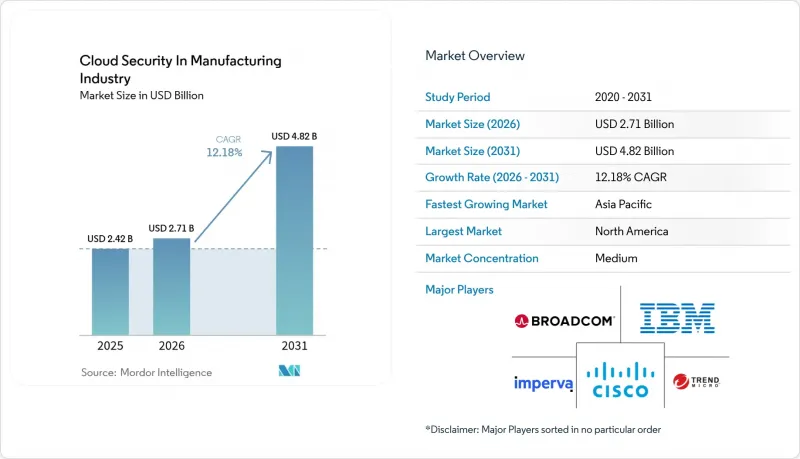
This report is Segmented by Solution (Identity and Access Management (IAM), and More), Security Type (Application Security, and More), Service Model (SaaS Security, and More), Deployment Model (Public Cloud, and More), Organization Size (Large Enterprises and Small and Medium Enterprises), and Geography (North America, and More). The Market Forecasts are Provided in Terms of Value (USD).
Global Cloud Security In Manufacturing Industry Trends and Insights
Surging Multi-Cloud Complexity Elevating Attack Surface
Manufacturers now operate across AWS, Azure and Google Cloud, with 95% using at least two providers. Connecting these environments to legacy shop-floor systems multiplies threat entry points and complicates compliance alignment. Unified cloud security platforms that interpret both IT and OT telemetry command premium budgets. Demand is acute for agentless, runtime-aware controls that safeguard programmable logic controllers without disrupting production. Vendors that simplify policy orchestration across heterogeneous estates gain clear advantage.
Regulatory Mandates Accelerate Security Spend
Implementation of the EU NIS2 Directive and U.S. CMMC Level 2 obligations forces immediate upgrades to monitoring, incident reporting and supply-chain assurance. Manufacturers invest in FedRAMP-authorized services and automated compliance tooling to avoid contract exclusion. Similar rules in India and Japan magnify complexity, spurring adoption of regionally hosted sovereign clouds to localize sensitive data. Short deployment windows turn compliance from a governance task into a primary budget catalyst.
Identity Debt from Unmanaged Machine Identities
IoT sensors, robots and edge gateways outnumber humans on the factory floor, yet 75% of firms lack lifecycle oversight for their credentials. Stale certificates and hard-coded keys provide covert persistence paths for attackers. Scaling zero-trust to millions of non-human identities demands automated discovery, rotation and revocation workflows that many plants still lack, constraining immediate uptake of advanced cloud services.
Other drivers and restraints analyzed in the detailed report include:
- AI-Driven Autonomous Remediation Cutting MTTR
- Cloud-Native Application Protection Platform (CNAPP) Consolidation Wave
- Shortage of Cloud-Literate Security Engineers
For complete list of drivers and restraints, kindly check the Table Of Contents.
Segment Analysis
Identity and Access Management commanded 37.10% of the cloud security in manufacturing industry in 2025, reflecting the urgent need to gate every user and machine session. Manufacturers integrate privileged-access vaults with zero-trust segmentation to curb lateral movement. Modern IAM stacks embed certificate authorities for robots and additive printers, unifying policy across IT and OT. Data Loss Prevention, growing at a 12.37% CAGR, gains traction as export-controlled design files are exchanged between CAD systems and contract assemblers. Advanced DLP that classifies engineering blueprints and blocks exfiltration by anomaly peaks addresses rising IP theft.
Micro-segmentation features bolster IAM by binding dynamic policies to workloads in Kubernetes clusters that feed production lines. Conditional access using real-time risk scores throttles credentials during suspected compromise, lifting resilience against ransomware. Meanwhile, encryption and key-management modules gain relevance as quantum-ready algorithms enter pilots. Collectively, these trends keep the cloud security in manufacturing industry focused on identity-centric controls that can scale to millions of endpoints without impairing uptime.
Application Security held a 37.75% share of the cloud security in manufacturing industry in 2025 as industrial firms re-platform MES and PLM workloads into containers hosted in public clouds. Runtime protection, software-composition analysis and API gateways form core defense layers. Network Security is projected to grow 12.62% annually, driven by east-west inspection for OT traffic traversing SD-WAN links to cloud data lakes. Manufacturers apply deep-packet inspection tuned for Modbus and OPC UA protocols to thwart command spoofing.
Edge rollouts that leverage 5G private networks further elevate demand for micro-firewalls and zero-trust network access. Database, endpoint and email security maintain steady uptake, yet incremental spending converges on network detection-and-response engines that correlate traffic anomalies with application logs. This convergence underscores how the cloud security in manufacturing industry is increasingly treating the application and network layers as a single, unified fabric governed by a single policy engine.
Complete Report Scope:
- By Solution
- Identity and Access Management (IAM)
- Data Loss Prevention (DLP)
- Security Information and Event Management (SIEM)
- Encryption and Key Management
- Other Solutions
- By Security Type
- Application Security
- Database Security
- Endpoint Security
- Network Security
- Web and Email Security
- By Service Model
- SaaS Security
- PaaS Security
- IaaS Security
- By Deployment Model
- Public Cloud
- Private Cloud
- Hybrid / Multi-Cloud
- By Organization Size
- Large Enterprises
- Small and Medium Enterprises (SMEs)
- By Geography
- North America
- United States
- Canada
- Mexico
- Europe
- Germany
- United Kingdom
- France
- Italy
- Spain
- Rest of Europe
- Asia-Pacific
- China
- Japan
- India
- South Korea
- Australia
- Rest of Asia-Pacific
- South America
- Brazil
- Argentina
- Rest of South America
- Middle East and Africa
- Middle East
- Saudi Arabia
- United Arab Emirates
- Turkey
- Rest of Middle East
- Africa
- South Africa
- Egypt
- Nigeria
- Rest of Africa
- Middle East
- North America
Geography Analysis
North America held 38.20% of the cloud security in manufacturing industry in 2025 due to strict CMMC enforcement on defense contractors and multi-billion-dollar federal programs such as the USD 5.6 billion Mission Partner Environment. U.S. automotive and aerospace primes demand proof of zero-trust adoption from tier-one suppliers, spurring platform standardization. Canada's CPCSC, effective winter 2025, introduces NIST-aligned certification for cross-border components, further reinforcing its regional leadership.
Europe accelerates on the back of the NIS2 Directive, compelling manufacturing firms to deploy incident monitoring, risk management, and supply-chain security by 2025. Germany, France, and the United Kingdom invest heavily in sovereign cloud zones managed by local telcos to comply with GDPR and upcoming AI Act data-governance clauses. Unified dashboards that map exposure across multinational plants are in demand as firms juggle varied national guidance.
Asia-Pacific records the fastest 12.88% CAGR, fuelled by national Industry 4.0 initiatives and rising awareness after headline OT attacks. China, India, and Japan combine smart-factory subsidies with stricter data-localization mandates, prompting hybrid architectures that keep telemetry onshore. Regional manufacturers show strong interest in AI-enabled threat hunting: 77% prioritise cybersecurity in digital roadmaps and 67% place cloud platform security among the top three investments. Sovereign clouds and shared-responsibility guidance tailored to multilingual workforces differentiate vendors seeking APAC market share.
- Palo Alto Networks Inc.
- Microsoft Corp.
- Cisco Systems Inc.
- Fortinet Inc.
- Check Point Software Tech. Ltd.
- Trend Micro Inc.
- IBM Corp.
- Broadcom Inc. (Symantec)
- Zscaler Inc.
- CrowdStrike Holdings Inc.
- Imperva Inc.
- McAfee LLC
- Sophos Ltd.
- Qualys Inc.
- Amazon Web Services (AWS)
- Google Cloud Security
- Cloudflare Inc.
- Okta Inc.
- Wiz Inc.
- Oracle Corp.
Additional Benefits:
- The market estimate (ME) sheet in Excel format
- 3 months of analyst support
TABLE OF CONTENTS
1 INTRODUCTION
- 1.1 Study Assumptions and Market Definition
- 1.2 Scope of the Study
2 RESEARCH METHODOLOGY
3 EXECUTIVE SUMMARY
4 MARKET LANDSCAPE
- 4.1 Market Overview
- 4.2 Market Drivers
- 4.2.1 Surging Multi-Cloud Complexity Elevating Attack Surface
- 4.2.2 Regulatory Mandates Accelerate Security Spend
- 4.2.3 AI-Driven Autonomous Remediation Cutting MTTR
- 4.2.4 Cloud-Native Application Protection Platform (CNAPP) Consolidation Wave
- 4.2.5 API Economy Exposure Driving Security Budgets
- 4.2.6 Quantum-Safe Encryption Pilots in Hyperscalers
- 4.3 Market Restraints
- 4.3.1 Identity Debt from Unmanaged Machine Identities
- 4.3.2 Shortage of Cloud-Literate Security Engineers
- 4.3.3 Cross-Border Data-Sovereignty Frictions Slow Roll-Outs
- 4.3.4 Hidden Egress Fees Inflate TCO of Secure Cloud Architectures
- 4.4 Industry Value Chain Analysis
- 4.5 Regulatory Landscape
- 4.6 Technological Outlook
- 4.7 Porter's Five Forces Analysis
- 4.7.1 Bargaining Power of Suppliers
- 4.7.2 Bargaining Power of Consumers
- 4.7.3 Threat of New Entrants
- 4.7.4 Threat of Substitute Products
- 4.7.5 Intensity of Competitive Rivalry
- 4.8 Assessment of the Impact of Macroeconomic Trends on the Market
5 MARKET SIZE AND GROWTH FORECASTS (VALUE)
- 5.1 By Solution
- 5.1.1 Identity and Access Management (IAM)
- 5.1.2 Data Loss Prevention (DLP)
- 5.1.3 Security Information and Event Management (SIEM)
- 5.1.4 Encryption and Key Management
- 5.1.5 Other Solutions
- 5.2 By Security Type
- 5.2.1 Application Security
- 5.2.2 Database Security
- 5.2.3 Endpoint Security
- 5.2.4 Network Security
- 5.2.5 Web and Email Security
- 5.3 By Service Model
- 5.3.1 SaaS Security
- 5.3.2 PaaS Security
- 5.3.3 IaaS Security
- 5.4 By Deployment Model
- 5.4.1 Public Cloud
- 5.4.2 Private Cloud
- 5.4.3 Hybrid / Multi-Cloud
- 5.5 By Organization Size
- 5.5.1 Large Enterprises
- 5.5.2 Small and Medium Enterprises (SMEs)
- 5.6 By Geography
- 5.6.1 North America
- 5.6.1.1 United States
- 5.6.1.2 Canada
- 5.6.1.3 Mexico
- 5.6.2 Europe
- 5.6.2.1 Germany
- 5.6.2.2 United Kingdom
- 5.6.2.3 France
- 5.6.2.4 Italy
- 5.6.2.5 Spain
- 5.6.2.6 Rest of Europe
- 5.6.3 Asia-Pacific
- 5.6.3.1 China
- 5.6.3.2 Japan
- 5.6.3.3 India
- 5.6.3.4 South Korea
- 5.6.3.5 Australia
- 5.6.3.6 Rest of Asia-Pacific
- 5.6.4 South America
- 5.6.4.1 Brazil
- 5.6.4.2 Argentina
- 5.6.4.3 Rest of South America
- 5.6.5 Middle East and Africa
- 5.6.5.1 Middle East
- 5.6.5.1.1 Saudi Arabia
- 5.6.5.1.2 United Arab Emirates
- 5.6.5.1.3 Turkey
- 5.6.5.1.4 Rest of Middle East
- 5.6.5.2 Africa
- 5.6.5.2.1 South Africa
- 5.6.5.2.2 Egypt
- 5.6.5.2.3 Nigeria
- 5.6.5.2.4 Rest of Africa
- 5.6.5.1 Middle East
- 5.6.1 North America
6 COMPETITIVE LANDSCAPE
- 6.1 Market Concentration
- 6.2 Strategic Moves
- 6.3 Market Share Analysis
- 6.4 Company Profiles (includes Global level Overview, Market level overview, Core Segments, Financials as available, Strategic Information, Market Rank/Share, Products and Services, Recent Developments)
- 6.4.1 Palo Alto Networks Inc.
- 6.4.2 Microsoft Corp.
- 6.4.3 Cisco Systems Inc.
- 6.4.4 Fortinet Inc.
- 6.4.5 Check Point Software Tech. Ltd.
- 6.4.6 Trend Micro Inc.
- 6.4.7 IBM Corp.
- 6.4.8 Broadcom Inc. (Symantec)
- 6.4.9 Zscaler Inc.
- 6.4.10 CrowdStrike Holdings Inc.
- 6.4.11 Imperva Inc.
- 6.4.12 McAfee LLC
- 6.4.13 Sophos Ltd.
- 6.4.14 Qualys Inc.
- 6.4.15 Amazon Web Services (AWS)
- 6.4.16 Google Cloud Security
- 6.4.17 Cloudflare Inc.
- 6.4.18 Okta Inc.
- 6.4.19 Wiz Inc.
- 6.4.20 Oracle Corp.
7 MARKET OPPORTUNITIES AND FUTURE OUTLOOK
- 7.1 White-Space and Unmet-Need Assessment

