PUBLISHER: Mordor Intelligence | PRODUCT CODE: 2113314

PUBLISHER: Mordor Intelligence | PRODUCT CODE: 2113314
Modified Atmosphere Packaging (MAP) - Market Share Analysis, Industry Trends & Statistics, Growth Forecasts (2026 - 2031)
According to Mordor Intelligence, the modified atmosphere packaging market size in 2026 is estimated at USD 20.68 billion, growing from 2025 value of USD 19.0 billion with 2031 projections showing USD 31.56 billion, growing at 8.82% CAGR over 2026-2031.
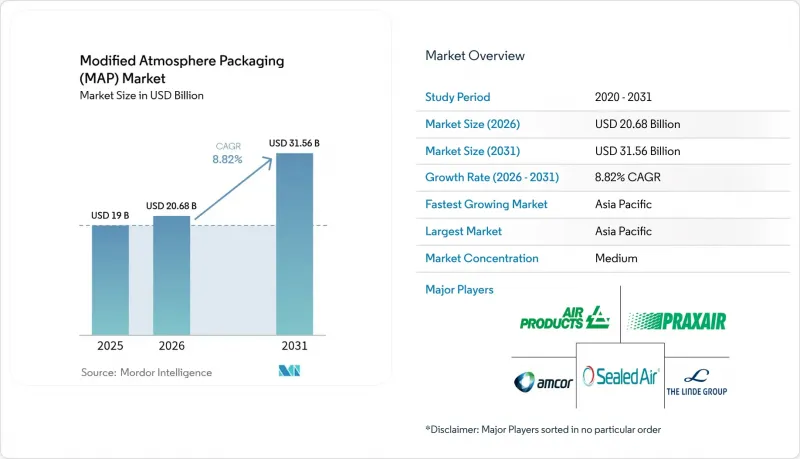
This report is Segmented by Packaging Gas (Oxygen, Nitrogen, Carbon Dioxide, and More), Packaging Material (Polyethylene, Polypropylene, PET, Compostable, and More), Application (Fruits and Vegetables, Meat/Poultry/Seafood, and More), Equipment Type (Tray-Sealing, Form-Fill-Seal, Bag-Sealing, and More), and Geography (North America, and More). The Market Forecasts are Provided in Terms of Value (USD).
Global Modified Atmosphere Packaging (MAP) Market Trends and Insights
Surge in E-grocery Adoption Requiring Extended Shelf-Life
Rising online grocery penetration lengthens distribution windows from 24 hours to as much as 72 hours, forcing retailers to adopt packages that preserve quality throughout last-mile delivery. Meal-kit leaders now specify nitrogen-flushed trays as standard for proteins, a specification that has already lowered spoilage losses from 8-12% to 3-5% in 2024 operations. Capital spending on vacuum-chamber lines therefore scales proportionally with subscription volume, underpinning long-term demand for modified atmosphere packaging market equipment. Supply-chain data visibility further supports dynamic shelf-life modeling, enabling inventory optimization that benefits both retailers and consumers. Consequently, the modified atmosphere packaging market enjoys a durable demand curve aligned with the growth trajectory of e-commerce food retail.
Regulatory Push to Cut Food Waste
The EU's Farm-to-Fork Strategy and similar United States guidance single out MAP as a validated tool for achieving 50% waste-reduction targets by 2030. France's anti-waste law even grants preferential status to retailers implementing certified MAP solutions, nudging procurement toward higher-specification equipment. Export-oriented processors adopt MAP not merely for compliance but also to secure access to high-margin markets in Western Europe and North America. Certification protocols have thus become competitive differentiators, amplifying the modified atmosphere packaging market's role in global trade flows. The legislative momentum places smaller firms under pressure to upgrade or risk exclusion from lucrative retail contracts, sustaining equipment replacement cycles.
High Capital Outlay for MAP Machinery
Entry-level tray sealers with gas-flush modules start near USD 200,000, while high-throughput vacuum-chamber systems surpass USD 600,000, sums that equal 15-20% of annual sales for typical SMEs. Traditional lenders hesitate because resale values are opaque and technology risk is poorly understood. Maintenance contracts add 12-15% of purchase price annually, stretching cash flows and slowing payback periods. Consequently, large processors consolidate share, widening scale advantages and nudging the modified atmosphere packaging market toward moderate concentration. Vendor-financing programs and government grants partially offset the barrier, but funding gaps persist, particularly in emerging economies.
Other drivers and restraints analyzed in the detailed report include:
- Emerging Cold-Chain Infrastructure in Africa
- Clean-Label Demand for Minimally Processed Foods
- Recycling Challenges of Multi-Layer Films
For complete list of drivers and restraints, kindly check the Table Of Contents.
Segment Analysis
Nitrogen retained 37.78% modified atmosphere packaging market share in 2025, reflecting its affordability and broad applicability in oxygen-sensitive categories. Carbon dioxide usage, however, is climbing at a 9.05% CAGR thanks to superior antimicrobial efficacy in proteins that command premium shelf-life extensions. Precision mixers able to regulate head-space to +-0.3% unlock product-specific recipes, gradually shifting the modified atmosphere packaging market size outlook toward multi-gas solutions.
Further differentiation arises as processors integrate inline sensors that adjust flow rates in real time, mitigating over-flush and trimming gas consumption by 12-15% . Oxygen retains niche relevance in fresh-cut produce where controlled levels preserve color, while argon appears in delicate confectionery demanding zero flavor carry-over. Long term, carbon-neutral CO2 captured from bio-ethanol plants could stabilize supply, insulating the modified atmosphere packaging industry from current price shocks.
Polyethylene kept 28.96% revenue share in 2025 because of consistent barrier performance and line familiarity, yet compostables expanded 9.94% annually as cost gaps narrowed and regulatory fees intensified. The modified atmosphere packaging market size for mono-material solutions is set to rise as metallized PLA films achieve oxygen transmission rates rivaling PET-aluminum laminates.
Material R&D now targets downgauging without compromising seal integrity, with pilot lines showing 8-10% resin savings per pouch at equal puncture resistance. Recycling-ready PE/PE structures compatible with store-drop streams help brand owners meet 2027 retailer mandates, offsetting fee exposure. As scale accelerates, compostable films are projected to command double-digit share by 2031, reflecting the sustainability pivot reshaping the modified atmosphere packaging industry.
Complete Report Scope:
- By Packaging Gas
- Oxygen
- Nitrogen
- Carbon Dioxide
- Other Packaging Gases
- By Packaging Material
- Polyethylene (PE)
- Polypropylene (PP)
- Polyethylene Terephthalate (PET)
- Compostable
- Other Packaging Materials
- By Application
- Fruits and Vegetables
- Meat, Poultry and Seafood
- Bakery and Confectionery
- Online Grocery Meal-Kits
- Other Applications
- By Equipment Type
- Tray-Sealing Machines
- Form-Fill-Seal Systems
- Bag-Sealing Machines
- Vacuum Chamber Machines
- Other Equipment Types
- By Geography
- North America
- United States
- Canada
- Mexico
- South America
- Brazil
- Argentina
- Chile
- Rest of South America
- Europe
- United Kingdom
- Germany
- France
- Spain
- Italy
- Rest of Europe
- Asia-Pacific
- China
- India
- Japan
- Australia
- South Korea
- Vietnam
- Rest of Asia-Pacific
- Middle East and Africa
- Middle East
- Saudi Arabia
- United Arab Emirates
- Turkey
- Rest of Middle East
- Africa
- South Africa
- Nigeria
- Egypt
- Rest of Africa
- Middle East
- North America
Geography Analysis
Asia-Pacific anchored 38.22% revenue in 2025 and is on track to post a 10.11% CAGR to 2031, propelled by urban migration, expanding cold chains, and rising middle-class food-safety expectations. China accelerates adoption under its "Zero Food Waste" policy that subsidizes smart packaging, while India's organized retail growth steers processors toward higher-specification MAP lines.
North America remains a steady yet innovation-intensive arena where e-grocery fulfillment centers demand IoT-ready machines that synchronize with inventory-management systems. Europe's roadmap centers on waste-reduction and circular-economy directives, making compostable solutions a disproportionate driver of regional modified atmosphere packaging market growth
The Middle East and Africa record single-digit share but double-digit growth as logistics corridors mature; South-Africa's citrus exporters set quality benchmarks influencing neighboring nations, illustrating how export requirements cascade through regional value chains. Latin America, while smaller, witnesses beef processors adopting hybrid nitrogen-CO2 blends to meet U.S. import regulations, underscoring regulatory convergence that aligns global modified atmosphere packaging industry standards.
- Amcor plc
- Sealed Air Corporation
- Linde plc
- Air Products and Chemicals Inc.
- Praxair Packaging Solutions LLC
- Mondi Group plc
- Multisorb Technologies Inc.
- StePac Ltd.
- Robert Reiser and Co. Inc.
- Wespertech s.r.o.
- CV Thermoformers Ltd.
- Orics Industries Inc.
- Ilapak International SA
- GEA Group AG
- Ulma Packaging S. Coop.
- Harpak-Ulma Packaging LLC
- CVP Systems Inc.
- Wipak Oy
- Coveris Holdings SA
Additional Benefits:
- The market estimate (ME) sheet in Excel format
- 3 months of analyst support
TABLE OF CONTENTS
1 INTRODUCTION
- 1.1 Study Assumptions and Market Definition
- 1.2 Scope of the Study
2 RESEARCH METHODOLOGY
3 EXECUTIVE SUMMARY
4 MARKET LANDSCAPE
- 4.1 Market Overview
- 4.2 Market Drivers
- 4.2.1 Surge in e-grocery adoption requiring extended shelf-life
- 4.2.2 Regulatory push to cut food waste
- 4.2.3 Emerging cold-chain infrastructure in Africa
- 4.2.4 Clean-label demand for minimally processed foods
- 4.2.5 IoT-enabled dynamic MAP solutions
- 4.2.6 Growth in compostable MAP films
- 4.3 Market Restraints
- 4.3.1 High capital outlay for MAP machinery
- 4.3.2 Recycling challenges of multi-layer films
- 4.3.3 Industrial-gas price volatility
- 4.3.4 CO2 supply shortages from decarbonisation drives
- 4.4 Industry Value Chain Analysis
- 4.5 Regulatory Landscape
- 4.6 Technological Outlook
- 4.7 Impact of Macroeconomic Factors on the Market
- 4.8 Porters Five Forces Analysis
- 4.8.1 Threat of New Entrants
- 4.8.2 Bargaining Power of Buyers
- 4.8.3 Bargaining Power of Suppliers
- 4.8.4 Threat of Substitutes
- 4.8.5 Intensity of Competitive Rivalry
5 MARKET SIZE AND GROWTH FORECASTS (VALUE)
- 5.1 By Packaging Gas
- 5.1.1 Oxygen
- 5.1.2 Nitrogen
- 5.1.3 Carbon Dioxide
- 5.1.4 Other Packaging Gases
- 5.2 By Packaging Material
- 5.2.1 Polyethylene (PE)
- 5.2.2 Polypropylene (PP)
- 5.2.3 Polyethylene Terephthalate (PET)
- 5.2.4 Compostable
- 5.2.5 Other Packaging Materials
- 5.3 By Application
- 5.3.1 Fruits and Vegetables
- 5.3.2 Meat, Poultry and Seafood
- 5.3.3 Bakery and Confectionery
- 5.3.4 Online Grocery Meal-Kits
- 5.3.5 Other Applications
- 5.4 By Equipment Type
- 5.4.1 Tray-Sealing Machines
- 5.4.2 Form-Fill-Seal Systems
- 5.4.3 Bag-Sealing Machines
- 5.4.4 Vacuum Chamber Machines
- 5.4.5 Other Equipment Types
- 5.5 By Geography
- 5.5.1 North America
- 5.5.1.1 United States
- 5.5.1.2 Canada
- 5.5.1.3 Mexico
- 5.5.2 South America
- 5.5.2.1 Brazil
- 5.5.2.2 Argentina
- 5.5.2.3 Chile
- 5.5.2.4 Rest of South America
- 5.5.3 Europe
- 5.5.3.1 United Kingdom
- 5.5.3.2 Germany
- 5.5.3.3 France
- 5.5.3.4 Spain
- 5.5.3.5 Italy
- 5.5.3.6 Rest of Europe
- 5.5.4 Asia-Pacific
- 5.5.4.1 China
- 5.5.4.2 India
- 5.5.4.3 Japan
- 5.5.4.4 Australia
- 5.5.4.5 South Korea
- 5.5.4.6 Vietnam
- 5.5.4.7 Rest of Asia-Pacific
- 5.5.5 Middle East and Africa
- 5.5.5.1 Middle East
- 5.5.5.1.1 Saudi Arabia
- 5.5.5.1.2 United Arab Emirates
- 5.5.5.1.3 Turkey
- 5.5.5.1.4 Rest of Middle East
- 5.5.5.2 Africa
- 5.5.5.2.1 South Africa
- 5.5.5.2.2 Nigeria
- 5.5.5.2.3 Egypt
- 5.5.5.2.4 Rest of Africa
- 5.5.5.1 Middle East
- 5.5.1 North America
6 COMPETITIVE LANDSCAPE
- 6.1 Market Concentration
- 6.2 Strategic Moves
- 6.3 Market Share Analysis
- 6.4 Company Profiles (includes Global-level overview, market-level overview, core segments, financials as available, strategic information, market rank/share for key companies, products and services, and recent developments)
- 6.4.1 Amcor plc
- 6.4.2 Sealed Air Corporation
- 6.4.3 Linde plc
- 6.4.4 Air Products and Chemicals Inc.
- 6.4.5 Praxair Packaging Solutions LLC
- 6.4.6 Mondi Group plc
- 6.4.7 Multisorb Technologies Inc.
- 6.4.8 StePac Ltd.
- 6.4.9 Robert Reiser and Co. Inc.
- 6.4.10 Wespertech s.r.o.
- 6.4.11 CV Thermoformers Ltd.
- 6.4.12 Orics Industries Inc.
- 6.4.13 Ilapak International SA
- 6.4.14 GEA Group AG
- 6.4.15 Ulma Packaging S. Coop.
- 6.4.16 Harpak-Ulma Packaging LLC
- 6.4.17 CVP Systems Inc.
- 6.4.18 Wipak Oy
- 6.4.19 Coveris Holdings SA
7 MARKET OPPORTUNITIES AND FUTURE OUTLOOK
- 7.1 White-space and Unmet-need Assessment

