PUBLISHER: Mordor Intelligence | PRODUCT CODE: 2113315

PUBLISHER: Mordor Intelligence | PRODUCT CODE: 2113315
India Kitchen Appliances - Market Share Analysis, Industry Trends & Statistics, Growth Forecasts (2026 - 2031)
According to Mordor Intelligence, the India kitchen appliances market size was valued at USD 11.41 billion in 2025 and estimated to grow from USD 12.22 billion in 2026 to reach USD 17.24 billion by 2031, at a CAGR of 7.12% during the forecast period (2026-2031).
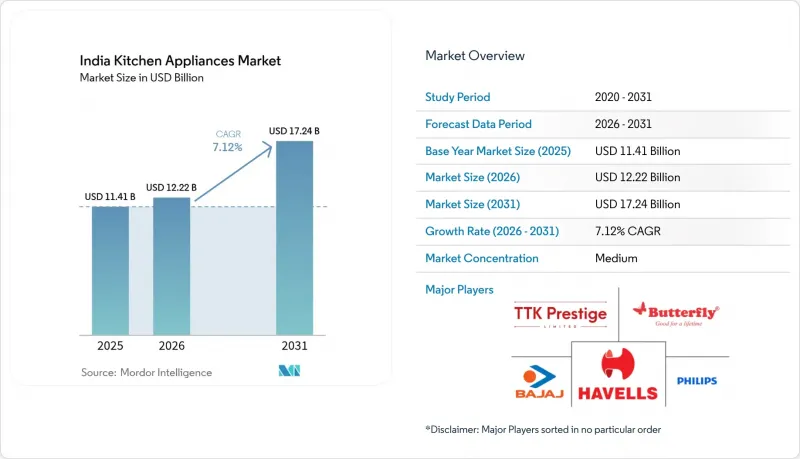
This report is Segmented by Product (Large Kitchen Appliances, Small Kitchen Appliances), End User (Residential, Commercial), Distribution Channel (B2C/Retail, B2B), and Geography. The Market Forecasts are Provided in Terms of Value (USD).
India Kitchen Appliances Market Trends and Insights
Rising Urban Middle-Class Disposable Income
Urban household spending on consumer durables climbed 18% year-on-year during the March 2024 quarter, allowing families to move from single-function gadgets to multi-tasking smart ranges. Average urban expenditure reached INR 49,418 per month, 1.6 times rural levels, boosting demand for premium refrigerators, dishwashers, and built-in ovens. Southern states recorded a 35% jump in grocery and home-goods outlays over two years, reinforcing the region's appetite for energy-efficient kitchen solutions. Manufacturers now position inverter compressors and AI-assisted menus as core selling points that fit status aspirations and utility-bill savings. Organized retail expansion further enhances access to branded appliances as mall developers anchor new properties around electronics megastores.
Growth of E-commerce & D2C Appliance Brands
Digital marketplaces contributed between 9-30% of sales across major appliance categories in 2024 and logged 25% growth in Amazon's home-and-kitchen vertical in Odisha alone. Lower entry barriers let challenger brands launch directly to consumers with online-only SKUs that undercut incumbents on price while offering app connectivity. Wonderchef's plan to double revenue within five years rests on search-optimized listings, influencer-led recipe videos, and same-day shipping across 100 cities. Flash-sale festivals during Diwali and Republic-Day weeks routinely drive triple-digit growth for air fryers, mixer-grinders, and countertop ovens. E-commerce reliability and doorstep installation have gradually shifted even high-ticket refrigerator purchases online, signaling a permanent omnichannel rebalancing.
Volatile Raw-Material & Component Costs
Spot steel and aluminum prices spiked 18-22% during 2024, cutting gross margins for cooker and chimney makers by up to 250 basis points. TTK Prestige's EBITDA margin slipped to 10.7% in Q2 FY25 despite automation investments aimed at offsetting commodity inflation. Container shortages stemming from Red Sea diversions delayed PCB shipments, forcing assemblers to carry inflated inventory that tied up working capital. Exchange-rate swings amplified exposure for firms importing compressors and semiconductors, prompting many to hedge dollar requirements or shift sourcing to Indian vendors. Local foundries are ramping induction-motor capacity, but ramp-up timelines limit short-term relief.
Other drivers and restraints analyzed in the detailed report include:
- Government Push for Domestic Manufacturing
- Energy-Efficiency Regulations Driving Replacements
- Wide Regional Price-Sensitivity Limiting Premiums
For complete list of drivers and restraints, kindly check the Table Of Contents.
Segment Analysis
Large appliances accounted for 68.10% of 2025 revenue, underscoring their anchor role in the India kitchen appliances market. Refrigerators lead the sub-segment, with AI-ready models featuring convertible freezer compartments that fit India's penchant for bulk produce shopping. Dishwashers, once niche, are on track to cross USD 90 million by 2026 as urban households seek hygienic, labor-saving solutions [IBEF.ORG]. Built-in hobs and chimneys benefit from rapid adoption of modular kitchens in new apartment complexes, especially across Bengaluru and Pune. Government LPG subsidies also boost gas-hob replacement cycles, ensuring demand resiliency despite commodity inflation.
Small appliances exhibit a 8.88% forecast CAGR through 2031, marking them the fastest-expanding slice of the India kitchen appliances market. Air fryers dominate this surge, and Philips' Ahmedabad plant with 1.5 million-unit capacity illustrates confidence in sustained growth. Electric kettles, toasters, and sandwich makers register holiday-season spikes, reflecting breakfast-on-the-go lifestyle shifts among millennials. Multi-cookers equipped with voice-guided recipes appeal to first-time cooks working from home, while robotic stir-fry devices introduced by Upliance.ai at INR 23,999 democratize automated cooking. Health-linked appliances such as cold-press juicers further diversify the segment, aligning with wellness priorities.
Complete Report Scope:
- By Product
- Large Kitchen Appliances
- Refrigerators & Freezers
- Dishwashers
- Range Hoods
- Cooktops
- Ovens
- Other Large Kitchen Appliances
- Small Kitchen Appliances
- Food Processors
- Juicers and Blenders
- Grills and Roasters
- Air Fryers
- Coffee Makers
- Electric Cookers
- Toasters
- Electric Kettles
- Countertop Ovens
- Other Small Kitchen Appliances
- Large Kitchen Appliances
- By End User
- Residential
- Commercial
- By Distribution Channel
- B2C/Retail
- Multi-brand Stores
- Exclusive Brand Outlets
- Online
- Other Distribution Channels
- B2B (directly from the manufacturers)
- B2C/Retail
- By Geography
- North India
- South India
- West India
- East & North-East India
List of Companies Covered in this Report:
- TTK Prestige Ltd.
- Philips Domestic Appliances India Ltd.
- Bajaj Electricals Ltd.
- Havells India Ltd.
- Butterfly Gandhimathi Appliances Ltd.
- LG Electronics India Pvt. Ltd.
- Samsung India Electronics Pvt. Ltd.
- Whirlpool of India Ltd.
- Voltas Beko Appliances Pvt. Ltd.
- Godrej Appliances
- Panasonic India Pvt. Ltd.
- Usha International Ltd.
- IFB Industries Ltd.
- Crompton Greaves Consumer Electricals Ltd.
- Inalsa Home Appliances
- Morphy Richards India
- Kenstar
- Glen Appliances Pvt. Ltd.
- Maharaja Whiteline
- Hindware Home Innovation Ltd.
- Preethi Kitchen Appliances Pvt. Ltd.
Additional Benefits:
- The market estimate (ME) sheet in Excel format
- 3 months of analyst support
TABLE OF CONTENTS
1 Introduction
- 1.1 Study Assumptions & Market Definition
- 1.2 Scope of the Study
2 Research Methodology
3 Executive Summary
4 Market Landscape
- 4.1 Market Overview
- 4.2 Market Drivers
- 4.2.1 Rising Urban Middle-Class Disposable Income
- 4.2.2 Growth of E-Commerce & D2C Appliance Brands
- 4.2.3 Government Push For Domestic Manufacturing
- 4.2.4 Energy-Efficiency Regulations Driving Replacements
- 4.2.5 Surge In Health-Centric Cooking Trends
- 4.2.6 Appliance-As-A-Service & Rental Models Emerging
- 4.3 Market Restraints
- 4.3.1 Volatile Raw-Material & Component Costs
- 4.3.2 Wide Regional Price-Sensitivity Limiting Premiums
- 4.3.3 Slow Smart-Appliance Uptake Over Data-Privacy Worries
- 4.3.4 Informal Repair Market Prolongs Product Lifecycles
- 4.4 Industry Value Chain Analysis
- 4.5 Porter's Five Forces Analysis
- 4.5.1 Threat of New Entrants
- 4.5.2 Bargaining Power of Suppliers
- 4.5.3 Bargaining Power of Buyers
- 4.5.4 Threat of Substitutes
- 4.5.5 Competitive Rivalry
- 4.6 Insights into the Latest Trends and Innovations in the Market
- 4.7 Insights on Recent Developments (New Product Launches, Strategic Initiatives, Investments, Partnerships, JVs, Expansion, M&As, etc.) in the Market
5 Market Size & Growth Forecasts (Value in USD)
- 5.1 By Product
- 5.1.1 Large Kitchen Appliances
- 5.1.1.1 Refrigerators & Freezers
- 5.1.1.2 Dishwashers
- 5.1.1.3 Range Hoods
- 5.1.1.4 Cooktops
- 5.1.1.5 Ovens
- 5.1.1.6 Other Large Kitchen Appliances
- 5.1.2 Small Kitchen Appliances
- 5.1.2.1 Food Processors
- 5.1.2.2 Juicers and Blenders
- 5.1.2.3 Grills and Roasters
- 5.1.2.4 Air Fryers
- 5.1.2.5 Coffee Makers
- 5.1.2.6 Electric Cookers
- 5.1.2.7 Toasters
- 5.1.2.8 Electric Kettles
- 5.1.2.9 Countertop Ovens
- 5.1.2.10 Other Small Kitchen Appliances
- 5.1.1 Large Kitchen Appliances
- 5.2 By End User
- 5.2.1 Residential
- 5.2.2 Commercial
- 5.3 By Distribution Channel
- 5.3.1 B2C/Retail
- 5.3.1.1 Multi-brand Stores
- 5.3.1.2 Exclusive Brand Outlets
- 5.3.1.3 Online
- 5.3.1.4 Other Distribution Channels
- 5.3.2 B2B (directly from the manufacturers)
- 5.3.1 B2C/Retail
- 5.4 By Geography
- 5.4.1 North India
- 5.4.2 South India
- 5.4.3 West India
- 5.4.4 East & North-East India
6 Competitive Landscape
- 6.1 Market Concentration
- 6.2 Strategic Moves
- 6.3 Market Share Analysis
- 6.4 Company Profiles (includes Global level Overview, Market level overview, Core Segments, Financials as available, Strategic Information, Market Rank/Share, Products & Services, Recent Developments)
- 6.4.1 TTK Prestige Ltd.
- 6.4.2 Philips Domestic Appliances India Ltd.
- 6.4.3 Bajaj Electricals Ltd.
- 6.4.4 Havells India Ltd.
- 6.4.5 Butterfly Gandhimathi Appliances Ltd.
- 6.4.6 LG Electronics India Pvt. Ltd.
- 6.4.7 Samsung India Electronics Pvt. Ltd.
- 6.4.8 Whirlpool of India Ltd.
- 6.4.9 Voltas Beko Appliances Pvt. Ltd.
- 6.4.10 Godrej Appliances
- 6.4.11 Panasonic India Pvt. Ltd.
- 6.4.12 Usha International Ltd.
- 6.4.13 IFB Industries Ltd.
- 6.4.14 Crompton Greaves Consumer Electricals Ltd.
- 6.4.15 Inalsa Home Appliances
- 6.4.16 Morphy Richards India
- 6.4.17 Kenstar
- 6.4.18 Glen Appliances Pvt. Ltd.
- 6.4.19 Maharaja Whiteline
- 6.4.20 Hindware Home Innovation Ltd.
- 6.4.21 Preethi Kitchen Appliances Pvt. Ltd.
7 Market Opportunities & Future Outlook
- 7.1 Rapid Adoption of AI-Enabled, Voice-Controlled Kitchen Ecosystems
- 7.2 Rise of Circular Economy Models: Subscription, Refurbishment & Appliance Recycling

