PUBLISHER: Mordor Intelligence | PRODUCT CODE: 2113330

PUBLISHER: Mordor Intelligence | PRODUCT CODE: 2113330
Commercial Aircraft Interior Lighting - Market Share Analysis, Industry Trends & Statistics, Growth Forecasts (2026 - 2031)
According to Mordor Intelligence, the commercial aircraft interior lighting market size was valued at USD 1.08 billion in 2025 and estimated to grow from USD 1.11 billion in 2026 to reach USD 1.31 billion by 2031, at a CAGR of 3.22% during the forecast period (2026-2031).
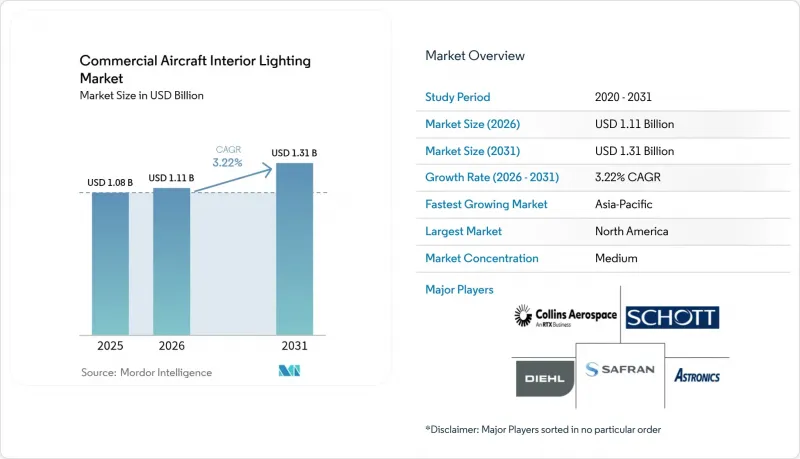
This report is Segmented by Aircraft Type (Narrowbody Aircraft, Widebody Aircraft, and Regional Jets), Light Type (Reading Lights, Ceiling and Wall Lights, Signage Lights, and More), Cabin Class (First Class, Business Class, and More), End User (OEM Linefit, and More), and Geography (North America, Europe, Asia-Pacific, and More). The Market Forecasts are Provided in Terms of Value (USD).
Global Commercial Aircraft Interior Lighting Market Trends and Insights
Accelerated narrowbody fleet expansion among LCCs
LCCs across Asia-Pacific are driving unprecedented demand for narrowbody aircraft interior lighting systems through massive fleet expansion programs that prioritize operational efficiency and passenger density optimization. IndiGo operates 388 aircraft with orders for 260 A320neos, 390 A321neos, and 30 A350-900s, representing one of aviation's largest single-operator backlogs while transitioning from single-cabin to dual-class configurations requiring sophisticated zone-based lighting control. This expansion pattern extends beyond India, with flyadeal targeting 100 aircraft by 2030 from its current 40 A320s, configured at 186-240 seats in high-density layouts that demand lightweight, energy-efficient LED systems. The LCC model's emphasis on rapid turnaround schedules creates demand for plug-and-play retrofit solutions that minimize aircraft downtime, with installation times as short as 12 hours for complete cabin lighting upgrades. Airlines prioritize systems that reduce maintenance complexity while supporting premium economy offerings within single-aisle aircraft, as demonstrated by IndiGo's "Stretch" product requiring differentiated lighting zones. The trend toward ultra-high-density configurations, with some LCCs achieving 240 seats in A321 aircraft, necessitates advanced lighting control systems that maintain passenger comfort despite reduced personal space allocations.
Retrofit wave toward LED mood-lighting for cabin refresh
Airlines embrace LED mood lighting retrofits as cost-effective alternatives to comprehensive cabin overhauls, delivering immediate passenger experience improvements without the capital intensity of full interior replacements that can cost USD 2-4 million per widebody aircraft. Delta's fleet-wide retrofit program incorporates phase-specific lighting schemes, including warm boarding illumination, candlelit dining ambiance, and circadian-aligned sleep transitions across diverse aircraft types to create consistent brand experiences. STG Aerospace's liTeMood system exemplifies this trend, offering plug-and-play LED replacements that achieve 30 kg weight savings per aircraft while reducing power consumption by 40% compared to fluorescent predecessors. The retrofit approach enables airlines to modernize aging fleets cost-effectively, with Cobalt Spectrum installations requiring no wiring modifications and delivering 500,000-hour mean time between failures. Aircraft refurbishment specialists report booming demand as airlines seek environmental benefits and passenger appeal through cabin lighting upgrades rather than fleet replacement programs. The trend reflects airlines' strategic focus on maximizing existing asset utilization while delivering contemporary passenger experiences that compete with newer aircraft deliveries, particularly important as aircraft retirement schedules extend due to supply chain constraints.
Persistent widebody production backlog and delivery delays
Widebody aircraft production constraints significantly impact the commercial aircraft interior lighting market by delaying new aircraft deliveries and forcing airlines to extend existing fleet operations beyond planned retirement schedules, creating mixed demand effects across market segments. B777X program faces continued delays with first deliveries now pushed to 2026, nearly five years after first flight, due to thrust-link design issues affecting all test aircraft and requiring comprehensive redesign and re-testing protocols. The program's extended certification timeline, complicated by post-B737 MAX regulatory scrutiny and EASA redundancy requirements, affects over 500 aircraft on order from major carriers, including Emirates, Qatar Airways, and Lufthansa, representing billions in delayed lighting system installations. Production stabilization challenges extend beyond Boeing, with Airbus acknowledging supply chain constraints that prevent achieving targeted A320-family production rates of 50 aircraft monthly. At the same time, small cabin parts shortages, including lighting components and wiring harnesses, explicitly contribute to delivery delays. Airlines respond by extending existing aircraft operations through heavy maintenance visits and pursuing retrofit programs to maintain service standards, creating increased aftermarket demand that partially offsets delayed new aircraft installations. The constraint particularly affects premium cabin lighting segments where widebody aircraft command higher per-unit values and more sophisticated lighting system specifications than narrowbody alternatives.
Other drivers and restraints analyzed in the detailed report include:
- Shift from fluorescent to energy-efficient, RoHS-compliant LEDs
- IoT-enabled smart lights enabling predictive maintenance
- Lengthy STC certification cycles for novel lighting systems
For complete list of drivers and restraints, kindly check the Table Of Contents.
Segment Analysis
Narrowbody aircraft command 50.92% market share in 2025, reflecting their central role in global aviation networks and the ongoing shift toward point-to-point connectivity models. The segment's dominance stems from airlines' preference for operational flexibility and route optimization capabilities that narrowbody platforms provide across diverse market conditions. Wizz Air's first A321XLR delivery exemplifies this trend, featuring Airbus Airspace cabin lighting with programmable settings for boarding, dining, relaxing, and sleeping phases across extended 4,700-nautical-mile routes.
While representing 49.08% of the market share, widebody aircraft demonstrate the fastest growth at 3.62% CAGR through 2031, driven by long-haul market recovery and airlines' focus on premium passenger experiences. The B777X program, despite delivery delays to 2026, incorporates sophisticated LED lighting systems designed to mimic destination time zones for jet lag mitigation. Qantas' Project Sunrise A350 installations feature 12 tailored lighting scenes developed through extensive testing at Airbus' Customer Definition Centre, demonstrating widebody platforms' capacity for advanced circadian lighting implementations. The widebody segment benefits from longer flight durations that justify sophisticated lighting investments and passengers' willingness to pay premiums for enhanced comfort features during extended travel periods.
Ceiling and wall lights dominate with 43.35% market share in 2025, reflecting their fundamental role in establishing cabin ambiance and supporting airlines' branding strategies through customizable color schemes and intensity control. This segment encompasses the primary mood lighting systems that define passenger experience across all flight phases, from boarding through disembarkation. Reading lights emerge as the fastest-growing segment at 3.98% CAGR through 2031, driven by technological innovations integrating ambient and task lighting functions within single fixtures.
Schott's Jade Reading Light exemplifies this convergence trend, combining touch operation with no moving parts to reduce maintenance costs by up to 90% compared to traditional flex-and-stay designs. Signage lights benefit from regulatory requirements and safety compliance mandates, while lavatory lights increasingly incorporate smart features like occupancy detection and automated activation sequences. Floor-path lighting strips represent a specialized segment with growth potential through photoluminescent technologies that eliminate electrical requirements while providing emergency guidance capabilities. Lufthansa Technik's GuideU system demonstrates this approach, achieving 60% weight savings versus predecessors while maintaining maintenance-free operation through ambient light charging.
Complete Report Scope:
- By Aircraft Type
- Narrowbody Aircraft
- Widebody Aircraft
- Regional jets
- By Light Type
- Reading Lights
- Ceiling and Wall Lights
- Signage Lights
- Lavatory Lights
- Floor-path Lighting Strips
- By Cabin Class
- First Class
- Business Class
- Premium Economy Class
- Economy Class
- By End User
- OEM Linefit
- Aftermarket/Retrofit
- By Geography
- North America
- United States
- Canada
- Mexico
- Europe
- United Kingdom
- France
- Germany
- Spain
- Italy
- Russia
- Rest of Europe
- Asia-Pacific
- China
- India
- Japan
- South Korea
- Indonesia
- Australia
- Rest of Asia-Pacific
- South America
- Brazil
- Rest of South America
- Middle East and Africa
- Middle East
- Saudi Arabia
- United Arab Emirates
- Qatar
- Rest of Middle East
- Africa
- South Africa
- Nigeria
- Rest of Africa
- Middle East
- North America
Geography Analysis
North America maintains market leadership with a 38.55% share in 2025, supported by extensive retrofit programs and regulatory frameworks encouraging LED adoption across commercial fleets. The region benefits from established supply chains, certification expertise, and airlines' willingness to invest in passenger experience differentiation through advanced lighting systems. Delta's comprehensive fleet refresh program exemplifies North American market characteristics, incorporating sophisticated mood lighting across diverse aircraft types to create consistent brand experiences.
Asia-Pacific demonstrates the fastest growth at 4.69% CAGR through 2031, driven by unprecedented LCC expansion and new aircraft delivery schedules that favor modern lighting installations. IndiGo's transformation from single-cabin operations to dual-class configurations with business-class "Stretch" products illustrates regional market evolution toward premium service offerings that demand sophisticated lighting capabilities. The region's growth trajectory reflects broader economic development patterns, increasing passenger traffic, and airlines' focus on operational efficiency through modern fleet configurations. Air India's post-privatization transformation under Tata ownership emphasizes cabin product improvements through new aircraft deliveries and retrofit programs, supported by the carrier's 470-aircraft order in 2023. These markets benefit from hub-and-spoke network strategies that concentrate passenger traffic through major airports, creating demand for premium cabin experiences that justify sophisticated lighting investments.
Middle East and other emerging markets demonstrate strong growth potential through aggressive fleet modernization and capacity expansion programs pursued by regional carriers. Middle East carriers like Etihad pursue aggressive fleet modernization programs, with USD 7 billion investment plans targeting B777 retrofits and capacity expansion from 92 to 170 aircraft by 2030. European markets demonstrate steady growth through established carriers' fleet renewal programs and LCC expansion, with regulatory frameworks supporting environmental compliance through energy-efficient lighting mandates. Regional carriers' focus on long-haul operations and premium service differentiation drives the adoption of advanced circadian lighting systems and mood control technologies that enhance passenger comfort during extended flights.
- Collins Aerospace (RTX Corporation)
- Safran SA
- Diehl Stiftung & Co. KG
- Astronics Corporation
- SCHOTT AG
- Honeywell International Inc.
- Luminator Technology Group
- Bruce Aerospace Inc.
- Cobalt Aerospace Group Limited
- S.E.L.A. Lighting Systems
- Soderberg Manufacturing Company, Inc.
- Prizm Aircraft Lighting
- Madelec Aero SAS
- Beadlight Limited
- Aveo Engineering Group, s.r.o.
- Heads Up Technologies, Inc.
Additional Benefits:
- The market estimate (ME) sheet in Excel format
- 3 months of analyst support
TABLE OF CONTENTS
1 INTRODUCTION
- 1.1 Study Assumptions and Market Definition
- 1.2 Scope of the Study
2 RESEARCH METHODOLOGY
3 EXECUTIVE SUMMARY AND KEY FINDINGS
4 KEY INDUSTRY TRENDS
- 4.1 Air Passenger Traffic
- 4.1.1 North America
- 4.1.2 Europe
- 4.1.3 Asia-Pacific
- 4.1.4 South America
- 4.1.5 Middle East
- 4.1.6 Africa
- 4.2 New Aircraft Deliveries
- 4.2.1 North America
- 4.2.2 Europe
- 4.2.3 Asia-Pacific
- 4.2.4 South America
- 4.2.5 Middle East
- 4.2.6 Africa
- 4.3 GDP per Capita (Value in USD)
- 4.3.1 North America
- 4.3.2 Europe
- 4.3.3 Asia-Pacific
- 4.3.4 Middle East
- 4.4 Revenue of Aircraft Manufacturers
- 4.5 Aircraft Backlog
- 4.6 Gross Orders
- 4.7 Expenditure of Airlines on Fuel
5 MARKET LANDSCAPE
- 5.1 Market Overview
- 5.2 Market Drivers
- 5.2.1 Accelerated narrowbody fleet expansion among LCCs
- 5.2.2 Retrofit wave toward LED mood-lighting for cabin refresh
- 5.2.3 Shift from fluorescent to energy-efficient, RoHS-compliant LEDs
- 5.2.4 IoT-enabled smart lights enabling predictive maintenance
- 5.2.5 Airline ESG targets favoring ultra-light photoluminescent floor paths
- 5.2.6 Government stimulus for airport infrastructure upgrades post-COVID
- 5.3 Market Restraints
- 5.3.1 Persistent widebody production backlog and delivery delays
- 5.3.2 Lengthy STC certification cycles for novel lighting systems
- 5.3.3 Supply-chain tightness for high-CRI LED chips and driver ICs
- 5.3.4 Capital reallocation toward IFEC/connectivity over lighting
- 5.4 Value Chain Analysis
- 5.5 Regulatory Landscape
- 5.6 Technological Outlook
- 5.7 Porter's Five Forces Analysis
- 5.7.1 Threat of New Entrants
- 5.7.2 Bargaining Power of Buyers
- 5.7.3 Bargaining Power of Suppliers
- 5.7.4 Threat of Substitutes
- 5.7.5 Intensity of Competitive Rivalry
6 MARKET SIZE AND GROWTH FORECASTS (VALUE)
- 6.1 By Aircraft Type
- 6.1.1 Narrowbody Aircraft
- 6.1.2 Widebody Aircraft
- 6.1.3 Regional jets
- 6.2 By Light Type
- 6.2.1 Reading Lights
- 6.2.2 Ceiling and Wall Lights
- 6.2.3 Signage Lights
- 6.2.4 Lavatory Lights
- 6.2.5 Floor-path Lighting Strips
- 6.3 By Cabin Class
- 6.3.1 First Class
- 6.3.2 Business Class
- 6.3.3 Premium Economy Class
- 6.3.4 Economy Class
- 6.4 By End User
- 6.4.1 OEM Linefit
- 6.4.2 Aftermarket/Retrofit
- 6.5 By Geography
- 6.5.1 North America
- 6.5.1.1 United States
- 6.5.1.2 Canada
- 6.5.1.3 Mexico
- 6.5.2 Europe
- 6.5.2.1 United Kingdom
- 6.5.2.2 France
- 6.5.2.3 Germany
- 6.5.2.4 Spain
- 6.5.2.5 Italy
- 6.5.2.6 Russia
- 6.5.2.7 Rest of Europe
- 6.5.3 Asia-Pacific
- 6.5.3.1 China
- 6.5.3.2 India
- 6.5.3.3 Japan
- 6.5.3.4 South Korea
- 6.5.3.5 Indonesia
- 6.5.3.6 Australia
- 6.5.3.7 Rest of Asia-Pacific
- 6.5.4 South America
- 6.5.4.1 Brazil
- 6.5.4.2 Rest of South America
- 6.5.5 Middle East and Africa
- 6.5.5.1 Middle East
- 6.5.5.1.1 Saudi Arabia
- 6.5.5.1.2 United Arab Emirates
- 6.5.5.1.3 Qatar
- 6.5.5.1.4 Rest of Middle East
- 6.5.5.2 Africa
- 6.5.5.2.1 South Africa
- 6.5.5.2.2 Nigeria
- 6.5.5.2.3 Rest of Africa
- 6.5.5.1 Middle East
- 6.5.1 North America
7 COMPETITIVE LANDSCAPE
- 7.1 Market Concentration
- 7.2 Key Strategic Moves
- 7.3 Market Share Analysis
- 7.4 Company Profiles (includes Global level Overview, Market level overview, Core Segments, Financials, Strategic Information, Market Rank/Share, Products and Services, Recent Developments)
- 7.4.1 Collins Aerospace (RTX Corporation)
- 7.4.2 Safran SA
- 7.4.3 Diehl Stiftung & Co. KG
- 7.4.4 Astronics Corporation
- 7.4.5 SCHOTT AG
- 7.4.6 Honeywell International Inc.
- 7.4.7 Luminator Technology Group
- 7.4.8 Bruce Aerospace Inc.
- 7.4.9 Cobalt Aerospace Group Limited
- 7.4.10 S.E.L.A. Lighting Systems
- 7.4.11 Soderberg Manufacturing Company, Inc.
- 7.4.12 Prizm Aircraft Lighting
- 7.4.13 Madelec Aero SAS
- 7.4.14 Beadlight Limited
- 7.4.15 Aveo Engineering Group, s.r.o.
- 7.4.16 Heads Up Technologies, Inc.
8 MARKET OPPORTUNITIES AND FUTURE OUTLOOK
- 8.1 White-space and Unmet-need Assessment
9 KEY STRATEGIC QUESTIONS FOR COMMERCIAL AIRCRAFT INTERIOR LIGHTING CEOS

