PUBLISHER: Mordor Intelligence | PRODUCT CODE: 2113332

PUBLISHER: Mordor Intelligence | PRODUCT CODE: 2113332
Geomembranes - Market Share Analysis, Industry Trends & Statistics, Growth Forecasts (2026 - 2031)
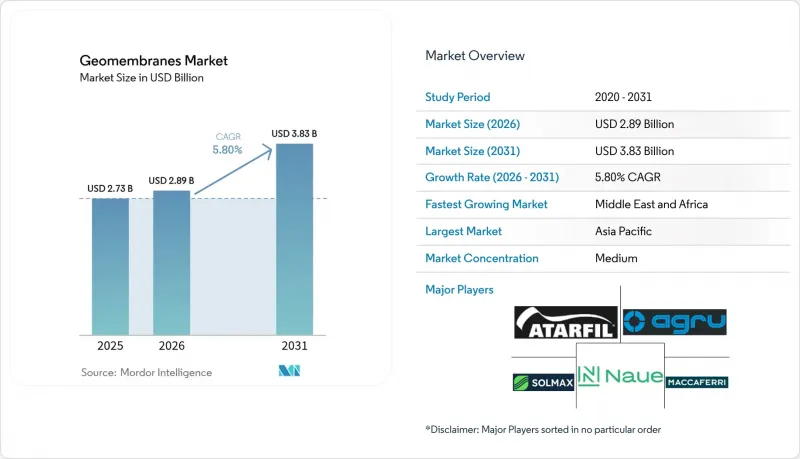
According to Mordor Intelligence, geomembranes market size in 2026 is estimated at USD 2.89 billion, growing from 2025 value of USD 2.73 billion with 2031 projections showing USD 3.83 billion, growing at 5.8% CAGR over 2026-2031.
This report is Segmented by Raw Material (High-Density Polyethylene, Low-Density Polyethylene, Polyvinyl Chloride, Polypropylene, and More), Application (Water Management, Waste Management, Mining, and More), Manufacturing Method (Extrusion/Blown-Film, Calendaring, Co-Extruded Multilayer Barrier, Reinforced/Composite), and Geography (Asia-Pacific, North America, Europe, South America, Middle East and Africa).
Global Geomembranes Market Trends and Insights
Stricter Global Landfill-Seepage Regulations
Worldwide landfill directives now compel composite liner systems, pushing operators to adopt thicker, chemically robust geomembranes that guarantee near-zero permeability over long service lives. The U.S. EPA's 40 CFR Part 258 updates, as well as similar EU rules, have set higher leakage detection standards that roll downstream into emerging economies. U.S. state amendments, such as Kentucky's heightened liner provisions, illustrate how local jurisdictions can exceed federal baselines to mitigate liability exposure. This regulatory cascade drives continuous product upgrades, prompting suppliers to market multilayer HDPE films fortified with UV stabilizers and conductive layers for integrity surveys. Market participants able to demonstrate full compliance through third-party certifications gain pricing power and preferred-bid status in municipal bids. Capital budgets for new landfill cells increasingly earmark 10-15% of project value for liner packages, embedding steady demand into the geomembranes market.
Surging Heap-Leach Copper Projects in Andean Region
Copper miners in Chile and Peru are scaling heap-leach operations to process lower-grade ores cost-effectively, each pad demanding millions of square meters of high-acid-resistant liners. CODELCO's alignment of all tailings facilities to GISTM exemplifies elevated containment spend that ripples through contractor and resin supply chains. HDPE and PP grades modified with antioxidants and higher molecular weight are becoming standard to endure high sulfuric acid concentrations and elevated temperatures. Regional installers are building niche expertise in cold-weld fusion and integrity testing, creating a competitive moat against generalist civil contractors. Suppliers that offer localized stock points and bilingual technical support secure repeat orders as maintenance campaigns run concurrently with expansion phases. By 2030, the Andean corridor is expected to remain the largest single regional pocket of geomembranes market demand outside Asia-Pacific.
Price Volatility of Petro-Based Resins
HDPE and PVC resin prices have experienced 15-20% quarter-to-quarter swings since 2024, driven by refinery outages and logistics disruptions. Membrane producers operate under fixed-award contracts that compress margins when resin costs spike. Some projects now include resin cost escalation clauses, but municipal tenders often resist variable pricing structures, forcing suppliers to hedge through forward contracts. Material substitution with PP or specialty blends partially offsets volatility but introduces supply complexities. The issue is more pronounced in emerging markets where cost sensitivity can delay liner upgrades, moderating short-term geomembranes market growth.
Other drivers and restraints analyzed in the detailed report include:
- Water-Scarcity-Led Reservoir Lining Mandates (Middle East)
- Ag-Tech Boom Driving Lined Irrigation Ponds (APAC)
- Limited Certified Installers in Frontier Mining Regions
For complete list of drivers and restraints, kindly check the Table Of Contents.
Segment Analysis
HDPE anchored 42.18% of the geomembranes market share in 2025 thanks to its proven chemical resistance, UV stability, and stress-crack endurance in exposed containment systems. The material remains the first choice for landfill caps, mining ponds, and canal linings where design lives exceed 50 years. HDPE's property profile and global resin supply chains allow consistent quality, yet its price fluctuation risk nudges some buyers toward PP. PP's 5.95% CAGR through 2031 positions it as the fastest-growing raw material, underpinned by advances in biaxially oriented and multilayer blends that deliver high flexibility and low thermal expansion. These traits suit floating covers and solar-pond hybrids where membrane dimensional stability is critical.
Polyvinyl chloride continues to serve chemical storage and tunnel waterproofing where ease of factory pre-fabrication and weldability are paramount, though environmental concerns cap its growth. LDPE and LLDPE occupy specialist niches requiring conformability over irregular subgrades or temporary linings that demand rapid field seaming. EPDM addresses roofing and potable-water reservoirs because of its elastomeric behavior at extreme temperatures. Hybrid formulations incorporating recycled polymers and nanofillers are emerging, offering improved puncture resistance and scratch toughness. Adoption remains limited but showcases the innovation bandwidth that characterizes the geomembranes market.
Complete Report Scope:
- By Raw Material
- High-density Polyethylene (HDPE)
- Low-density Polyethylene (LDPE)
- Linear Low-density Polyethylene (LLDPE)
- Polyvinyl Chloride (PVC)
- Ethylene Propylene Diene Monomer (EPDM)
- Polypropylene (PP)
- Other Raw Materials
- By Application
- Water Management
- Waste Management
- Mining
- Construction and Tunnel Lining
- Agriculture and Aquaculture
- Soil Management and Erosion Control
- By Manufacturing Method
- Extrusion/Blown-Film
- Calendaring
- Co-extruded Multilayer Barrier
- Reinforced/Composite
- By Geography
- Asia-Pacific
- China
- India
- Japan
- South Korea
- ASEAN Countries
- Rest of Asia-Pacific
- North America
- United States
- Canada
- Mexico
- Europe
- Germany
- United Kingdom
- France
- Italy
- Spain
- Russia
- Rest of Europe
- South America
- Brazil
- Argentina
- Chile
- Rest of South America
- Middle East and Africa
- Saudi Arabia
- United Arab Emirates
- South Africa
- Nigeria
- Rest of Middle East and Africa
- Asia-Pacific
Geography Analysis
Asia-Pacific captured 45.05% of global revenue in 2025, reflecting a scale of public infrastructure investment unmatched elsewhere. China's approval of the USD 137 billion Motuo Hydropower Project and India's USD 13.2 billion Siang Upper Multipurpose Project illustrate mega-developments that embed long-term liner demand. Robust agricultural modernization programs across China and Southeast Asia deploy lined ponds for aquaculture and irrigation, while Indonesia and the Philippines expand municipal solid-waste landfills under new environmental rules. Regional resin production capacity offers cost advantages, enabling local manufacturers to serve projects with shorter lead times. Export-oriented producers in China and South Korea ship factory-fabricated panels to the Americas and Africa, leveraging currency competitiveness to win international bids within the geomembranes market.
Middle East and Africa is on track to post a 5.78% CAGR to 2031, propelled by national water strategies that prescribe lined reservoirs, evaporation ponds, and tailings dams. Morocco's USD 40 billion water plan and Algeria's multi-phase desalination roll-outs typify government-backed megaprojects that embed geomembrane line items into every tender. Mining investment from southern Africa's copperbelt to Ghana's gold fields heightens demand for chemical-resistant HDPE liners compliant with global standards. Regional supply chains still lean heavily on imports of premium membranes, encouraging global suppliers to establish distribution hubs in Dubai and Casablanca for faster delivery.
North America and Europe maintain steady replacement-cycle demand as older landfill cells and wastewater lagoons reach end-of-life. Tightened EPA rules and EU circular-economy directives elevate specification thickness and require double-liner systems in new cells, sustaining volume despite flat landfill openings. South America remains a bright spot because of Andean mining expansion and strict tailings legislation in Chile and Peru. Local liners compete on cost, but major projects rely on globally branded membranes to secure financier confidence, nurturing a healthy mix of regional and international suppliers within the geomembranes market.
- AGRU America, Inc.
- ATARFIL, S.L.
- Carlisle SynTec Systems
- Carthage Mills
- Firestone Building Products Company LLC
- HUESKER International
- Huifeng Geosynthetics
- Jutta Ltd.
- Megaplast India
- NAUE GmbH & Co KG
- Nilex Inc.
- Officine Maccaferri S.p.A
- Plastika Kritis S.A.
- Raven Industries, Inc.
- RENOLIT SE
- SOLMAX
- Sotrafa
- Texel Industries
Additional Benefits:
- The market estimate (ME) sheet in Excel format
- 3 months of analyst support
TABLE OF CONTENTS
1 Introduction
- 1.1 Study Assumptions and Market Definition
- 1.2 Scope of the Study
2 Research Methodology
3 Executive Summary
4 Market Landscape
- 4.1 Market Overview
- 4.2 Market Drivers
- 4.2.1 Stricter global landfill-seepage regulations
- 4.2.2 Surging heap-leach copper projects in Andean region
- 4.2.3 Water-scarcity led reservoir lining mandates (Middle East)
- 4.2.4 Rapid tailings-dam safety reforms after Brumadinho disaster
- 4.2.5 Ag-tech boom driving lined irrigation ponds (APAC)
- 4.3 Market Restraints
- 4.3.1 Price volatility of petro-based HDPE and PVC resins
- 4.3.2 Rising adoption of geosynthetic-clay liners as substitutes
- 4.3.3 Limited certified installers in frontier mining regions
- 4.4 Value Chain Analysis
- 4.5 Porter's Five Forces
- 4.5.1 Bargaining Power of Suppliers
- 4.5.2 Bargaining Power of Buyers
- 4.5.3 Threat of New Entrants
- 4.5.4 Threat of Substitutes
- 4.5.5 Degree of Competition
5 Market Size and Growth Forecasts (Value)
- 5.1 By Raw Material
- 5.1.1 High-density Polyethylene (HDPE)
- 5.1.2 Low-density Polyethylene (LDPE)
- 5.1.3 Linear Low-density Polyethylene (LLDPE)
- 5.1.4 Polyvinyl Chloride (PVC)
- 5.1.5 Ethylene Propylene Diene Monomer (EPDM)
- 5.1.6 Polypropylene (PP)
- 5.1.7 Other Raw Materials
- 5.2 By Application
- 5.2.1 Water Management
- 5.2.2 Waste Management
- 5.2.3 Mining
- 5.2.4 Construction and Tunnel Lining
- 5.2.5 Agriculture and Aquaculture
- 5.2.6 Soil Management and Erosion Control
- 5.3 By Manufacturing Method
- 5.3.1 Extrusion/Blown-Film
- 5.3.2 Calendaring
- 5.3.3 Co-extruded Multilayer Barrier
- 5.3.4 Reinforced/Composite
- 5.4 By Geography
- 5.4.1 Asia-Pacific
- 5.4.1.1 China
- 5.4.1.2 India
- 5.4.1.3 Japan
- 5.4.1.4 South Korea
- 5.4.1.5 ASEAN Countries
- 5.4.1.6 Rest of Asia-Pacific
- 5.4.2 North America
- 5.4.2.1 United States
- 5.4.2.2 Canada
- 5.4.2.3 Mexico
- 5.4.3 Europe
- 5.4.3.1 Germany
- 5.4.3.2 United Kingdom
- 5.4.3.3 France
- 5.4.3.4 Italy
- 5.4.3.5 Spain
- 5.4.3.6 Russia
- 5.4.3.7 Rest of Europe
- 5.4.4 South America
- 5.4.4.1 Brazil
- 5.4.4.2 Argentina
- 5.4.4.3 Chile
- 5.4.4.4 Rest of South America
- 5.4.5 Middle East and Africa
- 5.4.5.1 Saudi Arabia
- 5.4.5.2 United Arab Emirates
- 5.4.5.3 South Africa
- 5.4.5.4 Nigeria
- 5.4.5.5 Rest of Middle East and Africa
- 5.4.1 Asia-Pacific
6 Competitive Landscape
- 6.1 Market Concentration
- 6.2 Strategic Moves
- 6.3 Market Share**/Ranking Analysis
- 6.4 Company Profiles (includes Global level Overview, Market level overview, Core Segments, Financials as available, Strategic Information, Market Rank/Share, Products and Services, Recent Developments)
- 6.4.1 AGRU America, Inc.
- 6.4.2 ATARFIL, S.L.
- 6.4.3 Carlisle SynTec Systems
- 6.4.4 Carthage Mills
- 6.4.5 Firestone Building Products Company LLC
- 6.4.6 HUESKER International
- 6.4.7 Huifeng Geosynthetics
- 6.4.8 Jutta Ltd.
- 6.4.9 Megaplast India
- 6.4.10 NAUE GmbH & Co KG
- 6.4.11 Nilex Inc.
- 6.4.12 Officine Maccaferri S.p.A
- 6.4.13 Plastika Kritis S.A.
- 6.4.14 Raven Industries, Inc.
- 6.4.15 RENOLIT SE
- 6.4.16 SOLMAX
- 6.4.17 Sotrafa
- 6.4.18 Texel Industries
7 Market Opportunities and Future Outlook
- 7.1 White-space and Unmet-Need Assessment

