PUBLISHER: Mordor Intelligence | PRODUCT CODE: 2113352

PUBLISHER: Mordor Intelligence | PRODUCT CODE: 2113352
Biomedical Sensors - Market Share Analysis, Industry Trends & Statistics, Growth Forecasts (2026 - 2031)
According to Mordor Intelligence, the biomedical sensors market size stood at USD 12.92 billion in 2026 and is forecast to advance at an 11.12% CAGR to reach USD 21.89 billion by 2031.
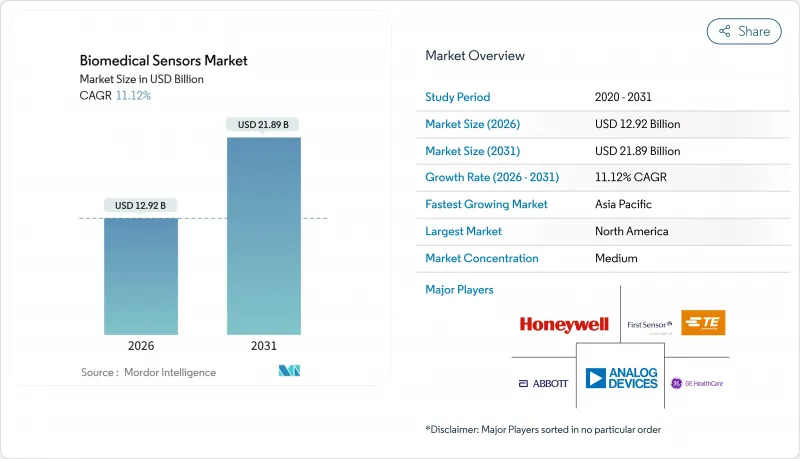
This report is Segmented by Type (Wired, and Wireless), Sensor Type (Temperature, Pressure, Image Sensors, Biochemical, Inertial Sensors, Motion Sensors, Electrocardiogram, Other Sensor Types), Industry (Pharmaceutical, Healthcare, Research Institutions, Fitness and Wellness), Application (Diagnostics, Monitoring, and More), and Geography. The Market Forecasts are Provided in Terms of Value (USD).
Global Biomedical Sensors Market Trends and Insights
Rising Demand for Wearable Health-Monitoring Devices
Consumer electronics brands have demonstrated that wrist, patch, and ring form factors can achieve clinical-grade sensitivity and specificity, as shown by studies on Apple Watch atrial fibrillation detection. Medicare added remote physiologic monitoring codes in 2024, creating a reimbursable pathway that accelerated the use of primary-care prescriptions. The Bluetooth 5.2 specification quadrupled range and doubled throughput, enabling stable links during vigorous activity. Two-week wearable electrocardiogram patches now replace 24-hour Holter monitors, capturing episodic arrhythmias that would otherwise be missed.
Proliferation of Remote Patient Monitoring Programs
The U.S. Department of Veterans Affairs enrolled more than 120,000 veterans in home telehealth programs, resulting in a 25% reduction in hospital bed days. European health ministries earmarked EUR 1.2 billion (USD 1.28 billion) in 2024 to subsidize remote-monitoring infrastructure for chronic disease cohorts. Private payers in the United States tie shared-savings bonuses to real-time sensor visibility for high-risk members, embedding monitoring mandates into value-based contracts. The ONC-endorsed FHIR standard enables sensor data to be directly integrated into electronic health records, eliminating the need for manual transcription and enhancing data integrity.
High Unit Cost of Advanced Implantable Sensors
Factory-calibrated continuous glucose monitors, plus yearly transmitter and sensor replacements, cost USD 3,000-5,000, exceeding the savings modeled in most value-based contracts. Cardiac loop recorders cost nearly USD 8,000, while Medicare covers only the implantation fee, leaving hospitals to absorb the device expense. Manufacturing yields for hermetically sealed implantable packages remain below 85% because laser-welded feedthroughs are prone to microcracks, which necessitate costly rework. Emerging markets often lack reimbursement codes for implantables, resulting in limited adoption, which is primarily confined to self-pay urban segments in Southeast Asia and Latin America.
Other drivers and restraints analyzed in the detailed report include:
- Miniaturization of MEMS and Flexible Electronics
- Integration of AI-Enabled Predictive Analytics Into Sensors
- Stringent Multi-Region Regulatory Approval Cycles
For complete list of drivers and restraints, kindly check the Table Of Contents.
Segment Analysis
Wireless configurations accounted for 64.17% of the biomedical sensors market share in 2025, and this segment is projected to grow at an 11.57% CAGR through 2031. Standards-based Bluetooth, Wi-Fi 6E, and IEEE 802.15.6 protocols allow hospitals to network dozens of devices per room without retrenching cabling or risking infection from tethers. The biomedical sensors market size for wireless platforms is projected to reach USD 14.8 billion by 2031 as disposable patches become routine on surgical wards. Wired systems endure where electromagnetic interference tolerance or sub-millisecond latency is essential, but commoditized radio chipsets have cut wireless bills-of-materials by 40% since 2022, tipping the cost-benefit equation in favor of general wards and home care. Regulatory cybersecurity clauses in ISO 13485 have standardized update mechanisms, alleviating payer concerns about data breaches.
Second-generation wireless nodes can run for a full year on coin-cell power, easing the caregiver burden in elder-care environments. In intensive care, wired sensors still dominate closed-loop anesthesia because latency under 10 ms remains unattainable over the shared spectrum. Yet firms are trialing ultra-wideband to meet this threshold, hinting at full-wireless theaters within the forecast horizon. Disposable, peel-and-stick patches eliminate sterilization logistics, freeing nursing hours and reducing capital cycles for hospitals that previously invested in durable wired probes.
Temperature sensors captured a 29.73% share in 2025, thanks to ubiquitous fever screening; however, biochemical sensors are pacing the field at a 12.73% CAGR. The biomedical sensors market size for biochemical modalities is expected to exceed USD 4.7 billion by 2031, driven by the adoption of continuous glucose, lactate, and ketone monitors. Electrochemical platforms have achieved a mean absolute relative difference of less than 9%, unlocking Medicare and Japan's national coverage for insulin-treated Type 2 diabetes. Sports physiology now demands real-time lactate thresholds, driving the integration of biochemical sensors into athletic wearables.
Pressure sensors face gross margin compression as mature MEMS lines push unit costs under USD 3. Image sensors incorporate on-chip processing to stream 4K endoscopy over legacy networks, while inertial sensors enter neurology with gait analytics that flag Parkinson's disease progression months earlier than clinical observation. Dry-electrode electrocardiogram patches permit 30-day recordings, capturing paroxysmal arrhythmias that short-duration Holters miss. Contactless time-of-flight motion arrays are replacing chest belts in neonatal wards, improving comfort and lowering false alarms.
Complete Report Scope:
- By Type
- Wired
- Wireless
- By Sensor Type
- Temperature
- Pressure
- Image Sensors
- Biochemical
- Inertial Sensors
- Motion Sensors
- Electrocardiogram (ECG)
- Other Sensor Types
- By Industry
- Pharmaceutical
- Healthcare
- Research Institutions
- Fitness and Wellness
- By Application
- Diagnostics
- Monitoring
- Therapeutics
- Imaging
- Research and Development
- Other Applications
- By Geography
- North America
- United States
- Canada
- Mexico
- Europe
- Germany
- United Kingdom
- France
- Russia
- Rest of Europe
- Asia-Pacific
- China
- Japan
- India
- South Korea
- Australia
- Rest of Asia-Pacific
- Middle East and Africa
- Middle East
- Saudi Arabia
- United Arab Emirates
- Rest of Middle East
- Africa
- South Africa
- Egypt
- Rest of Africa
- Middle East
- South America
- Brazil
- Argentina
- Rest of South America
- North America
Geography Analysis
North America accounted for 39.12% of global revenue in 2025, driven by Medicare CPT codes that reimburse device setup and monthly review. Provincial programs in Canada fully subsidize continuous glucose monitors for insulin users, while Mexico's social-security pilots have demonstrated a 30% reduction in emergency department visits, validating the economics of rural telehealth. A deep venture ecosystem and flexible FDA software update policies maintain innovation velocity.
Asia-Pacific is forecast to have a 12.19% CAGR through 2031. China's electronic-record mandate compels hospitals to integrate remote data, driving procurement of wireless vital-sign patches. Japan reimburses continuous glucose monitors for insulin-treated Type 2 patients, tripling its addressable base. India's digital health mission assigns every citizen a unified identifier, allowing sensor data to follow patients across facilities and powering state-level analytics. Korean semiconductor giants expanded MEMS capacity by 40% in 2025, lowering component costs worldwide and reinforcing the region's manufacturing dominance.
Europe grows unevenly as reimbursement and Medical Device Regulation demands diverge by country. Germany links payment to demonstrated reductions in hospitalization, nudging vendors toward predictive analytics. The United Kingdom secured volume discounts that slash unit prices by 35%, broadening access. France's health-technology assessments emphasize the use of real-world evidence, thereby incentivizing post-market registries. Middle East investments in smart hospitals and South American insurer pilots extend adoption, though inconsistent payer policies keep those regions trailing headline growth leaders.
- Abbott Laboratories
- Analog Devices Inc.
- First Sensor AG
- GE Healthcare
- Honeywell International Inc.
- Innovative Sensor Technology
- LumaSense Technologies
- Medtronic Plc
- Measurement Specialties Inc.
- NXP Semiconductors N.V.
- Koninklijke Philips N.V.
- Sensirion AG
- Smiths Medical
- STMicroelectronics N.V.
- TE Connectivity
- Texas Instruments Incorporated
- Zephyr Technology Corp.
- Nonin Medical Inc.
- Thermo Fisher Scientific
- Dexcom Inc.
- Amphenol Advanced Sensors
Additional Benefits:
- The market estimate (ME) sheet in Excel format
- 3 months of analyst support
TABLE OF CONTENTS
1 INTRODUCTION
- 1.1 Study Assumptions and Market Definition
- 1.2 Scope of the Study
2 RESEARCH METHODOLOGY
3 EXECUTIVE SUMMARY
4 MARKET LANDSCAPE
- 4.1 Market Overview
- 4.2 Market Drivers
- 4.2.1 Rising Demand for Wearable Health-Monitoring Devices
- 4.2.2 Proliferation of Remote Patient Monitoring Programs
- 4.2.3 Miniaturization of MEMS and Flexible Electronics
- 4.2.4 Integration of AI-Enabled Predictive Analytics Into Sensors
- 4.2.5 Government Incentives for Tele-health and Home Care
- 4.2.6 Adoption of Passive, Battery-Free Sensor Architectures
- 4.3 Market Restraints
- 4.3.1 High Unit Cost of Advanced Implantable Sensors
- 4.3.2 Stringent Multi-Region Regulatory Approval Cycles
- 4.3.3 Data-Privacy and Cyber-security Vulnerabilities
- 4.3.4 Packaging-Related Drift in Long-Term Implants
- 4.4 Impact of Macroeconomic Factors on the Market
- 4.5 Industry Value Chain Analysis
- 4.6 Regulatory Landscape
- 4.7 Technological Outlook
- 4.8 Porter's Five Forces Analysis
- 4.8.1 Threat of New Entrants
- 4.8.2 Bargaining Power of Buyers
- 4.8.3 Bargaining Power of Suppliers
- 4.8.4 Threat of Substitute Products
- 4.8.5 Intensity of Competitive Rivalry
5 MARKET SIZE AND GROWTH FORECASTS (VALUE)
- 5.1 By Type
- 5.1.1 Wired
- 5.1.2 Wireless
- 5.2 By Sensor Type
- 5.2.1 Temperature
- 5.2.2 Pressure
- 5.2.3 Image Sensors
- 5.2.4 Biochemical
- 5.2.5 Inertial Sensors
- 5.2.6 Motion Sensors
- 5.2.7 Electrocardiogram (ECG)
- 5.2.8 Other Sensor Types
- 5.3 By Industry
- 5.3.1 Pharmaceutical
- 5.3.2 Healthcare
- 5.3.3 Research Institutions
- 5.3.4 Fitness and Wellness
- 5.4 By Application
- 5.4.1 Diagnostics
- 5.4.2 Monitoring
- 5.4.3 Therapeutics
- 5.4.4 Imaging
- 5.4.5 Research and Development
- 5.4.6 Other Applications
- 5.5 By Geography
- 5.5.1 North America
- 5.5.1.1 United States
- 5.5.1.2 Canada
- 5.5.1.3 Mexico
- 5.5.2 Europe
- 5.5.2.1 Germany
- 5.5.2.2 United Kingdom
- 5.5.2.3 France
- 5.5.2.4 Russia
- 5.5.2.5 Rest of Europe
- 5.5.3 Asia-Pacific
- 5.5.3.1 China
- 5.5.3.2 Japan
- 5.5.3.3 India
- 5.5.3.4 South Korea
- 5.5.3.5 Australia
- 5.5.3.6 Rest of Asia-Pacific
- 5.5.4 Middle East and Africa
- 5.5.4.1 Middle East
- 5.5.4.1.1 Saudi Arabia
- 5.5.4.1.2 United Arab Emirates
- 5.5.4.1.3 Rest of Middle East
- 5.5.4.2 Africa
- 5.5.4.2.1 South Africa
- 5.5.4.2.2 Egypt
- 5.5.4.2.3 Rest of Africa
- 5.5.4.1 Middle East
- 5.5.5 South America
- 5.5.5.1 Brazil
- 5.5.5.2 Argentina
- 5.5.5.3 Rest of South America
- 5.5.1 North America
6 COMPETITIVE LANDSCAPE
- 6.1 Market Concentration
- 6.2 Strategic Moves
- 6.3 Market Share Analysis
- 6.4 Company Profiles (includes Global Level Overview, Market Level Overview, Core Segments, Financials as available, Strategic Information, Market Rank/Share for Key Companies, Products and Services, and Recent Developments)
- 6.4.1 Abbott Laboratories
- 6.4.2 Analog Devices Inc.
- 6.4.3 First Sensor AG
- 6.4.4 GE Healthcare
- 6.4.5 Honeywell International Inc.
- 6.4.6 Innovative Sensor Technology
- 6.4.7 LumaSense Technologies
- 6.4.8 Medtronic Plc
- 6.4.9 Measurement Specialties Inc.
- 6.4.10 NXP Semiconductors N.V.
- 6.4.11 Koninklijke Philips N.V.
- 6.4.12 Sensirion AG
- 6.4.13 Smiths Medical
- 6.4.14 STMicroelectronics N.V.
- 6.4.15 TE Connectivity
- 6.4.16 Texas Instruments Incorporated
- 6.4.17 Zephyr Technology Corp.
- 6.4.18 Nonin Medical Inc.
- 6.4.19 Thermo Fisher Scientific
- 6.4.20 Dexcom Inc.
- 6.4.21 Amphenol Advanced Sensors
7 MARKET OPPORTUNITIES AND FUTURE OUTLOOK
- 7.1 White-space and Unmet-Need Assessment

