PUBLISHER: Mordor Intelligence | PRODUCT CODE: 2113377

PUBLISHER: Mordor Intelligence | PRODUCT CODE: 2113377
Pet Hair Care - Market Share Analysis, Industry Trends & Statistics, Growth Forecasts (2026 - 2031)
According to Mordor Intelligence, the pet hair care market size is expected to grow from USD 3.95 billion in 2025 to USD 4.13 billion in 2026 and is forecast to reach USD 5.17 billion by 2031 at 4.58% CAGR over 2026-2031.
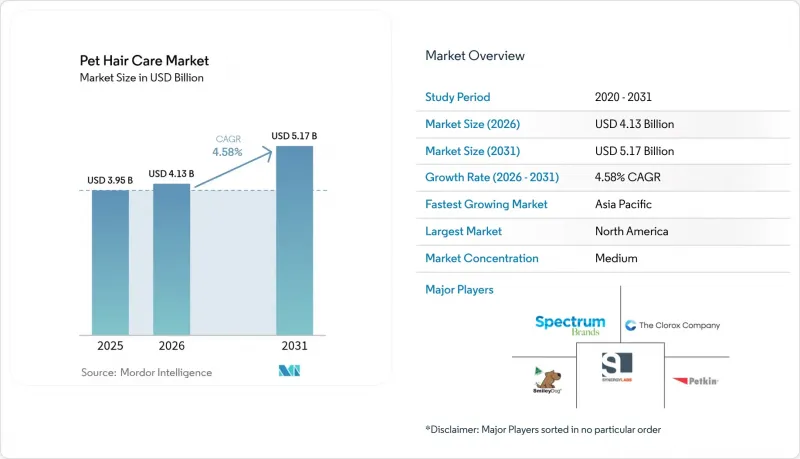
This report is Segmented by Product Type (Shampoos, Conditioners, Shedding and Trimming Tools, and Other Product Types), Animal Type (Dog, Cat, and Other Animal Types), and Geography (North America, Europe, Asia-Pacific, Middle-East and Africa, and South America). The Market Size and Forecasts are Provided in Terms of Value (USD Million) for all the Above Segments.
Global Pet Hair Care Market Trends and Insights
Pet humanization drives premium spend
Owners increasingly view grooming as an extension of personal care, elevating demand for salon-grade shampoos infused with argan oil, probiotics, and fragrance-neutralizing enzymes. U.S. pet expenditure is projected to reach USD 279 billion by 2030, led by millennials who equate pet well-being with family wellness. Celebrity-backed launches such as Jennifer Aniston's Puppy Love Dog Shampoo validate premium positioning and spur broader retail adoption. Veterinary clinics increasingly recommend microbiome-friendly cleansers that support skin barrier function, reinforcing the perception that specialized grooming is preventive healthcare.
Rising pet ownership in emerging markets
Urbanization and smaller household sizes in China, South Korea, and India are lifting pet adoption; China's wider pet economy is poised to exceed EUR 104.3 billion in 2025, nearly triple 2023 levels. Younger consumers prioritize quality ingredients over price, creating fertile ground for premium import brands and locally formulated alternatives. Regional players use social-commerce platforms to bundle shampoos with hair removal tools, meeting rising do-it-yourself grooming appetites. Veterinary associations across Southeast Asia are also rolling out coat-care education campaigns, further normalizing routine bathing and deshedding.
High price sensitivity in developing nations
In many low-income regions, grooming formulations compete with essential pet nutrition for limited household budgets. Affordability studies show pet food alone can consume a disproportionate share of disposable income, curtailing appetite for premium shampoos. Budget-friendly lines employing local botanicals and simplified packaging are therefore critical for penetration. Non-profit clinics offering subsidized grooming highlight latent demand but also illustrate the financial barriers mass-market producers must overcome.
Other drivers and restraints analyzed in the detailed report include:
- Growing dermatological issues in pets
- Expansion of e-commerce pet retail
- Stringent restrictions on harsh chemicals
For complete list of drivers and restraints, kindly check the Table Of Contents.
Segment Analysis
Shampoos & conditioners accounted for 51.62% of the pet hair care market in 2025, underlining their indispensability in routine hygiene. Hair removal tools, including widened ceramic-edge blades and AI-guided clippers, are forecast to grow at 4.96% CAGR, outpacing all other product groups. The segment's uptrend mirrors rising do-it-yourself grooming and the appeal of professional-grade finishes delivered at home. Sprays, wipes, and niche balms deliver incremental convenience but struggle to match the repeat-purchase cadence of cleansing detergents. Premiumization is evident across categories as brands integrate coconut-milk yogurt probiotics and odor-absorbing enzymes, commanding higher price points and nurturing brand loyalty.
Sustainable packaging deepens competitive differentiation. The AeroFlexx pouch for Furminator shampoos uses 66% less plastic yet protects viscosity and shelf life, reflecting broader environmental commitments. Larger players seek to pre-empt regulatory mandates by trialing compostable films and refill-station pilots in specialty stores. Meanwhile, tech-enabled dryers that monitor skin temperature promise cross-selling opportunities, further entrenching the pet hair care market within holistic wellness routines.
Complete Report Scope:
- By Product Type (Value)
- Shampoos & Conditioners
- Sprays & Mists
- Hair Removal Tools & Clippers
- Cleansing Wipes
- Other Grooming Aids
- By Pet Type (Value)
- Dogs
- Cats
- Small Mammals
- Other Companion Animals
- By Distribution Channel (Value)
- Offline
- Pet Specialty Stores
- Supermarkets & Hypermarkets
- Veterinary Clinics
- Online
- E-commerce Marketplaces
- Company-Owned Webshops
- Offline
- By Geography (Value)
- North America
- Uniited states
- Canada
- Mexico
- Europe
- Germany
- United Kingdom
- France
- Italy
- Spain
- Rest of Europe
- Asia-Pacific
- China
- India
- Japan
- South Korea
- Australia
- Rest of Asia-Pacific
- South America
- Brazil
- Argentina
- Rest of South America
- Middle East and Africa
- GCC
- South Africa
- Rest of Middle East and Africa
- North America
Geography Analysis
North America commands 37.08% of global revenue, anchored by high per-capita spend and a mature ecosystem of grooming salons, specialty chains, and subscription boxes. U.S. legislation governing cosmetic safety and state-level pet welfare statutes foster consumer trust and premium uptake. Canadian retailers rapidly expand private-label coat care lines, while Mexico sees rising penetration of mid-tier shampoos positioned as affordable upgrades.
Asia-Pacific represents the fastest expanding region at a 5.18% CAGR through 2031. China's single-child households elevate pets as family members, driving demand for luxurious cleansers and waterless foams suitable for apartment living. Korea's popularity of designer dog breeds boosts sales of detangling sprays and whitening conditioners. India's burgeoning e-commerce infrastructure democratizes access to specialty imports, though price tiers must align with varying income segments. Across the region, livestream shopping events foster discovery and impulsive grooming kit purchases, reinforcing digital pathways to growth. Europe maintains steady momentum underpinned by stringent product safety and sustainability regulation. Germany, the United Kingdom, and France collectively account for a majority of regional turnover, with eco-certified packaging and vegan formulas resonating with environmentally conscious shoppers. Southern European markets show increased influence of mobile groomers offering bundled services and retail products. South America and Middle East & Africa remain nascent, but Brazil's growing middle class and the United Arab Emirates' expatriate population exhibit rising appetite for premium grooming, tempered by import tariffs and limited cold-chain logistics that challenge product integrity.
- Spectrum Brands Holdings Inc.
- Wahl Clipper Corporation
- The Hartz Mountain
- Cosmos Corporation
- Andis Company
- Sunbeam Products Inc. (Oster)
- Beaphar B.V.
- Petco Health & Wellness Co. Inc.
- Earthbath LLC
- PetAg Inc.
- Garmon Corp. (NaturVet)
- Groomer's Choice Pet Products
- Animology (Group55 Ltd.)
- Petco Health & Wellness Co. Inc.
- Animology (Group55 Ltd.)
- Earth Rated Inc.
- Pogi's Inc. (Pogi's Pet Supplies)
Additional Benefits:
- The market estimate (ME) sheet in Excel format
- 3 months of analyst support
TABLE OF CONTENTS
1 Introduction
- 1.1 Study Assumptions & Market Definition
- 1.2 Scope of the Study
2 Research Methodology
3 Executive Summary
4 Market Landscape
- 4.1 Market Overview
- 4.2 Market Drivers
- 4.2.1 Humanization of pets drives premium spend
- 4.2.2 Rising pet ownership in emerging markets
- 4.2.3 Growing dermatological issues in pets
- 4.2.4 Expansion of e-commerce pet retail
- 4.2.5 Vet-endorsed microbiome-friendly formulas
- 4.2.6 AI-enabled smart grooming devices
- 4.3 Market Restraints
- 4.3.1 High price sensitivity in developing nations
- 4.3.2 Stringent restrictions on harsh chemicals
- 4.3.3 Supply bottlenecks for sustainable packaging
- 4.3.4 DIY substitution with human cosmetics
- 4.4 Value / Supply-Chain Analysis
- 4.5 Regulatory Landscape
- 4.6 Technological Outlook
- 4.7 Porter's Five Forces
- 4.7.1 Bargaining Power of Suppliers
- 4.7.2 Bargaining Power of Buyers
- 4.7.3 Threat of New Entrants
- 4.7.4 Threat of Substitutes
- 4.7.5 Competitive Rivalry
5 Market Size & Growth Forecasts
- 5.1 By Product Type (Value)
- 5.1.1 Shampoos & Conditioners
- 5.1.2 Sprays & Mists
- 5.1.3 Hair Removal Tools & Clippers
- 5.1.4 Cleansing Wipes
- 5.1.5 Other Grooming Aids
- 5.2 By Pet Type (Value)
- 5.2.1 Dogs
- 5.2.2 Cats
- 5.2.3 Small Mammals
- 5.2.4 Other Companion Animals
- 5.3 By Distribution Channel (Value)
- 5.3.1 Offline
- 5.3.1.1 Pet Specialty Stores
- 5.3.1.2 Supermarkets & Hypermarkets
- 5.3.1.3 Veterinary Clinics
- 5.3.2 Online
- 5.3.2.1 E-commerce Marketplaces
- 5.3.2.2 Company-Owned Webshops
- 5.3.1 Offline
- 5.4 By Geography (Value)
- 5.4.1 North America
- 5.4.1.1 Uniited states
- 5.4.1.2 Canada
- 5.4.1.3 Mexico
- 5.4.2 Europe
- 5.4.2.1 Germany
- 5.4.2.2 United Kingdom
- 5.4.2.3 France
- 5.4.2.4 Italy
- 5.4.2.5 Spain
- 5.4.2.6 Rest of Europe
- 5.4.3 Asia-Pacific
- 5.4.3.1 China
- 5.4.3.2 India
- 5.4.3.3 Japan
- 5.4.3.4 South Korea
- 5.4.3.5 Australia
- 5.4.3.6 Rest of Asia-Pacific
- 5.4.4 South America
- 5.4.4.1 Brazil
- 5.4.4.2 Argentina
- 5.4.4.3 Rest of South America
- 5.4.5 Middle East and Africa
- 5.4.5.1 GCC
- 5.4.5.2 South Africa
- 5.4.5.3 Rest of Middle East and Africa
- 5.4.1 North America
6 Competitive Landscape
- 6.1 Market Concentration
- 6.2 Market Share Analysis
- 6.3 Company Profiles (includes Global level Overview, Market level overview, Core Segments, Financials as available, Strategic Information, Market Rank/Share for key companies, Products & Services, and Recent Developments)
- 6.3.1 Spectrum Brands Holdings Inc.
- 6.3.2 Wahl Clipper Corporation
- 6.3.3 The Hartz Mountain Corporation
- 6.3.4 Cosmos Corporation
- 6.3.5 Andis Company
- 6.3.6 Sunbeam Products Inc. (Oster)
- 6.3.7 Beaphar B.V.
- 6.3.8 Petco Health & Wellness Co. Inc.
- 6.3.9 Earthbath LLC
- 6.3.10 PetAg Inc.
- 6.3.11 Garmon Corp. (NaturVet)
- 6.3.12 Groomer's Choice Pet Products
- 6.3.13 Animology (Group55 Ltd.)
- 6.3.14 Petco Health & Wellness Co. Inc.
- 6.3.15 Animology (Group55 Ltd.)
- 6.3.16 Earth Rated Inc.
- 6.3.17 Pogi's Inc. (Pogi's Pet Supplies)
7 Market Opportunities & Future Outlook
- 7.1 White-space & Unmet-Need Assessment

