PUBLISHER: Mordor Intelligence | PRODUCT CODE: 2113389

PUBLISHER: Mordor Intelligence | PRODUCT CODE: 2113389
Organic Personal Care - Market Share Analysis, Industry Trends & Statistics, Growth Forecasts (2026 - 2031)
According to Mordor Intelligence, organic personal care market size in 2026 is estimated at USD 158.03 billion, growing from 2025 value of USD 148.75 billion with 2031 projections showing USD 213.86 billion, growing at 6.24% CAGR over 2026-2031.
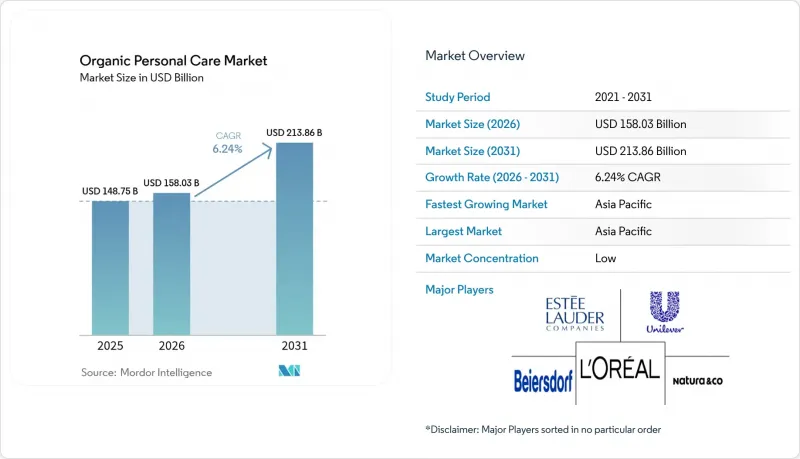
This report is Segmented by Product Type (Skin Care, Hair Care, Lip Care, Deodorants and Antiperspirant, Bath and Shower, and More), by Category (Mass, and Premium), by Distribution Channel (Hypermarkets/Supermarkets, and More), and by Geography (North America, Europe, Asia-Pacific, South America, Middle East and Africa). The Market Forecasts are Provided in Terms of Value (USD).
Global Organic Personal Care Market Trends and Insights
Growing awareness about environmental sustainability
Environmental sustainability has become a key growth driver in the global personal care products market, with consumers and companies focusing on environmentally responsible choices. Consumers demonstrate increased awareness of environmental impacts, particularly regarding plastic waste, chemical runoff, and carbon emissions, leading to higher demand for sustainable personal care alternatives. This consumer shift has compelled brands to modify their product formulations, packaging materials, supply chains, and operational models to minimize environmental impact. The market shows strong consumer preference for biodegradable packaging, natural ingredients, upcycled materials, and cruelty-free certifications, which influences product development across the industry. For example, in April 2023, Olay introduced product jars made from post-consumer recycled plastic for its Vitamin C + Peptide 24 Face Moisturizer and Retinol24 + Peptide Night Face Moisturizer, using Forest Stewardship Council-certified cartons. These recycled jars are projected to prevent 10,000 pounds of plastic waste from entering landfills.
Influence of social media platforms on purchasing decisions
Social media platforms have significantly influenced purchasing decisions in the organic global personal care products market. Platforms such as TikTok, Instagram, and YouTube function as digital marketplaces where user-generated content, reviews, influencer endorsements, and brand narratives shape consumer preferences. According to a TikTok survey, 70% of users discover new brands and products on the platform, while 83% indicate that TikTok influences their purchase decisions. Moreover, the proliferation of content formats, including Get Ready With Me videos, skincare routines, unboxing clips, before-and-after transformations, and viral challenges, has created direct consumer engagement opportunities for brands. This shift in content creation and distribution has enabled products to gain rapid market acceptance without relying on conventional marketing methods. April 2023, e.l.f. Beauty, Inc. debuted its "Vanity Table Talk" web series on various social media platforms. The series, hosted by influencers, champions self-expression and the unique beauty of individuals through makeup and skincare.
Strong penetration of synthetic products in the retail shelves
The prevalence of synthetic products in retail outlets represents a significant market restraint for the global personal care products industry, particularly in the organic segment. This market position stems from established retail and supply chain structures rather than consumer preferences alone. Traditional synthetic brands leverage extensive distribution networks, competitive pricing strategies, and economies of scale to secure prime shelf positioning across retail channels, including supermarkets, pharmacies, and e-commerce platforms. Organic and clean-label brands face challenges such as restricted shelf access, lower inventory turnover rates, and reduced profit margins, which limit their market visibility and consumer accessibility. In November 2024, the Food and Drug Administration (FDA) issued a warning letter to Tom's of Maine, an organic personal care company owned by Colgate-Palmolive, citing manufacturing violations under Current Good Manufacturing Practices (CGMPs) .
Other drivers and restraints analyzed in the detailed report include:
- Strong demand for products formulated with clean-label ingredients
- Rising concerns about skin and hair-related issues
- Uncertified organic and natural products thrive amid regulatory gaps
For complete list of drivers and restraints, kindly check the Table Of Contents.
Segment Analysis
In the global organic personal care market, skin care maintains a dominant position with 30.12% market share in 2025, primarily attributed to increasing consumer demand for anti-aging and protective formulations. The hair care segment demonstrates substantial growth potential, projecting a 6.98% CAGR through 2031, particularly in scalp health and sustainable styling products. The market performance variance is attributed to skin care's established correlation between organic ingredients and dermatological efficacy, while hair care consumer preferences remain focused on functional performance over ingredient composition. The lip care and deodorant segments exhibit higher organic adoption rates due to direct dermal contact applications, where consumer sensitivity to synthetic ingredients is heightened. Bath and Shower products demonstrate restricted market growth due to minimal differentiation between organic and conventional formulations.
Oral care emerges as the primary growth driver in the global personal care segment, driven by increasing consumer awareness of oral microbiome health and its correlation to overall wellness, generating demand for probiotic and prebiotic formulations. The men's grooming segment presents substantial market potential, despite challenges in reconciling traditional masculine marketing with organic product positioning. The perfumes and fragrances category encounters formulation constraints due to limited natural alternatives for complex fragrance compositions, driving innovation in biotechnology-derived aromatic compounds.
Complete Report Scope:
- By Product Type
- Skin Care
- Hair Care
- Lip Care
- Deodorant and Antiperspirant
- Bath and Shower
- Oral Care
- Men's Grooming
- Perfumes and Fragrances
- By Category
- Mass
- Premium
- By Distribution Channel
- Hypermarkets/Supermarkets
- Specialty Stores
- Online Retail Stores
- Other Distribution Channels
- By Geography
- North America
- United States
- Canada
- Mexico
- Rest of North America
- Europe
- Germany
- United Kingdom
- Italy
- France
- Spain
- Netherlands
- Poland
- Belgium
- Sweden
- Rest of Europe
- Asia-Pacific
- China
- India
- Japan
- Australia
- Indonesia
- South Korea
- Thailand
- Singapore
- Rest of Asia-Pacific
- South America
- Brazil
- Argentina
- Colombia
- Chile
- Peru
- Rest of South America
- Middle East and Africa
- South Africa
- Saudi Arabia
- United Arab Emirates
- Nigeria
- Egypt
- Morocco
- Turkey
- Rest of Middle East and Africa
- North America
Geography Analysis
Asia-Pacific holds a 31.10% share of the market in 2025 and is expected to grow at 7.05% CAGR during 2026-2031. The region's market position is supported by traditional herbal practices, increasing disposable incomes, and growing awareness of ingredient safety. China represents the largest and fastest-growing market in the region due to consumer sophistication and demand for premium organic products. Indonesia's National Agency of Drug and Food Control (BPOM) regulatory updates in 2024, including halal labeling requirements and contamination limits, demonstrate the region's evolving compliance standards that favor organic brands with established quality systems.
Europe maintains a significant market presence through mature consumer preferences and stringent organic certification regulations. Germany leads the European market due to its scientific approach to skincare and consumer demand for certified organic products. The region benefits from established certification standards and consumers who accept premium pricing for verified natural and organic products. European manufacturers have established global recognition through organic and sustainable products, focusing on farm-based production and supply chain transparency.
North America represents a developed market with sustained growth potential, led by the United States. American consumers demonstrate high awareness of ingredient safety and prefer clean beauty products without synthetic chemicals. The market features broad retail distribution through traditional and digital channels, with increasing online sales. The Middle East and Africa show high growth potential as organic adoption increases through economic development and consumer awareness, though infrastructure limitations affect distribution and supply chain efficiency.
- L'Oreal S.A.
- Estee Lauder Companies Inc.
- Unilever PLC
- Beiersdorf AG
- Natura & Co Holding SA
- Shiseido Company, Limited
- Procter & Gamble Company
- Groupe Rocher
- Carter and Jane LLC
- Weleda AG
- The Good Glamm Group
- Laboratoires Expanscience
- Starflower Essential Organic Skin Care
- Botanic Organic LLC
- Bio-Veda Action Research Pvt Ltd (Biotique)
- The Body Shop International Ltd.
- Eminence Organic Skincare Inc.
- Eco Lips, Inc.
- The Lea Nature Group (SO BiO etic)
- Idam Wellness (Bella Vita Organic)
Additional Benefits:
- The market estimate (ME) sheet in Excel format
- 3 months of analyst support
TABLE OF CONTENTS
1 INTRODUCTION
- 1.1 Study Assumptions and Market Definition
- 1.2 Scope of the Study
2 RESEARCH METHODOLOGY
3 EXECUTIVE SUMMARY
4 MARKET LANDSCAPE
- 4.1 Market Overview
- 4.2 Market Drivers
- 4.2.1 Growing awareness about environmental sustainability
- 4.2.2 Influence of social media platforms on purchasing decisions
- 4.2.3 Strong demand for products formulated with clean-label ingredients
- 4.2.4 Rising concerns about skin and hair-related issues
- 4.2.5 Technological advancements in organic ingredient processing and formulation
- 4.2.6 Increasing consumer awareness about the harmful effects of synthetic chemicals
- 4.3 Market Restraints
- 4.3.1 Strong penetration of synthetic products in the retail shelves
- 4.3.2 Uncertified organic and natural products thrive amid regulatory gaps
- 4.3.3 Supply chain constraints in sourcing organic raw materials
- 4.3.4 Consumer knowledge gaps about organic standards and benefits
- 4.4 Consumer Behaviour Analysis
- 4.5 Regulatory and Certification Outlook
- 4.6 Porter's Five Forces
- 4.6.1 Threat of New Entrants
- 4.6.2 Bargaining Power of Buyers
- 4.6.3 Bargaining Power of Suppliers
- 4.6.4 Threat of Substitutes
- 4.6.5 Intensity of Competitive Rivalry
5 MARKET SIZE AND GROWTH FORECASTS (VALUE)
- 5.1 By Product Type
- 5.1.1 Skin Care
- 5.1.2 Hair Care
- 5.1.3 Lip Care
- 5.1.4 Deodorant and Antiperspirant
- 5.1.5 Bath and Shower
- 5.1.6 Oral Care
- 5.1.7 Men's Grooming
- 5.1.8 Perfumes and Fragrances
- 5.2 By Category
- 5.2.1 Mass
- 5.2.2 Premium
- 5.3 By Distribution Channel
- 5.3.1 Hypermarkets/Supermarkets
- 5.3.2 Specialty Stores
- 5.3.3 Online Retail Stores
- 5.3.4 Other Distribution Channels
- 5.4 By Geography
- 5.4.1 North America
- 5.4.1.1 United States
- 5.4.1.2 Canada
- 5.4.1.3 Mexico
- 5.4.1.4 Rest of North America
- 5.4.2 Europe
- 5.4.2.1 Germany
- 5.4.2.2 United Kingdom
- 5.4.2.3 Italy
- 5.4.2.4 France
- 5.4.2.5 Spain
- 5.4.2.6 Netherlands
- 5.4.2.7 Poland
- 5.4.2.8 Belgium
- 5.4.2.9 Sweden
- 5.4.2.10 Rest of Europe
- 5.4.3 Asia-Pacific
- 5.4.3.1 China
- 5.4.3.2 India
- 5.4.3.3 Japan
- 5.4.3.4 Australia
- 5.4.3.5 Indonesia
- 5.4.3.6 South Korea
- 5.4.3.7 Thailand
- 5.4.3.8 Singapore
- 5.4.3.9 Rest of Asia-Pacific
- 5.4.4 South America
- 5.4.4.1 Brazil
- 5.4.4.2 Argentina
- 5.4.4.3 Colombia
- 5.4.4.4 Chile
- 5.4.4.5 Peru
- 5.4.4.6 Rest of South America
- 5.4.5 Middle East and Africa
- 5.4.5.1 South Africa
- 5.4.5.2 Saudi Arabia
- 5.4.5.3 United Arab Emirates
- 5.4.5.4 Nigeria
- 5.4.5.5 Egypt
- 5.4.5.6 Morocco
- 5.4.5.7 Turkey
- 5.4.5.8 Rest of Middle East and Africa
- 5.4.1 North America
6 COMPETITIVE LANDSCAPE
- 6.1 Market Concentration
- 6.2 Strategic Moves
- 6.3 Market Share Analysis
- 6.4 Company Profiles (includes Global level Overview, Market level overview, Core Segments, Financials as available, Strategic Information, Market Rank/Share for key companies, Products and Services, and Recent Developments)
- 6.4.1 L'Oreal S.A.
- 6.4.2 Estee Lauder Companies Inc.
- 6.4.3 Unilever PLC
- 6.4.4 Beiersdorf AG
- 6.4.5 Natura & Co Holding SA
- 6.4.6 Shiseido Company, Limited
- 6.4.7 Procter & Gamble Company
- 6.4.8 Groupe Rocher
- 6.4.9 Carter and Jane LLC
- 6.4.10 Weleda AG
- 6.4.11 The Good Glamm Group
- 6.4.12 Laboratoires Expanscience
- 6.4.13 Starflower Essential Organic Skin Care
- 6.4.14 Botanic Organic LLC
- 6.4.15 Bio-Veda Action Research Pvt Ltd (Biotique)
- 6.4.16 The Body Shop International Ltd.
- 6.4.17 Eminence Organic Skincare Inc.
- 6.4.18 Eco Lips, Inc.
- 6.4.19 The Lea Nature Group (SO BiO etic)
- 6.4.20 Idam Wellness (Bella Vita Organic)
7 MARKET OPPORTUNITIES AND FUTURE OUTLOOK

