PUBLISHER: Mordor Intelligence | PRODUCT CODE: 2113401

PUBLISHER: Mordor Intelligence | PRODUCT CODE: 2113401
United States Aesthetic Devices - Market Share Analysis, Industry Trends & Statistics, Growth Forecasts (2026 - 2031)
According to Mordor Intelligence, United States aesthetic devices market size in 2026 is estimated at USD 11.17 billion, growing from 2025 value of USD 10.31 billion with 2031 projections showing USD 16.65 billion, growing at 8.32% CAGR over 2026-2031.
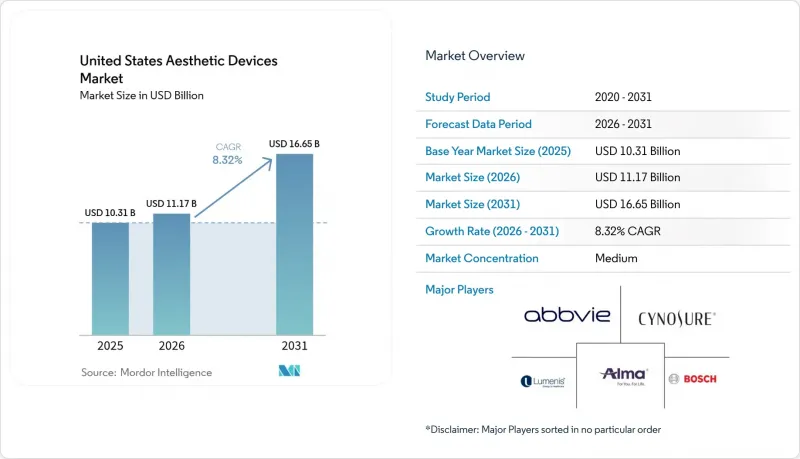
This report is Segmented by Device Type (Energy-Based Devices, Non-Energy-Based Devices), Application (Skin Resurfacing & Tightening, Body Contouring & Cellulite Reduction, Hair Removal, and More), End User (Hospitals, Dermatology & Cosmetic Clinics, Medical Spas, Home-Use Settings), and Geography (Northeast, Midwest, South, West). The Market Forecasts are Provided in Terms of Value (USD).
United States Aesthetic Devices Market Trends and Insights
Rising Demand for Minimally-Invasive Procedures
American Society of Plastic Surgeons data show non-surgical treatments outpacing surgeries, propelling clinics to favor devices that deliver lift, tightening, or pigment correction without incisions. FDA clearance of AI-guided radio-frequency platforms, such as Candela's Matrix, illustrates regulatory encouragement for technologies that minimize downtime while matching surgical outcomes. Manufacturers are shortening redesign cycles to embed thermal sensors and impedance feedback that protect epidermal layers. Patient satisfaction now exceeds 94% for new radio-frequency microneedling protocols, encouraging cross-sell of add-on treatments at medical spas. The United States aesthetic devices market therefore benefits from wider patient pools, including working adults who previously avoided aesthetic enhancement because of recuperation concerns.
Increasing Obese Population Driving Body-Contouring Demand
The pharmaceutical surge in glucagon-like peptide-1 (GLP-1) weight-loss agents has created downstream demand for non-surgical skin-tightening and fat-reduction devices. Clinics are forming integrated pathways that begin with semaglutide prescriptions and culminate in cryolipolysis or ultrasound sessions to manage residual adiposity and laxity. FDA approvals for next-generation ultrasound body-shaping systems reposition these treatments from cosmetic to functional wellness, strengthening insurance-preauthorization debates. Practitioners in the South and Midwest report two-digit case-volume gains, aligning with regional obesity prevalence. Consequently, body-contouring revenues are forecast to outstrip hair-removal gains within the United States aesthetic devices market, signaling a structural shift toward comprehensive weight-management ecosystems.
Social Stigma & Safety Concerns
FDA adverse-event files cite burns and pigmentation issues linked to unregulated home-use lasers, fueling negative media narratives. High-profile lawsuits against national surgery chains spotlight practitioner training gaps, undermining public confidence. The absence of a centralized cosmetic-procedure injury registry hinders transparent risk communication. Social media amplifies isolated complications, disproportionately affecting millennial and Gen-Z uptake. Although clinical evidence shows low complication rates in certified settings, stigma lingers, tempering growth potential within segments of the United States aesthetic devices market.
Other drivers and restraints analyzed in the detailed report include:
- Technological Advancements in Energy-Based Devices
- Growing Awareness & Adoption Among Male Consumers
- Lack of Reimbursement for Aesthetic Treatments
For complete list of drivers and restraints, kindly check the Table Of Contents.
Segment Analysis
Energy-based platforms held 62.74% of the United States aesthetic devices market in 2025, and the category is projected to expand at a 10.78% CAGR through 2031. This dominance rests on technological elasticity: lasers, radio-frequency, ultrasound, and intense pulsed light (IPL) can each be fine-tuned for multiple indications, generating recurring revenue streams for clinics that invest in stackable handpieces. Radio-frequency leads grow because they penetrate dermal layers with minimal melanin interaction, reducing post-inflammatory hyperpigmentation risks for darker skin types. Laser-based subsegments remain strong, buoyed by 1,726 nm acne-targeting systems that achieve 70% lesion clearance rates. Ultrasound-assisted lipolysis has advanced via cavitation-controlled algorithms that preserve connective tissue, improving downtime metrics. Cryolipolysis technology fights competitive pressure by integrating pre-heating stages that boost adipocyte susceptibility to cold-induced apoptosis. Collectively, these engineering improvements anchor premium pricing and keep capital equipment upgrades flowing throughout the United States aesthetic devices market.
Non-energy devices, including botulinum toxin injectables and dermal fillers, still generate high procedure volumes but exhibit slower equipment replacement cycles. Innovative hybrid fillers, such as calcium-hydroxylapatite blended with hyaluronic acid, now deliver scaffold and hydration benefits in a single syringe, supporting moderate revenue gains. Micro-needling pens, mechanical microdermabrasion units, and chemical-peel applicators fill entry-level niches but confront saturation. Although implantable aesthetics, like silicone chin implants, secure clinical success rates above 90%, regulatory audits on device sterility and long-term biocompatibility restrain their momentum. Overall, non-energy segments add breadth but not breakout velocity to the United States aesthetic devices market.
Complete Report Scope:
- By Device Type
- Energy-based Devices
- Laser-based
- Light-based (IPL)
- Radio-frequency-based
- Ultrasound-based
- Cryolipolysis & Plasma-based
- Non-energy-based Devices
- Botulinum Toxin
- Dermal Fillers & Threads
- Chemical Peels
- Microdermabrasion
- Implants
- Mesotherapy & Others
- Energy-based Devices
- By Application
- Skin Resurfacing & Tightening
- Body Contouring & Cellulite Reduction
- Hair Removal
- Tattoo & Pigmentation Removal
- Breast Augmentation
- Acne & Scar Treatment
- Other Applications
- By End User
- Hospitals
- Dermatology & Cosmetic Clinics
- Medical Spas
- Home-use Settings
- By Region
- Northeast
- Midwest
- South
- West
List of Companies Covered in this Report:
- AbbVie (Allergan Aesthetics)
- Alma Lasers (Sisram Medical)
- Bausch Health
- Candela Medical
- Cynosure
- Cutera
- Lumenis
- Venus Concept
- Sciton
- InMode
- Candela Medical
- El.En. - Asclepion
- Lutronic
- Fotona
- Aerolase
- Galderma
- Merz Pharma
- Revance Therapeutics
- Sientra
- Establishment Labs
Additional Benefits:
- The market estimate (ME) sheet in Excel format
- 3 months of analyst support
TABLE OF CONTENTS
1 Introduction
- 1.1 Study Assumptions & Market Definition
- 1.2 Scope of the Study
2 Research Methodology
3 Executive Summary
4 Market Landscape
- 4.1 Market Overview
- 4.2 Market Drivers
- 4.2.1 Rising Demand for Minimally-Invasive Procedures
- 4.2.2 Increasing Obese Population Driving Body-Contouring Demand
- 4.2.3 Technological Advancements in Energy-Based Devices
- 4.2.4 Growing Awareness & Adoption Among Male Consumers
- 4.2.5 AI-Driven Device Personalization Improving Outcomes
- 4.2.6 Private-Equity Backed Med-Spa Chains Boosting Device Throughput
- 4.3 Market Restraints
- 4.3.1 Social Stigma & Safety Concerns
- 4.3.2 Lack of Reimbursement for Aesthetic Treatments
- 4.3.3 Proliferation of Counterfeit / Gray-Market Devices
- 4.3.4 Semiconductor Shortages Hitting Laser Component Supply
- 4.4 Regulatory Landscape
- 4.5 Technological Outlook
- 4.6 Porter's Five Forces Analysis
- 4.6.1 Threat of New Entrants
- 4.6.2 Bargaining Power of Buyers
- 4.6.3 Bargaining Power of Suppliers
- 4.6.4 Threat of Substitutes
- 4.6.5 Intensity of Competitive Rivalry
5 Market Size & Growth Forecasts (Value in USD)
- 5.1 By Device Type
- 5.1.1 Energy-based Devices
- 5.1.1.1 Laser-based
- 5.1.1.2 Light-based (IPL)
- 5.1.1.3 Radio-frequency-based
- 5.1.1.4 Ultrasound-based
- 5.1.1.5 Cryolipolysis & Plasma-based
- 5.1.2 Non-energy-based Devices
- 5.1.2.1 Botulinum Toxin
- 5.1.2.2 Dermal Fillers & Threads
- 5.1.2.3 Chemical Peels
- 5.1.2.4 Microdermabrasion
- 5.1.2.5 Implants
- 5.1.2.6 Mesotherapy & Others
- 5.1.1 Energy-based Devices
- 5.2 By Application
- 5.2.1 Skin Resurfacing & Tightening
- 5.2.2 Body Contouring & Cellulite Reduction
- 5.2.3 Hair Removal
- 5.2.4 Tattoo & Pigmentation Removal
- 5.2.5 Breast Augmentation
- 5.2.6 Acne & Scar Treatment
- 5.2.7 Other Applications
- 5.3 By End User
- 5.3.1 Hospitals
- 5.3.2 Dermatology & Cosmetic Clinics
- 5.3.3 Medical Spas
- 5.3.4 Home-use Settings
- 5.4 By Region
- 5.4.1 Northeast
- 5.4.2 Midwest
- 5.4.3 South
- 5.4.4 West
6 Competitive Landscape
- 6.1 Market Concentration
- 6.2 Market Share Analysis
- 6.3 Company Profiles (includes Global level Overview, Market-level Overview, Core Segments, Financials, Strategic Info, Market Rank/Share, Products & Services, Recent Developments)
- 6.3.1 AbbVie (Allergan Aesthetics)
- 6.3.2 Alma Lasers (Sisram Medical)
- 6.3.3 Bausch Health Companies Inc. (Solta Medical Inc.)
- 6.3.4 Candela Medical
- 6.3.5 Cynosure
- 6.3.6 Cutera Inc.
- 6.3.7 Lumenis
- 6.3.8 Venus Concept
- 6.3.9 Sciton Inc.
- 6.3.10 InMode
- 6.3.11 Syneron Medical
- 6.3.12 El.En. - Asclepion
- 6.3.13 Lutronic Corporation
- 6.3.14 Fotona
- 6.3.15 Aerolase
- 6.3.16 Galderma
- 6.3.17 Merz Aesthetics
- 6.3.18 Revance Therapeutics
- 6.3.19 Sientra
- 6.3.20 Establishment Labs
7 Market Opportunities & Future Outlook
- 7.1 White-space & Unmet-need Assessment

