PUBLISHER: Mordor Intelligence | PRODUCT CODE: 2113419

PUBLISHER: Mordor Intelligence | PRODUCT CODE: 2113419
United States Diagnostic Imaging - Market Share Analysis, Industry Trends & Statistics, Growth Forecasts (2026 - 2031)
According to Mordor Intelligence, the United States diagnostic imaging market size is estimated at USD 10.57 billion in 2026, and is expected to reach USD 13.14 billion by 2031, at a CAGR of 4.46% during the forecast period (2026-2031).
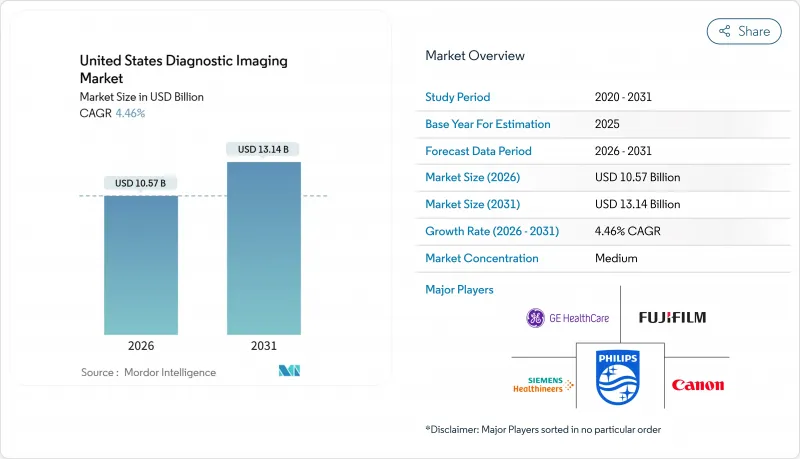
This report is Segmented by Product and Services (Imaging Systems and Equipment [X-Ray, Ultrasound, MRI, CT, Nuclear Medicine, Mammography, Fluoroscopy & C-Arms], Consumables and Accessories, Software and Services), Application (Cardiology, Oncology, and More), End User (Hospitals, and More), and Technology (AI-Enabled, Conventional). Market Forecasts are Provided in Terms of Value (USD).
United States Diagnostic Imaging Market Trends and Insights
AI-Driven Workflow and Image Interpretation Adoption
FDA clearances for radiology algorithms climbed to 87 in 2024, a 40% jump over 2023. Health systems deploy these tools to reallocate radiologist time toward higher-revenue interventional cases. Aidoc's triage platform cuts door-to-diagnosis time in stroke protocols by 30%. Integration remains a hurdle because legacy PACS need custom APIs, and community hospitals lack informatics teams to validate outputs locally. The FDA now requires demographic-stratified performance metrics, a change that lengthens submissions but favors vendors embedding AI inside scanners. Consequently, platform manufacturers bundle algorithms with hardware, locking in service contracts and extending the reach of the United States diagnostic imaging market.
Shift of Imaging Volumes to Outpatient and Ambulatory Settings
Ambulatory surgical centers deliver imaging at 30-40% lower cost per scan than hospital outpatient departments, attracting Medicare Advantage steerage that drives 13.32% CAGR through 2031. Site-neutral payment expansion in 2025 collapsed a USD 300 margin gap per lumbar spine MRI to roughly USD 50, pressuring hospital economics. Freestanding centers now perform 22% of non-hospital imaging, up from 18% in 2020, with growth strongest in states that repealed Certificate-of-Need laws. Hospitals respond by converting owned clinics into off-campus departments, but CMS tightened distance definitions, rendering 8% of legacy sites ineligible for hospital rates, a shift reshaping the United States diagnostic imaging market.
Shortage of Radiologists and Technologists
A projected 35,600-radiologist gap by 2034 coincides with 12,000 unfilled technologist roles in 2025, raising reliance on USD 75-150 per-study teleradiology. Burnout affects 42% of radiologists, primarily from case overload and administrative tasks. AI triage saves 10-15% reading time but still demands human oversight. CMS caps on residency funding persist, and scope-of-practice expansions face state opposition, prolonging workforce scarcity that restrains the United States diagnostic imaging market.
Other drivers and restraints analyzed in the detailed report include:
- Rapid Penetration of Portable and Handheld Ultrasound/X-ray Systems
- CMS Site-Neutral Payment Expansion Favoring Lower-Cost Imaging Sites
- Prolonged FDA Clearance Cycle for AI Algorithms and Novel Modalities
For complete list of drivers and restraints, kindly check the Table Of Contents.
Segment Analysis
Software and Services is projected to grow at a 16.73% CAGR, the quickest stride within the United States diagnostic imaging market. Cloud PACS, AI triage, and predictive-maintenance subscriptions appeal to hospitals facing workforce shortages. Imaging Systems and Equipment still accounts for 84.25% of 2025 revenue, anchored by MRI and CT units that cost USD 500,000-3 million. Deferred replacement cycles temper hardware growth but augment service contracts.
Predictive maintenance via GE HealthCare's CareIntellect curbs downtime by 30%, trimming USD 50,000 annually per scanner. Siemens' AI-Rad Companion cuts reading time to four minutes, supporting under-resourced radiology groups. Portable X-ray and handheld ultrasound commoditize entry-level imaging, while Cancer Moonshot-backed PET expansion maintains niche high-end demand, shaping revenue streams within the United States diagnostic imaging market.
Cardiology captured 33.63% of 2025 procedures, reflecting prevalent coronary disease and heart failure management. Neurology, driven by blood-based Alzheimer's markers funneling patients to amyloid-PET, is forecast to grow at a 15.18% CAGR through 2031, the fastest pace in the United States diagnostic imaging market. Oncology benefits from broadened lung-screening criteria that doubled the eligible cohort to 14.5 million adults.
Musculoskeletal MRI faces Medicare fee cuts, pushing centers toward higher-margin joints. Women's health imaging gains from earlier mammography age recommendations, raising tomosynthesis adoption to 75% of sites. Long-COVID keeps high-resolution CT in pulmonology workflows. AI lung-nodule tools trim false negatives by 20% yet require PACS integration funding, illustrating divergent adoption speeds inside the United States diagnostic imaging market.
Complete Report Scope:
- By Product and Services
- Imaging Systems and Equipments
- X-ray
- Ultrasound
- Magnetic Resonance Imaging (MRI)
- Computed Tomography (CT)
- Nuclear Medicine
- Mammography
- Fluoroscopy & C-arms
- Consumables and Accessories
- Software and Services
- Imaging Systems and Equipments
- By Application
- Cardiology
- Oncology
- Neurology & Neurodegenerative Disorders
- Orthopedics & Musculoskeletal
- Gastroenterology & Hepatology
- Women's Health & Obstetrics/Gynecology
- Pulmonology & Thoracic Imaging
- By End User
- Hospitals
- Independent Diagnostic Imaging Centers (IDTFs)
- Ambulatory Surgical Centers
- Physician Offices & Clinics
- Veterans Affairs & Federal Facilities
- Research Institutes & CROs
- By Technology
- AI-Enabled
- Conventional Systems
List of Companies Covered in this Report:
- Agfa-Gevaert
- Akumin Inc.
- Canon
- Carestream Health (Onex)
- Esaote
- FUJIFILM
- GE Healthcare
- Hitachi Healthcare
- Hologic
- Konica Minolta
- Koninklijke Philips
- KUB Technologies
- Mindray Medical
- MinXray
- RadNet Inc.
- Samsung Group
- Shimadzu Medical Systems
- Siemens Healthineers
- US Radiology Specialists
Additional Benefits:
- The market estimate (ME) sheet in Excel format
- 3 months of analyst support
TABLE OF CONTENTS
1 Introduction
- 1.1 Study Assumptions & Market Definition
- 1.2 Scope of the Study
2 Research Methodology
3 Executive Summary
4 Market Landscape
- 4.1 Market Overview
- 4.2 Market Drivers
- 4.2.1 AI-Driven Workflow & Image Interpretation Adoption
- 4.2.2 Shift Of Imaging Volumes to Outpatient & Ambulatory Settings
- 4.2.3 Rapid Penetration of Portable & Handheld Ultrasound/X-Ray Systems
- 4.2.4 CMS Site-Neutral Payment Expansion Favoring Lower-Cost Imaging Sites
- 4.2.5 Reimbursement Incentives for Low-Dose & Value-Based Imaging
- 4.2.6 Federal Investments in Cancer & Neurodegenerative Diagnostics (Cancer Moonshot 2.0, ARPA-H)
- 4.3 Market Restraints
- 4.3.1 Shortage of Radiologists & Technologists
- 4.3.2 Prolonged FDA Clearance Cycle for AI Algorithms & Novel Modalities
- 4.3.3 Capital-Intensive Nature of High-End MRI/CT Systems
- 4.3.4 Price Transparency & No-Surprises Act Squeezing Provider Margins
- 4.4 Value / Supply-Chain Analysis
- 4.5 Regulatory Landscape
- 4.6 Technological Outlook
- 4.7 Porter's Five Forces Analysis
- 4.7.1 Threat of New Entrants
- 4.7.2 Bargaining Power of Buyers/Consumers
- 4.7.3 Bargaining Power of Suppliers
- 4.7.4 Threat of Substitute Products
- 4.7.5 Intensity of Competitive Rivalry
5 Market Size & Growth Forecasts (Value in USD)
- 5.1 By Product and Services
- 5.1.1 Imaging Systems and Equipments
- 5.1.1.1 X-ray
- 5.1.1.2 Ultrasound
- 5.1.1.3 Magnetic Resonance Imaging (MRI)
- 5.1.1.4 Computed Tomography (CT)
- 5.1.1.5 Nuclear Medicine
- 5.1.1.6 Mammography
- 5.1.1.7 Fluoroscopy & C-arms
- 5.1.2 Consumables and Accessories
- 5.1.3 Software and Services
- 5.1.1 Imaging Systems and Equipments
- 5.2 By Application
- 5.2.1 Cardiology
- 5.2.2 Oncology
- 5.2.3 Neurology & Neurodegenerative Disorders
- 5.2.4 Orthopedics & Musculoskeletal
- 5.2.5 Gastroenterology & Hepatology
- 5.2.6 Women's Health & Obstetrics/Gynecology
- 5.2.7 Pulmonology & Thoracic Imaging
- 5.3 By End User
- 5.3.1 Hospitals
- 5.3.2 Independent Diagnostic Imaging Centers (IDTFs)
- 5.3.3 Ambulatory Surgical Centers
- 5.3.4 Physician Offices & Clinics
- 5.3.5 Veterans Affairs & Federal Facilities
- 5.3.6 Research Institutes & CROs
- 5.4 By Technology
- 5.4.1 AI-Enabled
- 5.4.2 Conventional Systems
6 Competitive Landscape
- 6.1 Market Concentration
- 6.2 Market Share Analysis
- 6.3 Company Profiles (includes Global level Overview, Market level overview, Core Segments, Financials as available, Strategic Information, Market Rank/Share for key companies, Products & Services, and Recent Developments)
- 6.3.1 Agfa-Gevaert Group
- 6.3.2 Akumin Inc.
- 6.3.3 Canon Medical Systems
- 6.3.4 Carestream Health (Onex)
- 6.3.5 Esaote SpA
- 6.3.6 Fujifilm Healthcare
- 6.3.7 GE Healthcare
- 6.3.8 Hitachi Healthcare
- 6.3.9 Hologic Inc.
- 6.3.10 Konica Minolta Inc.
- 6.3.11 Koninklijke Philips N.V.
- 6.3.12 KUB Technologies
- 6.3.13 Mindray Medical
- 6.3.14 MinXray Inc.
- 6.3.15 RadNet Inc.
- 6.3.16 Samsung Medison
- 6.3.17 Shimadzu Medical Systems
- 6.3.18 Siemens Healthineers
- 6.3.19 US Radiology Specialists
7 Market Opportunities & Future Outlook
- 7.1 White-space & Unmet-Need Assessment

