PUBLISHER: Mordor Intelligence | PRODUCT CODE: 2113432

PUBLISHER: Mordor Intelligence | PRODUCT CODE: 2113432
Europe Clinical Trials - Market Share Analysis, Industry Trends & Statistics, Growth Forecasts (2026 - 2031)
According to Mordor Intelligence, Europe clinical trials market size in 2026 is estimated at USD 25.13 billion, growing from 2025 value of USD 23.59 billion with 2031 projections showing USD 34.52 billion, growing at 6.55% CAGR over 2026-2031.
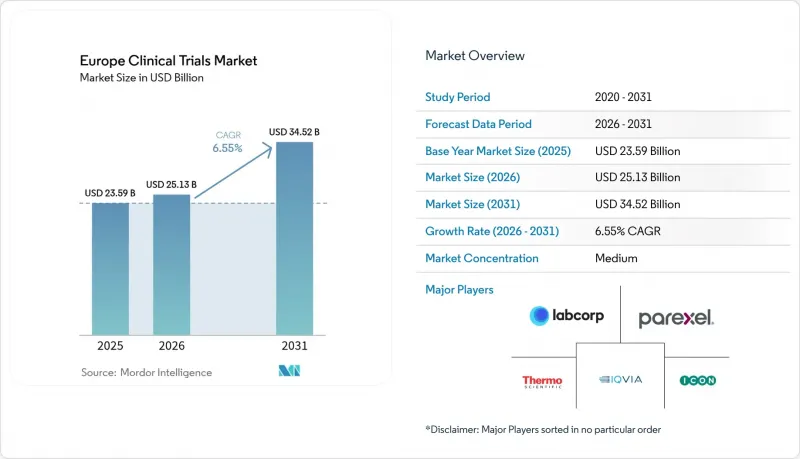
This report is Segmented by Phase (Phase I, Phase II, Phase III, and Phase IV), Study Design (Diagnostic Radiology, and More), Service Type (Protocol Design & Feasibility, and More), Therapeutic Area (Oncology, and More), Sponsor Type (Pharmaceutical & Biopharmaceutical Companies, and More), and Geography (Germany, United Kingdom, and More). The Market Forecasts are Provided in Terms of Value (USD).
Europe Clinical Trials Market Trends and Insights
High Pharmaceutical-Biotech R&D Intensity in Europe
Major multinationals have pledged more than EUR 2 billion of fresh investment across France, with Pfizer alone earmarking EUR 500 million to expand late-stage trials in hematology and rare cancers. Germany's Medical Research Act, effective 2025, allows parallel scientific and ethics reviews and permits confidential reimbursement talks that attract complex studies. Although European R&D spending still trails growth rates in the United States and China, policy makers are coupling tax credits with infrastructure grants to keep next-generation modalities-mRNA, cell, and gene therapies-onshore. Industry consolidation is speeding up as cash-strapped biotechs partner with CROs that already own pan-EU investigator networks. As a result, the Europe clinical trials market is witnessing more seamless, platform-based development programs that can move from Phase I through Phase III within integrated frameworks.
Rising Prevalence of Chronic & Infectious Diseases
An aging continent and lingering pandemic threats push demand for novel medicines, with more than 40 new products slated for German launch in 2025, most aimed at Alzheimer's disease, oncology, and genetic disorders. Oncology applications make up the largest share of submissions to the European Medicines Agency (EMA) pipeline, while vaccine and antiviral studies are leveraging compressed review timelines shaped during COVID-19. Digital biomarkers and home-based monitoring allow sponsors to integrate real-world data into study endpoints, raising recruitment efficiency among multimorbid patient pools. These factors collectively add buoyancy to the Europe clinical trials market even as recruitment grows more complex.
Stringent Multi-Layered Approval Processes
The ICH E6(R3) Good Clinical Practice guideline, effective July 2025, brings tougher data-integrity and computer-system-validation demands that lengthen sponsor checklists eca.de. National nuances in ethics-committee opinions generate unpredictable timelines, especially for digitally enabled or adaptive designs. Germany's new reporting duties for study participants add to monitoring overhead. These factors collectively suppress near-term growth even as harmonization efforts progress.
Other drivers and restraints analyzed in the detailed report include:
- Growing Orphan-Drug Incentives & Rare-Disease Focus
- ACT-EU & CTIS Accelerating Trial Start-Up Timelines
- Europe's Falling Share of Global Patient Enrollment
For complete list of drivers and restraints, kindly check the Table Of Contents.
Segment Analysis
Phase III studies represented 52.68% of the Europe clinical trials market in 2025, confirming the region's role in confirmatory evidence generation. Sponsors leverage Europe's dense hospital networks and seasoned investigators to run pivotal oncology and immunology programs that feed EMA submissions. Adaptive Phase II designs, growing at a 7.55% CAGR, let companies kill or pivot assets sooner, a critical hedge against soaring development costs. Seamless II/III platforms and real-time analytics are blurring traditional phase boundaries, tightening cycle times, and reinforcing the Europe clinical trials market as a preferred venue for integrated programs.
Second-generation cell and gene therapies now benefit from EMA's advanced-therapy guidance, which allows conditional approvals supported by robust post-marketing data. The Europe clinical trials market size for Phase II work is projected to expand materially as sponsors align biomarker discovery with proof-of-concept studies. Post-authorization Phase IV programs are also growing because payers increasingly demand real-world evidence before green-lighting reimbursement.
Interventional designs accounted for 79.85% of the Europe clinical trials market size in 2025, underlining regulators' continued preference for randomized evidence. Adaptive designs are climbing at an 7.66% CAGR thanks to Bayesian statistics and interim-data modeling that support early futility stops and dose re-optimizations. Pragmatic and decentralized models are now acceptable under EMA guidance, broadening participation among rural and mobility-challenged patients.
Observational cohorts complement interventional work by harvesting long-term safety and comparative-effectiveness data from electronic health records. Master protocols, including umbrella and basket trials, reduce administrative duplication when sponsors test multiple drugs across biomarker subsets. Together, these methodologies keep the Europe clinical trials market agile amid rising cost pressures.
Complete Report Scope:
- By Phase
- Phase I
- Phase II
- Phase III
- Phase IV
- By Study Design
- Interventional / Treatment Studies
- Observational Studies
- Expanded Access Studies
- By Service Type
- Protocol Design & Feasibility
- Site Identification & Start-up
- Regulatory Submission & Approval
- Clinical Trial Monitoring
- Data Management & Biostatistics
- Medical Writing
- Other Service Types
- By Therapeutic Area
- Oncology
- Cardiovascular
- Neurology
- Infectious Diseases
- Metabolic Disorders (Diabetes, Obesity)
- Immunology / Autoimmune
- Other Therapeutic Areas
- By Sponsor Type
- Pharmaceutical & Biopharmaceutical Companies
- Medical Device Companies
- Academic & Research Institutes
- Government & Non-profit Organizations
- Geography
- Germany
- United Kingdom
- France
- Italy
- Spain
- Rest of Europe
List of Companies Covered in this Report:
- IQVIA
- Parexel International (MA) Corporation
- ICON
- Thermo Fisher Scientific
- LabCorp
- Syneos Health
- Medpace Holdings
- Charles River
- Clinipace
- Eli Lilly and Company
- Pfizer
- Roche
- Sanofi
- Novo Nordisk
- AstraZeneca
- Boehringer Ingelheim
- Novartis
- Bayer
- Johnson & Johnson
- Merck
Additional Benefits:
- The market estimate (ME) sheet in Excel format
- 3 months of analyst support
TABLE OF CONTENTS
1 Introduction
- 1.1 Study Assumptions & Market Definition
- 1.2 Scope of the Study
2 Research Methodology
3 Executive Summary
4 Market Landscape
- 4.1 Market Overview
- 4.2 Market Drivers
- 4.2.1 High Pharmaceutical-Biotech R&D Intensity In Europe
- 4.2.2 Rising Prevalence of Chronic & Infectious Diseases
- 4.2.3 Growing Orphan-Drug Incentives & Rare-Disease Focus
- 4.2.4 ACT-EU & CTIS Accelerating Trial Start-Up Timelines
- 4.2.5 Rapid Adoption of Decentralized / Hybrid Trial Models
- 4.2.6 Central & Eastern Europe's Cost-Efficient Patient Recruitment
- 4.3 Market Restraints
- 4.3.1 Stringent Multi-Layered Approval Processes
- 4.3.2 Lower Reimbursement Levels in Parts of Southern / CEE Europe
- 4.3.3 Europe's Falling Share of Global Patient Enrollment
- 4.3.4 Fragmented Trial-Data Standards Across EU Study Sites
- 4.4 Regulatory Landscape
- 4.5 Porter's Five Forces Analysis
- 4.5.1 Threat of New Entrants
- 4.5.2 Bargaining Power of Buyers/-Sponsors
- 4.5.3 Bargaining Power of CRO / Tech Suppliers
- 4.5.4 Threat of Substitutes
- 4.5.5 Intensity of Competitive Rivalry
5 Market Size & Growth Forecasts (Value, USD)
- 5.1 By Phase
- 5.1.1 Phase I
- 5.1.2 Phase II
- 5.1.3 Phase III
- 5.1.4 Phase IV
- 5.2 By Study Design
- 5.2.1 Interventional / Treatment Studies
- 5.2.2 Observational Studies
- 5.2.3 Expanded Access Studies
- 5.3 By Service Type
- 5.3.1 Protocol Design & Feasibility
- 5.3.2 Site Identification & Start-up
- 5.3.3 Regulatory Submission & Approval
- 5.3.4 Clinical Trial Monitoring
- 5.3.5 Data Management & Biostatistics
- 5.3.6 Medical Writing
- 5.3.7 Other Service Types
- 5.4 By Therapeutic Area
- 5.4.1 Oncology
- 5.4.2 Cardiovascular
- 5.4.3 Neurology
- 5.4.4 Infectious Diseases
- 5.4.5 Metabolic Disorders (Diabetes, Obesity)
- 5.4.6 Immunology / Autoimmune
- 5.4.7 Other Therapeutic Areas
- 5.5 By Sponsor Type
- 5.5.1 Pharmaceutical & Biopharmaceutical Companies
- 5.5.2 Medical Device Companies
- 5.5.3 Academic & Research Institutes
- 5.5.4 Government & Non-profit Organizations
- 5.6 Geography
- 5.6.1 Germany
- 5.6.2 United Kingdom
- 5.6.3 France
- 5.6.4 Italy
- 5.6.5 Spain
- 5.6.6 Rest of Europe
6 Competitive Landscape
- 6.1 Market Concentration
- 6.2 Market Share Analysis
- 6.3 Company Profiles (includes Global level Overview, Market level overview, Core Segments, Financials as available, Strategic Information, Market Rank/Share, Products & Services, Recent Developments)
- 6.3.1 IQVIA
- 6.3.2 Parexel International (MA) Corporation
- 6.3.3 ICON plc
- 6.3.4 Thermo Fisher Scientific Inc.
- 6.3.5 Laboratory Corporation of America Holdings
- 6.3.6 Syneos Health
- 6.3.7 Medpace Holdings
- 6.3.8 Charles River Laboratories
- 6.3.9 Clinipace
- 6.3.10 Eli Lilly
- 6.3.11 Pfizer Inc.
- 6.3.12 F. Hoffmann-La Roche
- 6.3.13 Sanofi
- 6.3.14 Novo Nordisk
- 6.3.15 AstraZeneca
- 6.3.16 Boehringer Ingelheim
- 6.3.17 Novartis
- 6.3.18 Bayer AG
- 6.3.19 Johnson & Johnson (Janssen)
- 6.3.20 Merck KGaA
7 Market Opportunities & Future Outlook
- 7.1 White-space & Unmet-need Assessment

