PUBLISHER: Mordor Intelligence | PRODUCT CODE: 2113438

PUBLISHER: Mordor Intelligence | PRODUCT CODE: 2113438
Fluoroelastomers - Market Share Analysis, Industry Trends & Statistics, Growth Forecasts (2026 - 2031)
According to Mordor Intelligence, fluoroelastomers market size in 2026 is estimated at USD 1.85 billion, growing from 2025 value of USD 1.75 billion with 2031 projections showing USD 2.48 billion, growing at 5.99% CAGR over 2026-2031.
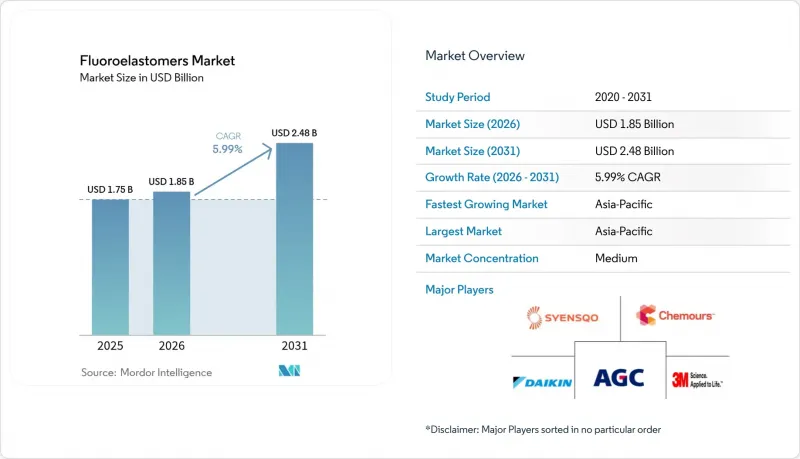
This report Segments the Industry by Product Type (Fluorocarbon Elastomers, Fluorosilicone Elastomers, Perfluoroelastomers ), Application (Diaphragms, Valves, O-Rings, Seals, and Sealants, Other Applications), End-User Industry (Automotive, Aerospace, and More), and Geography (Asia-Pacific, North America, Europe, and More). The Market Forecasts are Provided in Terms of Value (USD).
Global Fluoroelastomers Market Trends and Insights
EV Thermal-Management Seal Demand Surge
Electric-vehicle battery packs rely on sophisticated liquid-cooling loops that circulate dielectric fluids able to dissipate heat without risking short circuits. Seals made from Viton and similar compounds limit swelling to less than 5% after 1 000 hours in polyalphaolefin-based coolants, outperforming silicone and EPDM alternatives. Prestone's low-conductivity coolant formulated under China's GB29743.2 standard illustrates how chemistry updates push sealing specifications to new thresholds, Automakers have extended battery warranties to 10 years, so perfluoroelastomers that maintain tensile strength below -30 °C and above 150 °C become essential. As global EV production climbs past 25 million units in 2025, OEM sourcing teams lock in multiyear supply contracts for high-purity perfluoroelastomer compounds, anchoring a key growth pillar for the fluoroelastomers market.
Growing Demand for Aerospace & New Space Propulsion Seals
Commercial launch providers, satellite manufacturers, and defense primes specify perfluoroelastomer seals that survive propellants such as hydrazine or liquid oxygen while cycling from -200 °C to +300 °C. DuPont's Kalrez grades now guarantee chemical compatibility with more than 1 800 fluids, reducing mission-critical leak paths in spacecraft life-support lines and cryogenic feed systems . In aviation, lightweight turbochargers and sustainable-aviation-fuel delivery modules increasingly rely on Viton to curb maintenance frequency. Each reusable launch vehicle can contain over 1 200 individual O-rings, multiplying material demand as launch cadence accelerates. Consequently, aerospace programs amplify the long-run pull on the fluoroelastomers market.
High Material & Compounding Cost
Fluoroelastomer production relies on fluorinated monomers that trade at premiums standard petrochemical feedstocks. Tight process control and proprietary curing packages push conversion costs further, limiting uptake in low-margin components. Global natural rubber shortages extend price pressures across the wider elastomer landscape, reinforcing cost sensitivity even where performance benefits are clear-cut. To counterbalance, suppliers emphasize life-cycle savings: one gearbox seal rated for 10 000 operating hours often replaces two or three NBR equivalents. Halogen-free ethylene-acrylic alternatives such as Vamac creep into mid-temperature applications, compressing potential volume growth for the fluoroelastomers market.
Other drivers and restraints analyzed in the detailed report include:
- Increasing Requirement for Semiconductor Process Seals
- Growing Utilization in the Oil and Gas Industry
- Feedstock Supply Volatility
For complete list of drivers and restraints, kindly check the Table Of Contents.
Segment Analysis
Fluorocarbon elastomers retained 61.02% of the fluoroelastomers market share in 2025, buoyed by entrenched use in automotive fuel-line connectors, refinery gaskets, and general industrial equipment. Their broad processing window helps component suppliers meet mass-production takt times without resorting to exotic tooling. Volume leadership, however, does not equate to highest growth. Perfluoroelastomers expand at a 6.98% CAGR through 2031, catalyzed by semiconductor cleanrooms and reusable launch vehicles that push sealing specifications past traditional fluorocarbon limits. This growth vector translates to a perfluoroelastomer segment contribution of roughly USD 613 million to the overall fluoroelastomers market size by the end of the decade.
Demand acceleration also stems from novel manufacturing methods. Solvay's Tecnoflon NFS process eliminates PFAS surfactants yet delivers identical compression-set retention, addressing European policy uncertainty without sacrificing performance . As large fabs simulate chemical permeation down to parts-per-trillion thresholds, non-contaminating perfluoroelastomers gain value over lower-cost counterparts. Meanwhile, fluorosilicone elastomers hold a smaller niche but remain indispensable in aerospace environmental control systems where -60 °C flexibility meets jet-fuel resistance. Suppliers continue tailoring bisphenol-cure systems to enhance modulus at altitude pressures, protecting a steady revenue stream inside the broader fluoroelastomers market.
Complete Report Scope:
- By Product Type
- Fluorocarbon Elastomers
- Fluorosilicone Elastomers
- Perfluoroelastomers
- By Application
- O-Rings, Seals and Sealants
- Diaphragms
- Valves
- Other Applications (Hoses and Tubes, etc.)
- By End-user Industry
- Automotive
- Aerospace
- Oil and Gas
- Industrial
- Other End-user Industries (Semiconductor and Electronics, etc.)
- By Geography
- Asia-Pacific
- China
- Japan
- India
- South Korea
- Rest of Asia-Pacific
- North America
- United States
- Canada
- Mexico
- Europe
- Germany
- United Kingdom
- France
- Italy
- Rest of Europe
- South America
- Brazil
- Argentina
- Rest of South America
- Middle East and Africa
- SaudI Arabia
- South Africa
- Rest of Middle East and Africa
- Asia-Pacific
Geography Analysis
Asia-Pacific dominated the fluoroelastomers market in 2025 with 45.63% revenue share, and regional demand is projected to rise at a 7.02% CAGR through 2031. China's push for semiconductor self-sufficiency drives sustained investment in 12-inch fabs, each requiring thousands of high-purity O-rings with single-digit ppm outgassing specifications. India's automotive reforms, including PLI incentives for local battery manufacturing, encourage domestic production of EV-grade coolant seals. Gujarat Fluorochemicals has committed USD 6 billion over the next four years to expand battery-chemical capacity, signalling long-term regional integration of fluoropolymer supply chains.
North America ranks second, buoyed by mature aerospace programs, shale-oil activity, and onshoring of advanced logic foundries. The CHIPS and Science Act accelerates regional wafer capacity, translating into near-term spikes in perfluoroelastomer consumption. Additionally, US deepwater developments in the Gulf of Mexico reinforce demand for HPHT-rated sealing solutions. Europe's share faces pressure from prospective PFAS bans that could restrict certain fluorinated intermediates. Manufacturers such as James Walker publicly advocate for application-based exemptions while simultaneously piloting PFAS-free compounds for moderate-duty services. Smaller regional clusters add incremental growth. South America's pre-salt exploration programs necessitate high-performance fluoroelastomer isolation valves, whereas the Middle East targets hydrogen and ammonia export infrastructure that benefits from chemical-resistant sealing materials. Although these regions combined account for less than 10% of current fluoroelastomers market revenue, their multiyear capital-project pipelines suggest a notable contribution to volume upside by 2030.
- 3M
- AGC Chemicals Americas
- DAIKIN INDUSTRIES, Ltd.
- DuPont
- Eagle Elastomer Inc.
- Freudenberg Sealing Technologies
- GARLOCK, AN ENPRO COMPANY.
- Gujarat Fluorochemicals Limited
- HaloPolymer
- James Walker
- KUREHA CORPORATION
- LANXESS
- NOK CORPORATION
- Syensqo
- The Chemours Company
- Trp Polymer Solutions
Additional Benefits:
- The market estimate (ME) sheet in Excel format
- 3 months of analyst support
TABLE OF CONTENTS
1 Introduction
- 1.1 Study Assumptions and Market Definition
- 1.2 Scope of the Study
2 Research Methodology
3 Executive Summary
4 Market Landscape
- 4.1 Market Overview
- 4.2 Market Drivers
- 4.2.1 Surge in Demand for Thermal-Management Seal
- 4.2.2 Growing Demand for Aerospace and New Space Propulsion Seals
- 4.2.3 Increasing Requirement for Semiconductor Process Seals
- 4.2.4 Growing Utilzation in the Oil and Gas Industry
- 4.2.5 Expansion in Renewable Energy Infrastructure
- 4.3 Market Restraints
- 4.3.1 High Material and Compounding Cost
- 4.3.2 Feedstock Supply Volatility
- 4.3.3 Circular Economy Recycling Mandates
- 4.4 Value Chain Analysis
- 4.5 Porter's Five Forces
- 4.5.1 Bargaining Power of Suppliers
- 4.5.2 Bargaining Power of Buyers
- 4.5.3 Threat of New Entrants
- 4.5.4 Threat of Substitutes
- 4.5.5 Competitive Rivalry
5 Market Size and Growth Forecasts (Value)
- 5.1 By Product Type
- 5.1.1 Fluorocarbon Elastomers
- 5.1.2 Fluorosilicone Elastomers
- 5.1.3 Perfluoroelastomers
- 5.2 By Application
- 5.2.1 O-Rings, Seals and Sealants
- 5.2.2 Diaphragms
- 5.2.3 Valves
- 5.2.4 Other Applications (Hoses and Tubes, etc.)
- 5.3 By End-user Industry
- 5.3.1 Automotive
- 5.3.2 Aerospace
- 5.3.3 Oil and Gas
- 5.3.4 Industrial
- 5.3.5 Other End-user Industries (Semiconductor and Electronics, etc.)
- 5.4 By Geography
- 5.4.1 Asia-Pacific
- 5.4.1.1 China
- 5.4.1.2 Japan
- 5.4.1.3 India
- 5.4.1.4 South Korea
- 5.4.1.5 Rest of Asia-Pacific
- 5.4.2 North America
- 5.4.2.1 United States
- 5.4.2.2 Canada
- 5.4.2.3 Mexico
- 5.4.3 Europe
- 5.4.3.1 Germany
- 5.4.3.2 United Kingdom
- 5.4.3.3 France
- 5.4.3.4 Italy
- 5.4.3.5 Rest of Europe
- 5.4.4 South America
- 5.4.4.1 Brazil
- 5.4.4.2 Argentina
- 5.4.4.3 Rest of South America
- 5.4.5 Middle East and Africa
- 5.4.5.1 SaudI Arabia
- 5.4.5.2 South Africa
- 5.4.5.3 Rest of Middle East and Africa
- 5.4.1 Asia-Pacific
6 Competitive Landscape
- 6.1 Market Concentration
- 6.2 Strategic Moves
- 6.3 Market Share(%)/Ranking Analysis
- 6.4 Company Profiles (includes Global level Overview, Market level overview, Core Segments, Financials as available, Strategic Information, Market Rank/Share for key companies, Products and Services, and Recent Developments)
- 6.4.1 3M
- 6.4.2 AGC Chemicals Americas
- 6.4.3 DAIKIN INDUSTRIES, Ltd.
- 6.4.4 DuPont
- 6.4.5 Eagle Elastomer Inc.
- 6.4.6 Freudenberg Sealing Technologies
- 6.4.7 GARLOCK, AN ENPRO COMPANY.
- 6.4.8 Gujarat Fluorochemicals Limited
- 6.4.9 HaloPolymer
- 6.4.10 James Walker
- 6.4.11 KUREHA CORPORATION
- 6.4.12 LANXESS
- 6.4.13 NOK CORPORATION
- 6.4.14 Syensqo
- 6.4.15 The Chemours Company
- 6.4.16 Trp Polymer Solutions
7 Market Opportunities and Future Outlook
- 7.1 White-space and Unmet-need Assessment

