PUBLISHER: Mordor Intelligence | PRODUCT CODE: 2113440

PUBLISHER: Mordor Intelligence | PRODUCT CODE: 2113440
North America Pharmaceutical Packaging - Market Share Analysis, Industry Trends & Statistics, Growth Forecasts (2026 - 2031)
According to Mordor Intelligence, the North America pharmaceutical packaging market size is expected to grow from USD 58.95 billion in 2025 to USD 62.85 billion in 2026 and is forecast to reach USD 90.69 billion by 2031 at 7.61% CAGR over 2026-2031.
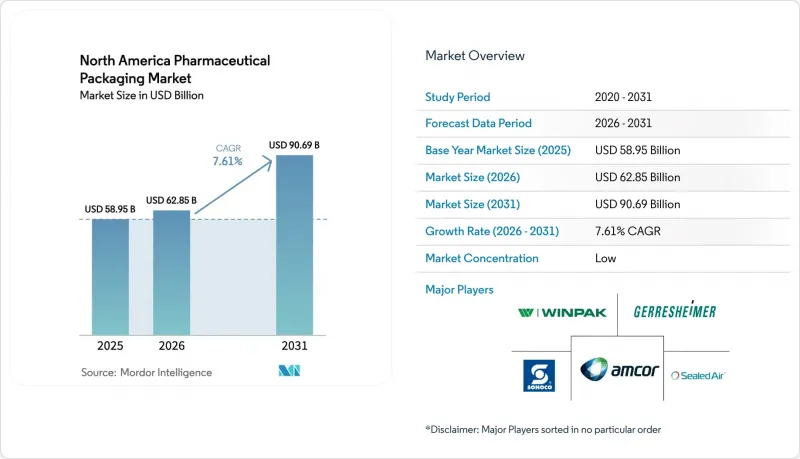
This report is Segmented by Material Type (Plastic, Glass, Metal, and More), Product Type (Bottles, Vials and Ampoules, Blister Packs, Tubes, and More ), Packaging Level (Primary, Secondary, and Tertiary), End-User Industry (Pharmaceutical Manufacturing Companies, Contract Packaging Organizations, and More), and Country. The Market Forecasts are Provided in Terms of Value (USD).
North America Pharmaceutical Packaging Market Trends and Insights
Growth of Biologics Requiring Specialized Container-Closure Systems
Biologics represented nearly 30% of FDA approvals in 2025, and each molecule demands rigorously validated elastomer stoppers, barrier coatings, and deterministic integrity testing that prevent oxygen ingress and particulate migration. Prefilled syringes and cartridges dominate self-administered monoclonal antibody and GLP-1 therapies, prompting West Pharmaceutical Services to accelerate NovaPure production lines in North Carolina to meet double-digit order growth. Drug owners are willing to pay premium prices for components that lower batch rejection risk, and are requesting helium-leak and laser-based inspections that simulate real-world transport vibration. The migration from vials to ready-to-inject devices shortens fill-finish cycles and reduces nurse preparation steps, making high-value closures critical to therapeutic outcomes. As a result, primary packaging suppliers that co-locate technical laboratories near biologics plants are winning multiyear supply contracts.
Stringent Anti-Counterfeiting Regulations Stimulating Advanced Track-and-Trace
Full DSCSA enforcement in November 2024 required every prescription pack shipped in the United States to carry a unique 2D code, and FDA warning letters issued in 2025 pushed wholesalers to verify serial numbers at unit level. Brand owners installed high-speed vision systems capable of authenticating 400 packs per minute, while contract packagers integrated aggregation software with enterprise resource planning suites to supply compliance data to trading partners. NFC-enabled labels and tamper-evident seals now allow pharmacists and patients to authenticate drugs with a smartphone, curbing diversion and gray-market infiltration. Although serialization raises per-unit costs by up to 12 cents, pharmaceutical sponsors view this as the price of market access. The downstream effect is sustained capital spending on digital presses, variable-data printing, and cloud-hosted traceability dashboards.
Volatility in Raw Material Prices of Medical-Grade Plastics
Medical-grade high-density polyethylene and polypropylene resin prices surged 22% in Q1 2025 following unplanned outages at petrochemical plants along the U.S. Gulf Coast, compressing converter margins. Force-majeure declarations by resin suppliers rose 40% year-on-year, underscoring supply vulnerability to weather-related disruptions. Long-term contracts fixing prices for 12-24 months, combined with limited pass-through, are forcing converters to renegotiate mid-term or absorb margin erosion. Sustainability mandates are amplifying volatility because recycled resin trades at a 15-20% premium and suffers from inconsistent quality that requires extra sorting and washing. Suppliers are accelerating diversification of feedstock sources and qualifying alternative suppliers to hedge risk, but price uncertainty remains an immediate profitability threat across the value chain.
Other drivers and restraints analyzed in the detailed report include:
- Rise in At-Home Care Driving Demand for Patient-Friendly Delivery Formats
- Increasing Adoption of Smart Blister Packaging Solutions
- Complex Regulatory Approval Cycles for New Packaging Innovations
For complete list of drivers and restraints, kindly check the Table Of Contents.
Segment Analysis
Composites and bio-based grades are projected to increase at a 9.21% CAGR from 2026 to 2031, outpacing incumbent substrates as converters meet EPR obligations in California, Colorado, and Maine. Plastics dominated 40.32% North America pharmaceutical packaging market share in 2025, driven by high-density polyethylene bottles and low-density polyethylene squeezers, yet resin price swings and recycling hurdles weigh on margins. Glass maintains its position for parenteral formats where inertness is paramount, but weight and breakage risk prompt exploration of cyclic olefin copolymer vials for ultra-high value biologics. Metal tubes for topicals face aluminum cost inflation, and laminate alternatives are gaining share by delivering equivalent barrier at lower gram weight.
Paperboard cartons and corrugated shippers remain essential for secondary and tertiary containment, although moisture sensitivity necessitates barrier coatings for humid routes. Amcor achieved 30% post-consumer recycled content in its North America pharmaceutical portfolio in 2025, showcasing technical progress on contaminant removal. Bio-based polyethylene sourced from sugarcane holds promise, but limited feedstock and a 10-15% premium constrain uptake. Suppliers moving the fastest to certify new composites under USP guidelines are positioned to capture forthcoming tenders as brand owners quantify Scope 3 emissions.
Pouches and bags are forecast to expand at an 8.54% CAGR through 2031 as drug makers favor flexible containment that slashes material weight, supports unit-dose therapy, and integrates tamper-evident seals. Bottles retained 22.43% North America pharmaceutical packaging market share in 2025, yet blister packs and stick packs are encroaching on solid oral and over-the-counter categories. Vials and ampoules remain indispensable for injectables, especially in cold-chain logistics, and prefilled cartridges dominate auto-injector platforms for GLP-1 therapies.
Blister line investments by contract packagers now top 1,200 cavities per minute with in-line serialization, shrinking batch turnaround for trial materials. Tubes service ophthalmic and dermal products, and laminate structures leveraging advanced foil replacements lower carbon footprint without sacrificing barrier. Caps and closures must meet child-resistant and senior-friendly torque windows, prompting design iterations that balance safety with accessibility. Labels have migrated from paper to multilayer films harboring holograms and color-shifting inks, creating downstream complexity in recycling but boosting brand owner security strategies.
Complete Report Scope:
- By Material Type
- Plastic
- High-Density Polyethylene (HDPE)
- Low-Density Polyethylene (LDPE)
- Polyethylene Terephthalate (PET)
- Other Plastics
- Glass
- Metal
- Paper and Paperboard
- Composites/ Bio-based Materials
- Plastic
- By Product Type
- Bottles
- Vials and Ampoules
- Blister Packs
- Prefilled Syringes and Cartridges
- Tubes
- Caps and Closures
- Pouches and Bags
- Labels
- Other Product Types
- By Packaging Level
- Primary
- Secondary
- Tertiary
- By End-user Industry
- Pharmaceutical Manufacturing Companies
- Contract Packaging Organizations
- Retail and Institutional Pharmacies
- Hospitals and Clinics
- Other End-user Industries
- By Country
- United States
- Canada
- Mexico
List of Companies Covered in this Report:
- Amcor plc
- West Pharmaceutical Services Inc.
- AptarGroup Inc.
- Gerresheimer AG
- Schott AG
- Becton, Dickinson and Company
- Cardinal Health Inc.
- Sealed Air Corporation
- Sonoco Products Company
- Alpha Packaging
- Catalent Inc.
- Winpak Ltd.
- Graham Packaging Company L.P.
- COMAR LLC
- Origin Pharma Packaging
- Rohrer Corporation
- Owens-Illinois Inc.
- Placon Corporation
- Neopac US Inc.
Additional Benefits:
- The market estimate (ME) sheet in Excel format
- 3 months of analyst support
TABLE OF CONTENTS
1 INTRODUCTION
- 1.1 Study Assumptions and Market Definition
- 1.2 Scope of the Study
2 RESEARCH METHODOLOGY
3 EXECUTIVE SUMMARY
4 MARKET LANDSCAPE
- 4.1 Market Overview
- 4.2 Market Drivers
- 4.2.1 Increasing Adoption of Smart Blister Packaging Solutions
- 4.2.2 Stringent Anti-Counterfeiting Regulations Stimulating Advanced Track-and-Trace
- 4.2.3 Growth of Biologics Requiring Specialized Container-Closure Systems
- 4.2.4 Rise in At-Home Care Driving Demand for Patient-Friendly Delivery Formats
- 4.2.5 Shift Toward Sustainable and Recyclable Packaging Materials in Pharma
- 4.2.6 Expansion of Cold Chain Infrastructure for Temperature-Sensitive Drugs
- 4.3 Market Restraints
- 4.3.1 Volatility in Raw Material Prices of Medical-Grade Plastics
- 4.3.2 Complex Regulatory Approval Cycles for New Packaging Innovations
- 4.3.3 Environmental Scrutiny on Single-Use Plastics Leading to Costly Compliance
- 4.3.4 Supply Chain Disruptions Causing Capacity Constraints
- 4.4 Impact of Macroeconomic Factors on the Market
- 4.5 Industry Value Chain Analysis
- 4.6 Regulatory Landscape
- 4.7 Technological Outlook
- 4.8 Porter's Five Forces Analysis
- 4.8.1 Bargaining Power of Suppliers
- 4.8.2 Bargaining Power of Buyers
- 4.8.3 Threat of New Entrants
- 4.8.4 Intensity of Competitive Rivalry
- 4.8.5 Threat of Substitute Products
- 4.9 Investment Analysis
5 MARKET SIZE AND GROWTH FORECASTS (VALUE)
- 5.1 By Material Type
- 5.1.1 Plastic
- 5.1.1.1 High-Density Polyethylene (HDPE)
- 5.1.1.2 Low-Density Polyethylene (LDPE)
- 5.1.1.3 Polyethylene Terephthalate (PET)
- 5.1.1.4 Other Plastics
- 5.1.2 Glass
- 5.1.3 Metal
- 5.1.4 Paper and Paperboard
- 5.1.5 Composites/ Bio-based Materials
- 5.1.1 Plastic
- 5.2 By Product Type
- 5.2.1 Bottles
- 5.2.2 Vials and Ampoules
- 5.2.3 Blister Packs
- 5.2.4 Prefilled Syringes and Cartridges
- 5.2.5 Tubes
- 5.2.6 Caps and Closures
- 5.2.7 Pouches and Bags
- 5.2.8 Labels
- 5.2.9 Other Product Types
- 5.3 By Packaging Level
- 5.3.1 Primary
- 5.3.2 Secondary
- 5.3.3 Tertiary
- 5.4 By End-user Industry
- 5.4.1 Pharmaceutical Manufacturing Companies
- 5.4.2 Contract Packaging Organizations
- 5.4.3 Retail and Institutional Pharmacies
- 5.4.4 Hospitals and Clinics
- 5.4.5 Other End-user Industries
- 5.5 By Country
- 5.5.1 United States
- 5.5.2 Canada
- 5.5.3 Mexico
6 COMPETITIVE LANDSCAPE
- 6.1 Market Concentration
- 6.2 Strategic Moves
- 6.3 Market Share Analysis
- 6.4 Company Profiles (Includes Global Level Overview, Market Level Overview, Core Segments, Financials as Available, Strategic Information, Market Rank/Share, Products and Services, and Recent Developments)
- 6.4.1 Amcor plc
- 6.4.2 West Pharmaceutical Services Inc.
- 6.4.3 AptarGroup Inc.
- 6.4.4 Gerresheimer AG
- 6.4.5 Schott AG
- 6.4.6 Becton, Dickinson and Company
- 6.4.7 Cardinal Health Inc.
- 6.4.8 Sealed Air Corporation
- 6.4.9 Sonoco Products Company
- 6.4.10 Alpha Packaging
- 6.4.11 Catalent Inc.
- 6.4.12 Winpak Ltd.
- 6.4.13 Graham Packaging Company L.P.
- 6.4.14 COMAR LLC
- 6.4.15 Origin Pharma Packaging
- 6.4.16 Rohrer Corporation
- 6.4.17 Owens-Illinois Inc.
- 6.4.18 Placon Corporation
- 6.4.19 Neopac US Inc.
7 MARKET OPPORTUNITIES AND FUTURE OUTLOOK
- 7.1 White-Space and Unmet-Need Assessment

