PUBLISHER: Mordor Intelligence | PRODUCT CODE: 2113444

PUBLISHER: Mordor Intelligence | PRODUCT CODE: 2113444
Italy Automotive Adaptive Lighting System - Market Share Analysis, Industry Trends & Statistics, Growth Forecasts (2026 - 2031)
According to Mordor Intelligence, the Italian automotive adaptive lighting system market size is valued at USD 0.06 billion in 2025, is estimated at USD 0.07 billion in 2026, and is projected to reach USD 0.13 billion by 2031, growing at a CAGR of 13.71% over 2026-2031.
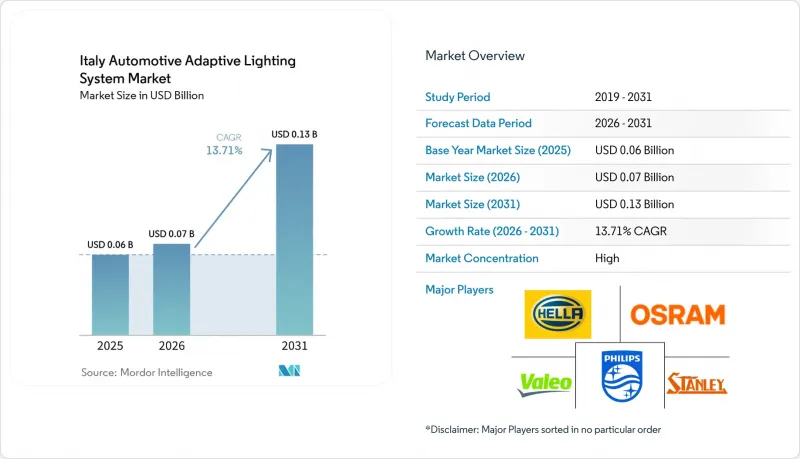
This report is Segmented by Vehicle Type (Passenger Cars and More), Lighting Type (Front and Rear), Component (Lamp Assemblies and More), Sales Channel (OEM and Aftermarket), and Technology (LED-Matrix and More). Market Forecasts are Provided in Value (USD) and Volume (Units).
Italy Automotive Adaptive Lighting System Market Trends and Insights
EU General Safety Regulation Mandates ADB in New Vehicle Types From 2027
The European Union's General Safety Regulation (EU 2019/2144) mandates adaptive driving beam capability in every new passenger car and light commercial vehicle type approved after July 2027, removing OEM discretion and turning adaptive headlights into a compliance item . Italian assemblers and importers must therefore integrate UNECE R123-compliant systems to preserve type-approval, creating a locked-in demand floor that shields suppliers from cyclical swings. Incumbents with validated portfolios, such as HELLA, benefit from multi-year nomination pipelines already stretching to 2028 program launches. Beyond new-vehicle volumes, the rule seeds a long-tail aftermarket for replacement parts once today's 2027-era cars cycle into repair age after 2030.
Rapid LED-Matrix Price Erosion Widens Fitment to B-Segment Cars
Module costs for 12,000-pixel LED-Matrix arrays have fallen below EUR 50 (USD 55), enabling Italian B-segment nameplates such as the Fiat Panda to bundle glare-free high beam without trimming gross margin. HELLA's FlatLight µMX package, introduced in 2024, trims optical depth by up to 50% and reduces power draw, further easing packaging and electrical load hurdles . As a result, the volume ceiling shifts from premium D-segment sedans to mass-market superminis, flipping the competitive script: hardware is commoditizing, while software-based beam-steering algorithms become the new battleground.
Semiconductor Supply Volatility Lengthens ECU Lead-Times Beyond 52 Weeks
Mature-node microcontrollers fabricated on 28 nm lines remain chronically tight, inflating lead-times to one year and forcing Tier-1s to hold buffer stock or pay spot premiums. HELLA's FY2025 bulletin cited Nexperia allocation caps that required last-minute redesigns. Such unpredictability compresses program margins and endangers just-in-time models that Italian OEMs apply to lower-volume nameplates.
Other drivers and restraints analyzed in the detailed report include:
- OEM OTA Feature-Unlock Revenue Models Accelerate Option Take-Rate
- Domestic Tier-1 Collaboration With ams OSRAM & STMicro Shrinks BOM by 12%
- Power-Based Italian Registration Tax Penalizes High-Lumen Retrofit Kits
For complete list of drivers and restraints, kindly check the Table Of Contents.
Segment Analysis
Light commercial vehicles account for a modest slice of the Italian automotive adaptive lighting system market size, but will outpace passenger cars with a 13.74% CAGR through 2031. In 2025, passenger cars dominated volumes at 67.16% share, powered by early OEM integration ahead of the EU regulation cut-over. Over the next five years, Lombardy's Vision-Zero grants, worth EUR 800 per van, tilt economics in favor of adaptive headlights that can cut accident-related downtime by a minimal rate per fleet year. Parcel and grocery operators that run pre-dawn routes across fog-laden Po Valley highways have become first movers, ordering retrofit kits bundled with forward-camera upgrades in 2026 procurement cycles.
Looking ahead, LCV fleets enjoy stronger payback math because each avoided collision translates directly into kept delivery slots, reduced body-shop downtime, and lower insurance deductibles. That benefit stack justifies higher up-front spend even without subsidy support, suggesting the segment can maintain double-digit growth once today's grants sunset in 2027. Passenger cars will add volumes mechanically as every new type-approved model carries ADB hardware, yet revenue elasticity will compress as LED-Matrix pricing continues to slide.
Front adaptive lighting held 71.24% of the Italian automotive adaptive lighting system market share in 2025, anchored by UNECE R123's stringent photometric benchmarks that make dynamic headlamps an OEM must-have. Rear adaptive lighting, though starting from a smaller base, is projected to post the fastest 13.83% CAGR through 2031 as micro-LED arrays unlock animated hazard icons that cut multi-car pile-ups in 50-meter fog. HGV and LCV pilots on the A22 Modena-Brenner corridor have shown faster reaction times among following drivers when dynamic rear icons replace static lamps, data that Lombardy authorities cite when lobbying Rome for V2V adoption guidelines.
Despite the tailwind, rear modules face regulatory gray zones: current UNECE files cover color and intensity but not animated symbol sets, forcing automakers to navigate varied member-state interpretations. Suppliers mitigate risk by shipping firmware-locked lamps that customers can activate only after national frameworks green-light specific icon libraries.
Complete Report Scope:
- By Vehicle Type
- Passenger Cars
- Light Commercial Vehicles (LCVs)
- Medium & Heavy Commercial Vehicles (M&HCVs)
- By Lighting Type
- Front Adaptive Lighting (Headlamps)
- Rear Adaptive Lighting (Tail Lamps)
- By Component
- Lamp Assemblies
- Sensors & Cameras
- Controllers
- Others
- By Sales Channel
- OEM
- Aftermarket
- By Technology
- LED-Matrix / Pixel Lighting
- Laser-Based Adaptive Lighting
- Halogen-/Xenon-Based Adaptive Lighting
List of Companies Covered in this Report:
- HELLA GmbH & Co. KGaA
- Valeo SA
- Marelli Automotive Lighting
- Koito Manufacturing Co. Ltd.
- Stanley Electric Co. Ltd.
- ams OSRAM
- ZKW Group GmbH
- Hyundai Mobis Co. Ltd.
- LG Innotek Co. Ltd.
- Robert Bosch GmbH
- Koninklijke Philips N.V.
- DENSO Corporation
- Aptiv PLC
- Texas Instruments Inc.
- Renesas Electronics Corp.
- STMicroelectronics N.V.
- Infineon Technologies AG
- Lear Corporation
- Panasonic Automotive Systems
- Nichia Corporation
Additional Benefits:
- The market estimate (ME) sheet in Excel format
- 3 months of analyst support
TABLE OF CONTENTS
1 Introduction
- 1.1 Study Assumptions & Market Definition
- 1.2 Scope of the Study
2 Research Methodology
3 Executive Summary
4 Market Landscape
- 4.1 Market Overview
- 4.2 Market Drivers
- 4.2.1 EU General Safety Regulation Mandates ADB in New Vehicle Types From 2027
- 4.2.2 Rapid Led-Matrix Price Erosion (More than Euro 50/Unit) Widens Fitment to B-Segment Cars
- 4.2.3 OEM OTA Feature-Unlock Revenue Models Accelerate Option-Take-Rate
- 4.2.4 Domestic Tier-1 Collaboration With AMS-OSRAM & STMICRO Shrinks BOM by 12 %
- 4.2.5 Micro-Led Rear-Lamp Communication for Low-Visibility Po Valley Fog Alerts
- 4.2.6 Lombardy "Vision-Zero" Incentives for Adaptive Headlights on LCV Fleets
- 4.3 Market Restraints
- 4.3.1 Semiconductor Supply Volatility Lengthens ECU Lead-Times Beyond 52 Weeks
- 4.3.2 Power-Based Italian Registration Tax Penalises High-Lumen Retrofit Kits
- 4.3.3 Limited Electronics Talent Pool Outside Piedmont Slows Local R&D Scaling
- 4.3.4 UNECE Photometric Test Costs (Less than Euro 0.9 M Per Variant) Deter SME Entrants
- 4.4 Value / Supply-Chain Analysis
- 4.5 Regulatory Landscape
- 4.6 Technological Outlook
- 4.7 Porter's Five Forces
- 4.7.1 Threat of New Entrants
- 4.7.2 Bargaining Power of Buyers
- 4.7.3 Bargaining Power of Suppliers
- 4.7.4 Threat of Substitutes
- 4.7.5 Competitive Rivalry
5 Market Size & Growth Forecasts (Value (USD) and Volume (Units))
- 5.1 By Vehicle Type
- 5.1.1 Passenger Cars
- 5.1.2 Light Commercial Vehicles (LCVs)
- 5.1.3 Medium & Heavy Commercial Vehicles (M&HCVs)
- 5.2 By Lighting Type
- 5.2.1 Front Adaptive Lighting (Headlamps)
- 5.2.2 Rear Adaptive Lighting (Tail Lamps)
- 5.3 By Component
- 5.3.1 Lamp Assemblies
- 5.3.2 Sensors & Cameras
- 5.3.3 Controllers
- 5.3.4 Others
- 5.4 By Sales Channel
- 5.4.1 OEM
- 5.4.2 Aftermarket
- 5.5 By Technology
- 5.5.1 LED-Matrix / Pixel Lighting
- 5.5.2 Laser-Based Adaptive Lighting
- 5.5.3 Halogen-/Xenon-Based Adaptive Lighting
6 Competitive Landscape
- 6.1 Market Concentration
- 6.2 Strategic Moves
- 6.3 Market Share Analysis
- 6.4 Company Profiles (includes Global Level Overview, Market Level Overview, Core Segments, Financials as Available, Strategic Information, Market Rank/Share for Key Companies, Products and Services, SWOT Analysis, and Recent Developments)
- 6.4.1 HELLA GmbH & Co. KGaA
- 6.4.2 Valeo SA
- 6.4.3 Marelli Automotive Lighting
- 6.4.4 Koito Manufacturing Co. Ltd.
- 6.4.5 Stanley Electric Co. Ltd.
- 6.4.6 ams OSRAM
- 6.4.7 ZKW Group GmbH
- 6.4.8 Hyundai Mobis Co. Ltd.
- 6.4.9 LG Innotek Co. Ltd.
- 6.4.10 Robert Bosch GmbH
- 6.4.11 Koninklijke Philips N.V.
- 6.4.12 DENSO Corporation
- 6.4.13 Aptiv PLC
- 6.4.14 Texas Instruments Inc.
- 6.4.15 Renesas Electronics Corp.
- 6.4.16 STMicroelectronics N.V.
- 6.4.17 Infineon Technologies AG
- 6.4.18 Lear Corporation
- 6.4.19 Panasonic Automotive Systems
- 6.4.20 Nichia Corporation
7 Market Opportunities & Future Outlook
- 7.1 White-Space & Unmet-Need Assessment

