PUBLISHER: Mordor Intelligence | PRODUCT CODE: 2113453

PUBLISHER: Mordor Intelligence | PRODUCT CODE: 2113453
Ultrasonic Sensors - Market Share Analysis, Industry Trends & Statistics, Growth Forecasts (2026 - 2031)
According to Mordor Intelligence, the ultrasonic sensors market size was valued at USD 7.13 billion in 2025 and estimated to grow from USD 7.75 billion in 2026 to reach USD 11.79 billion by 2031, at a CAGR of 8.72% during the forecast period (2026-2031).
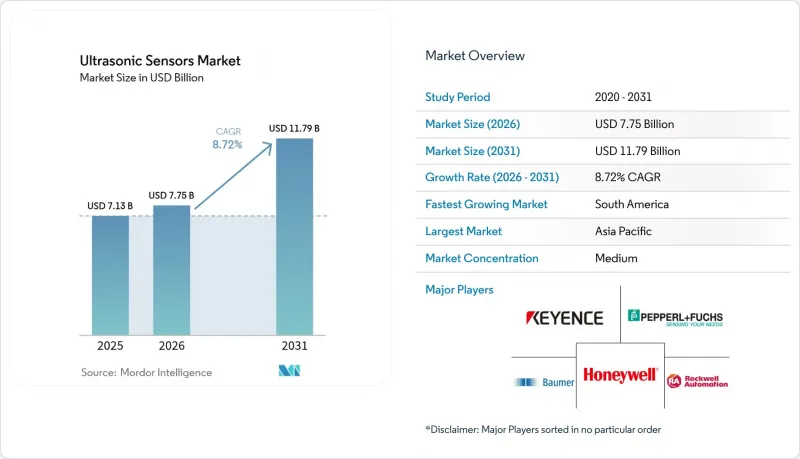
This report is Segmented by Technology (Bulk Piezoelectric Transducer, and More), Product Type (Proximity and Distance Sensors, and More), Range (Short-Range, Medium-Range, Long-Range), Mounting Type (In-Line/Threaded, and More), Operating Frequency (>= 70 KHz, and More), End-User Vertical (Automotive and Mobility, and More), Geography. The Market Forecasts are Provided in Terms of Value (USD).
Global Ultrasonic Sensors Market Trends and Insights
Rising Installation of High-Precision Ultrasonic Sensors in Industry 4.0 Production Cells
Industry 4.0 cells now demand sub-millimeter accuracy, pushing suppliers to adopt capacitive MUTs that achieve > 400 kHz and 40% broader bandwidth than legacy ceramics. IO-Link enabled devices feed machine-learning models that cut unplanned downtime by 30% through condition-based alerts. Global manufacturers localize capacity, exemplified by Omron's USD 9.2 million expansion in South Carolina, to shorten lead times for customized probes
Mandatory Front-Rear Obstacle-Detection Mandates in Chinese and EU Passenger-Car Safety Regulations
EU GSR2 and synchronized Chinese rules compel every new light vehicle to incorporate autonomous emergency braking and lane-keeping functions that rely on close-range ultrasonic sensing. Shipments leapt from 3 million units in 2009 to 200 million in 2023. Bosch couples ultrasonic, radar, and camera signals with AI fusion algorithms that distinguish pedestrians from static objects, meeting vulnerable road user requirements
Signal Attenuation in Multi-Sensor ADAS Clusters Beyond 10 m Ranges
High vehicle sensor density breeds ultrasonic cross-talk that lowers detection accuracy past 11 meters. Automotive designs now integrate 12-16 devices per car, widening interference risks. Research confirms that atmospheric variations magnify these effects, making radar or LiDAR pairing essential Sonair's acoustic ranging and detection platform reduces sensor count by widening field-of-view to 180
Other drivers and restraints analyzed in the detailed report include:
- Rapid Adoption of Non-Contact Level Monitoring in Smart Water and Wastewater Utilities Across GCC Countries
- Deployment of Corrosion-Resistant PVDF Probes in Offshore Wind O&M Robots
- Performance Drift of Piezoelectric Stacks Under -40°C Nordic Operating Conditions
For complete list of drivers and restraints, kindly check the Table Of Contents.
Segment Analysis
Bulk piezoelectric transducers retained a 64.30% ultrasonic sensors market share in 2025, anchored by economical mass production for automotive parking systems. The segment's scale advantage keeps unit costs low. In contrast, MUT arrays are growing at 12.64% CAGR as medical imaging and precision robotics demand miniaturized high-frequency performance. The ultrasonic sensors market size tied to MUT technology is expected to swell sharply as PMUTs excel in air-coupled detection while CMUTs dominate liquid-coupled imaging.
The technology transition reflects physical limits in ceramic plates when shrinking form factors. Potassium sodium niobate PMUTs recorded 105.5 dB/V at 10 cm, outclassing aluminum nitride competitors . Integration with CMOS electronics simplifies on-chip beamforming that lowers total bill of materials for smart devices.
Proximity and distance models captured 39.40% of 2025 revenue, favored for automotive bumpers and robot safety curtains. Level and depth sensors, however, are registering a 11.58% CAGR thanks to smart infrastructure projects. Continuous fluid-level insight curbs maintenance in water, chemical, and food facilities.
Wireless telemetry extends coverage to remote tanks, enabling predictive scheduling that trims service truck rolls. Transparent-liquid detection and through-wall sensing give ultrasonic probes an advantage over optical or float approaches, cementing market leadership across harsh industrial settings
Complete Report Scope:
- By Technology
- Bulk Piezoelectric Transducers
- Micromachined Ultrasound Transducers (MUT)
- PMUT (Piezo-MUT)
- CMUT (Capacitive-MUT)
- By Product Type
- Proximity and Distance Sensors
- Level/Depth Measurement Sensors
- Flow-measurement Sensors
- Ultrasonic Imaging Modules
- By Range
- Short-range ( >2 m)
- Medium-range (2 - 10 m)
- Long-range (> 10 m)
- By Mounting Type
- In-line / Threaded
- Block / Side-Looking
- Splice / Clamp-on
- By Operating Frequency
- <70 kHz
- 71 - 200 kHz
- > 200 kHz
- By End-user Vertical
- Industrial Manufacturing
- Automotive and Mobility
- Consumer Electronics and Appliances
- Medical and Healthcare
- Agriculture and Smart Farming
- Others (Oil and Gas, Marine, etc.)
- By Geography
- North America
- United States
- Canada
- Mexico
- South America
- Brazil
- Argentina
- Rest of South America
- Europe
- United Kingdom
- Germany
- France
- Italy
- Spain
- Nordics
- Rest of Europe
- Asia Pacific
- China
- Japan
- India
- South Korea
- Rest of Asia Pacific
- Middle East
- Saudi Arabia
- United Arab Emirates
- Turkey
- Rest of Middle East
- Africa
- South Africa
- Egypt
- Rest of Africa
- North America
Geography Analysis
Asia secured 37.60% of 2025 revenue on the back of China's vehicle electronics boom and Japan's precision manufacturing heritage. Government mandates make ultrasonic proximity detection standard in new passenger cars, while semiconductor clusters enable native MUT fabrication. South Korea supplies sensor ASICs, and India's affordable vehicle market increases penetration of cost-optimized designs. Policy-driven smart-city spending further embeds the ultrasonic sensors market in regional infrastructure rollouts.
North America concentrates on premium niches. The United States advances high-frequency probes for ambulatory diagnostics, while the aerospace sector exploits ruggedized units for structural health monitoring. Canada's winter environment shapes demand for temperature-compensated stacks. FDA guidance streamlines approvals, bringing new platforms to bedside and home settings faster than in earlier regulatory cycles.
Europe blends regulatory leadership and industrial prowess. EU GSR2 triggers synchronized automotive demand, and Germany's robotics clusters pioneer IO-Link enabled probes for real-time process feedback. Nordic utilities request heated sensor packages that withstand -40 °C, spurring material engineering breakthroughs. Meanwhile, South America posts the fastest 9.76% CAGR as mining firms automate remote sites and governments modernize water networks, enhancing need for resilient non-contact measurement.
- Keyence Corporation
- Pepperl+Fuchs AG
- Sick AG
- Honeywell International Inc.
- Omron Corporation
- Rockwell Automation Inc.
- Baumer Ltd
- Murata Manufacturing Co. Ltd
- Banner Engineering Corp.
- Balluff Inc.
- Robert Bosch GmbH
- Qualcomm Incorporated
- TDK Corporation
- Sensata Technologies
- TE Connectivity
- MaxBotix Inc.
- Siemens AG
- Texas Instruments Incorporated
- Hyde Park Electronics LLC
- Denso Corporation
Additional Benefits:
- The market estimate (ME) sheet in Excel format
- 3 months of analyst support
TABLE OF CONTENTS
1 INTRODUCTION
- 1.1 Study Assumptions and Market Definition
- 1.2 Scope of the Study
2 RESEARCH METHODOLOGY
3 EXECUTIVE SUMMARY
4 MARKET LANDSCAPE
- 4.1 Market Overview
- 4.2 Market Drivers
- 4.2.1 Rising installation of high-precision ultrasonic sensors in Industry 4.0 production cells
- 4.2.2 Mandatory fron trear obstacle-detection mandates in Chinese and EU passenger-car safety regulations
- 4.2.3 Rapid adoption of non-contact level monitoring in smart water and wastewater utilities across GCC countries
- 4.2.4 Use of high-frequency ( > 200 kHz) MUT arrays in medical point-of-care imaging devices
- 4.2.5 Deployment of corrosion-resistant PVDF-based probes in offshore wind O&M robots
- 4.3 Market Restraints
- 4.3.1 Signal attenuation in multi-sensor ADAS clusters beyond 10 m ranges
- 4.3.2 Performance drift of piezoelectric stacks under -40°C Nordic operating conditions
- 4.3.3 Regulatory hurdles around ultrasound exposure limits in wearable consumer electronics
- 4.3.4 Price premiums of PMUT wafers versus legacy bulk ceramic designs
- 4.4 Industry Value Chain Analysis
- 4.5 Technological Outlook (Miniaturized PMUT/CMUT wafers, ASIC integration)
- 4.6 Regulatory Outlook (ISO 19365, UNECE R159, FDA guidance for diagnostic ultrasound)
- 4.7 Porter's Five Forces Analysis
- 4.7.1 Bargaining Power of Suppliers
- 4.7.2 Bargaining Power of Buyers
- 4.7.3 Threat of New Entrants
- 4.7.4 Threat of Substitutes
- 4.7.5 Intensity of Competitive Rivalry
- 4.8 Assessment of Key Macroeconomic Trends
5 MARKET SIZE AND GROWTH FORECASTS (VALUE)
- 5.1 By Technology
- 5.1.1 Bulk Piezoelectric Transducers
- 5.1.2 Micromachined Ultrasound Transducers (MUT)
- 5.1.2.1 PMUT (Piezo-MUT)
- 5.1.2.2 CMUT (Capacitive-MUT)
- 5.2 By Product Type
- 5.2.1 Proximity and Distance Sensors
- 5.2.2 Level/Depth Measurement Sensors
- 5.2.3 Flow-measurement Sensors
- 5.2.4 Ultrasonic Imaging Modules
- 5.3 By Range
- 5.3.1 Short-range ( < 2 m)
- 5.3.2 Medium-range (2 - 10 m)
- 5.3.3 Long-range ( > 10 m)
- 5.4 By Mounting Type
- 5.4.1 In-line / Threaded
- 5.4.2 Block / Side-Looking
- 5.4.3 Splice / Clamp-on
- 5.5 By Operating Frequency
- 5.5.1 <70 kHz
- 5.5.2 71 - 200 kHz
- 5.5.3 > 200 kHz
- 5.6 By End-user Vertical
- 5.6.1 Industrial Manufacturing
- 5.6.2 Automotive and Mobility
- 5.6.3 Consumer Electronics and Appliances
- 5.6.4 Medical and Healthcare
- 5.6.5 Agriculture and Smart Farming
- 5.6.6 Others (Oil and Gas, Marine, etc.)
- 5.7 By Geography
- 5.7.1 North America
- 5.7.1.1 United States
- 5.7.1.2 Canada
- 5.7.1.3 Mexico
- 5.7.2 South America
- 5.7.2.1 Brazil
- 5.7.2.2 Argentina
- 5.7.2.3 Rest of South America
- 5.7.3 Europe
- 5.7.3.1 United Kingdom
- 5.7.3.2 Germany
- 5.7.3.3 France
- 5.7.3.4 Italy
- 5.7.3.5 Spain
- 5.7.3.6 Nordics
- 5.7.3.7 Rest of Europe
- 5.7.4 Asia Pacific
- 5.7.4.1 China
- 5.7.4.2 Japan
- 5.7.4.3 India
- 5.7.4.4 South Korea
- 5.7.4.5 Rest of Asia Pacific
- 5.7.5 Middle East
- 5.7.5.1 Saudi Arabia
- 5.7.5.2 United Arab Emirates
- 5.7.5.3 Turkey
- 5.7.5.4 Rest of Middle East
- 5.7.6 Africa
- 5.7.6.1 South Africa
- 5.7.6.2 Egypt
- 5.7.6.3 Rest of Africa
- 5.7.1 North America
6 COMPETITIVE LANDSCAPE
- 6.1 Market Concentration
- 6.2 Strategic Moves
- 6.3 Market Share Analysis
- 6.4 Company Profiles (includes Global level Overview, Market level overview, Core Segments, Financials as available, Strategic Information, Market Rank/Share for key companies, Products and Services, and Recent Developments)
- 6.4.1 Keyence Corporation
- 6.4.2 Pepperl+Fuchs AG
- 6.4.3 Sick AG
- 6.4.4 Honeywell International Inc.
- 6.4.5 Omron Corporation
- 6.4.6 Rockwell Automation Inc.
- 6.4.7 Baumer Ltd
- 6.4.8 Murata Manufacturing Co. Ltd
- 6.4.9 Banner Engineering Corp.
- 6.4.10 Balluff Inc.
- 6.4.11 Robert Bosch GmbH
- 6.4.12 Qualcomm Incorporated
- 6.4.13 TDK Corporation
- 6.4.14 Sensata Technologies
- 6.4.15 TE Connectivity
- 6.4.16 MaxBotix Inc.
- 6.4.17 Siemens AG
- 6.4.18 Texas Instruments Incorporated
- 6.4.19 Hyde Park Electronics LLC
- 6.4.20 Denso Corporation
7 MARKET OPPORTUNITIES AND FUTURE OUTLOOK
- 7.1 White-space and Unmet-Need Assessment

