PUBLISHER: Mordor Intelligence | PRODUCT CODE: 2113464

PUBLISHER: Mordor Intelligence | PRODUCT CODE: 2113464
Automotive Head-up Display - Market Share Analysis, Industry Trends & Statistics, Growth Forecasts (2026 - 2031)
According to Mordor Intelligence, the automotive head-up display market size was valued at USD 1.55 billion in 2025 and estimated to grow from USD 1.79 billion in 2026 to reach USD 3.71 billion by 2031, at a CAGR of 15.65% during the forecast period (2026-2031).
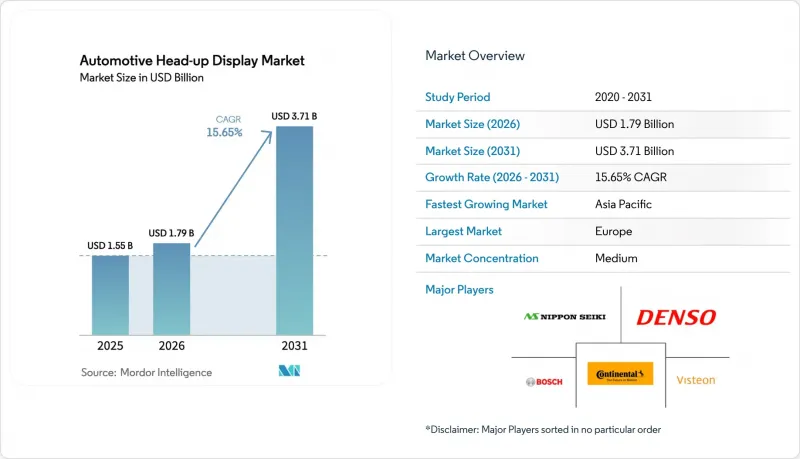
This report is Segmented by HUD Type (Windshield HUD and Combiner HUD), Technology (Conventional HUD and Augmented-Reality HUD), Sales Channel (OEM-Fitted and Aftermarket), Vehicle Type (Passenger Cars and Commercial Vehicles), and Geography (North America, South America, Europe, Asia-Pacific, and Middle East and Africa). The Market Forecasts are Provided in Terms of Value (USD).
Global Automotive Head-up Display Market Trends and Insights
Mandatory ADAS and GSR-II Compliance Push
Europe's General Safety Regulation II obliges intelligent speed assistance and lane-keeping alerts, increasing display workload that conventional clusters cannot accommodate without longer glance times. Continental's AR-HUD overlays speed limits and lane boundaries inside the driver's sightline, cutting cognitive load and meeting regulatory brightness and latency thresholds . The United States NCAP roadmap mirrors these guidelines, signalling converging global standards that point automakers toward HUD adoption as the most ergonomic path to compliance. Suppliers benefit from demand anchored in law rather than consumer discretion, protecting the Automotive Head-Up Display market against macro-economic softening.
Premium-Vehicle Digital-Cockpit Race
Luxury OEMs are reframing cabin design around seamless digital experiences in which head-up displays move from optional accessory to centerpiece. BMW's Panoramic iDrive projects a unified image band across the windshield that blends instrument data with live navigation cues, reinforcing brand value while reducing the need for secondary displays. Audi's A6 e-tron prototype stretches an 88-inch virtual plane at a 200-meter focal distance, lifting driver gaze from the dashboard to the road ahead. The United States newcomer Lucid guarantees AR-HUD availability across its UX 3.0 platform, confirming that premium EV buyers expect advanced projection by default. Early luxury adoption spreads fixed R&D costs, letting suppliers re-package the optics for mid-segment launches within two model cycles. Vendors that master this premium-to-volume cascade safeguard margins while meeting stricter safety validation criteria.
Windshield Real-Estate and Packaging Limits
Compact vehicles struggle to house projection optics between the dashboard and the glass. Ford's service bulletin details recalibration procedures that expose tight tolerances whenever a windshield is replaced. Mercedes-Benz internal studies show minor curvature shifts can degrade image focus and brightness, forcing OEMs to lock in glass suppliers early to secure consistency. Pillar-to-pillar concepts like Valeo's Panovision counteract space limits but require platform-level redesigns that add tooling cost and delay. The constraint divides the Automotive Head-Up Display market into premium programs that can afford bespoke dashboards and economy lines that must wait for slimmer optics.
Other drivers and restraints analyzed in the detailed report include:
- Falling PGU Optics Cost Below USD 35
- 5G Edge-Rendered AR Navigation Integration
- Persistent AR-HUD Ghost-Image Safety Risk
For complete list of drivers and restraints, kindly check the Table Of Contents.
Segment Analysis
Windshield systems captured 72.85% of the automotive head-up display market share in 2025, underpinned by seamless cabin integration and premium brand alignment. BMW's panoramic projection spans the full glass width and demonstrates how large virtual images can replace secondary screens. These units boost perceived vehicle value and satisfy ADAS visibility rules, though they depend on complex optical alignment and vehicle-specific packaging. As volumes scale, the Automotive Head-Up Display market size for windshield units will still widen, yet growth rates will cool as penetration saturates luxury models.
Combiner solutions recorded the sharpest rise with a 16.03% CAGR through 2031. Their self-contained modules bypass windshield geometry constraints, cutting install time and making retrofits feasible for used-car owners. Suppliers leverage standardized brackets and minimize vehicle teardown, giving dealers a high-margin accessory. Combiner technology now supports brighter images and anti-glare coatings, narrowing the quality gap with windshield projection. The segment will extend the Automotive Head-Up Display market to cost-sensitive customers and fleet refurbishments.
Conventional projection still accounts for 61.45% of the automotive head-up display market share in 2025, thanks to proven reliability and low cost. Continental continues to secure high-volume programs by meeting regulator-specified luminance without advanced rendering. However, AR-HUD installations are climbing at a 16.52% CAGR as falling micro-LED prices and stronger GPUs enable depth-accurate overlays. Cadillac's 2026 Vistiq will use Envisics holographic waveguides to place turn prompts at true-road distance, promising intuitive guidance. AR units fulfill the Level 3 automated-driving perception criteria as accuracy improves, positioning them for mainstream rollout. Therefore, the Automotive Head-Up Display market size for AR systems will gain share, especially once full-color yield hurdles are cleared.
Complete Report Scope:
- HUD Type
- Windshield HUD
- Combiner HUD
- Technology
- Conventional HUD
- Augmented-Reality (AR) HUD
- Sales Channel
- OEM-fitted
- Aftermarket
- Vehicle Type
- Passenger Cars
- Commercial Vehicles
- By Geography
- North America
- United States
- Canada
- Rest of North America
- South America
- Brazil
- Argentina
- Rest of South America
- Europe
- Germany
- United Kingdom
- France
- Italy
- Spain
- Russia
- Rest of Europe
- Asia-Pacific
- China
- Japan
- India
- South Korea
- Rest of Asia-Pacific
- Middle East and Africa
- United Arab Emirates
- Saudi Arabia
- Turkey
- Egypt
- South Africa
- Rest of Middle East and Africa
- North America
Geography Analysis
Europe's 36.90% of the automotive head-up display market share in 2025 stems from statutory driver-assistance display mandates and dense premium-vehicle sales. BMW, Audi, and Mercedes-Benz embed HUDs as standard on top trims, reinforcing buyer perception that projection is integral to safety packages. The regulatory backdrop under UNECE WP.29 creates a baseline technical specification, ensuring a steady pipeline of orders to tier-1s headquartered in the region. Local suppliers capitalize on proximity to OEM engineering centers, keeping iteration loops short and ensuring conformity with ISO 26262 validation audits.
Asia-Pacific charts the highest regional CAGR at 16.24% through 2031. Chinese brands like Li Auto and Nio use HUDs to differentiate software-defined cockpits, mirroring smartphone-grade UX. Taiwanese semiconductor firms supply specialized driver ICs, trimming the bill of materials and anchoring regional cost leadership. Government incentives that promote intelligent-vehicle production further stimulate adoption. The supply-chain density enables rapid engineering cycles, letting automakers deploy yearly HUD refinements that cater to tech-savvy domestic buyers.
North America leverages luxury SUVs and pickup trucks to widen adoption. Cadillac's upcoming AR-HUD launch signals Detroit's commitment, while aftermarket fitment thrives in a large used-vehicle base. The revised NCAP encourages OEMs to favor windshield projection for speed-assistance alerts. These factors lift regional demand even as a lower fleet-renewal tempo moderates volume compared with Asia.
Other regions, including the Middle East and Latin America, remain nascent yet attractive. Premium-import growth and rising safety-feature awareness will nudge penetration upward, helped by falling optics costs. Suppliers target these markets with modular combiner kits that bypass windshield variance and simplify homologation.
- Nippon Seiki Co. Ltd
- Continental AG
- Yazaki Corporation
- DENSO Corporation
- Robert Bosch GmbH
- Visteon Corporation
- Panasonic Corporation
- Pioneer Corporation
- HUDWAY LLC
- Harman International
- Valeo SA
- Alps Alpine Co. Ltd
- LG Display Co. Ltd
- Envisics Ltd
- WayRay AG
Additional Benefits:
- The market estimate (ME) sheet in Excel format
- 3 months of analyst support
TABLE OF CONTENTS
1 Introduction
- 1.1 Study Assumptions and Market Definition
- 1.2 Scope of the Study
2 Research Methodology
3 Executive Summary
4 Market Landscape
- 4.1 Market Overview
- 4.2 Market Drivers
- 4.2.1 Premium-Vehicle Digital-Cockpit Race
- 4.2.2 Mandatory ADAS and GSR-II Compliance Push
- 4.2.3 Falling PGU Optics Cost Below USD 35
- 4.2.4 Transparent Micro-LED Windscreen R&D Wins
- 4.2.5 China Tier-1 In-House HUD Sourcing Surge
- 4.2.6 5G Edge-Rendered AR Navigation Integration
- 4.3 Market Restraints
- 4.3.1 Windshield Real-Estate and Packaging Limits
- 4.3.2 Persistent AR-HUD Ghost-Image Safety Risk
- 4.3.3 Automotive-Grade Red Micro-LED Yield Gap
- 4.3.4 Windshield-Supplier Optical-Alignment Variance
- 4.4 Value / Supply-Chain Analysis
- 4.5 Regulatory Landscape
- 4.6 Technological Outlook
- 4.7 Porter's Five Forces
- 4.7.1 Threat of New Entrants
- 4.7.2 Bargaining Power of Buyers
- 4.7.3 Bargaining Power of Suppliers
- 4.7.4 Threat of Substitutes
- 4.7.5 Intensity of Competitive Rivalry
5 Market Size and Growth Forecasts (Value (USD))
- 5.1 HUD Type
- 5.1.1 Windshield HUD
- 5.1.2 Combiner HUD
- 5.2 Technology
- 5.2.1 Conventional HUD
- 5.2.2 Augmented-Reality (AR) HUD
- 5.3 Sales Channel
- 5.3.1 OEM-fitted
- 5.3.2 Aftermarket
- 5.4 Vehicle Type
- 5.4.1 Passenger Cars
- 5.4.2 Commercial Vehicles
- 5.5 By Geography
- 5.5.1 North America
- 5.5.1.1 United States
- 5.5.1.2 Canada
- 5.5.1.3 Rest of North America
- 5.5.2 South America
- 5.5.2.1 Brazil
- 5.5.2.2 Argentina
- 5.5.2.3 Rest of South America
- 5.5.3 Europe
- 5.5.3.1 Germany
- 5.5.3.2 United Kingdom
- 5.5.3.3 France
- 5.5.3.4 Italy
- 5.5.3.5 Spain
- 5.5.3.6 Russia
- 5.5.3.7 Rest of Europe
- 5.5.4 Asia-Pacific
- 5.5.4.1 China
- 5.5.4.2 Japan
- 5.5.4.3 India
- 5.5.4.4 South Korea
- 5.5.4.5 Rest of Asia-Pacific
- 5.5.5 Middle East and Africa
- 5.5.5.1 United Arab Emirates
- 5.5.5.2 Saudi Arabia
- 5.5.5.3 Turkey
- 5.5.5.4 Egypt
- 5.5.5.5 South Africa
- 5.5.5.6 Rest of Middle East and Africa
- 5.5.1 North America
6 Competitive Landscape
- 6.1 Market Concentration
- 6.2 Strategic Moves
- 6.3 Market Share Analysis
- 6.4 Company Profiles (Includes Global level Overview, Market level overview, Core Segments, Financials as available, Strategic Information, Market Rank/Share for key companies, Products and Services, and Recent Developments)
- 6.4.1 Nippon Seiki Co. Ltd
- 6.4.2 Continental AG
- 6.4.3 Yazaki Corporation
- 6.4.4 DENSO Corporation
- 6.4.5 Robert Bosch GmbH
- 6.4.6 Visteon Corporation
- 6.4.7 Panasonic Corporation
- 6.4.8 Pioneer Corporation
- 6.4.9 HUDWAY LLC
- 6.4.10 Harman International
- 6.4.11 Valeo SA
- 6.4.12 Alps Alpine Co. Ltd
- 6.4.13 LG Display Co. Ltd
- 6.4.14 Envisics Ltd
- 6.4.15 WayRay AG
7 Market Opportunities and Future Outlook

