PUBLISHER: Mordor Intelligence | PRODUCT CODE: 2113500

PUBLISHER: Mordor Intelligence | PRODUCT CODE: 2113500
Europe CT - Market Share Analysis, Industry Trends & Statistics, Growth Forecasts (2026 - 2031)
According to Mordor Intelligence, Europe CT market size in 2026 is estimated at USD 2.77 billion, growing from 2025 value of USD 2.614 billion with 2031 projections showing USD 3.74 billion, growing at 6.14% CAGR over 2026-2031.
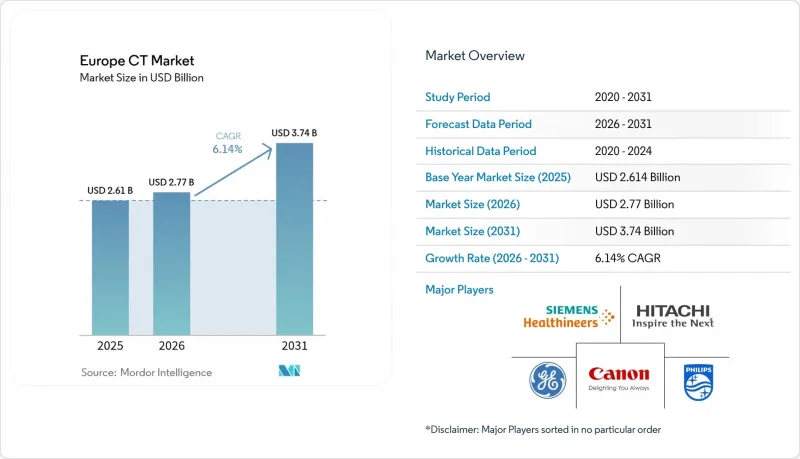
This report is Segmented by Technology (Low-End, Mid-End, High-End, and More), Device Architecture (Stationary CT Systems, Mobile/Portable CT Systems), Application (Oncology, Cardiology, and More), End User (Hospitals, Diagnostic Imaging Centers, and More), Component (Hardware, Software, Services), and Geography (Germany, United Kingdom, and More). The Market Forecasts are Provided in Terms of Value (USD) Only.
Europe CT Market Trends and Insights
Growing Burden of Chronic Disease & Cancer Boosts Demand for Early, Imaging-Led Diagnosis
European populations are aging, and chronic disease prevalence is climbing, reinforcing CT as a frontline modality for oncology and cardiovascular assessment. Cancer screening programs in Germany, France, and Italy anchor consistent scan volumes, while AI tools now assist in 33.9% of CT workflows in Polish hospitals, shortening interpretation time and raising diagnostic sensitivity. The European Society of Radiology survey found CT as the leading AI modality at 38.8%, underscoring clinical reliance on advanced reconstruction and automated triage. Early detection policies are also enlarging lung cancer screening cohorts, further lifting utilization. Together, these trends position the Europe CT market for sustained demand over the next decade.
Rapid Technology Shifts (AI, Photon-Counting, Spectral CT) Enhance Image Quality & Reduce Dose
Photon-counting detectors represent the most consequential advancement since helical scanning, delivering sub-0.2 mm spatial resolution and intrinsic spectral data at 45% lower dose than conventional energy-integrating arrays. Siemens Healthineers invested EUR 80 million in Forchheim to secure vertical supply of the detector ASICs . Sectra's PACS integration enables radiologists to manipulate photon-counting datasets without leaving their primary workstation. As dose limits tighten, premium systems offering automatic kV selection and photon-counting options are gaining preference, especially for pediatric and repeat imaging. AI-based noise-optimizing algorithms, now embedded in most Tier-1 offerings, further reduce dose and speed reconstruction, adding momentum to the Europe CT market.
High Capex & Maintenance Costs of >64-Slice Scanners
Premium systems priced above EUR 1.4 million strain local budgets in smaller European markets. MDR certification alone costs vendors near EUR 100,000 per model, a seven-fold increase over the prior directive, costs that flow through to list prices. Annual service contracts add 8-12% of purchase value, creating a lifecycle burden many district hospitals find unsustainable. Currency volatility in Central and Eastern Europe further complicates budgeting. Consequently, buyers sometimes opt for refurbished 64-slice units, tempering the high-end revenue opportunity within the Europe CT market.
Other drivers and restraints analyzed in the detailed report include:
- Accelerating Replacement Cycle of Legacy 16-/64-Slice Scanners Across EU Hospitals
- Stricter EU-Wide Dose Regulations Favor Adoption of Low-Dose Premium Systems
- Diagnosis-Related Group Tariff Pressure Squeezes CT Scan Profitability
For complete list of drivers and restraints, kindly check the Table Of Contents.
Segment Analysis
Mid-end 16-64-slice systems retained 42.12% revenue in 2025, confirming their role as versatile workhorses across routine body imaging. The Europe CT market size for dual-energy platforms is projected to grow at 6.28% CAGR, propelled by oncology and cardiology protocols that benefit from material decomposition and mono-energetic reconstructions. Over the same horizon, photon-counting CT units will outpace all classes by value, as early adopters validate dose savings and diagnostic yield in calcified plaque and lung nodule characterization. Vendors offer upgradable tubes and detector packages that allow mid-tier customers to migrate gradually, blurring boundaries between traditional tiers.
High-end scanners above 64 slices remain indispensable in trauma centers and tertiary cardiology hubs, while cone-beam and low-slice devices occupy niche roles in dental and basic emergency settings. The vendor roadmap through 2030 focuses on integrating photon-counting detectors, AI-driven image chain optimization, and subscription-based reconstruction engines. These trends will reshape the competitive hierarchy over the forecast period, anchoring photon-counting as the gold standard for premium diagnostics in the Europe CT market.
Stationary gantries accounted for 79.28% revenue in 2025, reflecting their entrenched role in high-volume imaging centers. Yet portable CT units are set to post a 6.75% CAGR as stroke ambulances, ICUs, and neonatal units embrace bedside scanning. The SOMATOM On.site system, featuring telescopic shielding and remote control, exemplifies vendor investment in this space. Clinical studies show that mobile CT reduces intra-hospital transfer times by 40% and lowers infection risk in ventilated patients, supporting the cost premium.
Scanners integrated in mobile stroke units enable immediate intracranial hemorrhage ruling-out, shaving crucial minutes from door-to-needle metrics and improving functional outcomes. Reimbursement is improving, with Germany's G-DRG 3-stage tele-stroke codes adding financial viability. Despite smaller detector arrays and limited field-of-view, image reconstruction engines have advanced to deliver diagnostic quality suitable for acute decision making. As component costs fall and battery runtimes lengthen, portable scanners will secure a larger niche within the Europe CT market.
Complete Report Scope:
- By Technology (Slice & Mode)
- Low-End (<16-slice)
- Mid-End (16-64-slice)
- High-End (>64-slice)
- Dual-/Spectral Energy CT
- Cone-Beam CT (CBCT)
- Photon-Counting CT
- By Product Type
- Stationary CT Systems
- Mobile / Portable CT Systems
- By Application
- Oncology
- Cardiology
- Neurology
- Musculoskeletal
- Vascular
- Pulmonology
- ENT & Dental / Maxillofacial
- Trauma & Emergency
- By End User
- Hospitals
- Diagnostic Imaging Centers
- Ambulatory Surgery Centers
- Research & Academic Institutes
- Veterinary Clinics
- By Component
- Hardware (Scanners)
- Software
- Services
- By Geography
- Germany
- United Kingdom
- France
- Italy
- Spain
- Rest of Europe
List of Companies Covered in this Report:
- Canon
- Carestream Dental
- CurveBeam AI
- Epica Medical Innovations
- Fujifilm Holdings Corp.
- GE HealthCare Technologies Inc.
- Koninklijke Philips
- Medtronic
- MinFound Medical Systems Co., Ltd.
- Neusoft
- Planmeca
- Samsung Electronics Co., Ltd. (NeuroLogica)
- Shenzhen Anke High-Tech Co., Ltd.
- Siemens Healthineers
- Stryker
- United Imaging Healthcare Co., Ltd.
- Vatech Co., Ltd.
- Xoran Technologies LLC
Additional Benefits:
- The market estimate (ME) sheet in Excel format
- 3 months of analyst support
TABLE OF CONTENTS
1 Introduction
- 1.1 Study Assumptions & Market Definition
- 1.2 Scope of the Study
2 Research Methodology
3 Executive Summary
4 Market Landscape
- 4.1 Market Overview
- 4.2 Market Drivers
- 4.2.1 Growing burden of chronic disease & cancer boosts demand for early, imaging-led diagnosis
- 4.2.2 Rapid technology shifts (AI, photon-counting, spectral CT) enhance image quality & reduce dose
- 4.2.3 Accelerating replacement cycle of legacy 16-/64-slice scanners across EU hospitals
- 4.2.4 Stricter EU-wide dose regulations favour adoption of low-dose premium systems
- 4.2.5 EU Recovery & Resilience Facility grants earmarked for digital radiology upgrades
- 4.2.6 Net-zero hospital initiatives drive purchase of energy-efficient CT platforms
- 4.3 Market Restraints
- 4.3.1 High capex & maintenance costs of >64-slice scanners
- 4.3.2 Diagnosis-Related Group (DRG) tariff pressure squeezes CT scan profitability
- 4.3.3 Shortage of CT-trained technologists limits utilisation of newly installed units
- 4.3.4 Supply-chain risk for X-ray tubes & detectors amid Russia-Ukraine conflict
- 4.4 Value / Supply-Chain Analysis
- 4.5 Regulatory Landscape
- 4.6 Technological Outlook
- 4.7 Porter's Five Forces
- 4.7.1 Threat of New Entrants
- 4.7.2 Bargaining Power of Suppliers
- 4.7.3 Bargaining Power of Buyers
- 4.7.4 Threat of Substitutes
- 4.7.5 Competitive Rivalry
5 Market Size & Growth Forecasts (Value)
- 5.1 By Technology (Slice & Mode)
- 5.1.1 Low-End (<16-slice)
- 5.1.2 Mid-End (16-64-slice)
- 5.1.3 High-End (>64-slice)
- 5.1.4 Dual-/Spectral Energy CT
- 5.1.5 Cone-Beam CT (CBCT)
- 5.1.6 Photon-Counting CT
- 5.2 By Product Type
- 5.2.1 Stationary CT Systems
- 5.2.2 Mobile / Portable CT Systems
- 5.3 By Application
- 5.3.1 Oncology
- 5.3.2 Cardiology
- 5.3.3 Neurology
- 5.3.4 Musculoskeletal
- 5.3.5 Vascular
- 5.3.6 Pulmonology
- 5.3.7 ENT & Dental / Maxillofacial
- 5.3.8 Trauma & Emergency
- 5.4 By End User
- 5.4.1 Hospitals
- 5.4.2 Diagnostic Imaging Centers
- 5.4.3 Ambulatory Surgery Centers
- 5.4.4 Research & Academic Institutes
- 5.4.5 Veterinary Clinics
- 5.5 By Component
- 5.5.1 Hardware (Scanners)
- 5.5.2 Software
- 5.5.3 Services
- 5.6 By Geography
- 5.6.1 Germany
- 5.6.2 United Kingdom
- 5.6.3 France
- 5.6.4 Italy
- 5.6.5 Spain
- 5.6.6 Rest of Europe
6 Competitive Landscape
- 6.1 Market Concentration
- 6.2 Strategic Moves
- 6.3 Market Share Analysis
- 6.4 Company Profiles (includes Global level Overview, Market level overview, Core Segments, Financials as available, Strategic Information, Market Rank/Share for key companies, Products & Services, and Recent Developments)
- 6.4.1 Canon Medical Systems Corp.
- 6.4.2 Carestream Dental LLC
- 6.4.3 CurveBeam AI
- 6.4.4 Epica Medical Innovations
- 6.4.5 Fujifilm Holdings Corp.
- 6.4.6 GE HealthCare Technologies Inc.
- 6.4.7 Koninklijke Philips N.V.
- 6.4.8 Medtronic plc
- 6.4.9 MinFound Medical Systems Co., Ltd.
- 6.4.10 Neusoft Medical Systems Co., Ltd.
- 6.4.11 Planmeca Oy
- 6.4.12 Samsung Electronics Co., Ltd. (NeuroLogica)
- 6.4.13 Shenzhen Anke High-Tech Co., Ltd.
- 6.4.14 Siemens Healthineers AG
- 6.4.15 Stryker Corporation
- 6.4.16 United Imaging Healthcare Co., Ltd.
- 6.4.17 Vatech Co., Ltd.
- 6.4.18 Xoran Technologies LLC
7 Market Opportunities & Future Outlook
- 7.1 White-space & Unmet-Need Assessment

