PUBLISHER: Mordor Intelligence | PRODUCT CODE: 2113506

PUBLISHER: Mordor Intelligence | PRODUCT CODE: 2113506
Emulsion Coatings - Market Share Analysis, Industry Trends & Statistics, Growth Forecasts (2026 - 2031)
According to Mordor Intelligence, the emulsion coatings market size in 2026 is estimated at USD 18.84 billion, growing from 2025 value of USD 18.23 billion with 2031 projections showing USD 22.23 billion, growing at 3.36% CAGR over 2026-2031.
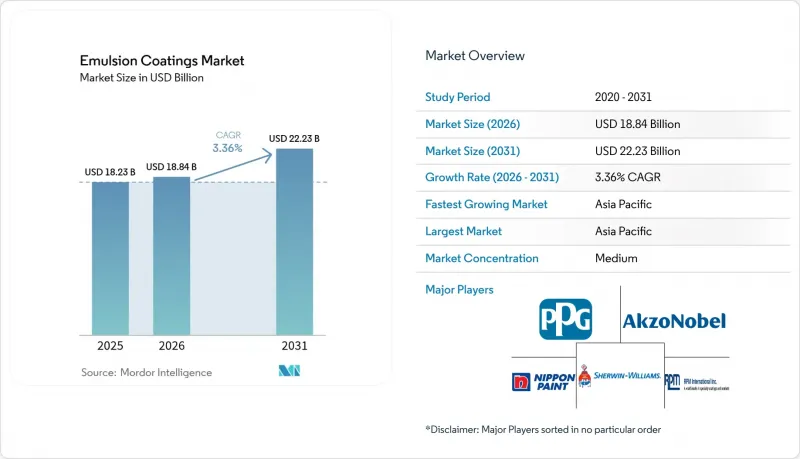
This report is Segmented by Resin Type (Acrylic, Vinyl Acetate Ethylene, Polyurethane, Others), Application (Building and Construction, Automotive, Aerospace, Home Appliances, Marine, Food Processing, Textile, Other Applications), and Geography (Asia-Pacific, North America, Europe, South America, Middle East and Africa). The Market Forecasts are Provided in Terms of Value (USD).
Global Emulsion Coatings Market Trends and Insights
Regulatory Tailwinds on VOC and Carbon-Reduction
Multiple jurisdictions now cap VOC levels for architectural coatings at or below 30 g/L, prompting formulators to accelerate the development of waterborne coatings. The European Commission's Industrial Emissions revisions and California's latest amendments to Rule 1113 exemplify the policy momentum that directly benefits the emulsion coatings market. U.S. states aligning with these benchmarks broaden the compliance footprint and reinforce demand for low-solvent chemistries across the residential, commercial, and industrial spectrum.
Rapid Formulation Advances Closing Performance Gap
Breakthrough acrylic copolymers launched by BASF in 2024 delivered chemical resistance levels once reserved for two-component polyurethanes. Hybrid crosslinking technology enhances hardness, weatherability, and early block resistance, enabling single-pack, waterborne systems to replace solvent-rich alternatives in the fields of equipment, transportation, and protective maintenance. Nanofiller dispersions strengthen barrier properties, while bio-derived crosslinkers improve adhesion without compromising sustainability.
Acrylic Acid and VAM Price Volatility
Supply disruptions linked to weather events and major maintenance turnarounds periodically spike feedstock costs, squeezing margins for commodity-grade architectural paints. Smaller regional producers without long-term contracts face the greatest exposure, prompting some to curtail output or pursue mergers to stabilize sourcing. Raw-material swings also trigger frequent surcharge announcements from multinational suppliers, forcing downstream customers to recalibrate budgets and inventory cycles.
Other drivers and restraints analyzed in the detailed report include:
- Urban Refurbishment Boom in Asian Megacities
- OEM Shift to High-Speed Water-Borne Lines in Appliances
- Skilled-Labor Gaps for Correct Film Application
For complete list of drivers and restraints, kindly check the Table Of Contents.
Segment Analysis
Acrylic solutions retained 57.92% of the emulsion coatings market share in 2025, owing to balanced cost-to-performance profiles across interior walls, facades, and DIY projects. The introduction of self-crosslinking acrylic-polyurethane hybrids by Dow in 2024 further blurred the boundary between commodity and premium grades. Polyurethane emulsions are projected to post the fastest expansion at a 4.17% CAGR through 2031, as industrial and automotive end-users demand superior abrasion resistance, chemical resilience, and gloss retention. Vinyl acetate ethylene copolymers maintain steady niches in paper, textile, and adhesive formulations, while specialty styrene-acrylic blends satisfy marine and aerospace regulations that require flame retardancy and low smoke density. Competitive positioning is increasingly dependent on polymer architecture customization, renewable content options, and compatibility with automated spray or roll-coat lines.
Downstream customers continually benchmark resin systems on hardness development, water whitening, and dirt pick-up resistance, criteria that now approach solvent-borne levels. Producers, therefore, channel research and development spending toward particle-size optimization, surfactant-free stabilization, and multifunctional additive packages that deliver stain blocking alongside early water resistance. Such advances help acrylic chemistries maintain volume leadership even as polyurethane grades capture higher-value pockets.
Complete Report Scope:
- By Resin Type
- Acrylic
- Vinyl Acetate Ethylene
- Polyurethane
- Others
- By Application
- Building and Construction
- Automotive
- Aerospace
- Home Appliances
- Marine
- Food Processing
- Textile
- Other Applications
- By Geography
- Asia-Pacific
- China
- India
- Japan
- South Korea
- ASEAN Countries
- Australia and New Zealand
- Rest of Asia-Pacific
- North America
- United States
- Canada
- Mexico
- Europe
- Germany
- United Kingdom
- Italy
- France
- Spain
- Netherlands
- Russia
- Rest of Europe
- South America
- Brazil
- Argentina
- Rest of South America
- Middle-East and Africa
- Saudi Arabia
- United Arab Emirates
- South Africa
- Egypt
- Rest of Middle-East and Africa
- Asia-Pacific
Geography Analysis
The Asia-Pacific region accounted for 45.05% of global revenue in 2025, underpinned by China's infrastructure outlays and India's Smart Cities investments, which collectively sustain tens of millions of gallons of architectural paint demand each year. Ongoing relocation of specialty chemicals production to Southeast Asia enhances regional self-sufficiency and shortens lead times for export-oriented OEMs. The emulsion coatings market benefits from favorable government policies that incentivize water conservation, VOC reduction, and circular-economy practices.
North America ranks second, driven by stringent EPA air-toxics rules and the Inflation Reduction Act's building-efficiency tax credits that reward low-emission products. Renovation cycles in residential housing and mandated bridge refurbishments keep baseline demand resilient even when new construction slows. Europe follows closely, with the EU Green Deal reinforcing eco-label criteria and carbon-pricing schemes that encourage specifiers to adopt water-borne solutions. Growth in these mature regions remains modest, yet elevated average selling prices buoy revenue.
Latin America, the Middle East, and Africa together represent a sizable catch-up opportunity. Brazil's Casa Verde e Amarela housing subsidy program, Mexico's near-shoring-driven industrial parks, and Saudi Arabia's giga-projects, such as NEOM, all require high-performance coatings that tolerate extreme climates. Political risk, currency volatility, and fragmented distribution complicate entry strategies; however, multinationals that localize production and establish installer training networks stand to reap outsized gains.
- AkzoNobel N.V.
- PPG Industries, Inc.
- The Sherwin-Williams Company
- Nippon Paint Holdings Co., Ltd.
- Asian Paints
- RPM International Inc.
- Axalta Coating Systems
- Kansai Paint Co., Ltd.
- Jotun
- Hempel A/S
- Berger Paints India Limited
- Carpoly Chemical Group Co., Ltd.
- NIPSEA Group
- Sika AG
- Mascoat
- Chugoku Marine Paints, Ltd.
- Yip's Chemical Holdings Limited
- Tikkurila Oyj
Additional Benefits:
- The market estimate (ME) sheet in Excel format
- 3 months of analyst support
TABLE OF CONTENTS
1 Introduction
- 1.1 Study Assumptions and Market Definition
- 1.2 Scope of the Study
2 Research Methodology
3 Executive Summary
4 Market Landscape
- 4.1 Market Overview
- 4.2 Market Drivers
- 4.2.1 Regulatory tailwinds on VOC and carbon-reduction
- 4.2.2 Rapid formulation advances closing performance gap
- 4.2.3 Urban refurbishment boom in Asian megacities
- 4.2.4 OEM shift to high-speed water-borne lines in appliances
- 4.2.5 Climate-proof infrastructure needs
- 4.3 Market Restraints
- 4.3.1 Acrylic acid and VAM price volatility
- 4.3.2 Skilled-labour gaps for correct film application
- 4.3.3 Water scarcity and wastewater-treatment cost inflation
- 4.4 Value Chain Analysis
- 4.5 Porter's Five Forces
- 4.5.1 Bargaining Power of Suppliers
- 4.5.2 Bargaining Power of Consumers
- 4.5.3 Threat of New Entrants
- 4.5.4 Threat of Substitutes
- 4.5.5 Degree of Competition
5 Market Size and Growth Forecasts (Value)
- 5.1 By Resin Type
- 5.1.1 Acrylic
- 5.1.2 Vinyl Acetate Ethylene
- 5.1.3 Polyurethane
- 5.1.4 Others
- 5.2 By Application
- 5.2.1 Building and Construction
- 5.2.2 Automotive
- 5.2.3 Aerospace
- 5.2.4 Home Appliances
- 5.2.5 Marine
- 5.2.6 Food Processing
- 5.2.7 Textile
- 5.2.8 Other Applications
- 5.3 By Geography
- 5.3.1 Asia-Pacific
- 5.3.1.1 China
- 5.3.1.2 India
- 5.3.1.3 Japan
- 5.3.1.4 South Korea
- 5.3.1.5 ASEAN Countries
- 5.3.1.6 Australia and New Zealand
- 5.3.1.7 Rest of Asia-Pacific
- 5.3.2 North America
- 5.3.2.1 United States
- 5.3.2.2 Canada
- 5.3.2.3 Mexico
- 5.3.3 Europe
- 5.3.3.1 Germany
- 5.3.3.2 United Kingdom
- 5.3.3.3 Italy
- 5.3.3.4 France
- 5.3.3.5 Spain
- 5.3.3.6 Netherlands
- 5.3.3.7 Russia
- 5.3.3.8 Rest of Europe
- 5.3.4 South America
- 5.3.4.1 Brazil
- 5.3.4.2 Argentina
- 5.3.4.3 Rest of South America
- 5.3.5 Middle-East and Africa
- 5.3.5.1 Saudi Arabia
- 5.3.5.2 United Arab Emirates
- 5.3.5.3 South Africa
- 5.3.5.4 Egypt
- 5.3.5.5 Rest of Middle-East and Africa
- 5.3.1 Asia-Pacific
6 Competitive Landscape
- 6.1 Market Concentration
- 6.2 Strategic Moves
- 6.3 Market Share/Ranking Analysis
- 6.4 Company Profiles (includes Global level Overview, Market level overview, Core Segments, Financials as available, Strategic Information, Market Rank/Share for key companies, Products and Services, and Recent Developments)
- 6.4.1 AkzoNobel N.V.
- 6.4.2 PPG Industries, Inc.
- 6.4.3 The Sherwin-Williams Company
- 6.4.4 Nippon Paint Holdings Co., Ltd.
- 6.4.5 Asian Paints
- 6.4.6 RPM International Inc.
- 6.4.7 Axalta Coating Systems
- 6.4.8 Kansai Paint Co., Ltd.
- 6.4.9 Jotun
- 6.4.10 Hempel A/S
- 6.4.11 Berger Paints India Limited
- 6.4.12 Carpoly Chemical Group Co., Ltd.
- 6.4.13 NIPSEA Group
- 6.4.14 Sika AG
- 6.4.15 Mascoat
- 6.4.16 Chugoku Marine Paints, Ltd.
- 6.4.17 Yip's Chemical Holdings Limited
- 6.4.18 Tikkurila Oyj
7 Market Opportunities and Future Outlook
- 7.1 White-space and Unmet-need Assessment

