PUBLISHER: Mordor Intelligence | PRODUCT CODE: 2113507

PUBLISHER: Mordor Intelligence | PRODUCT CODE: 2113507
GCC Fisheries And Aquaculture - Market Share Analysis, Industry Trends & Statistics, Growth Forecasts (2026 - 2031)
According to Mordor Intelligence, the GCC fisheries and aquaculture market size was valued at USD 3.42 billion in 2025 and estimated to grow from USD 3.63 billion in 2026 to reach USD 4.88 billion by 2031, at a CAGR of 6.11% during the forecast period (2026-2031).
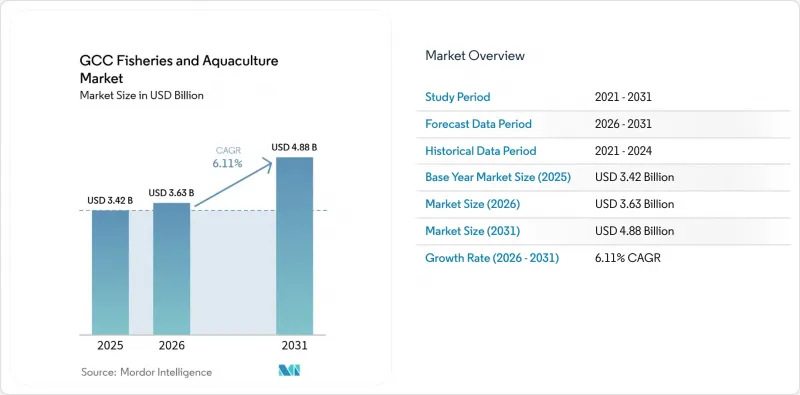
This report is Segmented by Type (Pelagic Fish, Demersal Fish, and More) and by Geography (Saudi Arabia, and More). The Report Includes Production Analysis (Volume), Consumption Analysis (Value and Volume), Export Analysis (Value and Volume), Import Analysis (Value and Volume), and Price Trend Analysis. The Market Forecasts are Provided in Terms of Value (USD) and Volume (Metric Tons).
GCC Fisheries And Aquaculture Market Trends and Insights
Increasing Production Initiatives
National food security programs are channeling capital into offshore cage arrays and hatchery expansions at a pace that outstrips private-sector investment cycles. Saudi Arabia's National Fisheries Development Program allocated USD 320 million in 2024 to co-finance shrimp and tilapia projects, with disbursements tied to production milestones rather than upfront capital expenditures . This performance-based funding model reduces speculative project launches and concentrates resources on operators with proven hatchery survival rates of 75% or higher. The UAE's Ministry of Climate Change and Environment expedited the issuance of 14 aquaculture licenses in 2024, representing a 40% increase over 2023, with a focus on prioritizing applications that incorporate renewable energy or closed-loop water systems. These initiatives are rebalancing the market away from import reliance, yet they also introduce supply volatility as new farms ramp production in staggered waves rather than smooth increments.
Rising Government Support
Zero-interest loans, reduced water lease fees, and duty-free imports of post-larval shrimp and tilapia fry are lowering the effective cost of capital for aquaculture ventures by an estimated 25% to 30% relative to unsubsidized financing. Saudi Arabia's Public Investment Fund acquired a 35% stake in National Aquaculture Group in 2024, injecting USD 150 million to expand shrimp hatchery capacity from 1.2 billion to 2.0 billion post-larvae annually. Bahrain's National Initiative for Agricultural Development extended duty-free status to imported broodstock and feed additives, reducing input costs for Delmon Aquaculture's seabream operations by 12%. These interventions compress payback periods and enable operators to price output below import parity, yet they also create dependency risks if subsidy frameworks shift in response to fiscal pressures.
Import Dependency for High-Value Species
Premium species such as salmon, cod, and sea bass remain 70% import-dependent across the GCC, a structural constraint that limits the market's ability to capture full value-chain margins and exposes operators to currency fluctuations and freight cost volatility. Norway and Scotland supply over 80% of GCC salmon imports, with landed costs in Dubai averaging USD 12 to USD 14 per kilogram in 2024. This price point poses a challenge for domestic Recirculating Aquaculture Systems (RAS) producers, who struggle to undercut it due to high electricity and feed expenses. The United Arab Emirates imported 42,000 metric tons of salmon in 2024, a volume that exceeds the combined output of all planned Recirculating Aquaculture Systems (RAS) projects through 2028, underscoring the scale gap between aspiration and execution . This import exposure incentivizes domestic production investments, yet the capital intensity of establishing hatcheries and grow-out facilities for cold-water species means that dependency will persist through the forecast period.
Other drivers and restraints analyzed in the detailed report include:
- Greater Focus on Food Security
- Rapid Build-Out of Recirculating Aquaculture Systems (RAS) in Desert Zones
- Premium Price Points for Selective Species
For complete list of drivers and restraints, kindly check the Table Of Contents.
Segment Analysis
Crustaceans and Mollusks captured 18.45% of the GCC fisheries and aquaculture market size in 2025. This includes crustaceans and mollusks beyond shrimp, such as lobster, harvested primarily in Oman's Dhofar region for export to European markets, and oysters, where Dibba Bay Oysters has carved a premium niche, supplying Michelin-starred restaurants in Dubai and Abu Dhabi. Shrimp holds the largest share in 2024, anchored by National Aquaculture Group's industrial operations in Saudi Arabia's Eastern Province, which produce 35,000 metric tons annually, and emerging projects in Oman's Batinah coast targeting export markets in Asia and the Middle East. Pelagic fish such as sardines, mackerel, and barracuda remain the backbone of Oman's capture sector, with 2024 landings exceeding 150,000 metric tons, yet aging vessel fleets and limited cold storage capacity at landing sites constrain growth.
Specialty fish is projected to advance at a 14.80% CAGR through 2031, a trajectory that reflects capital-intensive bets on import substitution for a species that currently accounts for over 30% of GCC's high-value seafood imports. Specialty segments, such as caviar and salmon, represent less than 5% combined share in 2024 yet attract disproportionate investment due to ultra-high margins. For instance, Emirates AquaTech produces 2 metric tons of sturgeon caviar annually in Abu Dhabi's desert climate using Recirculating Aquaculture Systems (RAS) technology. The segment's diversity creates opportunities for operators to specialize in underserved niches, yet it also fragments marketing efforts and complicates supply chain coordination across species with vastly different handling and storage requirements.
Complete Report Scope:
- By Species Type (Production Analysis (Volume), Consumption Analysis (Volume and Value), Import Analysis (Volume and Value), Export Analysis (Volume and Value), and Price Trend Analysis)
- Pelagic Fish
- Sardine
- Mackerel
- Tuna
- Barracuda
- Demersal Fish
- Grouper
- Trevally
- Emperor
- Pomfret
- Freshwater Fish
- Tilapia
- Crustaceans and Mollusks
- Scallop
- Lobster
- Shrimp
- Specialty Fish
- Caviar
- Salmon
- Pelagic Fish
- By Geography
- Saudi Arabia
- United Arab Emirates
- Oman
- Qatar
- Bahrain
- Kuwait
Additional Benefits:
- The market estimate (ME) sheet in Excel format
- 3 months of analyst support
TABLE OF CONTENTS
1 INTRODUCTION
- 1.1 Study Assumptions and Market Definition
- 1.2 Scope of the Study
2 RESEARCH METHODOLOGY
3 EXECUTIVE SUMMARY
4 MARKET LANDSCAPE
- 4.1 Market Overview
- 4.2 Market Drivers
- 4.2.1 Increasing production initiatives
- 4.2.2 Rising government support
- 4.2.3 Greater focus on food security
- 4.2.4 Rapid build-out of Recirculating Aquaculture Systems (RAS) in desert zones
- 4.2.5 Green-hydrogen powered chill-chain pilots
- 4.2.6 Traceability blockchains mandated by United Arab Emirates retailers
- 4.3 Market Restraints
- 4.3.1 Import dependency for high-value species
- 4.3.2 Premium price points for selective species
- 4.3.3 Disease-management skills gap in shrimp hatcheries
- 4.3.4 Salinity spikes from desalination brine returns
- 4.4 Regulatory Landscape
- 4.5 Technological Outlook
- 4.6 Value / Supply Chain Analysis
- 4.7 PESTLE Analysis
5 MARKET SIZE AND GROWTH FORECASTS
- 5.1 By Species Type (Production Analysis (Volume), Consumption Analysis (Volume and Value), Import Analysis (Volume and Value), Export Analysis (Volume and Value), and Price Trend Analysis)
- 5.1.1 Pelagic Fish
- 5.1.1.1 Sardine
- 5.1.1.2 Mackerel
- 5.1.1.3 Tuna
- 5.1.1.4 Barracuda
- 5.1.2 Demersal Fish
- 5.1.2.1 Grouper
- 5.1.2.2 Trevally
- 5.1.2.3 Emperor
- 5.1.2.4 Pomfret
- 5.1.3 Freshwater Fish
- 5.1.3.1 Tilapia
- 5.1.4 Crustaceans and Mollusks
- 5.1.4.1 Scallop
- 5.1.4.2 Lobster
- 5.1.4.3 Shrimp
- 5.1.5 Specialty Fish
- 5.1.5.1 Caviar
- 5.1.5.2 Salmon
- 5.1.1 Pelagic Fish
- 5.2 By Geography
- 5.2.1 Saudi Arabia
- 5.2.2 United Arab Emirates
- 5.2.3 Oman
- 5.2.4 Qatar
- 5.2.5 Bahrain
- 5.2.6 Kuwait
6 COMPETITIVE LANDSCAPE
- 6.1 List of Stakeholders
- 6.1.1 National Aquaculture Group Company
- 6.1.2 International Fish Farming Holding Company PJSC Asmak
- 6.1.3 Oman Fisheries Company SAOG
- 6.1.4 Saudi Fisheries Company SJSC
- 6.1.5 Fish Farm LLC
- 6.1.6 Lulu Group International LLC
- 6.1.7 Dibba Bay Oyster Farm LLC
- 6.1.8 Emirates AquaTech Caviar Farm LLC
- 6.1.9 Delmon Aquaculture Company SPC
- 6.1.10 Ocean Fisheries Company LLC
- 6.1.11 Al Watania Fisheries Company LLC
- 6.1.12 Integrated Seafood Company LLC
7 MARKET OPPORTUNITIES AND FUTURE OUTLOOK

